Angela Denning, CoastAlaska

Angela Denning is CoastAlaska's regional news director, based in Petersburg. CoastAlaska is our partner in Southeast Alaska. KTOO collaborates with partners across the state to cover important news and to share stories with our audiences.
Alaska’s new ferry director says reliability is his priority

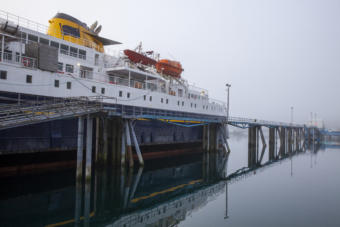
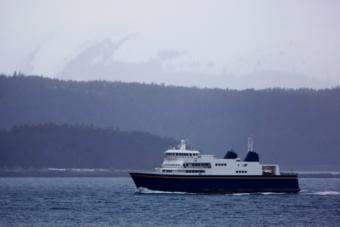
The Matanuska docked on Friday, February 7, 2020 at the Auke Bay ferry terminal in Juneau, Alaska. The ship was headed to Ketchikan for repairs. (Photo by Rashah McChesney/KTOO)

Craig Tornga became the new head of the Alaska Marine Highway System this month.

He comes to the job with 46 years in the marine industry. He worked at Crowley Marine Services for a few decades transporting fuel and supplies in Alaska. For the last six years, Tornga served as a senior vice president with Kirby Offshore Marine in Houston, Texas. It’s a large company, with 6,000 employees. It distributes petroleum products with 1,400 barges.
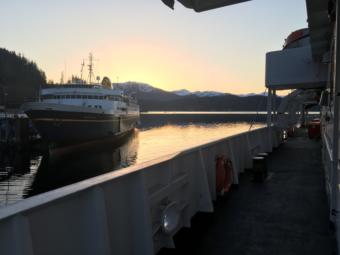
Now, Tornga is in charge of a fleet of nine ships and hundreds of ferry workers.

He spoke with CoastAlaska’s Angela Denning about his new role. He says his number one priority is seeking reliability.

Listen:

Craig Tornga has been selected as the new Marine Director for the Alaska Marine Highway System. (Photo courtesy of DOT)

Tornga: We don’t have a service to sell if we’re not reliable. And the last thing we want to be doing is selling something and disappointing people. So we will focus on reliability, it’s not a quick fix, working on making sure we have the foundational processes and procedures in place to be focused on reliability. And having our preventive maintenance, run through what you call it CMMS, a computer maintenance management system, so we’re pretty scripted on how we do our maintenance. So I’ll be real focused on that to start with.

Denning: There’s ships that are 50 and 60 years old, and they get tied up for mechanical problems and maintenance. So can you kind of tell me a little bit more about what you’re talking about?

Tornga: Every component on the vessel from the main engines all the way to the to the steering pump, has an OEM required maintenance schedule, we just need to make sure that we’re, we’re digging that far. And so we’ll make sure that our system has a hierarchy built up in it that gets down to every component. And that’s what I’ll be looking at. Now, age as you mentioned in the fleet, that gives another challenge. And so there are some things that are related to age that that do make it hard. And so, you know, we will be working on the long term portion of it, we will be working on fleet plants, replacements and at least have a retirement date set for different vessels based on their conditions as well. So every vessel gets to the point that is it worth even putting any more money into it, just like everybody’s vehicle, it’s really that same analysis.

Denning: I’m interested in knowing why you went after this job. There’s a lot of challenges. We talked about the aging fleet, but there’s also a severe, you know, shortage of crew, and some staffing shortages.

Tornga: You know, you’re not the first one asked me that question. So it’s, like I mentioned, I had done my six years, I was ready to get out of Houston. I’ve always liked the ferries, you know, they’re a unique ferry with a good big ship’s bow, they’re ocean going, I like that. And as far as challenges, you know, when you’re in business sometimes challenges are fun. You know, ‘Let me come tackle that’. And that’s just what I was doing at Kirby to be a part of that solution there. And here, we’re going to dig in, see if we can do. And as you point out, there’s a lot of challenges. The hiring or trying to find qualified, licensed individuals is not unique to the ferries right now. It is an industry problem across the US. We were the same way at Kirby. And we had to be proactive, to strategically try to beat out our competitors out of every, every licensed guy or gal coming out of a Maritime Academy. And as they graduate them each year, we’re there. We’re there. We’re taking them out to lunch, we’re taking them to dinner, we’re just trying to sell them on coming to work for us. And we need to do the same thing here.

Denning: How would you describe your leadership style, because in your past job, and now, here, you’re working with hundreds of people.

Tornga: You know, Kirby’s large, like I said, you know, there’s 6,000 employees there, as far as on the vessels, so it’s…and a lot of vessels. But I’m still very much a people’s person. I’m involved. I like to be on the boats. And I really like to have the office knowing that we’re here to support the vessels, and I like to see us on the boats. I have a program called boots on steel, others use it but I just need to make sure everybody’s out there engaged, knowing what the needs are, and that we’re here to support the vessel so they can deliver the customer service we need.

Listen to the full interview with Craig Tornga below:

Alaska ferry system, hamstrung by crew shortages, hired only 4 people last year

The MV Malaspina sits at the dock in Auke Bay, near Juneau, as the MV LeConte pulls away from the dock early March 28, 2019. Both ships are part of the Alaska Marine Highway System.
The M/V Malaspina sits at the dock in Auke Bay, near Juneau, as the MV LeConte pulls away from the dock early March 28, 2019. Both ships are part of the Alaska Marine Highway System. (Photo by Nat Herz/Alaska’s Energy Desk)

The Alaska Marine Highway System doesn’t have enough crew to operate all of its ferries this summer. The system needs about 150 more workers, both on water and on land. More than 200 workers have applied for ferry jobs in the last year, but the state has only managed to hire a few.
The state is making changes to its hiring systems, but it may be months or even years before the ferry system is running smoothly again.

Mika Hasbrouk has worked for the ferry system for 17 years.

“I’ve had permanent jobs on the Malaspina, the Taku, the Leconte, and I think I’ve been on the Kennicott now since 2017,” she said.

Hasbrouk is an able seaman, meaning she mans the wheel or does other on-board jobs reserved for more experienced workers. She loves the work but says in recent years, the job has been challenging. Longtime staff have had problems keeping their paychecks year-round when the 50 and 60-year old ships get tied up for maintenance.

Alaska Marine Highway System 3rd Mate Lonnie Walters, Able Seaman Mika Hasbrouk and Able Seaman Patrick Katzeek of Haines. “I always think, ‘Oh, it can’t get worse.’ And then it does. But yet, the system’s still somewhat there,” Hasbrouk says (Courtesy Mika Hasbrouk)

Other times, she can’t get days off. Hasbrouk says workers cover extra shifts because of short staffing, and then they’re told they can’t take vacation because of short staffing.

“I always think, ‘Oh, it can’t get worse.’ And then it does. But yet, the system’s still somewhat there,” she said. “It’s just, it’s mind blowing.”

Earling Walli, regional director of the Inlandboatmen’s Union of the Pacific, the largest of Alaska’s ferry unions says, “there’s a huge payroll issue going on right now.”

Walli says paychecks don’t always include all of the hours workers turn in. He doesn’t blame payroll workers because they’re short staffed too.

“We’re not pointing it out that it’s this person’s fault,” Walli said. “It’s that whole payroll issue — they need to recruit people in there. And we understand that, but we still need to get our members paid in a timely manner.”

The shortage of maritime workers is worldwide. The pandemic didn’t help. But Walli says Alaska has specific problems.

A report released in January by a state contractor shows that people are applying for ferry jobs – the state received 241 applicants over the past year. Even though most were qualified, only four were hired.

“Many applicants were lost due to a lack of timely communication,” the report states. “The process flow is creating a bottle-neck in the delivery of information to applicants.”

Sam Dapcevich is a spokesperson for the state Department of Transportation. He says the applicants got lost in the mix.

“There was no single coordinator that was dealing with recruiting and onboarding,” Dapcevich said.

Plus, sometimes the waiting period was too long. Applicants didn’t want to wait months for required credentials from the U.S. Coast Guard and the state.

Dapcevich says that’s being addressed. The ferry system now has a position dedicated to recruiting, plus a regular team meeting. Recruiters have created a program where new workers can get on-the-job training so they’ll get paid while earning credentials. They’ve also beefed up advertising.

He says the ferry system is recruiting on social media, in papers throughout Alaska and Washington, and they’re hitting job fairs.

“Believe it or not this coming week, we have. . . seven career fairs,” Dapcevich said. “We’re hitting two of them out of state at maritime communities.”

But that isn’t likely to help in time for this summer. One of the state’s main marine highways connects communities from Yakutat in northern Southeast to Bellingham, Washington. Two of the state’s largest ferries — the Columbia and the Kennicott — were scheduled to run that route. But DOT says there’s only enough staff to run one of them.

“If we were to try to run both of those ships, it was going to result in cancellations, burnout of the crew that we do have,” Dapcevich said.

Dapcevich also addressed the payroll issues the union has complained about. He says those are partly because payroll was moved under the Department of Administration. He says they plan to move payroll back to within the ferry system because of the system’s specific needs.

Walli says despite all the problems right now, the marine highway system is worth fighting for. He says working on ferries can be rewarding. You create a family on board and you meet interesting people.

“This is a good job. This is one of the best jobs I ever had,” Walli said. “But you need to get paid and need guaranteed work. So, I think at this point, the Marine Highway can only go up. We hit rock bottom.”

Robert Venables is the executive director for the Southeast Conference, a regional nonprofit that advocates for economic development. Venables says the ferry system is in a “perfect storm” but it has been a long time coming starting with a very old fleet. But he says the state has identified new solutions and his outlook is very positive.

“There is a much brighter future ahead,” Venables said. “But it’s going to take a couple of years to get there.”

Venables says it’s clear the ferry system is critical to Southeast Alaska. It’s a lot cheaper than taking a plane and has more flexibility moving cargo such as vehicles.

This year, the organization is planning to get updated information about the impact the ferry system has on communities in the region.

Alaska’s state ferry system hires a new boss

The M/V Tazlina rounds Point Retreat on its way to Juneau on Saturday, Jan. 29, 2020. (Photo courtesy of Jay Beedle)

The state of Alaska has hired a new leader for the Alaska Marine Highway System.

Craig Tornga has been selected as the new Marine Director for the Alaska Marine Highway System. His first day will be Monday, April 3, 2023. (Photo courtesy of DOT)

Craig Tornga has been selected as the ferry system’s new marine director. In that role, he’ll oversee hundreds of ferry workers and a fleet of nine ships. The marine director position, formerly known as the AMHS General Manager, has been vacant since the retirement of Captain John Falvey in January.

According to the state Department of Transportation, Tornga has extensive experience in the marine industry and management. He started his maritime career sailing aboard ocean-going vessels with Crowley Marine Services, which transports fuel and supplies in Alaska. He spent over 20 years working his way up through that company.

Since 2017, Tornga has served as a senior vice president with Kirby Offshore Marine in Houston, Texas. The company distributes petroleum products with a fleet of offshore tugs and barges.

The state worked with the Alaska Marine Highway Operations Board on the hire, which unanimously supported Tornga. Board Chair Shirley Marquardt said that the board is confident that Tornga’s “decades of experience and knowledge in the unique marine industry here in Alaska and Houston span every element needed” to manage the ferry system.

Tornga will take over a ferry system facing numerous challenges, from short-staffing to an aging fleet.

Tornga’s first day on the job will be Monday, April 3.

Alaska looks to obscure accounting quirk to turn old federal funds into new ones for state ferries

""
The Alaska ferry LeConte traveling toward Juneau on Aug. 3, 2022. (Photo by Claire Stremple/KTOO)

Alaska is slated to get $285 million from the federal government to modernize the state’s ferry fleet and improve service. It’s part of the bipartisan infrastructure law passed in 2021.

But to actually spend the windfall, the state needs to put up money, too. That’s a hard request in a state that’s facing a deficit amid falling oil revenue.

So, the state is turning to an obscure accounting quirk to turn old federal funds into new ones.

Katherine Keith is the deputy commissioner for the state’s Department of Transportation. She told the state’s Marine Highway Operations Board earlier this month that the federal grants would inject some life into the Marine Highway System.

“Modernize our vessels, begin designing some new builds, construction of new builds,” Keith said. “And then also reinvesting in some of our ferry terminal facilities so that we can get closer to running all ships and all docks, and then finally providing the Marine Highway System of some operating funds.”

But the grants aren’t free money. Each of the six grants requires a match from the state — between 25% and 50%.

Ferry board member Wanetta Ayers said she was worried about the state prioritizing the matching funds.

“The reality is, we’re in a deficit budget situation under certain circumstances,” Ayers said. “And that puts pressure on cash available for match.”

Ferry boosters might have a reason to be skeptical: During his first term, Gov. Mike Dunleavy cut millions from the ferry system’s budget and sold off three state ferries.

But in a state budget amendment submitted this month, Dunleavy’s administration proposed a solution. Department of Transportation Commissioner Ryan Anderson says the state needs almost $50 million in matching funds for this year’s ferry grants. And he’s got an idea for where to get it.

“To meet this requirement, the state is proposing to use an innovative federal aid highway tool that allows the state to use existing federal dollars to capture these new federal dollars,” Anderson said.

Turning old federal money into lots and lots of new federal money. It’s not alchemy. It’s accounting.

The secret here are so-called “toll match credits.”

Think of it this way: the Marine Highway System is part of the federal highway system. And if you think about ferry tickets as tolls, it’s not just a highway, it’s a toll road. And those toll revenues are at least partly invested in maintaining the ferry fleet and its network of terminals.

Toll match credits allow that maintenance spending to count towards the state’s portion of the match.

The federal grants break down like this: $68.4 million towards a hybrid diesel-electric replacement for the ferry Tustumena. That project is already underway. There’s also $8.6 million to design a new mainliner for Southeast. Another $163.7 million would go towards a new electric ferry, as well as upgrades to the system’s dock infrastructure and modernizing the existing vessels.

The $285 million package also includes nearly $45 million for operating funds.

On a tiny Southeast Alaska island, wolves are eating sea otters like popcorn

A wolf on Pleasant Island near Gustavus, Alaska peers at the camera. (Photo by Bjorn Dihle)

On a tiny, remote island in Southeast Alaska, scientists recently made a surprising discovery: Wolves are eating sea otters.

And not just one every so often. For this pack, it’s the wolves’ main source of food. The study is making waves in the scientific community.

Pleasant Island is about a mile south of the mainland, near the town of Gustavus. Historically, wolves would occasionally swim over but had never colonized the island until about a decade ago.

“This pack of wolves really defied all of our predictions,” said Gretchen Roffler, who has studied wolves in Southeast for eight years.

Roffler is the lead author of a study published in January in a journal of the National Academy of Sciences on the island’s wolves. This new pack killed all the black-tailed deer on the island — a favorite meal for Southeast wolves. They’re a territorial species, and an established pack was back on the mainland preventing a return. Roffler and other scientists assumed they would die off from starvation.

“Instead, what we found was that the wolves stayed on the island, and they continued to reproduce annually,” Roffler said.

But how? The island is small, just over 20 square miles. What were the wolves eating?

Nearby residents in Gustavus noticed new wolf activity on the island, where they would hunt deer and pick berries. Greg Streveler is one of them, and his first thought was, “Uh-Oh.”

Streveler is a retired ecologist with the National Parks Service and has studied the area’s land and animals for over 50 years.

“The ‘Uh-Oh’ was, you can see what’s coming,” he said. “Having the pack discover the place. And [then] there was two wolves instead of one. You could kind of read the tea leaves.”

Within a few years, Streveler and other residents saw the island’s deer disappear. So the scientists stepped in and began to gather data. In 2015, they counted three wolves. A year later there were 10. By the year 2017, there were 13 wolves.

“The wolf densities on this island at this time were some of the highest ever recorded,” Roffler said.

Roffler’s team collected scat and studied it in a lab to see what the wolves were eating. And it showed something surprising: sea otter.

“At first, I thought, well, this is maybe just a blip,” said Roffler. “Maybe this is just an occasional thing that wolves are able to do.”

They decided to collect wolf hair. While scat shows what wolves have eaten recently, hair gives scientists a longer-term look. And tests on the hair proved it wasn’t a blip. The wolves were eating lots of sea otters and had been for a while. Roffler said it underscores how adaptable wolves are.

“Something that we assume about wolves is that they really can’t live without ungulate prey,” she said. “They very quickly switched to a diet that primarily consists of sea otters. It really just took a couple of years for that to happen.”

Starting in 2020, Roffler’s team GPS-collared some of the wolves so they could study so-called “kill sites,” where the wolves likely feasted for a while. They noticed the wolves were traveling around the circular island, along the tideline.

A wolf on Pleasant Island walks along the beach. (Photo by Bjorn Dihle)

“When we look at all the wolf GPS location data, if we just splashed onto a map, it sort of looks like a doughnut,” Roffler said.

Sea otters might look cute — maybe you’ve seen photos of them floating on their backs and holding hands — but they aren’t small or defenseless. They have sharp teeth for cracking shellfish to eat and males can grow to 100 pounds. Based on the kill sites, the scientists believe the wolves are targeting otters at low tide when they’re on land or in the shallows and they’re more vulnerable.

Roffler hasn’t witnessed the pack hunt and is hesitant to speculate about it. But Streveler has a theory.

“The wolves are not dealing with a healthy group of otters,” he said. “So I don’t think it’s a big deal for wolves to find some.”

He says the otters in the area might be weak and are hauling out on land more than normal. Sea otters were introduced to the region in the 1960s after being hunted to near extinction. Streveler said it’s possible that there are more otters in the area than the habitat can support.

“Before, nobody here ever saw an otter haul out. Ever,” Streveler said. “And so, to find a naive group of very easy to catch, very, very delicious critters. Oh, my God, you know, it’s like discovering the Garden of Eden.”

Scientists don’t know how this unusual diet might affect wolves in the long term. Roffler said that’s their next big question — how contaminants accumulate in the food web.

“Wolves are apex predators, and sea otters are apex nearshore predators,” she said. “So any sort of contaminants in the environment, if they’re being consumed by sea otters, or by sea otter prey, they would bioaccumulate in wolves. So this is something we’re trying to study more.”

They also don’t know how long the food source will be around. But Streveler thinks it’s temporary.

“The sea otter-wolf thing is probably a flash in the pan,” he said. “It’s not likely there’s going to be both a lot of sea otters and a lot of weak sea otters available very long. It’s a very, very brief, I think, opportunistic window.”

Besides the future of this wolf pack, the implications of the study are turning some corners of the science world upside-down. In a commentary, Princeton University Ecology professor Robert Pringle says the conclusions “challenge dogma.” New ways of gathering data are debunking “grand theoretical generalizations.” He writes, “One thing it needs now is a rejuvenated commitment to figuring out what is what in the real world.”

Sen. Bert Stedman: Alaska’s PFD formula should change this year

Senator Bert Stedman, R-Sitka, speaks to on the Senate floor on July 8, 2019, in Juneau, Alaska. (Photo by Rashah McChesney/KTOO)

For almost 20 years, Sen. Bert Stedman has represented much of Southeast Alaska in the state Legislature. District A includes the communities of Ketchikan, Wrangell, Petersburg and Sitka, and several smaller towns in between.

The next legislative session begins Tuesday. For the 11th year, Stedman will co-chair the Senate Finance Committee. He’ll oversee efforts to create a multi-billion dollar operating budget.

There is a lot on the table. One recurring issue is the Alaska Permanent Fund. Stedman told CoastAlaska’s Angela Denning that the state needs to balance its longterm fiscal health against its ability to pay large Permanent Fund dividends.

Listen:

Bert Stedman: It’s not the individual dividend that creates the problem. It’s when you combine everybody’s dividend together. We don’t have the cash. So we’re going to talk about that and try to come up with how we can rewrite the formula and make some adjustments and see how that goes. But clearly, there’s no math model that I’ve ever seen that shows that we can afford to not change that dividend formula.

Angela Denning: So what I’m hearing is that maybe instead of looking for new revenue and more money, maybe looking at what the state is already getting now.

Bert Stedman: Well, there is support by some legislators to impose income tax or sales tax across the state and pay it out as dividends. But you’re just taking it from people that are working and spreading it out. That doesn’t make any sense. I think it’s unlikely we’re gonna pass a statewide tax and income tax or sales tax.

Denning/CoastAlaska: One of the big budget items for the operating budget that you see is for the Alaska Marine Highway System. You know, Southeast and other coastal areas have not been satisfied with the lack of ferry service in recent years. I’m wondering what the Legislature can do about that. What are your thoughts? Because Gov. Dunleavy’s administration has vetoed millions in ferry funding in his first four years in office. He’s going to be around for another four years. What would you like to see this year?

Bert Stedman: Well, let’s not forget that the Legislature is the appropriators. But the governor has a line item veto on appropriations. And it’s the strongest veto protection of any governor in the country — it takes three quarters of the vote in the Legislature to overturn an appropriation veto. So, unless you can overturn his veto, which is unlikely, he could set that level of funding to, frankly, any level he wants. He has a very strong hand in some of the budget negotiations that take place. So, I’ll work with the governor to try to restructure the marine highway, the best we can from our position on the coast. But not all legislators are supportive of the marine highway. And there’s fewer and fewer of us on the coast relative to the Railbelt. So it is a challenge. On the positive side, we’ve got some federal funding that Lisa Murkowski structured in the appropriation bill here several months ago, and there’s 200 million a year for various systems. But [the state is] not the only one that qualifies. So we’re still sorting through that to figure out how much the state’s going to actually get when it’s going to arrive and then how to split it between operating costs and capital costs. So that’s a positive. But my goal is to make sure the marine highway still is in existence four years from now.

Site notifications
Update notification options
Subscribe to notifications