A healthy mountain goat kid and adult pictured in the Haines area. (Photo courtesy of Alaska Department of Fish & Game)
A Juneau resident took home a sick mountain goat kid with crusty skin lesions after hiking Perseverance Trail last weekend and contacted the Alaska Department of Fish & Game. Officials say the goat had a highly contagious viral skin infection that can transfer to humans and pets.
“It’s very important that people — if they see a sick or a dead wild animal — that they call Fish and Game, and not try to take it home themselves,” said Kimberlee Beckmen, the wildlife health veterinarian at ADF&G. “It’s also illegal to pick up wildlife and take it home.”
Beckmen said the goat had contagious ecthyma. It’s not always fatal in sheep and goats, but it’s usually more severe and deadly in lambs and kids. It causes skin lesions to develop around openings in the body.
“When it covers their face, their eyes, their mouth, they can’t eat,” she said. “This recent case — the poor animal was starving to death and was completely dehydrated. It could not see out of its eyes.”
She said the goat probably would have died from the infection within a couple of days, and ADF&G euthanized the animal over the weekend.
In people, the infection is called orf and it’s typically mild. A lesion usually appears within a week of exposure. Beckmen said it’s not fatal to humans or dogs, and the lesions typically go away on their own after several weeks. The virus can transfer when the scabs make contact with openings in the skin.
A mountain goat with contagious ecthyma that wandered into a Juneau neighborhood and later died. (Photo courtesy of Alaska Department of Fish & Game)
But Beckmen said hunters can still eat the meat of an infected animal if it’s handled properly.
“We recommend that people wear gloves when they’re harvesting their animal and butchering it, and if they see any lesions on the skin or anything unusual, they want to make sure that they clean their knives off before they cut into the meat,” she said.
ADF&G officials said they get calls about the infection popping up every once in a while. Carl Koch, the department’s area biologist in Juneau, said his team collected a dead goat kid with ecthyma near the Flume Trail in December. He said the department received a call in October about twin goats with the early stages of an infection, and thinks the two that died recently could be them.
Beckmen said this is not an outbreak or an unusual occurrence. Sporadic cases have appeared in Dall sheep and mountain goats across Alaska since the 1980s, and she said the state is not currently concerned about it affecting those populations.
ADF&G requests that people report ecthyma cases to the wildlife disease surveillance hotline at 907-328-8354, by emailing dfg.dwc.vet@alaska.gov or calling the local ADF&G office. People can also report sick or injured wild animals through the department’s web form.
Koch said the person who took the goat home last week had called the department and left a message while out on the trail, but didn’t get a response since it was Saturday. He said people can call the police non-emergency number at (907) 586-0600 if they don’t hear back from ADF&G about a time-sensitive wildlife issue over the weekend.
Researchers used air and water temperature from sites around the Copper River Delta to gauge climate impacts on wetlands. (Amaryllis Adey)
Before juvenile salmon make their way to the sea, they grow and feed in freshwater, including wetlands, for anywhere between a few months and several years.
But new research finds that as air temperatures rise with climate change, the water that flows through coastal Alaska’s ponds and marshes is warming rapidly, too. That could spell trouble for Pacific salmon, which can’t grow – or live – in waters above certain temperatures.
“I’ve never really hoped so much that I might be wrong,” said Amaryllis Adey, a researcher at Virginia Tech.
Adey is a co-author of the report, which was published in December in the journal Nature. The researchers compared nine years of water and air temperature data from 20 ponds near Yakutat and Cordova. They found that the water was keeping pace with increases in air temperatures.
That’s notable because it marks a departure from what’s happening with other freshwater ecosystems as temperatures rise, Adey said.
Past research shows that rivers and streams are warming more slowly than the air due to a range of factors, including that they move quickly and benefit from glacial runoff. Wetlands, meanwhile, are typically shallow, still, and more spread out across the landscape – leaving them more exposed to the air.
“It was really stark,” she said. If “one degree of air temperature results in one-degree increases in water temperature, that could be really concerning in the future.”
Report co-author Amaryllis Adey and a fellow researcher download temperature data in the field. (Elliot Deins)
The researchers’ next step was using the historical data to model what might happen in the decades to come.
The researchers looked at two possible scenarios. One was a future in which humans continue producing greenhouse gases at the current rate. Adey called that the “business as usual scenario” and said it resulted in a “drastic increase” in water temperatures.
“It was like up to 22 degrees Celsius by the end of the century,” Adey said.
That’s about 71 degrees Fahrenheit, which is really warm – and dangerous – for these wetland ecosystems. Coho salmon, for instance, stop growing at around 68 F. And death becomes likely once temperatures surpass about 73 F.
Adey says it’s certainly possible that salmon would adapt. But if they can’t shift the timing of their migrations or habitat use, she said, “they won’t be able to continue to grow and survive in these systems that are very economically and culturally dependent on them.”
The second scenario was less grim. If humans continue emitting at current rates for another decade and then begin reducing carbon emissions, water temperatures would still rise. But they would be less likely to reach dangerous levels.
The study looked specifically at two areas – the Yakutat Forelands and the Copper River Delta. But the results have far-reaching implications, including in Southeast Alaska.
“We’d expect that there’s going to be kind of similar responses across that coastal region,” she said.
Other organisms, including algae and bottom-dwelling invertebrates, are also temperature sensitive, the study said. That means warmer water could be felt by the entire food chain, ranging from different fish species to migratory birds.
Skiers and snowshoers enjoy the snow in downtown Juneau on Tuesday, Dec. 30, 2025. (Photo by Clarise Larson/KTOO)
More snow is on the way this week for Juneau and the rest of the panhandle, even as recovery from last week’s storm continues.
The Juneau School District announced Sunday night that school would be closed Monday. City and state offices are also closed, and the University of Alaska Southeast campus will operate remotely.
National Weather Service meteorologist Greg Spann says communities from Elfin Cove to Juneau can expect anywhere from 5 to 13 inches of new snow on Monday. The heaviest snow is expected mid-morning through the afternoon.
There’s a possibility for a changeover to rain or a mixture of rain and snow sometime later Monday. It’s expected to change back to snow Tuesday and continue into Wednesday. Spann said the variability of that makes it hard to predict precipitation amounts on Tuesday and Wednesday.
“One part of Juneau might get three inches or four inches of new snow out of a new snow shower,” Spann said. “Another part of Juneau might not see anything at all.”
The snowstorm that hit the region last week dumped about 4 feet of snow on the capital city in as many days. That helped break the record for Juneau’s snowiest December ever and made it the second snowiest month ever.
“We do not expect to get as much snow overall as we got with last week’s event, that event that we got up previously, around Christmas through New Year’s, that was an extraordinary event that broke a whole lot of records,” he said. “Hopefully this event will not be quite as extreme.”
Spann advised that people take their time with travel and do their best to uncover any nearby fire hydrants that may be covered by snow.
Light snow showers will continue later in the week. Spann said there’s a chance for another system to bring even more snow after that — for those who haven’t had enough yet.
This story has been updated with additional information about state, school and city closures.
A Dickcissel spotted in Sitka in mid-November (Marc Kramer/Birding By Bus)
Two different birds rarely seen in Sitka and much of Alaska showed up in Southeast last month. As KCAW’s Katherine Rose reports, it was exciting news for birders leading into a big month for our feathered friends–the Audubon Society’s annual Christmas Bird Count.
In mid-November, the arrival of two rare birds in Sitka caught the attention of birders from around the state. Local naturalist Matt Goff said his son, a fellow naturalist, spotted them back-to-back.
“My son got ambitious about feeding birds this fall again, so [he’s] been putting out a lot of bird food, and he noticed a Harris’s sparrow in the yard, which is a bird that we’ve been looking for for a while,” Goff said.
The small brown sparrow breeds in the boreal forest of Northern Canada, but typically winters in the lower Midwest. Goff had never seen a Harris’s Sparrow in Sitka- the bird was last spotted here in the 1990s.
Just minutes later, his son spotted a second bird.
“About a half hour later, he’s like, ‘There’s another unusual bird in the in the yard,’” Goff recalls. “And he says, ‘I think I remember what it is. I can’t remember its name, but it’s like, it begins with a D, and it’s rare,’ and I said, ‘Is it a Dickcissel? And he said, ‘Yeah, that’s what it was.’”
The Dickcissel was even more unusual. Goff said the midwestern bird that winters in South America was last spotted in Juneau in 2004, and the Sitka sighting is the third on record for Alaska. Its arrival was so unexpected, it brought even more out-of-town visitors. Goff said after he posted about the sightings to the Alaska Rare Birds Facebook group, several birders from Anchorage flew down too…by plane, of course.
“There’s folks that keep track of a list, their Alaska State list, how many birds they’ve seen in the state. Some of these folks have well over 300 species. One of the people that came had over 400 species,” Goff said. “And it’s pretty difficult for them to get new birds these days, because they’ve seen most of them.”
For some it wasn’t their first stop- one drove over five hours from Anchorage to Valdez the day before to see a Broad-winged hawk, the first spotted in Alaska.
“Some of us are mad travelers when it comes to birds,” Goff said. “Especially unusual birds.”
While the Dickcissel hasn’t been seen since late November, Goff said it’s possible the Harris’s Sparrow will stick around for the winter. If it does, it could be counted as part of the Audubon Society’s Christmas Bird Count. Victoria Vosburg is a retired Alaska Raptor Center veterinarian, and she said it’s the country’s longest running citizen science initiative.
“Way back in the beginning, people on Christmas Day used to get together and hunt. They called it a ‘side hunt,’ and it was a competition to see who could kill the most living things,” Vosburg said. “So it wasn’t just birds, it was killing everything. And then some people decided, ‘Let’s do something different. Let’s just count birds, instead of kill them.’” For more than a century, the Christmas Bird Count has documented population declines and recoveries of all types of bird species, and the data collected during the count has influenced policy and conservation efforts. Sitkans began participating in the 1970s, and in just the past couple of decades, Vosburg said they’ve observed a lot.
“I started running the bird count about 20 years ago, and just since I started doing that, we’ve seen swans come back to town. We’ve seen Anna’s hummingbird start spending the winter,” Vosburg said. “We’ve seen Eurasian collared doves come to town, population explosions, disappear, and now we’re watching them on the rise again.”
Sitka’s Christmas Bird Count is December 20, and there are a number of ways to get involved. But if you’re looking to see a Dickcissel or a Harris’s Sparrow, it’ll be a lucky break. Only one of each was spotted. Goff said that’s often the case with lost birds.
“I think there’s some speculation that what might happen, in part, is their internal compass, so to speak, might be off 180 degrees or 90 degrees, or something like that, and they just go the wrong way because they orient differently,” Goff said. “Then they end up someplace that is not at all what their, sort of, biological systems are expecting.”
Goff said lost birds often look for the birds that are local and “in the know” to find food and sometimes they settle in for the winter. Sometimes not. But even if participants at the Christmas Bird Count don’t spot one of the rare birds, there are plenty of other bird species that are counting on being counted.
Kevin White checks a trail camera strategically positioned to capture images of lynx and other wildlife in the Chilkat Valley. (Avery Ellfeldt/KHNS)
On a crisp day in mid-November, two wildlife biologists bushwhacked into the Takshanuk Mountains until they reached the edge of a canyon that offers close-up views of mountain goats.
Kevin White, a wildlife biologist and Haines local, checked the batteries and downloaded the photos from a camera strapped to a nearby tree.
“There’s a porcupine,” he said, scrolling through the images. “And a brown bear, it looks like.”
The camera is one of about 60 spread throughout the Chilkat Valley as part of a broader project focused on one carnivore in particular: lynx. Its aim is to gather more information about the wildcats’ presence and behavior in the region.
Leading the effort is longtime lynx researcher Liz Hofer, who splits her time between Haines and Haines Junction, in Canada. For decades, she has studied lynx and other wildcats in the neighboring Yukon, as well as in countries ranging from Switzerland and Norway to Mongolia and Yemen.
Lynx researcher Liz Hofer watches a mountain goat navigate an avalanche chute on a hike in November 2025. (Avery Ellfeldt/KHNS)
Now, with the help of a small army oflocal volunteers, she’s doing the same in the Chilkat Valley. The area is far from a hot spot for lynx, which are known for thriving in dry, boreal forests rather than coastal areas. But local trappers do harvest them in Haines, more in some years than others.
Particularly active trapping seasons in 2019 and 2020 piqued Hofer’s curiosity. She suggested launching a study that would examine the cats’ presence in the valley. She wanted to look at whether they could live here permanently – and whether some already do.
“It seems that the area could support a resident population. And so the question is, is that possible? Can they adapt?” Hofer said.
When hare populations crash, some lynx “just start walking”
When lynx do end up in Haines, it’s due to the population cycles of their favorite meal: the snowshoe hare. Hares are abundant in the Yukon’s Kluane area, just over the Canadian border from Haines. Their populations grow over the course of about a decade before crashing amid predation.
Lynx populations follow the same cycle, increasing in size alongside their prey. But when hare populations nosedive, lynx respond in one of three ways. They starve, they shift their hunting strategies, or “they just start walking,” Hofer said.
And some make it all the way to coastal areas, Haines among them.
(Graph courtesy of Kevin White)
That’s what happened in 2019 and 2020, when local trappers reported catching 25 and 26 lynx, respectively, according to state trapping records. Those were the highest numbers since 1992, when trappers harvested 27 lynx. Most other years, the number is closer to one or two.
The researchers haven’t detected a lynx on camera since 2022, after the last peak. As White sees it, that at least seems to suggest lynx have not set up here permanently.
“The jury’s still out a little bit, because we haven’t totally saturated all the places we could have cameras, and there’s still certainly little pockets where there could be lynx that are resident,” White said. “But it seems like the initial indications are, there probably isn’t.”
Ready for the next wave of lynx, whenever that comes
But there’s still plenty to learn – especially because hare populations in the Yukon are on the rise yet again. And Hofer expects the pattern will repeat, with lynx dispersing within the next two to three years.
“It may be very big because of the signs that say that the Kluane region, the Yukon region lynx, will be higher than usual,” she said.
This time, dozens of cameras will already be set up in key wildlife corridors to capture them in action. Photos could help the researchers get a better handle on how many are in the area.
“It will also be valuable to learn about, where are the hot spots? When they are in the area? And what are the habitat conditions like?” said White.
A trail camera captured a photo of this lynx in February 2022. (Courtesy of Liz Hofer)
The project isn’t limited to cameras. The researchers have also asked the public to immediately alert them if they spot lynx – or lynx tracks. Between 2020 and 2025, the team received nearly 50 reports.
In one case, a Klukwan community member observed an adult female with one offspring in February 2023. The sighting indicates that successful lynx reproduction may be happening in the valley.
Hofer said she’s also in conversation with local trappers about either selling carcasses for research purposes or allowing the team to take tissue samples, which could provide insight into what exactly the lynx feed on while in the valley.
“So we have some more tricks up our sleeve,” Hofer said.
She is particularly curious about salmon and thinks the Chilkat River’s fall chum run could serve as an excellent food source.
Trappers have already provided the team with some hair samples to gauge lynx feeding behaviors. Those samples indicate that lynx were primarily eating “mammalian herbivores” and did not provide evidence of marine diets.
Kevin White scrolls through the images captured on one of dozens of trail cameras spread throughout the Chilkat Valley. (Avery Ellfeldt/KHNS)
The area is also home to some snowshoe hairs, just not as many as in boreal forests further inland. Indeed, about halfway through the hike last month, a solid white hare darted across the mountainside. It was stark against the moss-covered forest floor.
“Good timing,” White said.
Hofer acknowledged that trapping data only provides so much information, and that they can only glean so much from photos. She said tagging and tracking lynx might be the best way to answer her most burning questions — but that’s beyond the scope of the scrappy local study.
Ideally, she said, the information they do collect might “maybe spur somebody else on who has more academic or agency-oriented research.”
The Alaska Department of Fish and Game reported the whale in Unalaska Bay to the National Oceanic and Atmospheric Administration on Dec. 4. The Alaska Marine Mammal Stranding Network said there is no cause of death. (Photo courtesy of Ellis Berry)
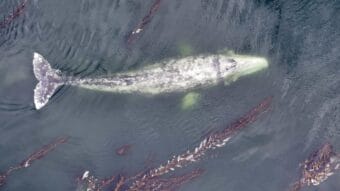
A dead humpback whale was spotted in Unalaska Bay on Dec. 4, the third reported dead whale to wash up on the island since Oct. 16.
The Alaska Department of Fish and Game reported the whale to the National Oceanic and Atmospheric Administration the same day. The Alaska Marine Mammal Stranding Network said there is no cause of death.
Fish and Game staff were told to wait for better weather and for the whale to beach before trying to collect more information.
But this isn’t the only dead whale you can see in Unalaska.
The carcasses of two other dead humpbacks remain on the beach at Morris Cove after washing up Oct. 16. There is no cause of death for them either, though NOAA said one showed extensive rake marks from orcas — scratch marks left when orcas drag their teeth across another animal’s skin.
NOAA said 54 humpback whales have been reported stranded in Alaska so far this year and that multiple whales washing ashore in the same area is not unusual due to ocean currents.
Close
Update notification options
Subscribe to notifications
Subscribe
Get notifications about news related to the topics you care about. You can unsubscribe anytime.