KCAW is our partner station in Sitka. KTOO collaborates with partners across the state to cover important news and to share stories with our audiences.

A Sitka-based cruise line is closing its doors. Alaskan Dream Cruises announced Wednesday that it has ceased operations and cancelled all future sailings.
In a post on its website, the cruise company said since 2011, it’s had the “privilege of sharing the wonders of Alaska and the richness of our Alaska Native heritage with incredible guests from across the globe.”
The company is owned by Allen Marine, a local maritime business that’s been offering wildlife and sightseeing tours in Southeast Alaska for about five decades.
“We’re really proud that we were a homegrown and Indigenous-owned line right here in Sitka,” said Allen Marine spokesperson Zak Kirkpatrick. “And that grew into world class cruises and winning national awards and appearing in worldwide publications, which was really something we’re proud about.”
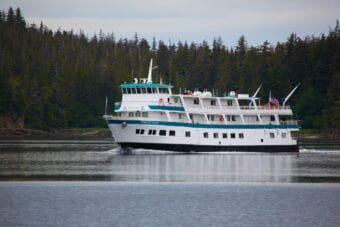
Alaskan Dream Cruises operated four overnight cruise vessels that each held between 40 and 80 passengers, according to Kirkpatrick. Cruises lasted between five and eight nights, and offered a comprehensive look at the Inside Passage, with activities like hiking, kayaking and paddle boarding.
Kirkpatrick said the decision to get out of the overnight cruise business was “intentional and necessary” for the sustainability of the company.
“When you just kind of boil it down, the company is just planning to refocus 100% of our resources on what we consider our founding strengths and roots, which are the day tour excursions and the shipyard operations and marine services,” he said.
In 2025, Alaskan Dream Cruises employed 95 seasonal workers and about 10 year-round workers, and Allen Marine employed 305 seasonal workers and about 100 year-round workers for its other services, according to Kirkpatrick. With the closure, he said Allen Marine won’t be hiring for the overnight boats this cruise season.
The company said it’s directly communicating with all guests about reservations and processing refunds.
Like many people during the holiday season, Sitkan Gaylen Needham was planning on spending Christmas with her adult children, who planned to fly in from Pelican.
However, due to record snowfall, low visibility and cold temperatures, Pelican has been without seaplane access since Nov. 28, cutting the Southeast community of 91 people off from the rest of the region.
“We lived out there full time in the 70s, and we had hard winters out there then, and the seaplanes landed, and they would often ice up,” said Needham. “I think now they’re just more cautious.”
With transportation to and from Pelican limited to Coast Guard and law enforcement helicopters in medical emergencies, not only was Needham unable to celebrate Christmas with her family, she also has had difficulty bringing the Christmas spirit to them.
“I was thinking of a Christmas package I was getting ready to mail out there, and knowing that the planes weren’t flying if you send it, then it ends up going into (the) Alaska Seaplane office and just sitting there. And in this case, the Christmas cookies would have been moldy, right?,” said Needham. “So we’ve just kind of been waiting to hear that they’ve gotten a plane.”
Ajax Eggleston is Needham’s son who has been living in Pelican off-and-on for about five decades, and says he thinks this is the longest period of time Pelican has gone without plane access.
He says it doesn’t help that Pelican’s December ferry was also canceled due to rough winter conditions in the region. Living in remote Alaska, Eggleston is used to the occasional mail delay, but dealing with decreased ferry capacity at the same time has not made things easy.
“That’s kind of a big part of this, is that we just don’t have reliable ferry service anymore, because we only have (the) LeConte that can tie up to our ferry terminal, and when the LaConte is laid up, we don’t have a big enough ferry to run in foul weather,” said Eggleston.
As a result, Eggleston is still waiting to receive the replacement parts he needs to repair his broken furnace and pipes. As for other residents in Pelican, he knows some who have rescheduled their medical appointments. Others are waiting on Costco orders of fresh produce that are stuck in Juneau.
“Everybody’s kind of hunkered down just watching their vegetables disappear,” said Eggleston. “We’re fine. We’re a subsistence-based community, so we’re not going to starve. But there’s no vegetables and no produce of any kind. So we’re overdue for a mail plane!”
Eggleston says Pelican residents have saved up enough frozen vegetables to get by. There is a Allen Marine catamaran expected to arrive on Jan. 6, as well as a state ferry on Jan. 10. Until then, Eggleston says right now, Pelican residents are in a waiting game for better weather.
Jack Petersen poses with a portion of his nutcracker collection displayed at Wildflour Cafe and Bakery. (Ryan Cotter/KCAW)
As a well-known prop designer for community theater productions in Sitka, Jack Petersen is no stranger to construction. He holds up one of his proudest works, a wooden nutcracker adorned in a blue marching band uniform.
“As an artist, I do get very particular about…not just like the visual aesthetics, but also how things feel, how they sound and stuff, and I love how this one feels when it cracks a nut,” Petersen said. “For being the first Nutcracker that I kept myself, I am very proud of the construction.”
Reaching into a basket of walnuts, Petersen plucks one out and places it into the nutcracker’s mouth, preparing for a satisfying crack.
The first nutcracker Jack Petersen ever made stands proudly amongst other displayed nutcrackers in his collection. (Ryan Cotter/KCAW)
This nutcracker is the first of three that Petersen has made. They are part of his large nutcracker collection, which features over 130 nutcrackers. Since the beginning of the month, the majority of the nutcrackers in Petersen’s collection have been displayed at Wildflour Cafe and Bakery, where he serves as a year-round line cook. The nutcrackers are spread out across the restaurant in an array of sizes and materials, some made from various kinds of wood, and others from relatively unconventional materials like iron and brass. Their uniforms are adorned in details marking their country of origin, from Germany to Russia. Wreaths of fake pine boughs and Christmas lights wrap around the room, a playful reminder to patrons that the holiday season is upon us.
While many of them are displayed out in the open by Wildflour’s entrance, some of the nutcrackers have more cheeky hiding spots.
“I do like hiding the nutcrackers really high up on shelves, especially for kids who like to look around and stuff,” said Petersen. “I have nutcrackers hiding in the rafters in the bathroom by the salt shakers there. It is a wonderful little game of ‘I Spy’ for people who want to come in and look around.”
Petersen’s fascination with nutcrackers began when he was around three years old, when he saw a local production of the iconic ballet, you guessed it, The Nutcracker.
“It was just like something magical,” Petersen said. “I like the ideas of toys and dolls and things coming to life when we don’t see them and stuff.”
While many young audience members who attend the yearly production often walk away inspired to become ballerinas, the show took Petersen’s imagination in a different direction.
“This may seem silly, but I remember being a kid and wishing that I could crack a nut with a nutcracker and having daydreams of some whimsical Drosselmeyer figure of my own to [say] ‘Hello, young boy. Would you like to crack a nut?,’” said Petersen.
As his admiration for nutcrackers persisted over time, Petersen began the work of collecting them to fulfill his childhood dream.
“Eventually, when I became an adult with adult money, but none of the adult responsibility, I started looking online, reaching out, and started researching nutcrackers that could actually crack nuts, and one thing led to another, and we are now here,” he said.
A freshly cracked nut, with this nutcracker being one of three nutcrackers Jack Petersen made himself. (Ryan Cotter/KCAW)
When it comes to determining what nutcrackers to add to his collection, Petersen is drawn to those that have unique designs that resonate with his inner child.
“I really love finding the ones that are homemade, like they’re ones that individual people made, or smaller crafters, or some older oddities,” said Petersen. “I look for ones that look like they could have leapt off of the children’s books I used to read as a kid because I don’t know, there’s just something really magical about that.”
And it is that very magic that Petersen wishes to share with the community through displaying his collection at Wildflour.
“I love sharing my collection with people, and I specifically love being able to share nutcrackers that actually crack nuts, because it’s a very mundane thing, but it’s also not something that the average person gets to do in a lifetime,” he said. “And it’s a bit of holiday magic to be silly.”
Petersen’s nutcrackers will continue to be displayed up until Christmas, before being packed away once more as Wildflour begins renovations in January. In the meantime, Petersen hopes his collection can spread some Christmas cheer, and that he can maybe even help some folks crack a nut for the very first time, just like the nut-cracking mentor he dreamed of having as a child.
A Dickcissel spotted in Sitka in mid-November (Marc Kramer/Birding By Bus)
Two different birds rarely seen in Sitka and much of Alaska showed up in Southeast last month. As KCAW’s Katherine Rose reports, it was exciting news for birders leading into a big month for our feathered friends–the Audubon Society’s annual Christmas Bird Count.
In mid-November, the arrival of two rare birds in Sitka caught the attention of birders from around the state. Local naturalist Matt Goff said his son, a fellow naturalist, spotted them back-to-back.
“My son got ambitious about feeding birds this fall again, so [he’s] been putting out a lot of bird food, and he noticed a Harris’s sparrow in the yard, which is a bird that we’ve been looking for for a while,” Goff said.
The small brown sparrow breeds in the boreal forest of Northern Canada, but typically winters in the lower Midwest. Goff had never seen a Harris’s Sparrow in Sitka- the bird was last spotted here in the 1990s.
Just minutes later, his son spotted a second bird.
“About a half hour later, he’s like, ‘There’s another unusual bird in the in the yard,’” Goff recalls. “And he says, ‘I think I remember what it is. I can’t remember its name, but it’s like, it begins with a D, and it’s rare,’ and I said, ‘Is it a Dickcissel? And he said, ‘Yeah, that’s what it was.’”
The Dickcissel was even more unusual. Goff said the midwestern bird that winters in South America was last spotted in Juneau in 2004, and the Sitka sighting is the third on record for Alaska. Its arrival was so unexpected, it brought even more out-of-town visitors. Goff said after he posted about the sightings to the Alaska Rare Birds Facebook group, several birders from Anchorage flew down too…by plane, of course.
“There’s folks that keep track of a list, their Alaska State list, how many birds they’ve seen in the state. Some of these folks have well over 300 species. One of the people that came had over 400 species,” Goff said. “And it’s pretty difficult for them to get new birds these days, because they’ve seen most of them.”
For some it wasn’t their first stop- one drove over five hours from Anchorage to Valdez the day before to see a Broad-winged hawk, the first spotted in Alaska.
“Some of us are mad travelers when it comes to birds,” Goff said. “Especially unusual birds.”
While the Dickcissel hasn’t been seen since late November, Goff said it’s possible the Harris’s Sparrow will stick around for the winter. If it does, it could be counted as part of the Audubon Society’s Christmas Bird Count. Victoria Vosburg is a retired Alaska Raptor Center veterinarian, and she said it’s the country’s longest running citizen science initiative.
“Way back in the beginning, people on Christmas Day used to get together and hunt. They called it a ‘side hunt,’ and it was a competition to see who could kill the most living things,” Vosburg said. “So it wasn’t just birds, it was killing everything. And then some people decided, ‘Let’s do something different. Let’s just count birds, instead of kill them.’” For more than a century, the Christmas Bird Count has documented population declines and recoveries of all types of bird species, and the data collected during the count has influenced policy and conservation efforts. Sitkans began participating in the 1970s, and in just the past couple of decades, Vosburg said they’ve observed a lot.
“I started running the bird count about 20 years ago, and just since I started doing that, we’ve seen swans come back to town. We’ve seen Anna’s hummingbird start spending the winter,” Vosburg said. “We’ve seen Eurasian collared doves come to town, population explosions, disappear, and now we’re watching them on the rise again.”
Sitka’s Christmas Bird Count is December 20, and there are a number of ways to get involved. But if you’re looking to see a Dickcissel or a Harris’s Sparrow, it’ll be a lucky break. Only one of each was spotted. Goff said that’s often the case with lost birds.
“I think there’s some speculation that what might happen, in part, is their internal compass, so to speak, might be off 180 degrees or 90 degrees, or something like that, and they just go the wrong way because they orient differently,” Goff said. “Then they end up someplace that is not at all what their, sort of, biological systems are expecting.”
Goff said lost birds often look for the birds that are local and “in the know” to find food and sometimes they settle in for the winter. Sometimes not. But even if participants at the Christmas Bird Count don’t spot one of the rare birds, there are plenty of other bird species that are counting on being counted.
The parking lot outside the Mt. Edgecumbe High School Aquatics Center in Sitka. (Photo by Katherine Rose/KCAW)
When the Alaska State Board of Education & Early Development met on December 3, several Mt. Edgecumbe High School alumni, as well as current and former staff said that budget and staffing cuts over the past year were putting students at risk. Several said that over 40 students have withdrawn their enrollment so far this year.
Tanya Kitka is a member of the school’s alumni advisory board. She said conditions at the school, like limited recreation opportunities and “excessively restrictive” dorm culture are negatively impacting students, and parents are worried.
“Parents, in general, feel left out or not included in the changes that have been made, and have a general mistrust of those in charge to where they don’t know who else to go to when their very real concerns don’t seem like they’re being addressed sufficiently,” Kitka said. “They’re worried for their children, and so far, the only recourse seems to be to pull their kids out of school.”
“We already started seeing issues with the budget, and we knew that there was going to be some cuts,” said fellow advisory board member Dorothy Chase of Bethel. “I didn’t think that it was going to be as bad as it is, and it’s really impacting students.”
Kristen Homer is a nurse practitioner who manages the school’s health center. But she said she was speaking as an individual. She said budget cuts this year resulted in staff resignations and turnover, including the loss of a mental health services position.
“Three days prior to the arrival of students in August, the superintendent chose to move the behavioral and mental health services coordinator position over to an academic counselor position. This left a huge gap in in the dorms,” Homer said. “There was no licensed mental health provider in the dorms, no female mental health provider in the dorms. This position was responsible for providing counseling, case management, suicide prevention and substance use programming.”
Homer said that from November 12 to the 26, eight students were hospitalized for suicidal ideation.
That information was a bright red flag to Chase.
“It’s really concerning to me to hear that there are more issues and occurrences regarding suicidal ideation,” said Chase. “[Just] one number, one person, that number is should be alarming to begin with. Alaska Natives have the highest rate of suicide. All of this should be taken seriously.”
Mt. Edgecumbe High School has two principals – an academic principal and a residential principal who oversees the dorms. Andrew Friske worked in the latter role, and as the schools activities director, for just over 20 years. He said his retirement last summer was spurred by major concerns about understaffing and student safety. He said just four of his 14 person staff from last year remain at the school. He echoed alumni testimony, and urged the board to take action by forming an ad hoc committee to investigate.
“Give the group the authority to ask hard questions and bring real transparency forward with this committee, and get the full picture, because I do feel that folks that make decisions are not getting the full picture of what’s happened at Mt. Edgecumbe,” Friske said. “I care deeply for the school, I raised my kids there. I worked there for over 20 years, and I’m asking you, as the only governing body at Mt. Edgecumbe to step up before another crisis occurs.”
At the end of the meeting, Board Chair Sally Stockhausen responded to the comments. She said the state’s commissioner of education, Deena Bishop, should get involved.
“I would like to ask Commissioner Bishop and related members of the department, to gather some more information regarding the concerns that we heard today, as well as more information regarding the ad hoc committee, and to come back to us in Jan at our January meeting, so that we can see what needs to be done,” she said.
KCAW reached out to Mt. Edgecumbe Superintendent David Langford, who is new this year, for comment
Editor’s Note: If you or someone you know is struggling with emotional distress or suicidal thoughts, you can call or text 988 to reach the Suicide Crisis Line for 24-hour support. Or contact the Alaska Careline at 1(877) 266-4357.
Bear 309 was captured, tagged and released on Aug. 22, 2025. (Stephanie Sell/ADF&G)
Biologists have launched the first-ever state study of brown bear numbers on Sitka’s Baranof Island. Managers say they need updated data to manage the population appropriately.
Baranof Island is really big — about 1,600 square miles and larger than the state of Rhode Island. The brown bear population is currently managed using really old numbers based on populations from a different island, measured nearly 40 years ago.
Stephanie Sell, a wildlife research biologist with the Alaska Department of Fish and Game, said there’s never been a population estimate study completedonBaranof.
“The management numbers that we’re using for brown bears on Baranof were extrapolated from a project that happened on northern Admiralty (Island) in the late 1980s and the early 1990s,” Sell said.
There was a track study in the 1930s, where researchers went up salmon streams to measure the widths of paw pads to determine how many animals were on the island, but modern research techniques invalidate it.
Based on the information they found on nearby Admiralty Island — located between Sitka and Juneau — Sell said researchers determined there was likely more suitable habitat on Baranof, meaning more bears.
The number they settled on? 1,045.
But Sell said they really don’t know how accurate that number is. And to be able to sustainably manage brown bears on the island, it’s really important to have updated information.
“What we’re trying to do is figure out what those numbers are,” she said.
Sell estimates the study will take about five to six years to complete. Biologists recently wrapped a similar six-year project near Haines and Skagway. Sell said ADF&G had been managing for a population of 400 bears in the area, but the study led them to lower that estimate to just over 300.
“I don’t know if it’s going to be more or less on Baranof Island, but that’s what this project is going to hopefully find out,” she said.
The price tag on the study is still unknown, according to Sell, but they have a funding source: the Pittman-Robertson Wildlife Restoration Act, which is supported by federal excise taxes on the sale of ammunition and firearms.
In early September, Sell and her assistant began capturing brown bears near Sitka and putting GPS collars on them to learn more about their habitats and day-to-day movements.
“We use helicopters wherever we can to dart bears, and then it takes us about an hour to process the bears,” she said. “We also use foot snares in places where we won’t run into people, for safety reasons. And then the other method is free range darting, where we sit next to some sort of salmon stream or some sort of attractant, where the bear is drawn in by some natural food source, and we just wait for bears to show up.”
Each of the 25 bears they aim to capture each year will wear a collar for up to two years. When they retrieve them, researchers will then be able to look at that data and focus their efforts on the next part of the study: genetics.
“Once we get more spatial data and see where bears are moving across the island, we can start looking at where we’re going to actually put genetic sampling detectors,” Sell said. “We’re going to start catching bear hair to increase our sample size, and that way we can use that information to determine how many animals are actually on the island.”
A brown bear on northern Baranof Island. (Steve Bethune/ADF&G)
Sell said Baranof bears are generally really dark, almost resembling black bears. They’re also quite fat this time of year because of the island’s healthy salmon runs — something she said they didn’t see everywhere else this year.
“What we do know about Game Management Unit Fourbears is that they’re genetically similar to polar bears,” Sell said. “They had refugia, it seems like, since the last ice age. And so they’re genetically different from mainland bears.”
(Refugia are geographical areas where a population, species or community has survived environmental instabilities over long periods of time.)
As of Friday, Sell said biologists have put 20 collars on bears: 14 on females and six on males.
Brown bear hunting season in Sitka starts on Sept. 15. Hunters are currently able to harvest 42 bears on Baranof — that’s 4% of the estimated population. Sell said they hope to be done tagging for the season before that begins.
Later on in the study, she said they’ll be reaching out to the community to see if anyone wants to volunteer by checking hair snares. If anyone has questions, wants to volunteer, or even give her a guesstimate on how many bears they think might be on Baranof Island, Sell said they can email her.
Close
Update notification options
Subscribe to notifications
Subscribe
Get notifications about news related to the topics you care about. You can unsubscribe anytime.