KCAW - Sitka

KCAW is our partner station in Sitka. KTOO collaborates with partners across the state to cover important news and to share stories with our audiences.
At Sitka library, Dungeons & Dragons plays a critical role in community building

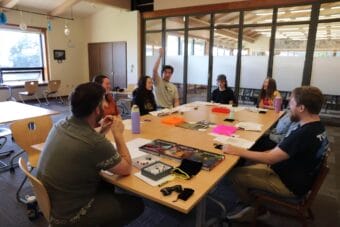
Players role-play during a session of Dungeons and Dragons at the Sitka library.
Players role-play during a session of Dungeons and Dragons at the Sitka library. (Ryan Cotter/KCAW)

On an uncharacteristically sunny day, Sitkans spread out all across town, kayaking out on the ocean and scaling mountains for a rare, clear view. However, one specific group of Sitkans is tasked with an important quest: rescuing a blacksmith’s daughter from a horde of goblins.

Armed with their gifted set of dice and assigned character sheets, the seven players wield their pencils to take notes on their surroundings. Gathered around a table at the Sitka Public Library’s multipurpose room, the players range in experience from this being the first time they have played the tabletop role-playing game Dungeons & Dragons, or D&D, to veterans with years of experience and D&D podcast recommendations under their belt.

Riley Whitson is what the game deems the Dungeon Master, a storyteller who guides the players throughout the whole gameplay experience, from helping them create their characters to narrating their characters’ surroundings. Having regularly mentored middle schoolers in how to play D&D under the city’s Parks and Recreation Division, Whitson was recruited to lead a two-week workshop for adults. Having played the game for over two decades, what keeps Whitson coming back for more is D&D’s unique collaborative nature.

“Dungeons and Dragons is kind of a shared story,” Whitson said. “You’re all characters in some type of adventure going on or some activity, and everyone gets a piece to kind of make it a living, breathing story. And that’s what excites me the most.”

Riley Whitson narrates the scene of players combatting an army of goblins. (Ryan Cotter/KCAW)

After defeating the goblins and freeing both the blacksmith’s daughter and a captured paladin (played by an experienced player who joined that day), the party uncovers a statue of a knight with a mysterious riddle engraved below it:

“If you are to keep this, you must first give it to me…”

As a fantasy-game that prominently features riddles, D&D is a game that is fully dependent on the imagination of its players. As a born-and-raised Sitkan, Whitson believes that Sitka is a prime location for fueling prospective players’ imaginations.

“All I ever wanted to do as a child was leave this place,” Whitson said. “We’re very rural and isolated, and so your imagination kind of tends to take you on adventures no matter what, whether you’re imagining just going to Seattle for a weekend, or you’re off in a mythical land where it’s always sunny, you can just put yourself in a world that you want to go to.”

First-time player Carole Knuth was inspired to attend the library’s workshop by her grandson’s imagination, and wanted to learn how to play D&D in order to create an opportunity to connect with him. However, learning how to harness her imagination while learning the plethora of unique game mechanics has been a challenge.

“I’m more of a black-and-white person and to have this much — well, the numbers and the the variety and imagination was just really stretching for me,” Knuth said.

Newfound DnD player Carole Knuth rolls a 20-sided dice. (Ryan Cotter/KCAW)

While it can be an adjustment, Whitson believes that the limitless imagination D&D encourages in its players is what makes the game so special.

“All of us played pretend when we were kids, and everybody has some part of them that still wants to,” Whitson said. “And so once you see people kind of get over that initial shock of, oh, there’s numbers and probability and math and stepping outside of your own shoes, you see people just take to it.”

It is moments of learning and camaraderie that the players experienced in their session that led Adult Services Librarian Margot O’Connell to co-create this event with Sitka Parks and Recreation. She believes hosting tabletop role-playing game events are an important way to facilitate community building.

“We kind of think of ourselves as a community living room,” O’Connell said. “And I think with games like Dungeons and Dragons or board games, they are inherently very social. And so anytime we can provide a space for folks to come and build community together, learn new skills, just come and hang out, I am thrilled.”

This fall, Whitson will lead some intermediate D&D workshops, as well as some middle school and high school campaigns with Sitka Parks and Recreation.

Southeast Alaska weaver threads together wisdom and technique

Lingít weaver Tleinax Shaawat Sydney Akagi poses with two of her creations displayed at the Sheldon Jackson Museum.
Lingít weaver Tleinax Shaawat Sydney Akagi poses with two of her creations displayed at the Sheldon Jackson Museum. (Ryan Cotter/KCAW)

Back when she was an art manager at the Sealaska Heritage Institute in 2017, Sydney Akagi would frequently spot people using weaving kits. Inspired by the weaving surrounding her, she scored a spot in Ravenstail and Chilkat weaver Lily Hope’s class, and Akagi was hooked.

“Weaving felt pretty, almost addictive at first. I couldn’t stop,” said Akagi. “I was up late at night. I’d be sitting in bed with tiny projects and wouldn’t go to sleep, and I kind of just lost time.”

Since then, Akagi continued to study under Hope’s tutelage as an apprentice in Juneau, mastering the intricate finger-twining steps of Ravenstail weaving and the geometric designs of the Chilkat style. As her skills improved, Akagi says she was able to find healing and empowerment in her own Lingít identity.

“I think it started to kind of heal some maybe cultural things, a little bit of cultural trauma that I had had from growing up and not feeling accepted and kind of keeping my culture kind of like just at bay and not fully accepting it,” Akagi said. “So it was kind of like my gateway into having that healing with my culture.”

With Hope’s encouragement, Akagi quit her job at the Sealaska Heritage Institute in 2020 to pursue weaving full-time. Now, with nearly a decade of weaving under her belt, she is excited to share her knowledge with Sitkans as the current Native artist resident at the Sheldon Jackson Museum.

There, visitors can view a killer whale Chilkat tunic Akagi completed in 2023. The tunic immediately captures attention as people enter the museum, with its vibrant yellows and blues blasting through its black and white borders to define the whale’s geometric shapes. The tunic’s design mirrors itself on either side in what is known as a distributive design. The tunic is a recreation of one Akagi observed at the Anchorage Museum back in 2022, in order to learn how to weave a traditional tunic.

“There’s not very many weavers that understand the process of creating the shoulders on that tunic, so it felt more almost 3-D versus the flat surface of like a robe that’s hanging on a loom,” said Akagi. “So what I really wanted to do was understand that shoulder, the techniques of creating that and that construction.”

Next to the tunic is one of Akagi’s works-in-progress – a black wall of thread with diamonds swimming across a budding yellow line below it across her weaving loom. These initial threads will eventually culminate into a Chilkat robe depicting a salmon. This robe is unique in that unlike Akagi’s previous pieces like the distributive killer whale tunic, this one will have a configurative design, or an asymmetrical design across the piece.

“So I might be a little anxious before starting that and just having that understanding, but again, that I think that’s part of my evolution as a Chilkat weaver, and like understanding that and gaining all that knowledge,” said Akagi.

Sydney Akagi demonstrates her weaving technique on her developing Chilkat robe. (Ryan Cotter/KCAW)

The salmon robe was inspired by Akagi’s experience as a resident of the Taku River near Juneau and her advocacy work as a Salmon Beyond Borders Ambassador fighting mining companies whose wastewater endangers the health of the river’s salmon.

“So I was kind of trying to figure out how the art I make, what I could make to kind of bring in a more traditional conversation to these conversations I’ve been having with the CEOs and presidents of these mining companies to ask them to respect our rivers and to do the cleanup,” Akagi said.

Akagi says the work she does, both on her loom and as an advocate for environmental justice, is connected.

“Every part of what I’m creating is from the earth, and so not protecting the Earth only affects what I am creating,” she said.

In addition to a lecture, as part of her residency Akagi will lead a sold-out weaving workshop where participants can create their very own keychains. Akagi is excited to introduce students to the wide-variety of benefits weaving has to offer.

“For kids, weaving can be used as a hands-on method to teach math,” Akagi said. “There’s pattern recognition for anybody older. Just understanding how to do this and use your hands, and even for the cultural reason of being able to connect with the culture or understand the culture. I think there’s so many things that anybody can benefit from learning about weaving.”

Amidst the chaos of balancing numerous other weaving projects with navigating grants and family life, Akagi is grateful to be present in Sitka and engage with the community, exchanging ideas like two threads being woven together to create something meaningful.

Solo pilot rescued after crash south of Haines

The rescued pilot stands before his turned over plane near Haines (Courtesy of the Alaska Coast Guard)

The U.S. Coast Guard rescued a pilot after his small plane crashed near Haines on Sunday.

Chief Petty Officer Travis Magee told KCAW that around 8:30 a.m. the Coast Guard received a signal from the emergency locator transmitter of a two seat, single engine airplane over the Chilkat Range, approximately 35 miles south of Haines.

“The Coast Guard reached out to the Haines airport, who confirmed that there was an aircraft matching that description to the two seat, single engine airplane that had departed earlier that morning, but it had not returned,” said Magee.

Around 10:30 a.m., a 5-person helicopter crew from Air Station Sitka located the pilot and overturned aircraft near the Endicott River. Magee said the pilot walked away from the accident unscathed.

“So we’re very thankful that this case resulted in the way that it did, with this individual having no reported back injuries,” said Magee.

The helicopter crew transported the pilot to the Juneau airport. The pilot met with emergency medical services, but he did not request any assistance from them, and was released shortly afterwards.

This is a developing story and may be updated. 

Alaska Marine Lines will no longer ship electric vehicles due to fire risk

In June, an international cargo ship, the Morning Midas, caught fire and ultimately sunk off the coast of Alaska. The ship was carrying around 3000 vehicles, including around 70 EVs and nearly 700 hybrids (U.S. Coast Guard Photo)

Alaska Marine Lines will no longer ship electric vehicles or plug-in hybrid vehicles to Alaska or Hawaii.

Last week, the barge company announced the policy change in a statement due to the fire risk associated with shipping large lithium ion batteries.

AML’s decision to stop shipping electric vehicles means reduced access for communities off the road system in Southeast Alaska, where EVs have become an increasingly popular option.

Alaskans can still bring electric vehicles up by ferry, though it can take longer. The Alaska Marine Highway System limits its policy to two electric vehicles per sailing. Once electric vehicles catch fire, they’re challenging to put out, according to Alaska Department of Transportation Spokesperson Sam Dapcevich.

“EV fires, I believe, kind of burn until they go out, and so you have to kind of contain them. Each vessel has two specialized blankets on board that can be thrown over a vehicle, and it sort of smothers it,” Dapcevich says. “We also have a policy to park those vehicles in a specific location on the ship, and we provide extra room around them for the possibility of needing to fight the fire.”

In June, a cargo ship southwest of Adak caught fire in the open ocean. It was carrying over 3000 vehicles, including nearly 700 hybrid vehicles and around 70 fully-electric vehicles. All crew members were rescued, but the U.S. Coast Guard could do little to contain the blaze due to the risks associated with lithium ion batteries. The ship burned for days before ultimately capsizing and sinking.

Dapcevich says it’s not just the fire that makes EVs high risk, especially on a passenger vessel like a state ferry.

“It’s the toxic fumes, and you’re in an enclosed space, and they can travel into through the ventilation system in the vessel,” Dapcevich says. “They can travel into passenger spaces, and so it’s just a very dangerous situation to have an EV fire on a boat. And that’s part of why we limit it.”

Dapcevich said Alaskans looking to bring up electric vehicles from the Lower 48 should flag that information when they’re making a ferry reservation.

In an email to KCAW, Alaska Marine Lines spokesperson Ryan Dixon said the barge company would continue to reassess its decision to stop shipping electric vehicles as industry safety standards improve. Hybrid vehicles that do not plug in will still be allowed on the company’s cargo ships, as well as smaller electric recreational vehicles, like e-bikes and 4-wheelers.

The new policy is effective immediately for Central and Western Alaska and Hawaii, but the change doesn’t go into effect for Southeast until September 1.

Woman dies after boating accident near Sitka

A white and grey coast guard helicopter over cloudy skies
A Coast Guard Jayhawk rescue helicopter from Air Station Sitka participates in a training exercise. (Photo by Petty Officer 3rd Class Wes Shinn/U.S. Coast Guard)

A 35-year-old woman has died after the vessel she was on capsized Sunday near Sitka, according to the U.S. Coast Guard.

The Coast Guard is investigating the accident and has not yet released her name.

At about 5 p.m. Sunday, Air Station Sitka received reports of a capsized skiff and an overturned kayak in the Redoubt Bay area, each with one person on board. A Coast Guard helicopter crew, an emergency response vessel from the Sitka Fire Department, and several nearby boaters responded to the calls that came in over VHF radio.

In an email to KCAW, Coast Guard public affairs officer John Hightower said the man operating the skiff, which was a Boston Whaler, was rescued by a nearby good Samaritan boater — he was taken to emergency responders who were waiting on shore in Sitka.

Hightower said the woman was recovered from the water by another good Samaritan. She was then transferred to the Sitka Fire Department vessel, and the Coast Guard helicopter crew lowered a rescue swimmer onto the boat to help with medical treatment while they headed back to town.

Fire Chief Craig Warren said the crew made it back to Sitka shortly after 6 p.m. Sunday, where an ambulance was waiting to take the unresponsive woman to Mt. Edgecumbe Medical Center. Hightower said she was pronounced dead at the hospital. He said the woman’s next of kin have been notified.

‘Stubby squid’ saved by savvy science center aquarist

The stubby squid at the Sitka Sound Science Center usually burrows in the sand during the day, but emerges when she feels comfortable. (Photo provided by Matt Wilson.)

In a corner tank in the Sitka Sound Science Center, there’s a soft creature about the size and shape of a plum. She’s a deep, ruddy purple, and she blasts little puffs of sand when someone gets too close to the tank.

Matt Wilson has worked as the aquarist here for a few years. He manages the care of about 200 species in the aquarium. He says this stubby squid — also known as a dumpling squid, or Rossia pacifica — isn’t really a squid at all.

“With every, you know, group of animals, there’s some weirdos that are out on the fringes,” he said. “They are most closely related to cuttlefish, more than they are squid or octopus. But they are not quite cuttlefish.”

Wilson found the stubby squid by accident. In March, he was walking along the beach next to the Science Center, looking for live crabs to feed to aquarium animals.

Wilson found the stubby squid while walking along Sage Beach, pictured here. (Photo by Meredith Redick/KCAW)

“I think she was trying to go after shrimp that were eating the herring eggs right after herring spawn,” he said. “She was only in a couple inches of water when I spotted her.”

Stubby squid usually live in deeper waters and burrow in the sand during the day. Wilson says finding one out in the open like that was a sign she was in bad shape.

“She was a dark purple, which means that all of her color-changing cells had completely relaxed,” he said. “So she probably was almost sort of unconscious at the time, and she could barely move, and she couldn’t burrow in the sand.”

Wilson scooped the stubby squid up in a bucket. Over several days, he adjusted the temperature and salt levels in the tank to better resemble a typical habitat. Wilson said the animal stayed ghost white for two days — a bad sign — but then changed colors and started burrowing again.

“That was our first sign that she probably was going to start to improve, and from there, she has continued to make a full recovery from that, and is now doing all the normal behaviors we’d expect,” he said.

It was a fortuitous outcome – Wilson happens to be one of a handful of aquarium biologists with experience caring for the species. He first worked with them more than a decade ago, learning from guidelines left by the late octopus specialist Roland Anderson. Anderson cared for stubby squid during a three-decade career at the Seattle Aquarium — one of the only public aquariums that displays the species.

Wilson poses next to the stubby squid in her tank (left) in May 2025. (Photo by Meredith Redick/KCAW)

“It was about probably four years off and on working with these animals before I really felt like I was getting positive, good interactions with them,” Wilson said.

Kathryn Kegel is a curator at the Seattle Aquarium. She says stubby squid don’t often show up in aquariums because they can be hard to find, don’t live long, and they’re not easy to keep – they’re really picky eaters.

“They hunt small crustaceans, and don’t always like to eat dead food,” she said.

Kegel says reviving an unhealthy stubby squid, like the one Wilson found, can be especially difficult.

For Wilson, keeping the stubby squid alive and happy is a lot of work. He doesn’t often get to watch her hunt, but when he does, it’s quite a show.

“They pop up completely out of the sand, start to basically hover and rise just above the sand and shoot those tentacles out really, really quickly, like just lightning speed, grab that animal, pull them back and bite it with their beak to immobilize and paralyze it,” he said.

Stubby squid typically live for one-and-a-half to two years. Wilson says that this particular pint-sized predator was already full-sized — a whopping three inches — when he found her. He estimates that she has another four-to-six months left.

“That’s the downside to working with cephalopods, is that they don’t live for very long in most cases,” he said.

After she dies, this stubby squid will be preserved as a learning tool. Wilson sees that as another way to respect the animal.

“Skeletons, preservations, all of those are really important to me as somebody who wants to continue to respect that animal and have them continue to teach even after death,” he said.

He considers his relationship with the animals as a collaborative one – and he says that’s why he avoids giving pet names to animals in his care.

“These are not my pets,” he said. “These are my colleagues.”

Wilson also hopes to expand the existing care manual for the species, sharing what he’s learned, so that other biologists can effectively care for this not-quite-a-squid, not-quite-a-cuttlefish creature.

In the meantime, visitors can meet the stubby squid at the Sitka Sound Science Center.

Site notifications
Update notification options
Subscribe to notifications