KCAW - Sitka

KCAW is our partner station in Sitka. KTOO collaborates with partners across the state to cover important news and to share stories with our audiences.
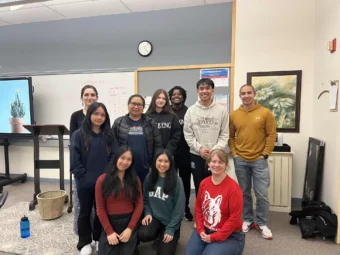
Sitka High ‘Barkadas’ Club celebrates Filipino heritage

Members and advisors of Sitka High School’s Barkadas Club smile for a picture during a January 2025 meeting. (Meredith Redick/KCAW)

On a rainy Wednesday around lunchtime, the students in Room 211 at Sitka High are passing around Styrofoam takeout containers of egg rolls. They’re here for the weekly meeting of the Barkadas Club.

The word “barkadas” translates to “group of friends” in Tagalog. Senior Julia Nabua started the club in 2023 after attending a camp for young Filipino Americans in Washington State.

“All my friends all talked about a Filipino club and it sounded really interesting, so I wanted to start one here too,” she said.

She said she wanted a space where Filipino American students could take pride in their culture – and for some, learn more about their own heritage.

“Usually we don’t really learn much about it in school or at home, because, you know, we’re in the U.S.,” she said.

A little over six percent of Sitkans identify as Filipino or Filipino American, according to the most recent data. Julia’s mother, Bennie Grace Nabua, is an advisor for the club. In 2022, she helped develop a scholarship for Filipino students in Sitka and drafted a municipal resolution declaring October to be Filipino American History Month. She said she was eager to support Julia’s idea to start a club.

“Julia, you know, finding herself and and having a better and deeper appreciation of her identity as a Filipino teenager in the US, I was kind of like, ‘Oh, I think it will be super great, you know, to have that space,’” she said.

The Barkadas have extended their reach far beyond the walls of Room 211. The club partners with the Tulong Aral scholarship fund, which provides scholarships for graduating Filipino American students to pursue higher education. The club has also coordinated two “Salo-Salos,” or community gatherings, to celebrate Filipino American History Month.

Last year’s Salo-Salo brought in more than a hundred people. Bennie Grace said the students did most of the work to organize the event.

“The Salo-Salo gatherings that we have been having for the past two years are big projects — fundraisers, connecting with businesses, asking for solicitations,” she said. “Most of them are done by the students, and — how should I say it? They have really been independent about doing a lot of the work.”

Sitka High teacher Jarred Rivera is a faculty advisor for the Barkadas and a Filipino-American. He said growing up, Sitka’s Filipino American community hosted a lot of community events.

“I remember when I was young, we had huge potlucks,” Rivera said. “The whole community was invited, and it was a big thing. It was huge, and, and then, you know, that went away but now, since the Barkadas club started, you know, we’re getting a lot of buy-in from the community and stuff.”

The club has attracted a diverse group of students, including many who aren’t Filipino American. Senior Desirae Hutton said she initially joined to support Julia, her friend since sixth grade.

“When she told me she was starting this group, she was like, ‘Can you come for this first meeting? I’m nervous,’” Hutton said. “And I was like, ‘I got you. I’ll be there.’”

Hutton has been a member since that first meeting. She’s now the club treasurer.

“I’ve never been a part of a heritage-type of club, so being here and learning about this different stuff has been really interesting,” she said. “And it’s also been cool, though I’m not Filipino, being able to still be involved how I am, that’s just fun and cool, getting to learn something new.”

Julia said she hopes the club continues to grow, even in her absence. She’s already mentoring younger students to take over club leadership after she, Hutton, and vice president Rex Adres graduate this spring – and she said even after graduation, she hopes to serve as a resource for future members.

A grieving mother wanted her son’s possessions returned for his memorial. Mt. Edgecumbe High School couldn’t find them.

Pace Carson Chikigak passed away on April 22, 2024. Since then, his mother Jolene has been trying to recover his belongings from Mt. Edgecumbe High School. (Photo courtesy of Chikigak family)

Pace Chikigak would have been a senior at Mt. Edgecumbe High School this year, the third generation in his family to attend the state-run boarding school in Sitka. His mom Jolene, who graduated in 2003, says he was a straight-A student with a huge heart.

“If you needed a friend, he was there. He never turned anybody away,” she said. “He was an amazing kid. I was so proud to be his mom.”

When Pace died in April at home, Chikigak says she called the school to let them know, and asked if a staff member could pack up her son’s belongings from his dorm room and mail them to her. The person she spoke with on the phone said they would.

“Every day I was wondering if I would come home from work to see a box of his stuff, but it never came. And so, you know, I would email and be like, ‘Hey, I still haven’t received his items. You know, were they mailed?’ And they were like, ‘Oh, we do have a tracking number. It was mailed.’”

But when a package finally showed up, it was a memorial plaque and letters from students from Pace’s service at the school, not the items from his room.

“I always made him come back [home] because I wanted him here for his birthday. So he only brought home the clothes he was clothed [in], sweaters and other items he wasn’t going to be bringing back,”Chikigak said. “I know left his towels, bedding, probably extra clothes that he didn’t bring. I think maybe shoes, toiletries and whatnot he did leave behind that we did not receive.”

It was important for Chikigak to get these items for Pace’s traditional funeral rites in her home village of Alakanuk.

“In our culture, we were supposed to burn his items 40 days after his death and hold a feast, she said. “But the items I never received, we never got to burn, and it’s just our culture.”

After 40 days, they held the feast without all of Pace’s belongings. But she continued to reach out to staff at Mt. Edgecumbe, holding out hope that the items were still on their way. Via email, staff said they would look for them, but then she says they didn’t follow up about whether the items were lost or found.

40 days after Pace passed away, his family held a feast and traditional burning of his belongings in Alakanuk. (Photo courtesy of Chikigak family)

“You never know if the item, the thing, might not be valuable, but they might be sentimental and have huge meaning for the student,” Chikigak said. “That’s what really upsets me. I just feel like I’m being gaslighted.”

Eventually one of Chikigak’s co-workers connected her with KCAW, and we reached out to see if we could learn what had happened to Pace’s missing belongings. In a statement, Superintendent Suzzuk Huntington wrote, “Mount Edgecumbe High School remains deeply saddened by the loss of one of our students. Our administrators, staff, students, and community have come together to pay our respects and show our support for the family -and continue to keep them in our thoughts. Out of respect, courtesy, and privacy to the student’s family, we will not be giving further comment.”

KCAW also reached out to the Chair of the Alaska Board of Education and Early Development, which oversees Mt. Edgecumbe High School.  We were referred to a public affairs staff member, but have received no statement.

A week after KCAW reached out to the high school, Chikigak received an email from staff. They’d finally found something – a notebook. She was informed that it was the only remaining item of Pace’s at the school.

Chikigak’s grief is compounded by the fact that Pace died by suicide. Getting his belongings back won’t necessarily ease her pain, but it could offer her some closure. She says she wishes the school would take accountability for losing the dorm room items. She says she’s connected with two other parents who have had trouble recovering their children’s property from the school.  She hopes the school will review their practices around recovering and returning student’s items to families, so no parent has to go through this again.

Mostly, she just wants folks to remember Pace, who loved hiking and biking, his two dogs, going for a random car ride, and so much more.

“I would like to keep his memory alive. I want him to be remembered for the lovable, amazing person he was, [rather] than how he had passed away,” she said. “I just want him to be remembered for the amazing, straight-A kid he was.”

If you are a loved one is struggling with thoughts of suicide, call the National Suicide and Crisis Lifeline at 988 or Alaska Careline at 877-266-HELP. 

This story has been updated to correct that Pace’s funeral rights took place in Alakanuk. 

On fourth try, Sitka cruise limit ballot prop goes out for signatures

The Serenade of the Seas in Sitka on July 21, 2021, the first port call of the curtailed 2021 cruise season. (Tash Kimmell/KCAW)

After three previous failed attempts, a fourth application to put a cruise limit question before Sitka voters has passed the city’s initial legal review.

Organizers now have a few months to collect 613 signatures in support of their ballot proposition. If they get enough signatures, it could go before the voters in a special election next spring.

The advocacy group Small Town SOUL wants to limit cruise traffic in Sitka, following several years of growth in the industry that’s more than doubled the community’s pre-pandemic cruise traffic numbers.

The proposed ballot initiative would limit cruise traffic in Sitka to 4,500 cruise passengers per day, and 300,000 annually. It would establish a permitting process for cruise ships that the city would oversee, and would fine cruise ships if they dock without a permit or exceed the number of scheduled passengers. The new initiative also removes language requiring a Sitka port facility permit and considers “passengers” ashore instead of persons, meaning cruise ship crew members would not count toward the cap.

It’s the first time a cruise limit ballot question has advanced this far in the process. The last three petition applications were denied by the city’s legal department because they were deemed unenforceable, and included confusing or misleading provisions.

Anchorage law firm Jermain, Dunnagan & Owens prepared the legal opinion on the proposal. In their letter, they note that opponents have called into question a number of legal concerns around the initiative. But the bar is very high for proving a ballot initiative is unconstitutional before it has been enacted.

While they say the ordinance invites “a variety of possible constitutional challenges,” none are clear-cut enough to warrant the city’s rejection of the application at this stage in the process. The clerk can only reject an application if the law leaves “no room for argument about its unconstitutionality.” In their recommendation that the city approve the application, they write, “At this point, any legal challenges to the proposed initiative are best addressed by a court.”

Organizers now have to collect signatures amounting to one-third of the number of votes in the last regular municipal election. In a statement, Larry Edwards, one of SOUL’s organizers wrote, “Sitka’s home rule charter allows ninety days for us to get the signatures. But we aim to get them in weeks, not months, toward having the special election in early spring.”

Once they’ve collected signatures, the petition will be submitted to the city clerk’s office for a signature review. If enough signatures are collected for a special election, one must be held between 40 to 90 days later. If the ballot proposition is approved by the voters, it would go into effect in 2026.

After a year rocked by tragedy, Sitkans gather to grieve

Attendees wearing gear embroidered with the name “F/V Wind Walker” bow their heads for a moment of silence during Sitka’s community vigil on Saturday, December 7. The Wind Walker was a seiner that capsized earlier this month with five crew members aboard. (KCAW/Redick)

The loss of five lives aboard the seiner Wind Walker earlier this month was the latest in a string of tragedies that has shaken Sitka this year, from a January boating accident that killed two teens to the apparent bear mauling of a local fisheries advocate in October.

In a two-hour vigil at the University of Alaska Southeast Sitka campus boat ramp on Saturday, more than 80 Sitkans and visitors gathered to share stories of loss.

Mementos and photos of the Wind Walker crew sit on a table at Saturday’s vigil. (KCAW/Redick)

Paul Rioux, who organized the event with Nalani James, said they wanted the community to have a space to come together in grief.

“When someone is hurting, we can’t usually see the mess, and even if we could see it, we can’t reach into their hearts and put things back into the right places,” he said. “What we can do is acknowledge one another – give one another permission to hurt. Today, you all have permission to hurt. We can offer that love to one another.”

Malisa Crisman held up a photo collage of her son, who was one of five crew members aboard the F/V Wind Walker. She said she had come up from Las Vegas with her daughter-in-law.

“My son was E.J. Celaya. He was a commercial fisherman out here for seven months,” she said. “He loved the people that he met here. He said Sitka is a beautiful place. He eventually wanted his family to come. He said everyone welcomed him, and he wanted to make this his home. He’s going to be forever missed.”

Sitkan Jackie DeBell held up a photo of her grandson, David Jackson, who died at age 16 in a car accident this September.

“It’s been a real struggle with our family,” she said. “We have to learn how to live. It’s just learning to live without him, learning new things. And I just want to acknowledge everyone here. I know everyone has somebody they lost, and their lives are forever changed. Whether your grief started five, 10 years ago or last month, I want to offer you my condolences.”

Representatives from community organizations, including the Alaska Marine Safety Education Association and Brave Heart Volunteers, spoke briefly.

Attendees toss flowers into the water following the vigil. (KCAW/Redick)

Brave Heart program manager Kathryn Winslow encouraged Sitkans to rely on each other.

“The holes in our hearts do not go away, and neither does the love,” she said. “So keep supporting each other, listening and sharing. We are a community woven together with threads of compassion and strength.”

Local musicians Elias Erickson and the Jen Reid Trio led the group through a hymn and a rendition of The Beatles’ “Let it Be.” Afterward, attendees stood at the edge of the boat ramp and tossed flowers into the channel.

Coast Guard releases names of 5 men missing after their fishing boat capsized

A map of the search area spanned over 100 nautical miles (U.S. Coast Guard)

The U.S. Coast Guard has released the names of the five fishermen lost in the boat sinking near Hoonah on Sunday.

A Coast Guard public information officer confirmed the names of the missing Wednesday morning. They are: Travis Kapp, Jacob Hannah, Alex Ireland, Emilio Celaya-Talamantez and Michael Brown.

The five men were aboard the Wind Walker, a 52-foot Sitka-based seiner, when it capsized near Point Couverden. Their ages and hometowns were not released, but the Coast Guard official confirmed that their family have been notified.

After more than 24 hours of searching over 100 nautical miles, the Coast Guard found no signs of the missing mariners, except for seven empty survival suits and two strobe lights. They called off the search on Monday afternoon pending new information. Anyone with new information is asked to call Coast Guard headquarters in Juneau at 907-463-2980.

New study of salmon abundance prompts a rethink of endangered killer whale decline

A killer whale, also known as an orca, swims in Alaska waters on July 25, 2013. (Photo by Kaitlin Thoreson/National Park Service)

King salmon, or chinook, are a critical part of the diet of Southern Resident killer whales. The population of Southern Residents has been dangerously low for decades, at around 75 members.

Research into this problem focuses on the habitat, and especially the availability of chinook. There is a preponderance of evidence correlating, for example, low birth rates among Southern Residents to years of low abundance of chinook. There are also statistical models that point to the same conclusion: Southern Residents aren’t getting enough of what they need to thrive.

But no one has ever gone out and counted the chinook in the Southern Resident habitat – until now.

“And what we found was the opposite of what we expected, what was predicted,” said Dr. Andrew Trites, “the prevalence of chinook was double in the Southern Resident Killer Whale habitat.”

Trites is the director of the Marine Mammal Research Unit at the University of British Columbia. He expected his research to confirm the premise that Southern Residents lacked a readily available supply of chinook – not upend it.

“I think it undermines the premises for a lot of that research,” said Trites, “and I think it undermines how quickly some people have jumped to conclusions. They’ve connected dots that should not be connected, and they’ve had huge leaps of faith in doing that.”

Trites’s study was conducted over three years (2018-2020), and was funded by Fisheries and Oceans Canada (DFO), the Canadian equivalent of the US National Marine Fisheries Service. His credibility, or the integrity of his project, isn’t in question. But in science, one study is never definitive. Misty MacDuffee is the Director of Salmon for the Raincoast Conservation Foundation, who specializes in chinook. She considers Trites’s paper a valuable contribution to understanding the availability of chinook in a particular area in summer and fall, but she doesn’t think the study solves the entire puzzle, when it’s only just a piece.

“I think the concerns start with extrapolating that [Trites’s paper] means that Southern Resident killer whales aren’t prey-limited,” she said.

Because there is no baseline study of the availability of chinook in the Salish Sea, as the waters between Washington state and Vancouver Island are known, Trites decided to compare the numbers of fish in the southern part of the Salish with numbers in the northern part, where the killer whale population is actually growing. MacDuffee, however, believes the study misses the big picture.

“[To captur] the level of abundance that Northern Residents have access to in that time period in the Salish might be adequate for Southern Residents – but that the study wasn’t set up to answer that question,” said MacDuffee. “So extrapolating that from what the study methods were and the study design were, is just too much of a stretch.”

MacDuffee was one of many scientists whose research supported a lawsuit brought in 2020 by the Wild Fish Conservancy, a Washington state conservation organization, against the National Marine Fisheries Service. NMFS carefully regulates certain commercial fisheries, like the Southeast Alaska chinook troll fishery, when they have an impact on endangered species.

The lawsuit nearly brought an end to chinook trolling, which has been the backbone of the Southeast Alaska economy for a century.

“Yeah, we feel vindicated,” said Matt Donohoe, former president of the Alaska Trollers Association, which filed a brief in support of NMFS. Donohoe feels Trites’s paper is confirmation of his industry’s position: the problem for Southern Residents is not in Alaska.

“The fish that don’t come up here, that are vital to killer whales,” he said, “the troll fishery was responsible for those killer whales’ decline? I mean it [the premise of the suit] was absurd on the face, even if the nutrition issues were correct.”

Donohoe believes the lawsuit was a fundraising tactic, and deflected attention from the genuine threat of marine contaminants in Puget Sound.

Andrew Trites is aware that his work doesn’t unravel the problem of why Southern Residents seem to be at capacity, when their Northern neighbors are growing. If anything, his study suggests that more answers about the health of Southern Residents may lie outside of Puget Sound and the Salish Sea, and along their likely winter range on the Oregon and California coasts.

“Part of our message from this paper is that we want people to, yes, protect your backyard, but you need to also consider protecting the other areas that the whales use when you don’t see them,” said Trites. “And almost no research attention or management attention is being given to what they need when they’re not in the Salish Sea.”

Trites uses an analogy of a bird feeder in Alaska: If one summer you notice that you have far fewer birds returning to your feeder, he says “do you assume that there’s something wrong with your backyard?”

Site notifications
Update notification options
Subscribe to notifications