KCAW is our partner station in Sitka. KTOO collaborates with partners across the state to cover important news and to share stories with our audiences.

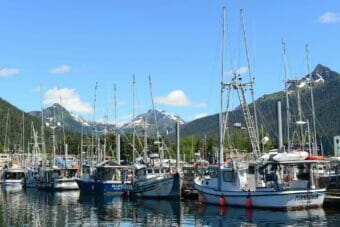
Trollers await the July 1 opening of the king salmon season in Sitka’s Crescent Harbor. The commercial season for king salmon in Southeast Alaska opens on Saturday, July 1, 2023. (Berett Wilber/KCAW)
A widespread internet and cellular outage in Sitka continued into the weekend.
Sitka has been without internet access since Thursday after an undersea fiber optic cable broke, cutting off the island from the online world.
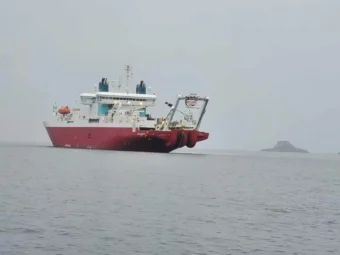
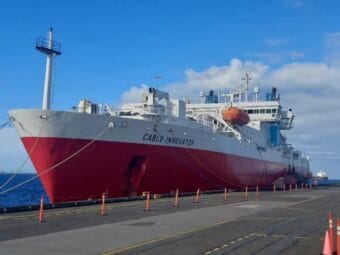
GCI provides internet and cell service for most Sitkans. In an email to KCAW on Saturday, GCI Communications Manager Josh Edge said that a fiber repair ship is en route to the site of the break in the cable, and is expected to arrive in five to six days.
Once on site, Edge wrote that the repairs could take up to six days depending on the complexity of the situation. Edge said GCI is working to fully restore service as quickly as possible.
On Friday evening, GCI reported that some texting, calling and internet capabilities had been restored for its customers. Some Sitkans are reporting the ability to send texts and make calls in some areas of town, but the service is spotty and limited.
The Sitka Public Library is back online using satellite internet that is available to the public. The library is open for extended hours this Sunday from 11 a.m. to 2 p.m. with plans to return to regular business hours on Tuesday, Sept. 3.
Trollers await the July 1 opening of the king salmon season in Sitka’s Crescent Harbor. The commercial season for king salmon in Southeast Alaska opens on Saturday, July 1, 2023. (Berett Wilber/KCAW)
Sitka continued to experience a wide internet and cell service outage Friday.
Nearly all Sitkans use GCI for both services, but that went out Thursday shortly after 11 a.m. On Friday, GCI said in a statement posted to social media that they are investigating a break in a subsea fiber optic cable.
The company said technicians were working to temporarily reroute Sitka’s internet traffic with hopes to restore basic voice and text service and limited internet sometime Friday.
Emergency services are still available. The Sitka Police Department announced that it is still receiving 911 calls from both landlines and cell phones. Mt. Edgecumbe Medical Center’s emergency room is still open, and they are accepting local patients but are diverting other communities from sending in patients until internet access is restored.
Tricia Bruckbauer is a spokesperson for Alaska Airlines. She said that all Alaska Airlines regularly scheduled flights are operating normally. The airline flew in an IT tech Friday morning to restore some internet access for their local site by installing Starlink, which is satellite internet. Before Starlink was installed, they were able to check in passengers in Sitka Friday morning through the Juneau station.
A representative from the Sitka Trial Court told KCAW that they cannot access online filings, which is slowing things down, but as of Friday, they were still holding court proceedings as scheduled.
The last time Sitka experienced a major internet outage was in 2016. At the time, KCAW reported that service was impacted for 12 days due to a damaged fiber optic cable.
In its statement on Friday, GCI did not confirm where the current break is located or how it occurred.
A humpback whale breaches in Kenai Fjords National Park on June 12, 2013. Humpback whales, with their distinctive fins, are being increasingly spotted farther north in Arctic waters used by ice-adapted bowhead whales. (Photo by Kaitlin Thoreson/National Park Service)
Two deceased whales were discovered in the Icy Strait area in July in Southeast Alaska. Scientists believe at least one died after being struck by a vessel.
On July 3, NOAA Fisheries received a report of a floating yearling humpback whale, which later washed ashore near Elfin Cove. Mandy Keogh is NOAA’s marine mammal stranding coordinator in Alaska. She says they worked with their stranding partners to respond and perform a necropsy, or an animal autopsy, on the whale.
“A few days later, and that investigation found evidence of blunt force trauma, so there was bruising, there was some broken bones, and those are all indicative of a large blunt force trauma, which would really only be a vessel strike in that area,” Keogh said. “So we have determined that the cause of death for that yearling was of likely a vessel strike.”
She says the broken bones were larger, which is consistent with the whale being struck by a larger vessel.
A second humpback whale was reported floating near Point Adolphus on July 22. The whale was identified as a 23-year-old female. While they found some bruising on the whale that may have suggested a vessel strike, due to the whale’s size and position they weren’t able to fully examine the bones to confirm the cause of death. “We also confirmed in that autopsy or necropsy that she was actually pregnant at her time of death, and so we found fetal bones in her uterus, which was very sad to hear,” Keogh said. “This female hadn’t been seen with a calf before, that we know of. So it was also a hard finding because of that.”
Keogh says a large number of whales are active in the area and they’ve received a number of reported whale interactions from boaters. Cruise ships, ferries and fishing boats all frequent Icy Strait.
Keogh says the best thing boaters can do to prevent vessel strikes across Alaska’s waters is slow down.
“Just try and reduce your speed, especially if you’re in an area like Point Adolphus and Icy Strait area, where we know this summer we’ve had a lot of whales, to just slow down your boat speed,” he said. “That allows you more time to observe a whale in the area. It also may help the whale not be surprised by vessels moving into the area, so that’s the safest thing you can do, and it’s also safer for the vessel operator.”
Alaska’s humpback whale approach regulations require that vessels stay over 100 yards away from humpback whales, not disrupt whale activity and operate vessels at slow, safe speeds when near whales. Boaters can report all dead, injured or entangled marine mammals to NOAA’s 24-hour stranding hotline 1-877-925-7773.
Traffic in downtown Sitka on a busy cruise ship day in June. (Jeb Sharp/KCAW)
Sitka’s summer tourism season is in full swing with numbers expected to be close to last year’s record-breaking 585,000 cruise visitors. On a handful of days the number of visitors will exceed Sitka’s own population of about 8,000.
On a busy day in June, the scale of the phenomenon was on full display. Lincoln Street was closed, people streamed up and down the steps of St. Michael’s Cathedral, buses rumbled in and out of the parking lot at Harrigan Centennial Hall.
In front of the library, Daina Bauman of Minneapolis tied a bag of salmon onto the back of her rented e-bike in preparation for the ride back out to the Sitka Sound Cruise Terminal. She was feeling good about her family’s decision to book e-bikes online before arriving in Sitka.
“I just think it’s awesome we didn’t have to sit on the bus and wait in line,” Bauman said. “They said, ‘Go early because there’s going to be another cruise ship with some 4,000 people showing up.’ We got in and out, we’ll just zip back and we’re done.”
Bauman was traveling with her daughter Lexi and mother Rita Skurupijs.
“Thank heavens for the bike path,” Skurupijs said, as she contemplated the six-mile ride back out to the Sitka Sound Cruise Terminal in an unprotected bike lane. “But of course when the big buses pass it’s a little nervy.”
A couple blocks away Sitka resident Rachel Jones was leaving Highliner Coffee, shepherding three kids on regular bikes.
“I’m certainly not opposed to the tourism industry at all, but it definitely does impact how we structure our day when the cruise ships are in town,” Jones said.
She and her family live downtown near Crescent Harbor. When it’s quiet the kids can ride around by themselves, but on heavy cruise ship days she accompanies them. It’s a lot to navigate: scooters, pedestrians, buses, stop lights.
“The number of things your brain needs to juggle feels much more like trying to ride bikes in a city,” Jones said.
Jones sees tourism as a major economic engine, noting that she herself benefits as the owner of an Airbnb unit. She likes the fact that cruise ship visitors show up in the morning and leave in the afternoon, making Sitka feel very livable the rest of the time.
Not everyone is so optimistic. Klaudia Leccese grew up in Sitka and has fond memories of waterskiing around cruise ships and learning to drive a skiff in their wake. But what’s happening now is a different scale, with more crowds, buses, e-bikes, noise, pollution. Leccese is president of the advocacy group Small Town Soul, which wants to cap the number of cruise ship visitors at 300,000 a year. That’s about half what Sitka will experience this year.
“Everyone in the Small Town Soul group supports cruise tourism,” Leccese said. “We just feel like there needs to be a limit.”
So far the group has tried three times, unsuccessfully, to get a limit before Sitka voters. From Leccese’s house you get a sense of what she’s trying to protect. The window of her living room looks out on Sitka Sound and Mt. Edgecumbe. She treasures everything about the landscape.
Klaudia Leccese of Small Town Soul at her home on Cascade Creek Road. (Jeb Sharp/KCAW)
“The quietness, the wildness, I’ve been raised subsistence hunting and fishing and gathering so there’s something for every season,” Leccese said. “I really treasure being alone in bays and on trails.”
Leccese can feel the pressure on those quiet places these days, whether she’s stuck in traffic or out running on the Cross Trail or fishing along the coast. There are more people and vehicles and boats wherever she goes.
Out at the Sitka Sound Cruise Terminal there’s no denying the hubbub. On a busy day the facility is alive with ships, visitors, vehicles, retail, food. The enticing aroma of roast nuts greets you as you enter. Chris McGraw is the owner and general manager and the main force behind the explosion in cruise ship numbers in Sitka. After the city voted down a public deep water dock his family business built a private one.
“It’s been a work in progress since 2011,” McGraw said. “The more ships we’ve gotten, you learn to adjust, learn things you need to add, learn to expand.”
A lot of McGraw’s challenge is logistics: moving people smoothly around town.
“Wednesday we had 6,200 people here,” McGraw said. “How do you deal with 6,200 people that come in at 8 o’clock and leave at 5 o’clock and get them to do what they want for the day. How do you do that without impacting the average local who wants to drive to work and go to lunch and come home. And how do you minimize that impact?”
A visitor relaxes at the Sitka Sound Cruise Terminal. (Jeb Sharp/KCAW)
McGraw sat on Sitka’s tourism task force so he’s familiar with the problems people cite. He’s working on various fixes: dispersing visitors, a cleaner bus fleet, a berthing policy of no more than one large ship and one medium ship on any one day. But he doesn’t want strict limits on visitor numbers.
“I’m opposed to any hard caps,” McGraw said.
McGraw’s interest is obvious but he argues the economic benefits go far beyond his own business. You can see that in the startups across the street from the terminal where the Sitka Tribe of Alaska houses an economic development center. There’s office space, a commercial kitchen, a bike-and-hike business, scuba diving, e-bike rentals, jet ski rentals, a four-wheeling venture, a warehouse for merchants at the cruise ship terminal.
“This is a hustling, bustling little place,” Sitka Tribe of Alaska Economic Development Director Camille Ferguson said.
Ferguson’s assessment is that Sitka is still gearing up to handle the influx of visitors.
“There’s a lot of tired people out there,” Ferguson said. “A lot of people putting in long hours and trying to keep up. That’s kind of what I feel. And I know that I’m not the only one that feels that way. We are super busy and we look forward to the days when we can have a day off.”
Amy Ainslee, director of planning and community development for the City and Borough of Sitka, sees this moment as the transition between reacting to tourism and managing tourism.
“I think about what does Sitka look like for the next couple years, and what does tourism look in Sitka for the next five to 10 years,” Ainslee said. “Because we’re in some ways kind of at this tipping point.”
The Sitka Assembly is now working on the recommendations of its tourism task force. That includes figuring out to regulate e-bikes and what areas or activities require special permits and how permits and locations should be doled out for Sitka’s burgeoning food truck scene. Another big action item is to negotiate a memorandum of understanding with the cruise industry over visitor numbers.
“I think there’s been a lot of earnest effort to hear from the community and to try to find the balance point that works for everybody,” Ainslee said. “But I don’t think it’s ever going to feel that way because it’s a really polarized issue.”
As the search for that balance point continues, Sitkans like Rachel Jones are adjusting to the new normal.
“You know I think you just have to adapt,” Jones said. “It’s going to be happening for a while. I got to town right when the discussion about whether the town should put in a deep water dock was happening and I understand why that didn’t happen, but if you don’t do it in a way that’s got public control then you don’t have public control. I think it’s just an ongoing conversation.”
North Pacific sablefish exhibit panmixia, or random mating, meaning that a sablefish born in Bering Sea is just as likely to mate with a Southeast sablefish as with a fish from up north. (NOAA Fisheries)
Some species, like salmon, spend most of their lives in the ocean and return to their birthplace to spawn.
“A salmon will go out of its stream and then it’ll go in the middle and mix with a bunch of different populations,” said Wes Larson, the genetics program manager at the NOAA Alaska Fisheries Science Center and co-author of a paper published last month on sablefish genetics. “So it would be like the one that would go to New York for college and then come back home.”
Larson said that sablefish, or black cod, don’t return home to spawn. In this analogy, if salmon move back home to settle down, black cod tend to meet someone abroad and start a family.
“The sablefish, it’s doing its thing, it’s eating, it’s swimming around finding food, and then we think basically, it just sort of spawns close-ish to where it’s at,” Larson said.
That tendency to mate randomly is called panmixia, and it means that Alaska doesn’t have genetically distinct populations of sablefish. A sablefish born in the Bering Sea could mate with a Southeast sablefish — or with a fish from up north.
Larson said there are limits on that mixing.
“It’s not equally probable that a fish from Mexico will come up to Alaska compared to, like, a fish from northern B.C., but the panmixia means that there’s enough exchange across the whole range,” he said.
Larson said that understanding that kind of genetic variation is important in fisheries management.
“When you’re setting quotas and things like that, it’s important to know whether you’re fishing on a stock that exchanges with other stocks or a stock that doesn’t, because if you don’t know that information, and let’s say it’s structured, you can really fish down a certain area,” he said. “If they don’t exchange with other areas, then you can basically fish that out, essentially.”
Larson and other researchers did a deep dive into Alaska’s sablefish populations, using advanced techniques to map and compare the entire genetic footprints of juvenile and adult sablefish across Alaska and Washington.
Although previous studies have shown evidence of panmixia, a 2023 study by Mexican researchers suggested that Alaska sablefish might actually have distinct populations. Larson said that’s part of the reason that he and other researchers wanted to publish new data.
“If management took that microsatellite paper, that would sort of change the management paradigm,” Larson said. “Which, if it’s real, is important, but we didn’t think it was real.”
Larson said the new data, which used millions of genetic markers, provides a much higher-resolution picture of the population – and confirms that fisheries managers are using an appropriate framework to manage Alaska sablefish.
The city clerk’s office had ten working days to review the document and respond. It was also reviewed by attorneys from Jermain Dunnagan Owens law firm in Anchorage. The city is currently contracting with JDO to provide legal services in the absence of a full-time municipal attorney.
In a memo on July 2, attorneys Michael Gatti and Taylor McMahon said the ballot initiative is legally unenforceable for two reasons– it has “misleading, confusing and incomplete” terms, and the section requiring permits for cruise ships violates the “tonnage clause” of the United States Constitution, which prohibits charging vessels fees for using navigable waterways.
Gatti writes that states and cities can only charge fees if they’re providing a service to a vessel. On those grounds, the municipal clerk’s office denied Small Town SOUL’s application.
JDO’s legal opinion also references several letters from attorneys representing cruise lines– The Sitka Dock Company, Royal Caribbean and Allen Marine each submitted letters to the city opposing the application. Several argue that the initiative violates federal law, including the right to travel and the “commerce clause” in the US Constitution.
Gatti says it’s premature to consider those arguments at this stage.
The letters also call into question how many times organizers have submitted petitions to limit cruise traffic. City code states that when a petition is denied for any reason other than the signature count, the petitioners must wait a full year to resubmit the same petition. But so far, all attempts to generate a ballot initiative to limit cruise traffic have been denied at the application phase.
Gatti writes that the one year rule only applies to the petition itself, not the application for a petition.
KCAW has reached out to petition organizers for comment.