KCAW - Sitka

KCAW is our partner station in Sitka. KTOO collaborates with partners across the state to cover important news and to share stories with our audiences.

Angoon celebrates launch of long-awaited hydroelectric project

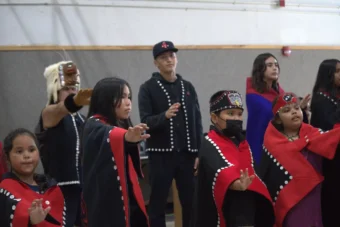
Members of Aangóon Yátx’i, Angoon’s youth dance group, perform during a celebration to launch the Thayer Creek hydroelectric project in the elementary school gym. (Mary Catharine Martin/2024)

It’s taken 44 years, but a hydroelectric project in Angoon finally has all of the funding, and most of the permits, to launch. And while construction on the Thayer Creek Project is still a few months out, organizers say they’re ready to celebrate.

Angoon mayor Peter Duncan remembers first hearing about a proposal to develop Thayer Creek when Jimmy Carter was president.

“When I first heard about all this, I was still in high school — back in 1980, but it could have been earlier than that, that they were talking about it,” Duncan said. “But back in 1980, I know for a fact. So for sure that was the serious talks with the corporation and everybody about the possibility of a hydro.”

The hydroelectric project on Thayer Creek will include a hydroelectric facility, barge landing, service road, and underground cable system. (Photo provided by Jon Wunrow)

In December 1980, Congress passed the Alaska National Interest Lands Conservation Act and established the Admiralty Island National Monument on the ancestral lands of the Angoon Lingít. In the process, Angoon’s village corporation, Kootznoowoo, negotiated the right to develop hydroelectric resources in the area.

But, those rights didn’t come with funding. Jon Wunrow, director of tourism and natural resources for Kootznoowoo, said that stopped the project from ever getting off the ground.

“We’ve had lots and lots and lots of attempts at getting funding in a community the size of about 400 people, in rural remote Alaska, where everybody has needs,” Wunrow said.

For the past four decades, residents of Angoon have relied on diesel to heat their homes, power their freezers, and keep their lights on. And that fuel gets expensive — up to eight times the national average.

A few years ago, spurred by rising fuel prices, Kootznoowoo decided to move forward without federal funding, using a $7 million grant from the Alaska Energy Authority. They started designing a run-of-river hydroelectric facility on Thayer Creek, a few miles north of town. The project they envisioned would generate more than enough electricity for the community of Angoon – if they could find another $30 million or so.

Earlier this year, Wunrow was ready to give up.

“Several of us were about ready to just sort of toss in the towel there,” he said. “We just had had one funding denial after another, after another, after another.”

Then, this February, Senators Lisa Murkowski and Dan Sullivan announced that Angoon would receive $27 million in federal funding to develop the Thayer Creek Project as part of a bipartisan federal infrastructure bill that funneled 125 million dollars to clean energy projects in Alaska. Combined with smaller grants, that means the $34 million project is fully funded.

Although they’re still waiting on some final reports, Wunrow considers the project fully permitted – another hard-fought success.

“Not only is it federal land, it’s National Monument land,” Wunrow said. “And so it’s a tough place to get permission to build, even though Thayer was granted, the right to develop Thayer, to the community and to Kootznoowoo 40 years ago through legislation, that doesn’t mean that it was an easy project.”

There are a couple more boxes to check off before construction begins. A Forest Service team is drafting a report to confirm that the project won’t damage historic or cultural artifacts. And a team of engineers will bore down into the seafloor, where the underground cable will sit, to make sure the rock composition is suitable.

Once construction begins in spring 2025, Wunrow estimates that it will take three years to complete the hydroelectric facility, plus a barge landing, service road, and underground cable system. When the project is complete, it is expected to stabilize or reduce electric costs for residents for at least 50 years — and provide a lot of extra power.

“Probably up to 70% of the hydro will be excess,” he said. “So we’re looking to be able to work to establish reduced rates for that excess hydro to incentivize heat pumps in homes, someday maybe electric vehicles, electric boat motors, and attracting business to the community that maybe isn’t here in part because of the high cost of energy.”

Mayor Duncan said that collaboration between the city, tribe, and village corporation helped make this project a reality. And he said the hydroelectric project is just one way that Angoon is moving into the future.

“This is the result of working together,” he said. “Good things can happen. And that’s what we’re seeing right now today is, you know, everybody working together to make something happen. And I haven’t seen something like this for Angoon in quite some time, so we’re all excited.”

The community held a celebration to officially launch the project — and to look back on its 44-year history — on Friday afternoon in the elementary school gym. The agenda included speeches from local leaders, as well as stories of Angoon elders testifying in front of Congress and adopting President Carter into a clan.

Accidental discovery of sunken ship near Sitka reveals surprising history

A dive team investigated the site of a sunken wooden vessel in Herring Cove on Friday, June 14, 2024. (Katherine Rose/KCAW)

On June 9, a mariner fouled his anchor in Herring Cove. Every time he tried to move the anchor, a little oil sheen and debris would pop up.

“He called us to check and make sure that there wasn’t any known debris in the area, and to try to see if there was a known snag,” said Petty Officer First Class Heather Darce in an interview with KCAW. Darce is a marine science technician with the Coast Guard’s Marine Safety Detachment in Sitka.

“We were able to check local charts, [and] there was nothing down there that was charted,” Darce said.

Darce says the mariner then hired a local diver to help retrieve his anchor. In doing so, the diver discovered a sunken boat, an 80-foot wooden vessel, attached to a smaller boat. The boat’s sinking hadn’t been reported to the Coast Guard. But they were able to find its vessel number and name.

“So the Dragon Lady is the last name that she held, but the boat was actually built in the ’40s and went through a bunch of different iterations,” Darce said.

The Coast Guard immediately hired a marine salvage crew to contain the oil and figure out if it was purging any more oil– and it wasn’t. So Darce says they began to research the boat to figure out where its fuel tanks might be so they could dive down and remove the fuel safely. They found the builder, Wheeler, in Brooklyn, New York, and requested diagrams of the boat.

“They didn’t have anything that old, but they did go ahead and let us know that that hull number corresponded to a vessel that was built by them in 1943 for use by the United States Coast Guard,” Darce said.

“That sort of changed…things on a little bit of an emotional level for us, knowing that, as Coasties, that this was a Coast Guard Cutter.”

Wheeler built over 230 patrol boats for the Coast Guard during World War 2. According to the Wheeler Yacht Company, 48 of them were at Omaha Beach on D-Day. Before the Dragon Lady got her name, Darce  said she was Coast Guard Cutter 83482.

“The military was basically pumping out equipment to get it to the frontlines as fast as possible,” Darce said. “And none of the 238 cutters that were built by Wheeler during those years were actually named, they were given a hull number.”

Darce said they dove deeper into the history of the cutter, and discovered the vessel was delivered to Guam in 1943.

“Her delivery would have taken place prior to the Battle of Guam, which happened in summer of 1944,” Darce said. “So she very well have maintained on that service during the Battle of Guam.”

Coast Guard cutter 83482 being delivered to Guam in 1943. (USCG Photo)

After the War was over, Coast Guard Cutter 83482 was decommissioned and turned into a private craft. She was in Portland for a while, was used as a fishing vessel and brought to Alaska, sold again to become the Dragon Lady, a charter yacht, and eventually became a liveaboard toward the end of her life.

It’s unclear exactly when the Dragon Lady sank — it had been anchored in Herring Cove for a while. Darce said they were able to contact the boat’s owner who wasn’t in the area when it began taking on water, but the owner has been cooperating with the Coast Guard. But salvaging the boat isn’t in the cards.

“Even if somebody really wanted to bring up the Dragon Lady, she’s a wooden hulled vessel built in the ’40s. She’s been underwater for a significant period of time, and she’s 80 years old,” Darce said. “So even if for some reason we could not get to the tanks, in her case she’s not necessarily a good candidate even to try to move or roll, especially with her size.”

Darce doesn’t believe there’s much fuel on the boat, but a dive team has been diligently working to remove any remaining fuel to prevent future environmental risk. Once they’ve emptied the vessel and sealed up vents, Darce said they’ll update charts to show Herring Cove as the resting place for the Dragon Lady.

The most recent known photo of the F/V Dragon Lady (Coast Guard)

Pennsylvania craftsman restores stonework at Sitka church

Randy Bollinger works on one of the sidewalls at the front of the Church, resetting stones. (Jeb Sharp)

If you stop by St. Peter’s by the Sea Episcopal Church on Lincoln Street this month you might catch stonemason Randy Bollinger working outside. He is restoring some of the stonework on the exterior of the 125-year-old building.

“I identify as a craftsman,” Bollinger said on a recent morning as he reset stones on one of the sidewalls on the front steps. “I like imagining, creating, restoring old things, building new things, just for the joy of the materials you’re working with.”

Bollinger is based in Pennsylvania but travels to do restoration work.

“The issue here is the salt air, salt water gets absorbed into the old mortar and corrodes it,” Bollinger said. “Rots it. Makes it soft. And then the stones just get loose. So we’re tearing all this loose stone out and replacing it, putting new mortar in and they’ll have to do it again in 125 years.”

Bollinger is salvaging some of the old stone but also adding new stone. The new material comes from a local quarry that was blasted with dynamite so he has to check carefully for fractures. The mortar he’s using contains lime which has been processed the same way it would have been 150 years ago. He also got permission to add a glue-like bonding agent that will help ward off water damage.

So why bring someone all the way from Pennsylvania to do this work? It turns out Bollinger is a gifted stonemason with deep experience. He grew up around craftspeople who found joy in making things. His dad had a woodshop; his uncle built beautiful furniture.

“And growing up in south central Pennsylvania, stone walls are everywhere,” he said. “Stone structures, buildings, farm buildings. So it’s as common as breathing to look at and see some pretty incredible things.”

In his early twenties, Bollinger became an apprentice to a craftsman with a woodshop whose wife also had a pottery studio.

“They lived in a 300-year-old mill, a stone mill. Three stories of just immaculate stonework. As as a young person I hired on with him and we cut through walls to make doorways and windows. And it felt very, very comfortable.”

Since then Bollinger has built whole houses out of stone and restored other historical properties throughout New England. He’s expert in stone but has made a point of working in a variety of construction trades.

“The more you know about someone else’s trade, the more you can work with them,” he said. “I feel like I’ve created a niche where I work for people who are very interested in doing exceptional work. And the more you know about each other the better you can work together.”

Bollinger was an old friend of the late artist Eric Bealer, whose Sea Pony Farm property near Pelican is now run by the Sitka Conservation Society as a retreat and field station. Bollinger did a residency there last year and is thrilled to be back in Sitka this summer working on the church.

“I like the challenge. I like the ability to enhance a situation. The place needed help.”

New Sitka Sound Science Center director: ‘The first thing I want to do is listen’

Arleigh Reynolds stepped into the role of Executive Director of the Sitka Sound Science Center after former director Lisa Busch retired in April. He says he looks forward to expanding partnerships, especially with Indigenous-run organizations in Sitka. (Meredith Redick/KCAW)

When Lisa Busch announced she was retiring this April after 14 years as Executive Director of the Sitka Sound Science Center, Fairbanks-based veterinarian Arleigh Reynolds says he was ready to hop on a southbound flight. Reynolds, who most recently served as the director of the University of Alaska – Fairbanks Center for One Health Research, says he has been collaborating with the science center and other Sitka organizations for the past decade. And now that he’s been hired as Busch’s successor, he says he’s eager to get to work. Reynolds sat down with KCAW’s Meredith Redick to talk about his first few weeks on the job, and how he hopes to grow the organization.

Listen:

Arleigh Reynolds: When Lisa Busch, the former executive director of the Science Center went on sabbatical a couple years ago, she asked me to sit in as the Interim Executive Director. I’d never worked for a nonprofit before, but it was great – really great people, wonderful community, I just really loved it. And I thought, you know, I’d love to do this before I retire. I mean, I never thought Lisa would be retiring this early. She’s very young, and she’s done such an incredible job getting the science center up and going. But she did this year, and so I was fortunate enough to be chosen as the new Executive Director.

Meredith Redick: So this is your first time really manning the helm at a nonprofit. That must be a big transition.

Arleigh Reynolds: It is a big transition in a way. But what I really love about this job is, first of all, I have great people to work with, and I like the way that we are really integrated in the community. And I love working with different groups within the community on issues that are really important to them. I’ve done that my whole time at UAF. So this One Health program that I ran, for those that don’t know what One Health is, it’s the concept that our health as humans is really interdependent with the health of the environment we live in and the animals and plants that we live with and depend on. And for any of those to be healthy, they really all have to be healthy. We often consider big issues from only our perspective when we really need to be considering all of those perspectives and how they integrate. And the Science Center has already been doing that for a long time. The Tribe has done that since millennia. This is really an Indigenous concept. And so, coming to the Science Center is a fairly natural progression.

Meredith Redick: I’m curious, and it’s okay if you don’t have an answer to this, but do you have any ideas about what that kind of work could look like in Sitka?

Arleigh Reynolds: That’s a great question. I think the first thing I want to do is listen – because I’m relatively new to the community, and people who’ve lived here a long time know a heck of a lot more about it than I do. And I’d love to hear what people here are concerned about in terms of, you know, what’s going on with fisheries, what’s going on in the marine environment, and even the terrestrial environment and what’s going on with issues like food security and food sovereignty. And once I get a better understanding of that, to work with them to help get funding and build some programs that they’re interested in. It’s not so much me coming to them saying, “Hey, I want to do this, would you help me?” It’s kind of the opposite.

Meredith Redick: So Lisa Busch is retiring from this role, and you’ve already spoken about this a little bit, but how do you envision making this role your own?

Arleigh Reynolds: To start with, I do want to say a huge thanks to Lisa because she built an incredible organization. You know, it’s really nice to take over the helm of a ship that’s incredibly well-built and running well, right? No big leaks, no problems with the motor. It’s good. It’s running great, and I’m super grateful to her for that. You know, it’s not like I want to change a lot of things. There are a lot of things that are just fabulous about the science center, and there are some areas that I think I can bring some new insight in. And you know, for me, One Health is something that’s always been part of Indigenous worldviews, and we now have a Western way of trying to describe it. But it’s so many levels of complexity that Indigenous people, I think, understand to such a degree. I’d really like to build and expand on partnerships with the Indigenous community and learn from them and work together with them on some of these really pressing issues that we have here. You know, and please understand, I don’t think it’s gloom and doom. I think this place is remarkable. But you want it to stay remarkable, and there are some issues, like ocean acidification and what’s going on with some of our fisheries and, you know, some of the risk of invasive species that we really do want to stay ahead of.

Meredith Redick: What else do you want people to know about you?

Arleigh Reynolds: Well, you know, it’s always been my wife, Donna’s, and my dream to end up here. Since the first time we came here, we just fell in love with this community, and it’s taken us 10 years to figure out a way to do it. And we’re super grateful to be here and just really looking forward to meeting folks and learning more about the community and fitting into our place in this community. Sitka has a sense of community like no place I’ve ever been before, and I’m really grateful for that.

Coast Guard says a wave likely overwhelmed charter boat near Sitka last year, killing 5

Morgan Robidou poses with his boat in October, 2022. Robidou and one of his passengers, 61-year old Robert Solis, still remain missing following the accident on May 28, 2023. (Facebook image)

The U.S. Coast Guard presented its findings last week on the sinking of a charter boat near Sitka that killed five people last year, saying the boat likely capsized after it was hit by a wave.

The Awakin was a very typical charter boat for Sitka: 31 feet long, aluminum hull, twin 250-horsepower outboards, eight years old, and fully equipped with radar, radios, and other electronics for the kind of day fishing it was designed to do.

This type of boat is common in Alaska’s charter industry. Called a “well deck,” it has a big central cabin, and tall sides that allow passengers to safely walk all around the perimeter of the boat when fishing.

While the well deck makes for great fishing, it proved to be a conspicuous liability in the tragedy that struck the Awakin on May 28, 2023,  at exactly 2:43 p.m.

“We determined, based on all the evidence before us and an analysis, that the initiating event of the Awakin’s casualty was a sudden flooding of Awakin’s well deck by a large swell,” said Cmdr. Nate Menefee, who led the Coast Guard’s investigative team.

He told Thursday’s standing-room-only crowd in Harrigan Centennial Hall that the Coast Guard’s forensics lab was able to recover the data from the laptop on board the Awakin used for navigation.

Investigators could determine position, speed, and depth of the water under the Awakin from the moment it departed Sitka’s Crescent Harbor at 6 a.m. until the moment it stopped recording at 2:43 p.m., when the Awakin was on a slow drift south of Low Island, its passengers jigging for rockfish at the end of a long day of trolling for salmon and halibut fishing.

The Coast Guard Investigative Team began its Casualty Report with a solemn recognition of those who lost their lives in the incident on May 28, 2023: vessel master Morgan Robidou, 32; Brandi Tyau, 56, and her partner Robert Solis, 61, of Canoga Park, California; and Danielle Agcaoili, 53, and her husband Maury Agcaolli, 57, of Waipahu, Hawaii.

On a good day, the shore of Low Island can be treacherous. The bottom is irregular – formed by lava from the Mount Edgecumbe volcano thousands of years ago – and ocean swells can suddenly heave and break, especially at low tide.

Menefee said the Awakin, its captain busy assisting clients, was likely taken by surprise by a breaking swell that first flooded the boat, and then rolled it.

“The loss of vessel control may have prevented the master from making a radio distress call,” he said. “The loss of control could have been due to electrical or mechanical issues, or the chaotic situation that would likely ensue following the swamping of the vessel’s well deck.”

Robidou, the Awakin’s owner and captain, was young and in his first season operating a charter boat, but he knew his business. He grew up in Sitka and had logged over 800 service days on the ocean toward earning his 50-ton master’s license. Also, he had taken this same route 19 times in just the previous five days.

Safety aboard a charter boat – officially called an uninspected passenger vessel, and unofficially known as a six-pack – is heavily dependent on the master. The Awakin was well-equipped with safety gear, including two “digital selective calling” radios that would have sent an SOS and the boat’s position, if only someone had known to push the button.

The DSC system, called the “Alaska 21 Rescue System,” is relatively new and has “reliability issues. On May 28, 2023, there was no DSC coverage in Sitka Sound from a Coast Guard shore station, although a message could have been relayed – had one been sent.

Unfortunately, Robidou himself was likely among the first two people swept overboard.

“it’s very probable that anybody standing on the back of the well deck may have gone overboard including the master,” said Menefee.

With no captain and no other boats nearby, the remaining passengers on the Awakin were in dire straits. Uninspected passenger vessels in the U.S. are not required to carry a life raft or an emergency position-indicating radio beacon. The beacon, also known as an EPIRB, is a device which automatically releases from a submerged boat and sends an emergency signal.

The investigators said a well-deck hull lacks adequate drainage if a lot of water suddenly floods over its tall bulwarks. Once swamped, it did not take much for the boat to roll and capsize. In perhaps the most tragic detail of the investigation, a passenger remained alive in the submerged cabin of the Awakin for at least half an hour and sent several texts asking the recipient to call 911. Then the person, referred to as Passenger One in the report, tried calling Sitka police dispatchers.

“There were five outgoing calls to 911 on Passenger One’s phone made between 15:01 and 15:12,” a narrator said during a slide presentation. “Data showed all five attempts to call 911 as not answered.”

Sitka police dispatch records show no calls were received during that time. Although there is spotty cell service in Sitka Sound, investigators believe that it was impossible for Passenger One to obtain a signal while trapped in a submerged aluminum boat.

The investigative team examined several other factors that it concluded played no role in the loss of the Awakin or its passengers:

— Although one full and one partially-full bottle of rum were found on board, Morgan Robidou’s blood alcohol level was consistent with the natural post-mortem process between his death on May 28 and his autopsy on June 9, and not from consumption of alcohol. Charter guests often gave Robidou bottles of “Captain Morgan”-brand rum as gifts.

— Awakin’s anchor was found fouled on the bottom near Low island, but investigators concluded that it slipped from the bow roller after the boat capsized.

— Flare sightings reported in Sitka Sound during the search were not related to the incident. The Awakin’s flare kit was recovered intact and unopened.

— Although winds were expected to increase offshore to small-craft level later in the afternoon of May 28, they were not yet high at the time of the incident. The Awakin was under control until the moment it was lost.

— Discrepancies at Low Island between raster charts and the Time Zero vector charts in use on the Awakin’s navigation laptop (although the Team notified Time Zero of this issue).

The Awakin was due back in port at 4 p.m. on May 28. When it failed to arrive, fellow charter operators began calling the Awakin on VHF radio. Others began looking, and at least one boat went all the way out to Cape Edgecumbe following the Awakin’s usual route. It wasn’t until almost 5:30 p.m. that the owner of Kingfisher Lodge notified the Coast Guard of an overdue vessel.

Typically, once the Coast Guard decides to initiate a search, a helicopter can be airborne in a half-hour. On May 28, a half-fueled helicopter was ready at Air Station Sitka, but the pilot, expecting a long search flight, ordered a full tank. The pit crew encountered some problems, however, and it was 58 minutes before the helicopter took off.

Air Station Sitka commander Capt. Vincent Jansen supported his pilot’s decision, although looking back it was clear that the fueling issues weighed heavily on him.

“I’ve been flying for 20 years, the fuel tanks and the fuel pit we have right here in Sitka is the best I’ve ever seen,” said Jansen. “And it’s also the most well-maintained. We had two malfunctions that day with that fueling system. It’s Murphy’s Law. Everything else was by the book but it couldn’t happen at a worst time. And I own that.”

The 58-minute delay likely didn’t matter. By the time the Coast Guard was notified that the Awakin was overdue, the five people aboard had been in the water two and a half hours without flotation devices, or trapped in the sunken vessel’s cabin, and almost certainly no longer alive.

The investigators made a handful of recommendations to Coast Guard Commandant Adm. Linda Fagan to prevent similar tragedies, including requiring uninspected passenger vessels to carry life rafts and EPIRBs – much like the commercial fishing fleet – and to have significantly more drainage on deck. It’s not clear whether anything will change, however.

“We’ve made these recommendations before,” Menefee said, referring to the life rafts and EPIRBs.

Sitka Indian Village recognized as endangered historic place

Sitka Indian Village pictured circa 1878. (Photo provided by Alaska State Library Historical Collections)

Sitka Indian Village was once home to over forty Lingít clan houses. Today, only eight of those are still standing, and even fewer serve as active clan houses. Now, the area has been recognized as one of 11 endangered historic places in the US. Organizers are hoping that the attention will inspire efforts to creatively conserve – and rebuild – a cultural hub that has fallen into disrepair.

Katlian Street stretches along the waterfront just north of downtown Sitka. Today, it’s a bustling commercial hub. Workers unload fish totes at the seafood processor, and cars whiz by on their way to the harbors. Dotted between the shops and restaurants are houses – some standing, others collapsed – that tell the story of this street’s past.

“Just this short little walk, there’s multiple clan houses here,” says Chuck Miller, gesturing to lots now occupied by metal shops and parking lots. He’s pointing out sites that once served as cultural centers for Lingít people – places where members of a clan gathered for meetings, ceremonies, and even wakes.

“I remember there were a few here by this parking lot,” Miller says. “The Whale House, the Sea Lion house used to stand here, and a few more Kaagwaantaan houses here.”

Miller is the caretaker for the Kayaash ka hít, or Porch House, one of the few standing clan houses in Sitka. He inherited that responsibility in the 90’s from his late maternal uncle. Under traditional law, that’s how clan houses are passed down. Under the western legal system, though, properties often go to a spouse or children, who aren’t in the same clan. In other cases, multiple clan members are on the deed, making it hard to rebuild or demolish.

“You have to have everybody’s signature on it,” Miller says. “So you can’t demolish something without having everybody’s permission. Sometimes people die, and then you can’t track down the descendants or they didn’t have any. So that’s the debacle we run into nowadays. That’s the clash of the worlds — you have the Western world law, and you have our traditional law.”

In the case of the Point House, a Kiks.ádi clan house that fell out of clan ownership when it was transferred in a will, the house was eventually demolished. Jerrick Hope-Lang, a member of the Kiks.ádi clan, worked with the legal owners to repatriate the land in 2022. He’s been the caretaker since then – and now he’s eager to tackle what he sees as a broader problem.

“We see the collapsed houses, and we see things falling into disrepair, so I wanted to shed light on what’s happening next to me, too,” Hope-Lang says. “Because it’s not just problematic for me, it’s problematic for other people.”

That’s why he asked the National Trust for Historic Preservation to recognize Sitka’s Indian Village as an endangered historic place. He worked with Sitka historian and adopted Kiks.ádi clan member James Poulson to submit the nomination.

“This nomination, although it’s about Sitka’s Indian Village and clan houses, isn’t situational to only Sitka,” Hope-Lang says. “Broadly speaking, Klukwan, Haines, Angoon, all of them are having similar issues.”

The National Trust recognizes 11 endangered historic places each year, prioritizing sites that highlight unique or underrepresented parts of American history. Sitka’s Odess Theater, formerly Richard Allen Memorial Hall, on the Sheldon-Jackson campus, made the 1999 list. In a statement announcing Sitka Indian Village on the 2024 list, National Trust president Carol Quillen said, “the Sitka Tlingit Clan Houses are a critically important part of both the history and the future of Tlingit culture. We hope that broader recognition of their significance will encourage rehabilitation and return of the houses to clan ownership.”

While the nomination doesn’t come with funding, it does come with a lot of publicity. Hope-Lang is hoping that attention will draw support for the neighborhood’s preservation.

“We don’t know what the implications of this nomination will give us but attention,” Hope-Lang says. “And how do we utilize that attention now?”

Figuring out what preservation looks like, though, will require creativity. Outside of tangled questions of ownership, Hope-Lang says that clan houses don’t fit neatly into western historic preservation systems, like the National Parks Service’s National Register of Historic Places.

“The Secretary of Interior has standards for preservation, and they’re often trying to preserve a section in time,” Hope-Lang says. “But those standards don’t really align with Indigenous standards. You know, clan houses can be rebuilt.”

In this case, he says, the actual structure of the house isn’t the most important part.

“It goes beyond just the structure of the building,” he says. “We’re saying, first of all, the land underneath is sacred. The Point House exists whether the building does or not.”

And because most clan houses are privately-owned, he says, it’s harder to get funding to maintain or rebuild them. Hope-Lang says he’s working to start a nonprofit to bypass those challenges and streamline ownership.

“We’re looking at legal structures of how to leave this plot in a way that is for more public-based use, not an individual landowner,” he says. “So sharing those mechanisms of success with other clans and other tribes, we’re navigating Western constructs.”

Those aren’t problems that can be easily solved, but Hope-Lang says the National Trust nomination makes an important statement.

“Our history is worth saving, you know, and that part of town is intrinsically valuable to us. We need to figure out a way to preserve it.”

In the meantime, both Miller and Hope-Lang are working to provide space that reflects what their clans need today. Miller often hosts events for other clans who don’t have active clan houses, and he hopes one of his nephews will become the caretaker someday.

“I’m very proud to take on the role of caretaker as I did,” Miller says. “I did it out of respect and honor for my uncles, you know, and one of these days, hopefully one of my nephews will take up that honor, take the torch up and keep this house going.”

Hope-Lang is working with a Lingít architect to design a 21st-century clan house on the Point House site. He wants it to be a space that not only preserves history, but that allows the clan to flourish today.

“We’re trying to preserve this cultural lifestyle for perpetuity, so this is an opportunity to do so,” Hope-Lang says.

He hopes that with innovative thinking and collaboration, clan houses around the region can flourish as centers for Lingít identity, ceremony, and tradition.

Site notifications
Update notification options
Subscribe to notifications