KCAW is our partner station in Sitka. KTOO collaborates with partners across the state to cover important news and to share stories with our audiences.
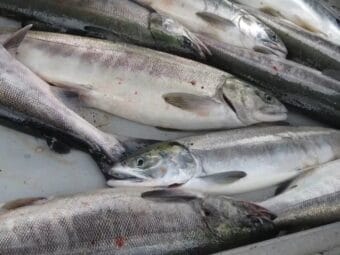
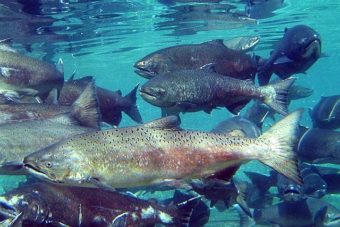
Chinook Salmon (Photo by Pacific Northwest National Laboratory)
It’s likely to be another weak year for king salmon returns to the major river systems of Southeast Alaska in 2024.
The Alaska Department of Fish & Game issued its 2024 Southeast Alaska Chinook Salmon forecasts last week.
Of the 11 chinook stocks in the region, only the Chilkat River is expected to have an adequate number of chinook returning to spawn. Nevertheless, this number – known as escapement – is still in the middle of the range, and could be lower depending on how many fish are harvested before they get to the river.
The Alaska Department of Fish & Game has adopted action plans to try and limit the catch of king salmon bound for Southeast Rivers, but some are always intercepted.
However, ADF&G Assessment Biologist Philip Richards says overharvest is probably not the problem.
“There is some level of harvest for all of our Southeast stocks,” said Richards. “However, in the past five years in particular, the harvest rates have been extremely low for all of our stocks. That indicates that the harvest is not driving the low abundance – it’s most likely marine conditions.”
Marine survival remains “the million-dollar question” according to Richards. Many factors could be at work in the ocean, but Southeast’s chinook runs have dipped before, and the cause is unclear.
“Some of our chinook escapement projects started in the early 1970s. And at that time, escapements were extremely low,” Richards said. “Once again, we don’t know why. But that was a period (of low escapements). And we don’t know how long that lasted, you know, prior to us starting the stock assessment projects.”
In addition to the Chilkat, only the Unuk River in southern Southeast is expected to reach its escapement target – but just at the lower end with 1,800 kings returning to spawn. The Taku River near Juneau should see a return of just over 17,000 large fish, which is 2,000 below minimum. The department had insufficient data to forecast the run for the Stikine River near Wrangell, but it’s expected to be far below the minimum of 14,000 fish.
The Alaska Board of Fisheries has designated seven of Southeast Alaska’s wild chinook runs as “stocks of concern.” They are the Chilkat, Taku, King Salmon, Stikine, Unuk and Chickamin rivers and Andrew Creek.
The fuselage of a crashed U.S. Coast Guard Jayhawk helicopter sits on the deck of a boat near Petersburg. (Photo courtesy of USCG)
The Coast Guard has recovered the wreckage of an Air Station Sitka helicopter that crashed last month near Petersburg, but it could take up to eight months to learn what happened.
In a news release, the Coast Guard reports that the aircraft was removed from the shore of Read Island last week. Now, the MH-60 Jayhawk is on its way to North Carolina for an inspection as part of a larger investigation into what caused the crash.
On Nov. 13, the Air Station Sitka crew was responding to a Mayday call from a fishing boat that was taking on water in Farragut Bay, about 20 miles northwest of Petersburg. The skipper of the boat had brought the flooding under control by the time the helicopter arrived. However, something went wrong and the helicopter crashed on nearby Read Island.
The two men on the boat came to the aid of the helicopter crew, and supported them through the night with communications and supplies while awaiting emergency responders from Petersburg and a second helicopter from Air Station Sitka. All four crewmembers were medevaced to Seattle, two of them with serious injuries. The Coast Guard now says that all four crew members have returned home from the hospital and are recovering.
Weather conditions were poor during the mission, with wind speeds up to 40 mph in the area and low visibility.
The Coast Guard established a security zone around the crash site and began an investigation. On Dec. 8, with the help of the U.S. Army’s Downed Aircraft Recovery team, the Forest Service, the Alaska Department of Environmental Conservation, and Petersburg Fire and Rescue, among others, they were able to retrieve the helicopter.
In an email to KCAW, Coast Guard spokesman Cmdr. Mike Salerno said the helicopter is being transported to Aviation Logistics Center in Elizabeth City, North Carolina, where investigators will further examine the airframe.
Salerno told KCAW that aviation experts from across the service have been investigating the crash– from collecting and examining the wreckage to interviewing all parties involved with the accident and reviewing environmental factors. Salerno said the investigation can take up to eight months.
A home under construction in Mertarvik in 2020 (Katie Basile/KYUK)
Alaska’s response to the national housing shortage has been different than other states. In many areas across the country, new housing is going up rapidly to meet demand.
But not in Alaska.
In a recent presentation to the Sitka Chamber of Commerce, Nolan Klouda explained that Alaska ranks 45th out of all states in per capita new housing construction, building about two new units per thousand people on average. Within the state, the Mat-Su was at the top of the list for new construction, and not far behind – surprisingly – is Southeast.
“Sitka actually builds a lot more housing per capita than anywhere else in the state besides the Mat-Su,, which is just something that’s really interesting,” said Klouda. “This is all adjusted for population: Sitka is building about four units for every 1,000 people. I found it interesting that Southeast communities are on the top there. Also Haines, Ketchikan, and Skagway, which are above the statewide average, too.”
Klouda is the director of the University of Alaska Center for Economic Development in Anchorage. He traveled to Sitka to participate in the chamber’s fall speaker series on housing.
Most of the new housing construction in Sitka is the result of an expansion by the Southeast Alaska Regional Health Consortium. Overall, Klouda said that projects like employer-built housing and new subsidized housing for seniors will improve housing markets — but not necessarily the bottom line for buyers.
“Whatever the cause, though, I think that’s really good news overall,” he said. “I still want to see much more housing. Nonetheless, Sitka is doing better than most of our communities in Alaska on this measure, even though affordability might still be a big problem.”
Klouda attributed the affordability problem to a lack of land in the state, high construction costs, and out-of-date zoning laws, most of which were written when Alaska was a different kind of state.
“A lot of times zoning is about protecting existing neighborhoods from change, more than it is about health or safety or anything like that,” Klouda said.
He also was unwilling to place full blame on the growth of short-term rentals for Alaska’s high housing costs. Based on anecdotal data, he estimated that three percent of Sitka’s housing stock was tied up in short-term rentals. Klouda felt that the short-term rental market was adapting to changes in the visitor industry, faster than other types of accommodation.
“So the challenge is not that short term rentals are inherently evil,” Klouda said. “I think it makes a lot of sense that you would want to have that kind of income supplement. I think the challenge with it is each year you’re going to see more and more housing tied up as short term rentals, as visitor numbers increase. Statewide, we don’t necessarily build a lot of hotels anymore. And so more and more of your housing stock gets tied up as short term rentals. And we have low rates of building (new housing), so more and more housing stock becomes essentially a hotel.”
Klouda said he feared the short-term rental trend growing out of hand, however, and he favored imposing caps to keep them in check.
Nolan Klouda spoke at the Sitka Chamber’s Fall Housing Series on November 29.
Actor and producer David Moscow shakes hands with chef Renee Jakaitis Trafton of Beak Restaurant in Sitka during a shoot for his show “From Scratch.” (Photo provided by Renee Jakaitis Trafton)
Sitka’s culinary scene will be coming to television screens around the country this spring. Former child actor and film producer David Moscow recently visited the island community to film an episode of his show “From Scratch” in collaboration with Beak restaurant. Between jaunts pulling bull kelp out of Sitka Sound and foraging for cranberries, Moscow sat down with KCAW’s Meredith Redick to talk about food, foraging, and filming in Southeast Alaska.
Listen:
David Moscow: I produce and host a show called “From Scratch.” It is a travel and food documentary series, and we meet with a chef somewhere around the world. They make a meal, I taste it, figure out all the ingredients, and go out and source all those ingredients – harvesting, hunting, fishing, foraging. I come back and then I have a week and try and remake the dish with the chef.
Meredith Redick: Can you tell me about your experience hunting, fishing and foraging in Sitka so far?
David Moscow: Well, so that’s at the heart – I mean, I kind of went high-minded, but at the heart of the show is the adventure of food sourcing. I’m here working with Renee at Beak, and she made two incredible dishes for me. And as soon as I walked out the door, like, reality hit me. It is November in Alaska. Not a lot of green stuff in the ground. What am I going to get? And then it turned out that one of the fish I couldn’t even get because non-Alaskans can’t harvest at this time of year. [KCAW: what was that?] Rockfish. But we heard rumors that there were still wild cranberries up in the bogs on the mountains. And then we had mushrooms. And we couldn’t find a guide to take me to go get the mushrooms. So for the first time on the show, I went, and I’m not a mushroomer. I went by myself to try and find mushrooms, which was scary for me. And luckily, we got some that were the right kind. And yeah, the whole thing was kismet. First of all, you know, Beak is an incredible restaurant. Sitka is a gorgeous town and incredible place. This is a food destination.
Meredith Redick: So you weren’t allowed to harvest rockfish because of regulations. What did you end up with?
David Moscow: Well, people have to watch it. Maybe I got it. Maybe I didn’t.
Meredith Redick: Oh, okay, right.
David Moscow: Yeah. The scariest moment was when we went out for bull kelp on two little boats in like – I don’t know what was going on with the water at that point, but the swells were like nine-feeters. It was crazy. And we had professors from the college over here, and they are insane. These three women were wild. My crew was huddled on the bottom of the boat.
Meredith Redick: You said something about Sitka being a food destination. And that surprises me because, you know, I think about our grocery store prices. And I think a lot of people here subsist because it feels like there aren’t a lot of options.
David Moscow: But that’s special, right? Like the fact that everyone has, all winter long, an insane amount of protein in their freezer, and then you come to a place like Beak or a number of the other restaurants in town, and they are using ingredients from right here on their menus. And so it’s of the place, it’s of the time, and it’s interwoven.
Meredith Redick: Is it accurate to say that food, then, is sort of a vessel for a bigger message you’re trying to communicate?
David Moscow: Yeah, I think it really is about how community is tied together. And to show that we all need one another. I think Americans sometimes think that, you know, I did this by myself, I’m on an island, I pull myself up by my bootstraps, and it’s frankly not true. Like, if you eat a slice of pizza, it took 68 people to make that pizza. So there’s a web. [KCAW: Is that specific, that number?] That’s when I made my pizza, it took 68 people to make it. There is a web of community that holds us all up and feeds us the most important sustenance. And so, you know, one of the things we realized on this journey is that it’s not just about community. It’s also about how we treat the planet. If we keep going in this direction around food production and around pollution, we’re in very serious trouble. And you see that in, food producers are at the frontlines of global climate change, of economic justice, of social justice. And so it becomes clearer and clearer everywhere I go.
The episode featuring Sitka and Beak restaurant is scheduled to air in February 2024. You can learn more about the show at www.discoverfromscratch.com.
A growth of Japanese knotweed in Ohio’s Cuyahoga Valley National Park. (From National Park Service)
It comes from Japan, and it can’t be stopped. You can’t burn it, drown it or bury it. Concrete is nothing but so much dust in its path.
It’s Japanese knotweed, and it’s been quietly taking over many roadways in Southeast Alaska.
John Hudson, with the Southeast Alaska Watershed Coalition in Juneau, discussed the challenges knotweed poses at the Alaska Invasive Species Partnership conference in Sitka in November.
“This plant possesses supernatural qualities, unearthly qualities that are not of this world,” he said.
Hudson is working on ways to destroy a plant that is almost indestructible.
“Apparently you can douse it with salt water; it doesn’t suffer too much from that,” he said. “You can take the cuttings and toss it in the ocean for a couple of days and they’ll just wash up somewhere else and take root. If you’re crazy enough to bury this stuff, dig the hole 15 feet deep — deeper because it can remain dormant underground for 20 years.”
Hudson says it is the most invasive plant in Alaska, and it’s often called the most invasive plant in the world.
“The freakin’ thing grows through buildings, brick buildings,” he said. “Look at that. This plant grew through a big brick building out the roof.”
The picture Hudson used to illustrate knotweed growing through a building was captioned, “Relax! This is in Britain.”
In Alaska, knotweed prefers not the urban zone, but the urban fringe, especially habitat where the much-loved salmonberry grows, and which it will eventually smother. There are about 400 knotweed infestations in Juneau, and a bit fewer in Sitka — but only because Sitka’s road system is smaller.
The infestation is only partly the plant’s fault: The reason knotweed loves highway pullouts and remote turnarounds is because that’s where people put it.
Hudson calls it “Dump Your Stuff Sunday,” an American tradition to discreetly drive out the road somewhere on the weekend and dump old appliances, furniture, and sometimes yard waste. He put up another picture of a pile of dead leaves and branches someone had thrown out beside the road in Juneau. Among all the brown stems were two that were bright green.
“Well, if you look closely at that yard waste pile, yeah, this look appears to be viable stocks of knotweed there — and it doesn’t care that it’s fall, or that winter’s coming,” he said. “It’ll survive the winter. And two years later, exactly. there you have it: a nice little knotweed patch, it will double the next year, double again the next year, keep doubling. And at some point in time, a hydro axe or a mowing unit or a snowplow will come along and it will move it — and that’s where the rest of those knotweed infestations come from.”
No one is quite sure how knotweed came to Alaska. As an aesthetically beautiful plant it almost certainly it arrived as an ornamental, probably brought by a gardener rather than a gold miner or, as is rumored, by famed naturalist John Muir.
However it arrived, Hudson is committed to ousting it. He’s found a recipe of 2% Roundup Custom herbicide and 1% surfactant, sprayed directly on foliage late in the growing season, will knock down knotweed — but only if you diligently reapply it annually for several years. He’s been lucky to win the help of the state Department of Transportation with this work, and he soon may have another colleague.
Oregon State University researcher Fritzi Grevstad traveled to Japan to find knotweed’s natural enemy.
“And so this is a picture from from Japan, and this is kind of — often knotweed looks like this, it’s very, very shabby looking,” Grevstad said. “And that’s because there’s a variety of insects feeding on it, and pathogens.”
Knotweed in Japan is engaged in an eternal struggle with a small insect – a psyllid (Aphalar itadori) – which evolved to eat it specifically. Grevstad joined an international team that traveled the length of Japan in 2007 collecting psyllids feeding on all three varieties of knotweed, and brought them back for testing against a number of native North American species related to knotweed. After nine years of testing, the U.S. Fish & Wildlife Service issued a finding of no significant impact from the insects and Grevstad was granted a release permit, giving humans a tiny ally in the battle against this invasive.
“They’re very effective at damaging and killing knotweed,” Grevstad said.
But it doesn’t necessarily mean the knotweed problem is solved. Grevstad has been developing a biocontrol program in the Pacific Northwest, releasing thousands of psyllids in eight states over the last three years, and what worked pretty well in the greenhouse under laboratory conditions has not been as successful in the field, with populations of psyllids failing to survive beyond a couple of winters. Predation by North American critters – like ants – may prevent psyllids from surviving, or other factors that may or may not be present in Alaska. Grevstad says she doesn’t know what would happen if psyllids were released in the Last Frontier.
“They may like this environment better,” she said.
Even if biocontrol works, Hudson warned the members of the Alaska Invasive Species Partnership to never let down their guard – against knotweed, or whatever comes next.
“Spoiler alert here: everybody’s aware of that capsule of soil from an asteroid NASA’s sitting on, that they haven’t quite opened it up yet. You’ve heard of this?” Hudson said jokingly. “They collected soil from an asteroid 100 million miles away. I know what’s in it.”
Kake Youth Conservation Corps (YCC) help butcher one of five deer obtained under the emergency season. (Photo courtesy of the Organized Village of Kake)
An emergency subsistence hunt held in Kake at the start of the COVID pandemic has been found to be lawful, over the objections of the state.
The hunt was authorized by the Federal Subsistence Board, and managed by the Forest Service, Petersburg Ranger District, after a request from the tribal government of Kake.
The Organized Village of Kake petitioned the Federal Subsistence Board in 2020 shortly after nationwide lockdowns and supply chain disruptions threatened the food supply to the 500 residents of the community, located on Kupreanof Island, about 50 miles east of Sitka.
Hunters designated by OVK were allowed to take two bull moose, and five male Sitka blacktailed deer per month, outside of the state-regulated seasons for these animals. Meat from the harvest was distributed to 135 households in Kake.
The hunt prompted a swift legal response from the state, essentially a new challenge to a three-decade old conflict in Alaska: the discrepancy between the 1980 Alaska National Interest Lands Conservation Act,or ANILCA, which – in the simplest terms – grants a rural subsistence priority, and the Alaska Constitution, which does not.
The Nov. 3 ruling by U.S. District Court Judge Sharon Gleason reaffirmed that, when push comes to shove, federal laws supersede state laws in matters of subsistence.
Gleason concluded that the ANILCA gave the US Secretary of Interior broad discretionary power to authorize emergency hunts, even though they’re not strictly spelled out.
“The Court finds that the Secretary’s regulation (at 50 C.F.R. § 100.19) which authorizes the Federal Subsistence Board to ‘open . . . public lands for the taking of fish and wildlife’ for ‘public safety reasons,’ is valid as applied to the emergency hunt that the board authorized for Kake,” she wrote.
And Gleason let the state know they should have seen it coming. Citing one of the first major subsistence cases following ANILCA, “Katie John,” Gleason wrote, “Congress was clear in ANILCA’s text that enforcement of the subsistence priority would entail altering the traditional balance of power between the State of Alaska and the federal government.”
Close
Update notification options
Subscribe to notifications
Subscribe
Get notifications about news related to the topics you care about. You can unsubscribe anytime.