KCAW - Sitka

KCAW is our partner station in Sitka. KTOO collaborates with partners across the state to cover important news and to share stories with our audiences.
When a Coast Guard helicopter crashed, first on the scene was the fishing crew it came to rescue

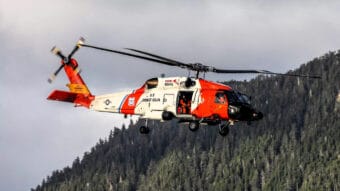
“Well, it was it was dark,” said Logan Padgett, captain of the Lydia Marie as the helicopter from Air Station Sitka arrived. “So we were just looking at the helicopter lights and there wasn’t really much to see. But we could hear the rotors one second, and then loud crash the next. Then silence.” In the photo, an Air Station Sitka Jayhawk on a training flight. (Photo courtesy of Don Kluting)

The first people at the scene of Monday night’s crash of an Air Station Sitka helicopter were the crew of the distressed fishing vessel it was sent to assist. The two brothers aboard the Lydia Marie played a critical role in the rescue of the downed air crew.

Logan Padgett is the captain of the Lydia Marie, a 44-foot wooden troller based in Wrangell. The Lydia Marie began taking on water around 8 p.m. Monday in the rough seas of Frederick Sound. Padgett sent out a mayday and steered for the protected northern shore of Read Island in Farragut Bay.

The helicopter launched from Air Station Sitka and made the 81-mile trip to Read Island by 10:15. Padgett spoke to the air crew by radio, letting them know that the flooding was under control.

Then something went wrong.

“Well, it was dark,” Padgett explained. “So we were just looking at the helicopter lights, and there wasn’t really much to see. But we could hear the rotors one second, and then (a) loud crash the next. Then silence.”

Padgett turned on the Lydia Marie’s crab lights. He and his younger brother rowed ashore and met one of the helicopter’s pilots on the beach, near where the aircraft had come to rest, inverted among some trees. Two members of the helicopter crew were pinned inside, and the brothers tried to keep them comfortable with sleeping bags and ibuprofen. And they used their own radios to help the crew call for help.

Petersburg Search and Rescue, EMS, police, Alaska Wildlife Troopers and more Coast Guard personnel answered their call.

Aaron Hankins is the director of Petersburg’s emergency services. He says the ride to Read Island was pretty treacherous — waves were nearly washing over the sides of the boat. And all the while, they were being pelted with snow and rain.

“We were kind of going with it on our way there and it was still pretty lumpy,” said Hankins. “It was pretty rough. At times, it was whiteout (conditions) on our way out there.”

Patrick Fowler leads Petersburg’s Search and Rescue team. He says when they reached the downed helicopter — a couple hours after the crash — they walked into a mess.

“(There was a) strong smell of fuel in the air, as could be expected,” said Fowler. “The helicopter was almost totally on its top side — totally upside down.”

The team was ready to render aid. But they didn’t have the right tools to immediately get the crew out of the fuselage. What they had with them might have been suitable to extract someone from a car accident — not a helicopter. But with time — and some brute force — they were able to free the injured crew.

​​”(It was) just a small space that’s gone topsy-turvy, and people kind of stuck and injured,” said Fowler. “It’s always a tricky environment to work in. And so yeah, cutting some straps, breaking a couple of pieces of metal and ultimately getting where we could transition them up and out of the helicopter.”

In spite of the challenges, Fowler said it was his favorite type of rescue mission.

“At the end of the day, everyone came home — and that’s why we do this,” said Fowler. “You see a direct correlation to your actions and a positive benefit to the people there that were in trouble. So that’s the most rewarding type of mission that we get.”

Back in Petersburg, Dr. Alice Hulebak was the physician on call that night. She says it was all hands on deck. Most of the hospital’s nurses and providers came out to lend a hand — even though they weren’t on call. Hulebak says the attending staff didn’t know what to expect — but they weren’t optimistic.

“There was a lot of unknown,” said Hulebak. “But (we were) sort of planning for, unfortunately, the worst. So that is why we essentially called in as much help as we could.”

Once the patients were stabilized, two nurses and a doctor accompanied the Coast Guard medevac flight to Seattle, because the Coast Guard didn’t have their own medevac team available at the time.

Mary Kravitz is Petersburg Medical Center’s nursing supervisor. She was on that flight, tending to the injured helicopter crew. She’s also the spouse of a Coast Guardsman. Kravitz says that connection made it very easy for her to volunteer her time.

“Thinking of my husband — it’s something that if I was in their shoes, and I couldn’t get to my husband in this sort of situation, I would hope that somebody would do the same for him,” said Kravitz.

Padgett, the captain of the fishing boat, says it did not feel strange coming to the aid of the Coast Guard.

“It’s just people helping people at that point,” he said.

Padgett says he knows nothing about helicopters, or what might have caused the accident. As a mariner, he does know the weather, and it was not a good night.

“I know that visibility was terrible,” he said. “And the gusts of wind were terrible. And it was just really bad flying conditions.”

In all, Padgett says he and his brother spent five or six hours on the beach at Read Island helping the air crew. Shortly after daybreak, the cutter Elderberry came to escort the Lydia Marie.

Asked if he’ll carry any particular memory of the events with him, Padgett said, “It was just kind of all one long, cold night.”

This story has been updated.

2 Coast Guard crash survivors released from hospital, 2 others improving

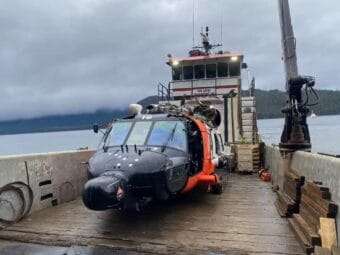
A Coast Guard MH-60 Jayhawk helicopter from Air Station Sitka pends investigation Nov. 14, 2023 after it crashed on Read Island, Alaska. The helicopter crash occurred Nov. 13, at approximately 11:05 p.m. All four crewmembers survived. (U.S. Coast Guard photo)

Two of the Coast Guard crew members who were involved in a helicopter crash in Southeast Alaska late Monday night were released from the hospital Wednesday.

According to a Coast Guard press release, the other two crew members with severe injuries remain hospitalized in Washington state, but their conditions have improved.

The crew from Air Station Sitka was on a search and rescue mission, responding to a fishing boat that was taking on water near Farragut Bay, about 20 miles northwest of Petersburg, when their helicopter crashed on Read Island. While Petersburg’s search and rescue team and coast guard crews responded to the downed helicopter, the Coast Guard Cutter Elderberry oversaw the dewatering of the fishing vessel Lydia Marie and escorted the boat back to Petersburg.

The Coast Guard has not released the names of the crew members or any information on what may have caused the crash, though weather conditions at the time of the accident included reduced visibility in the area from rain and snow storms and up to 45 mile per hour winds. An investigation into the crash is ongoing.

Sitka workshop discusses the future of invasive crabs in Alaska

Twenty green crabs laid out in rows on a table, with a bucket full of green crabs next to them
European green crabs collected from Metlakatla’s Tamgas Harbor this week. The crabs were trapped in shrimp pots. (Photo courtesy of Dustin Winter)

Tammy Davis is the invasive species program coordinator for the Alaska Department of Fish & Game. During the Alaska Invasive Species Partnership workshop in Sitka on Thursday, she was teaching a roomful of people how to identify invasive green crabs – which, surprisingly, are not always green.

“They can be brown, they can be orangish, reddish, yellowish,” Davis continues. “They’re four inches — an adult is four inches across the back of the carapace.”

European green crabs first reached the Pacific coast in 1989, but it wasn’t until 2022 that they showed up in Alaska. Davis remembers the moment she learned that green crabs had been found in Metlakatla last summer.

“And I think we were all really close to tears, because we should have known they were coming,” Davis said. “But we didn’t think they would come this soon, I guess.”

Genelle Winter is the Climate & Energy Grant Coordinator for Metlakatla Indian Community.  While Metlakatla is the only place in Alaska where green crabs have been positively identified, Winter said it’s likely that they’ve already spread.

“The numbers that we’re finding them in — we’re pretty sure that there are other places, we just haven’t found them yet,” Winter said. “And with that, right now, we’re just under 3000 crabs total that have been caught since discovering them in 2022.”

She said that aggressive trapping in Metlakatla, combined with early detection, has made it easier to reduce their spread.

“The first thing that was found was the first shell,” Winter said. “And that triggered that response to really start intensifying our trapping and then modifying how and where to make sure that we were really actually putting the traps where the crab were. And now those guys, they have it dialed in something fierce.”

These crabs tend to decimate eelgrass beds, which are critical habitat for juvenile salmon and other critters. They are also voracious eaters of clams and other small crabs. They reproduce quickly, and can survive in a wide range of environments.

Davis said communities like Sitka should be on the lookout.

“It seems so frightening and negative to say it’s inevitable, but based on ocean currents, it’s likely,” Davis said. “We don’t actually have good oceanographic information about currents in the Alexander Archipelago, so some of our Southeast communities may be slightly more protected if currents tend to go out along the coast. Unfortunately, that puts Sitka more likely.”

Davis said that Alaskans can help by learning how to identify green crabs and looking out for them on beach walks. While collecting some invasive species requires a permit, Alaska beachcombers can collect potential green crabs for the purposes of reporting – but they should keep the crab in a container and report the find immediately. You can report invasive species online through the Alaska Department of Fish & Game website or by calling the invasive species hotline at 1-877-INVASIV.

A conversation with Alaska’s exorcist

Father Joseph McGilloway, the Catholic Church in Alaska’s designated exorcist. (Meredith Redick/KCAW)

Sitka’s new Catholic priest has an unusual skill set – he’s also the official exorcist for the Catholic Church in Alaska. KCAW’s Meredith Redick sat down with Father Joseph McGilloway, a former Benedictine monk who moved to Sitka in September, to talk about his work in a ministry sensationalized by pop culture.

Listen:

Meredith Redick: You have been the exorcist for the Catholic Church of Alaska for four years. How did you get into that? What motivated you to do this work?

Joseph McGilloway: Okay, so, nothing. So what happened was the then-Archbishop of Anchorage had brought a friend of his, a priest who has been an exorcist for almost 20 years to talk to us. And really, it was kind of the first time I suppose I took the ministry seriously, in the sense of, you know, the talk made sense. And so then a few weeks later, I was trying to get the book. And the book was blocked. You could only buy it with a bishop’s permission. So I asked the bishop, ‘Hey, would you give me a letter of permission? Or could you order it for me and I’ll pay for it or whatever?’ And he said, ‘Leave that until I see you.’ So a few weeks later, I met him at a mutual friend’s house for dinner. And as we were leaving the house, I said, ‘Oh, by the way, did you think about whether or not I could have that book?’ He said, ‘Yeah, you’re gonna be the exorcist. Bye!’ And he jumped in his car and drove off. I’m like, ‘What?’  and he’s got a big smile on his face. And he waved at me and drove off. So that’s how I became the exorcist. Yeah.

Meredith Redick: What do you see as the role of this particular ministry?

Joseph McGilloway: Most of the work that’s done is gentle ministry to people who are under some kind of spiritual stress. You know, it’s not the big scary stuff that you see in the movies, but it’s something in their lives that’s causing them some stress or grief. And basically, most people, all they need is a reassurance that they’re not crazy for wondering if it’s a spiritual affliction. You know, what you really don’t want is, you know, everybody running around thinking it’s always the devil, and it’s always, you know, evil. Sometimes someone could be physically ill. I mean, the reasons why people can be – they could have a brain tumor, or something that creates real problems in there. And they don’t understand. We’ve got to go and see. They could have mental illness. And thank God we’re becoming much more aware of mental illness as a real part of human experience, so that we’re able to deal with that more rationally as well, and without the stigma of approaching it.

Meredith Redick: You mentioned mental illness. How do you figure out if someone needs an exorcism?

Joseph McGilloway: Before we can do anything there, we need to have the person’s permission to go and get medical and mental health checks, because the worst thing possible is to perform – especially if it is a mental illness that someone’s suffering from – the worst thing is to feed into that mental illness by then suggesting to them that there’s some demon involved as well.

Meredith Redick: So you spoke about a couple of really extreme cases. What do those look like when you do end up in that kind of situation?

Joseph McGilloway: I mean, my very first exorcism was assisting Vince Lampert. He’d given me, before that, a whole load of books to read and so on. All the books start the same way, you know: 99.9% of exorcism ministry is gentle, and it’s prayerful, and it’s quiet, and it’s whatever. And then the whole book talks about the 0.1 percent, because I guess that’s what people are interested in a lot of the time. So I went along to this expecting it to be, you know, the 99.9, but it was actually the 0.1.  Father Vince had told me all this a long time before – he said, if any of these things happen, the intention is to distract us from prayer. Because we get fascinated by the strength, the voice change, the visual change, all those things, the sort of knowledge the person has that’s not natural knowledge. It’s really exhausting. So,  Father Vince, knowing I had a sweet tooth, had bought me a big family pack of M&Ms. So after all that work, we sat around a table eating M&Ms and a divided-up brownie, and that’s all we had for dinner that night. Father Vincent says he often goes to Dairy Queen wherever he is for some ice cream after, that’s his treat.

Meredith Redick: Can you tell me a little bit about the conference in Rome?

Joseph McGilloway: Amazingly, for a conference, you know, that is dealing with evil, the atmosphere was really happy. People would say “So, where are you from?” And I would say, “Alaska” and “Alaska. Wow. So you know, is the devil at work in Alaska?” And I said, “Well, you know the expression ‘’till hell freezes over?'” There’s not a huge amount of demonic going on in Alaska, thank God – but there is some.

Meredith Redick: What do you think people get wrong about exorcism?

Joseph McGilloway: First of all, an exorcist isn’t a magician, you know. It’s not like a kind of a holy wizard or something who comes in and does a few spells and everything is fine. The really important thing for them to know is that even if a priest comes to do that, if you are either not a faithful person or have no interest in becoming one, what an exorcist can do for you is very limited.

A co-creator of Alaska’s PFD program is calling for reinstating a personal income tax

State Rep. Cliff Groh, then the chair of Alaska Common Ground, talks to a crowd about Alaska’s budget at McGivney’s a sports bar and grill in Juneau, Alaska in 2017. (Rashah McChesney/Alaska’s Energy Desk)

That Alaska’s fiscal system is broken is probably most obvious to the people who helped create it. Two civic organizations in Sitka recently heard from a co-author of the Alaska Permanent Fund dividend, who’s on a mission to set the state’s finances right.

State Rep. Cliff Groh was a 28-year old legislative aide in 1982 when he helped draft the legislation establishing the Alaska Permanent Fund Dividend. He’s worked in and out of government since then — he now represents House District 18 in North Anchorage as a Democrat.

Groh recently returned to Sitka to visit with old friends and share his ideas about Alaska’s fiscal problems with the local Rotary and Chamber of Commerce on Oct. 25.

Fellow House member Rebecca Himschoot, an Independent representing Sitka, Petersburg, and many surrounding communities, participates in the minority caucus with Groh. She said that among their very diverse caucus, Groh has earned a nickname.

“The expertise that Cliff brings to the table, well he’s actually earned a nickname,” said Himschoot. “He’s the ‘Fiscal Cliff.’  So we talk a lot about our fiscal cliff here in Alaska, and he really, truly is literally, our Fiscal Cliff. So he’s going to share some of those ideas that he has with us today – not even just ideas – but facts and figures about where we are and how we got there. And some ideas for how things might be different in the future.”

Groh’s vision for the future is basically a return to the past, and to the strategies that a bankrupt Territory of Alaska used to shore up its finances and win statehood. The territory relied on revenues from fishing and mining in those days, and was crippled by deficits. In 1948, territorial voters threw out almost the entire Legislature — and brought in new people with a purpose.

“And the new legislators came in, and in an eleven-day period they passed five taxes in a special session before the regular session started in January of 1949,” Groh said. “And the biggest one by far, and the one that’s had the most consequence in terms of revenues, was the first personal income tax in Alaska.”

That income tax was repealed in 1980, shortly after the completion of the trans-Alaska pipeline. Groh says that was the beginning of the “Alaska Disconnect” — when Alaskans began to expect not just an annual dividend check, but also free government in perpetuity.

Groh says that strategy worked pretty well for about 35 years. But now that oil revenues have peaked and are on a steady decline, without an income tax there’s no way to scale Alaska’s revenues to the population.

He asked the Sitka Chamber of Commerce to conduct a thought experiment, and to imagine Alaska’s population doubling.

“What would happen to government services?” Groh asked. “Well, the roads would ‘go south’ and like I said, they’re already terrible in my district. I have to say, driving around Sitka right now, they’re not exactly perfect here either. And obviously the state ferries, which used to run a lot more when I lived here more than 15 years ago, that would decline. We would need more school facilities and teachers, or face worse outcomes. Our dividends get smaller. And public health and safety resources like troopers, firefighters, and public health nurses would be stretched thin. And actually all the state services would either require more investment or the quality would suffer. So let’s talk about what happened to state revenue if the population doubled. It would be about the same as it is now. So we need to understand that.”

Just 10 years ago, Groh’s might have been a lone voice in the wilderness, but Alaska has since burned through billions in savings. While the principal of the Permanent Fund itself can’t be touched, another account called the earnings reserve can be spent with just a majority vote of the Legislature — and then Alaska would have no operating cash at all. So now many of Groh’s colleagues are also talking about taxes: a state sales tax, an income tax or both.

Groh has introduced HB 156, which would impose a 2% income tax — but only on earnings above $200,000. Anyone earning less than $200,000 would just “chip-in” $20.

He’s not keen on a sales tax.

“Some other legislators favor a sales tax — one was introduced this year,” Groh said. “It was a very broad sales tax. And then I said, ‘Folks, before we start taxing groceries and feminine products, I’d rather tax millionaires first.”

Asked by a chamber member whether Permanent Fund dividends should be discontinued, Groh said he didn’t think that would solve the Alaska Disconnect, although he did support restructuring the dividend and protecting the fund itself with a constitutional amendment. And he also did not support a strategy used by many governments, including the federal government: deficit spending.

“We can’t borrow our way out of this problem,” Groh said.

Alaska-raised composer makes music from the sounds of nature

Matthew Burtner stands with a bass saxophone while recording ‘Icefield’ on the Harding Icefield in 2022. (matthewburtner.com)

Matthew Burtner once wrote a nocturne – for moths.

“I was thinking of these moths and how they have these beautiful ears,” Burtner says. “They’re like, these kind of feathers on their throat. You see a picture of a moth and it has these two different-sized feather things. So I thought well, I’ll make some music for the moths so that they can use their hearing to hear something beautiful too.”

Moths can’t hear the music we listen to, since their ears are attuned to higher frequencies. So, Burtner wrote something they could hear. The resulting piece, ‘Moth Song,’ is one of many works that Burtner has composed over his career in ecoacoustics, which he says all boils down to an effort to help humans better connect with the natural world.

Burtner, who was born in Naknek and grew up around Alaska, says that the sounds of the natural world have always resonated with him.

“When I was learning music, I would play music outside, with that presence of the environment,” he says. “So they were somehow connected to me — the sounds of the wind, and the snow and the water, and the sounds of, you know, my saxophone or the piano, or whatever I was playing.”

Burtner has now built an award-winning career around turning nature into music, using both recorded sound and scientific data that he transforms into sound. One of his current projects focuses on the seasonal changes of an Arctic lagoon. Scientists monitored the lagoon’s temperature, salinity, light, and currents over the course of a year, and Burtner transformed that data into sound that allows listeners to hear how the lagoon shifts with the seasons.

“We get a kind of sonic sense of the way the ecosystem works, the dynamics of it, and it’s actually like very pronounced in the sound,” he says. “It’s much more impactful than looking at a graph of it.”

Recording the elusive sounds of glaciers, seagrass beds, and cooling lava isn’t easy. Burtner says your standard microphone probably won’t cut it.

“When you’re dealing with, you know, tundra, or a river covered in three feet of ice, and you want to record that, there aren’t reall, ready-made devices for that,” he says. “So a lot of it is figuring out what you might hear there, because you can’t really always know, and in a way, that’s why we’re going there.”

He says there’s always some amount of risk when you’re recording in extreme environments.

“I just have a kind of ‘YOLO’ approach to it, where I’ll save and save and save and save money and write grants, and I’ll get this one piece of gear, and then I’ll just go throw it out in the ocean and hope for the best,” he says.

Burtner sees his work as a way to open humans up to an expanded awareness of the natural world.

“Music is, we think of that as a human expression,” he says. “But if we extend life and humanness or beingness to the glacier, then certainly it is making music. You know, if it has the characteristics of a being, it will probably make music too. If we don’t recognize that music, that’s really our own shortcoming, not the glacier’s shortcoming.”

You can find Burtner’s work at matthewburtner.com.

Site notifications
Update notification options
Subscribe to notifications