Spirit

Anchorage’s white raven has become a local legend

Kathrin Seymour, owner of Kat’s Wilderness Photography, says she made a lot of friends with other photographers, as they passed the time in Spenard parking lots, hoping to catch sight of the white raven. (Courtesy Kathrin Seymour, Kat’s Wilderness Photograph)

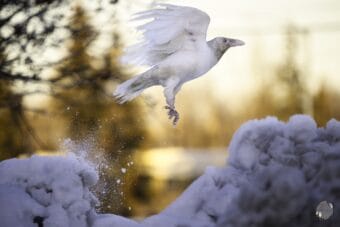
Since October of last year, Anchorage has been visited by a rare, feathered celebrity — a white raven, which appears to have taken up residence in the Spenard neighborhood.

Last summer, the raven was spotted south of Anchorage on the Kenai Peninsula, where biologists confirmed the bird is not an albino but leucistic — which means it has a gene that causes a loss of pigmentation. It also has blue eyes. Biologists believe it’s most likely the same bird that has delighted Anchorage this winter.

Almost every day you can find new photos of the raven on Facebook on a page called Anchorage White Raven Spottings. There, you can see the bird aloft with its feathers, translucent through the light, or at play with another raven in the snow. Someone recently snapped a shot of the raven, as it strutted with a slice of pizza in its beak.

There’s also footage on Facebook of the raven loosening a bolt on a streetlamp and carrying it off in its beak, and a guy in conversation with the bird from its perch near McDonald’s.

Glen Klinkhart, a retired Anchorage police detective, says he uses some of the surveillance skills he learned in law enforcement to track the raven down. (Courtesy Glen Klinkhart)

Among the most recent posts, there are regal photos of the raven perched on a spruce bough as the moon rises in the backdrop. Many faces of the bird have been captured by a ravenous Anchorage paparazzi, who don’t seem to compete against one another but cooperate by sharing tips on how to photograph their quarry.

“It’s just so different. It is so out of the norm,” says Glen Klinkhart, a retired Anchorage police detective who has almost made tracking the raven a full-time job.

“We all know what a raven looks like. We all know the shape, how it’s supposed to look,” Klinkhart said. “And then when you see this, this white raven with this genetic difference, it just kind of stops you.”

Michelle Hanson captured a shot of white raven paparazzi behind Billiard Palace and Bar. (Courtesy Michelle Hanson)

Scientists say the white raven is very rare. But how rare? Rick Sinnott, a wildlife biologist, says he knows of only two other white raven sightings in Anchorage. The last one was 20 years ago in the Midtown area.

“It wasn’t as white as this one,” said Sinnott, who remembers that its feathers were tipped with a bronze hue. “It was shiny bronze. It was very beautiful.”

Sinnott says another white raven was spotted 20 years before that and believes three sightings over the course of four decades meets the definition of rare, especially when you consider the genetic odds. Sinnott says it would take both a male and a female with a recessive leucistic gene to mate — and even then, maybe one of four chicks would be white, if any at all.

Ravens are smart enough to know what they look like and can recognize themselves in mirrors, so Sinnott worried that other ravens would pick on the white raven because it’s different. But he’s glad that doesn’t appear to be the case.

“When it’s around other ravens, it doesn’t seem to raise feathers around the top of its head, which would suggest it’s not subordinate,” Sinnott says.

Glen Klinkhart took this photo of the raven after it had a squawking match with four other ravens over a carton of Häagen-Dazs ice cream. (Courtesy Glen Klinkhart)

In fact, the white raven behaves more like an “alpha” bird. In a recent post, Klinkhart shared pictures of the raven in a spat with four black ravens over a discarded Häagen-Dazs carton of White Raspberry Chocolate Truffle ice cream. In the last photo in the series, the raven shows off its prize.

It’s one of more than 10,000 photos Klinkhart has taken of the raven since October. But there’s one that he’s especially proud of, taken on a day in which he found the bird completely alone. He laid down on the ground to watch, with camera in hand.

“It started getting closer and closer. And I just froze. I’m like, ’Don’t move. Don’t affect its behavior. Let it behave,’” said Klinkhart, who wondered if the bird was just curious.

“That white raven came (within) about two feet of me and looked in my camera lens,” he said. “Then it tilted its head. And then it waddled off.”

Klinkhart says he was so close to the bird that the photo showed his reflection in the bird’s blue eye, a magical moment. Since that first time, the raven has come close to Klinkhart’s lens a couple of times. In a video, the bird comes so close that Klinkhart is unable to focus his camera.

In many Alaska Native stories, the bird is a mystical being.

Meda DeWitt, a Lingít healer who works with medicinal plants, says she first heard about the white raven’s meaning years ago from another traditional healer, the late Rita Blumenstein, known as Grandma Rita — a Yup’ik from Southwest Alaska, trained by her elders from childhood to ease pain and suffering.

“This is one of the stories that she would tell that brought hope,” DeWitt said. “She would say, ‘We will see a white raven, and that’s when we’ll know that humanity as a whole is shifting towards one of peace.’”

DeWitt says it’s a prophecy Grandma Rita heard from her elders, an example of the white raven’s long history throughout the world as a messenger bird. Even the Greek god Apollo had one, which turned from white to black after displeasing him.

Rita Blumenstein at the 2019 Rural Providers Conference at Alaska Pacific University. Blumenstein, who was known as Grandma Rita, was known for her healing hugs. (Rhonda McBride/KNBA)

In Alaska Native stories, Raven also transforms. DeWitt says not to forget that Raven is a trickster who finds trouble. Her uncle tells a story about how Raven wanted to bring mankind fresh water to drink, so he tried to steal a bucket from a chieftain’s house. Soot blackened his feathers as he escaped through a smoke hole. In another version of the Lingít story, Raven turns black after he steals the moon, the sun and the stars to bring light into the world.

DeWitt believes Raven has transformed yet again and has returned to encourage mankind to save the planet, a message especially important to Alaska Natives.

“Our whole job is to steward the earth, and if the earth is sick, that means we’re sick,” DeWitt said. “When I see something like White Raven, it gives me a profound sense of hope. Even beyond hope, knowing that we’re going to be successful.”

Floyd Guthrie, another traditional healer who is Tsimshian, Lingít and Haida, says he has waited a long time for the white raven to appear.

“It makes our hearts feel good, because we connect to the truth of his existence,” said Guthrie, who believes the raven has always been around to watch over humans but not necessarily visible.

“It’s so wonderful to see White Raven with the blue eyes,” Guthrie said. “In his own way, he just has to tell us, ’I’m not very far away from you.’”

Guthrie and his wife, Dr. Marianne Rolland, specialize in treating trauma. Years ago, when Rolland was searching for a name for their counseling center in Anchorage, she says the words “White Raven” came to her, not in a voice, but from what she calls a place of knowing.

“White Raven is reminding us of our own spirituality and of what we’re here on earth to do,” Rolland said. “That we’re not just physical human beings, but we’re spiritual beings.”

Rolland says she’s not surprised by the hundreds of raven photographs that have been posted on Facebook, which include artwork the bird has inspired. From paintings to sculptures to beaded earrings, there’s almost a cottage industry of art featuring the raven, not to mention mugs, stickers and keychains.

“White Raven opens hearts, and opening up hearts opens up creativity,” said Rolland.

Jerrod Galanin of Sitka was inspired by white raven photos to make a copper and silver bracelet. He says not long afterwards, the raven found him as he was driving in Anchorage. (Courtesy Jerrod Galanin)

After seeing the photos, Jerrod Galanin felt the urge to fashion a Lingít-style, copper armband with the white raven in silver. Not long afterwards, it was as if the bird sought him out.

“The flight pattern was like sporadic and kind of crazy,” said Galanin. “And so, I looked closer, and it landed on a light post, right on top of us.”

Some Facebook followers have speculated about whether the white raven is male or female. Biologists say it’s hard to tell for sure. The males are a little larger and can have pouches with a bigger bulge under their throats. Rick Sinnott, the biologist, says males also like to show off during courtship.

“He’ll fly up in the air and drop sticks and fly down and pick them up, catch them as they fall. Or do all kinds of aerobatics, like you see them flipping on their back and doing all kinds of things,” Sinnott said. “When males are trying to impress females, they go into quite a frenzy of that kind of behavior.”

Sinnott says the mating season begins at the end of January and runs through March, so we may soon find out whether the raven is a him or a her. Or maybe not. Sinnott says sometimes ravens just like to entertain their buddies.

Sinnott says when ravens take up urban life, you can usually find them hanging out near busy intersections, where there are restaurants and grocery stores. And for the white raven, that means plenty of dumpster dining. Seems the bird has favored those at the Spenard Roadhouse. As one Facebook poster put it, “At least the white raven has good taste.”

Michelle Hanson, a photographer who recently moved from Colorado, now has a photo business in Alaska, mhphotoco. She has been following the white raven’s interactions with other ravens. She says the two ravens were atop a light pole and appeared to be having a tender moment. The photo she posted on Facebook has some speculating that there might be a raven romance going on. (Courtesy Michelle Hanson)

From the progression of photos from October, the raven appears to have fattened up, but maybe it’s just the bird’s feathers fluffing up to survive the subzero temperatures.

Sinnott says it’s likely the raven will move on come spring and head out into the wilderness. Ravens are known to travel hundreds of miles away. Some birds tagged in Anchorage have been spotted as far away as Juneau, Fairbanks and the North Slope.

But for now, the white raven brings warmth and cheer into the heart of an Anchorage winter.

As Floyd Guthrie says, it is here to say, “I see you.”

Editor’s note: Audio of the white raven unscrewing a bolt on a street lamp was from a Jennifer Collin’s video. Sound of the bird preaching to the choir came from a Todd Billingslea video.

St. Olga of Kwethluk to become first-ever Yup’ik saint

Matushka Olga and Fr. Nikolai Michael (Courtesy Fr. Michael Oleksa)

Olinka Arrsamquq Michael of Kwethluk, known as “Matushka Olga,” died more than four decades ago, but she may soon become a household name among Orthodox Christians across the world. In a recent meeting of the Orthodox Church in America, she was selected to be the first female saint in North America, and the first-ever Yup’ik saint.

The late Orthodox missionary and scholar Fr. Michael Oleksa played a key role in compiling the accounts of holiness essential to the official process of Olga’s glorification. Oleksa spoke to KYUK shortly before his death in late November 2023.
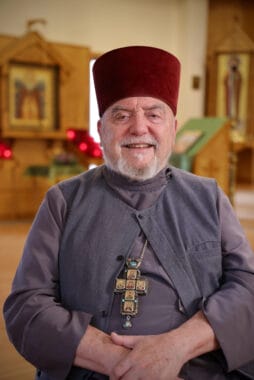
“She’s the first saint who didn’t go on a great missionary journey, didn’t publish any theological books, had not become a nun or a monastic, had not been martyred for the faith,” Oleksa said. “She’s proof that as long as you’re true to your Christian calling, living a good Christian life even in the humblest circumstances, as we could certainly say hers were, that’s good enough.”

Fr. Oleksa was born in 1947 in Allentown, Pennsylvania. He said that he first met Olga and her husband, Fr. Nikolai Michael, when he served as deacon in the Kuskokwim River village of Kwethluk in 1972.

“I was welcomed to the village at the home of Uliggaq and Arrsamquq, their Yup’ik names,” Oleksa said. “And I had my first akutaq there, what’s called Eskimo ice cream in English.”

Olga is known to have lived a humble life as a midwife and the wife of a priest, denoted by the honorific “matushka,” literally meaning “little mother.” Born in 1916 in Kwethluk, Olga gained a reputation throughout her life for compassion when it came to women who had suffered abuse. Upon her death in 1979, this reputation continued to spread.

An extraordinary account

About a decade after publishing an account of Olga in his 1993 book “Orthodox Alaska,” Oleksa said that a stranger reached out to him to share an extraordinary account.

“I got a letter from a woman who wasn’t Christian, wasn’t Orthodox for sure, married to a Hindu from upstate New York,” Oleksa said. “And she said, ‘I’ve had this vision, this dream of a woman who came out of a birch forest and signaled for me to follow her.’”

A rendition of St. Olga (Courtesy Diocese Of Sitka And Alaska)

The woman went on to describe being led into a house that looked like a hill, illuminated within by stone oil lamps. She was told to lay down on a bed of moss where, despite not being pregnant, she was treated as if giving birth. She said that the pain of sexual abuse suffered as a child left her body. She was led outside, where the northern lights danced in the sky, and was given a hot drink that fit the description of tundra tea, known more commonly as Labrador tea.

“And then she started to walk back into the forest. And this woman called after her, ‘Who are you? What’s your name?’ And she said something she didn’t understand, something indistinguishable: ‘Olga,’” Oleska said. “And that was the end of her vision, and she wrote to me about this.”

Oleksa said that he was shocked by the depiction of traditional Yup’ik ways of living by someone claiming to have no prior knowledge of Alaska. He also said that the woman from upstate New York ultimately converted to the Orthodox faith.

“Now this woman has come to Alaska, she herself has painted some of the first icons of Matushka Olga,” Oleksa said. “But the miracles then began multiplying.”

The glorification of St. Olga

Over the years, Oleksa said that he compiled dozens of testimonies of healing associated with Olga from around the country, which he eventually sent to Bishop Alexei, head of the Orthodox Church of Alaska.

“There are more stories than what I’ve heard, of course, but I compiled a dossier, you could say,” Oleksa said.

Oleksa said that Alexei then presented the accounts to the Holy Synod of Bishops of the Orthodox Church in America, and that the decision to canonize Olga was immediate and unanimous.

Fr. Michael James Oleksa is seen while giving an interview at St. Innocent Russian Orthodox Cathedral on July 5, 2021. (Simon Scionka/Sacred Alaska Film)

St. Olga is expected to be added to the official canon of Orthodox saints as early as November 2024.

“The news of her miracles and appearances has actually become global by now. And when she’s formally added to the canon, there will be people coming from all over the world wanting to participate in those services,” Oleksa said.

With no hotels and limited access to Olga’s remote home village, Oleksa emphasized that Kwethluk is not the most ideal pilgrimage site for masses of Orthodox followers. When Olga is officially glorified, services will likely be held in both Kwethluk and Anchorage.

Oleksa was laid to rest on Dec. 5 after two days of services at St. Innocent’s Cathedral in Anchorage, where Alaskans from across the state came to say their goodbyes. Among his numerous accomplishments in the Orthodox clergy and as a cross-cultural communicator, one of his last acts was playing a direct role in the canonization of St. Olga.

Russian Orthodox Archpriest Michael James Oleksa has died at 76

Fr. Michael James Oleksa is seen while giving an interview at St. Innocent Russian Orthodox Cathedral on July 5, 2021. (Simon Scionka/Sacred Alaska Film)

The well-known Russian Orthodox missionary and scholar, Archpriest Michael James Oleksa, has died at the age of 76 in Anchorage following a stroke. His death was confirmed by the Russian Orthodox Diocese of Sitka and Alaska on Nov. 29.

Oleksa served as a priest in more than a dozen Alaska Native villages across the state over his five decades in Alaska. He came to Kwethluk in 1972, where he met his wife Xenia and served as a deacon before spending time as a priest in Napaskiak.
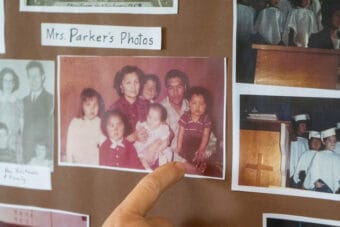
Retired priest Fr. Martin Nicolai of Kwethluk worked with Oleksa on Yup’ik translations of documents related to Orthodox history in Alaska. He said that Oleksa had deep ties to the local community.

“He married into a Kwethluk family. He was very close to the Yup’ik community,” Nicolai said. “He was instrumental in a lot of things, not only the church in Alaska, but for the Alaska Native peoples in general.”

Most recently, Oleksa played a key role in the process of nominating Olga Michael of Kwethluk to become the first female Orthodox saint in North America, as well as the first-ever Yup’ik saint. Oleksa met St. Olga when he served as deacon in Kwethluk in the 1970s and spent years compiling the testimonies necessary for her official naming as a saint.

Oleksa was born on March 16, 1947 in Allentown, Pennsylvania. He came to Alaska in 1970 from St. Vladimir’s Seminary in New York at the invitation of the Alutiiq village of Old Harbor on Kodiak Island.

Oleksa was a leader in cross-cultural communication in Alaska and a student of Alaska Native languages and cultures. He taught at multiple universities in Alaska and published books on Russian Orthodox history, including “Orthodox Alaska” and “Alaskan Missionary Spirituality.” He earned his Ph.D. in Slovakia in 1988 with an emphasis on Alaska Native history during the Alaska Russian period (1741-1867).

Oleksa is survived by his wife and children.

Klukwan church returned to tribe after century of Presbyterian ownership

Lani Hotch points to photos on the Klukwan church wall of her family. (Lex Treinen/Chilkat Valley News)

On a recent Sunday, about a dozen parishioners sit on wooden pews at the Klukwan church listening to a sermon.

With a grand piano accompanying them, they sing along to “Count your blessings” and “These are the days of Elijah.” And, as they listen, a few parishioners sew animal hide.

On the surface, little has changed about the church services in years. The community staple — originally known as the Klukwan Presbyterian Church — has been holding regular Sunday services for nearly a century.

But one thing about the church has changed: its owner.

Last November, a national denomination of the Presbyterian Church transferred the deed to the Klukwan tribe, as part of the denomination’s effort to reconcile past abuses by clergy members and teachers against Alaska Native people.

Tribal and church leaders said it was an important step towards self-determination for the Chilkat Indian Village, the federally recognized tribe in Klukwan.

“It just kinda hits you dead center – the church is ours,” said Jones Hotch, a longtime church member and a member of the Klukwan tribal council.

The idea was first floated years ago under then-pastor Jami Campbell after she witnessed a statewide apology made by the Presbyterian Church at the Alaska Federation of Natives conference in 2016.

Campbell has since moved away from Klukwan but returned for the Oct. 8 ceremony.

“Being part of healing is a pretty amazing thing,” she said in a phone interview from Washington state, where she now lives. “They’ve gained some of their power back.”

Starting with an apology

Lani Hotch, another longtime church member and culture bearer in Klukwan, said some of her earliest memories are with the church. While she spent her early years in Haines, Hotch remembered coming to services with her grandmother, Jennie Warren, who wore a navy blue dress with white polka dots on Sundays. They walked over the wooden sidewalks to the wooden building, Warren in her black leather shoes with modest heels, keeping a strict eye on the rambunctious children.

Hotch said she loved the services and the connection it brought to her family and the history of the region. Her great grandfather James Katchkanuk had purchased the cast iron bell in 1903. She continued to attend church through adulthood.

Campbell said she quickly felt the importance of the church after she was recruited as pastor of Klukwan Church at the end of 2017. She served a brief volunteer stint cleaning the Jilkaat Kwaan Heritage Center earlier in the year and some church members asked if she would be interested in the pastorship. She decided to make the move with her partner in September of 2017.

Campbell tried to integrate into the community as quickly as she could, but the darker sides of the church’s history in Alaska gnawed at her. She remembered seeing a document at the Jilkaat Kwaan Heritage Center to prove they were no longer Indigenous. It required a signature from five non-Native Alaskans to prove they were “civilized.”

The Presbyterian Church was a major force in several regions in Alaska, including in the Chilkat Valley. The church was particularly active in missionary boarding schools, taking Alaska Native children away from their families to boarding school and prohibiting local languages as part of a “civilizing” mission. Among the most prominent Presbyterians was Rev. Sheldon Jackson, who established a system of boarding schools across the state.

Lani Hotch passes a jar of chowder to pastor Al Giddings, who recently took over pastorship of Klukwan Church. (Lex Treinen photo/Chilkat Valley News)

Shortly after taking up the ministry in Klukwan, Campbell stumbled across a YouTube video of an apology from the Presbyterian USA denomination of the church for abuses at boarding schools in Alaska. The speech was delivered by Rev. Curtis Karns at the Alaska Federation of Natives conference in Fairbanks in 2016.

“To those individuals who were physically, sexually and emotionally abused as students of the Indian boarding schools in which the (Presbyterian Church USA) was involved, we offer you our most sincere apology. You did nothing wrong; you were and are the victims of evil acts that cannot under any circumstances be justified or excused,” Karns told the AFN convention, according to an Anchorage Daily News account at the time.

The discovery had a deep effect on Campbell, who decided the Klukwan church should make its own apology. In May of 2019, she gave a speech to the congregants at the Klukwan heritage center based on the Presbyterian USA apology from 2016.

“To those individuals who were physically, sexually, and emotionally abused and mistreated as a result of assimilation practices, we apologize,” Campbell told congregants.

The ceremony wasn’t publicized at the time.

“They decided they wanted it to be intimate,” said Campbell. “They decided not to inform local media at the time so it could be a personal, genuine moment.”

Jones Hotch remembers being moved by the speech.

“Pastor Jami was very real. I stood up and I said ‘I accept it.'” he said. “It was really something to hear and see in person.”

Campbell said she felt like it was a milestone for the church’s role in the community. She said she’s had people who weren’t even at the ceremony come up to her and recite portions of it word for word.

Still, she said there were members who weren’t supportive and who argued the church shouldn’t be apologizing for sharing the word of God.

Lani Hotch, a longtime church member and culture bearer, said it was bittersweet for her.

“It was great there was an apology after the fact, but in my heart, I had already moved on,” she said.

Hotch had completed a Klukwan Healing Robe, a Chilkat weaving project in 2001 that marked a focal point in throwing off cultural oppression and embracing Tlingit heritage for the community.

The text of Campbell’s apology to Klukwan still hangs on the wall of the church.

Words and deeds

Shortly after the apology, Campbell started hearing about a movement within the Presbyterian USA denomination of returning church lands to Indigenous peoples. She wondered if the church would be willing to do the same for Klukwan church.

The property where it sat, about halfway between the banks of the Chilkat River and the Haines Highway, was the sole piece of land still owned by non-tribal members in Klukwan. Campbell reached out to Presbyterian USA over email.

“Would you please consider gifting the Klukwan, Alaska church building to the Chilkat Tlingit people of Klukwan?” she wrote. “This transaction can easily be done by donating, gifting or selling for $1 to the Chilkat Indian Village.”

Within a week, she had a phone call.

“I didn’t even know there was a church there,” said Dean Strong, the clerk for the Northwest Presbytery at the time.

Strong combed through records Presbyterian USA kept in New York state to find the property. It was hardly a question of whether to return the property, Strong said.

“Once we found out about it, we were happy to have the Native American tribe own it. It was their property, their community center,” he said. “We’ve been trying to do this with all our churches on all our native properties and reservations.”

Getting it through the tribal council took a bit longer, but not for lack of support. Jones Hotch said there were minor technical issues and one of the tribal council members, Tony Strong, died.

“Just normal paperwork, I think the biggest problem was formatting the letter for the borough,” he said.

By 2022, the council had approved the transfer and the church became part of the tribal land.

Unfortunately, COVID concerns were still present in the village, and the tribe decided to delay a formal ceremony until Oct. 8 of this year.

The event was held at the church. Congregants brought local foods and heard speeches.

“Not too many empty seats that day,” said Pat Warren, a church elder. “There was fish and side dishes – it was a festive time.”

A series of people spoke about the meaning of the deed transfer, for the tribe and the church.

Campbell spoke as well, emphasizing that it allows the people of Klukwan to choose how they honor their faith.

Pastor Jami Campbell in October, 2023 with Kath Hotch (left) and Joann Elsie Spud (right). (Photo courtesy of Jami Campbell)

Klukwan tribal administrator Brian Willard and tribal council president Kim Strong spoke about the history of the church and the significance of the transfer.

“It was just very warm, very celebratory and very reflective and an excitement of moving forward,” said Al Giddings, who was also welcomed as the new pastor of the church during the ceremony.

Former pastor Campbell said it was a celebration “but not necessarily people jumping around hooping and hollering,” said Campbell. “It’s the kind of celebration of recognizing broken things coming back together.”

Campbell said making the trip back to see the culmination of years of effort was emotional.

“Being part of healing is a pretty amazing thing,” she said. “The village worked so hard for healing to sustain their culture and their way of life. Now the church isn’t standing in the way, it’s an ally for them.”

Church members like Lani Hotch echoed the sentiment.

“I think it’s made a difference to take ownership and to have that autonomy that we should have always had – it’s just natural,” she said.

Practically, there are small but significant differences. Hotch said the church can now choose which denomination to have preaching.

Right now, Giddings’ services are non-denominational. And, the tribe has been able to take over insurance and has paid for some repairs to the building.

Hotch pointed to a silver lining of history that despite the abuses by the church, many of the most influential Alaska Native leaders have come from it, including civil rights leader Elizabeth Peratrovich, influential pastor and elder Rev. Walter Soboleff, and William Paul, the first Alaska Native legislator.

Now that the Klukwan church is back in tribal hands, she said, the village will keep growing new leaders, and hopefully put the abuses behind.

A conversation with Alaska’s exorcist

Father Joseph McGilloway, the Catholic Church in Alaska’s designated exorcist. (Meredith Redick/KCAW)

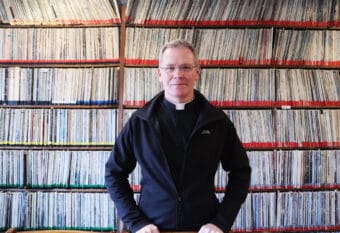
Sitka’s new Catholic priest has an unusual skill set – he’s also the official exorcist for the Catholic Church in Alaska. KCAW’s Meredith Redick sat down with Father Joseph McGilloway, a former Benedictine monk who moved to Sitka in September, to talk about his work in a ministry sensationalized by pop culture.
Listen:

Meredith Redick: You have been the exorcist for the Catholic Church of Alaska for four years. How did you get into that? What motivated you to do this work?

Joseph McGilloway: Okay, so, nothing. So what happened was the then-Archbishop of Anchorage had brought a friend of his, a priest who has been an exorcist for almost 20 years to talk to us. And really, it was kind of the first time I suppose I took the ministry seriously, in the sense of, you know, the talk made sense. And so then a few weeks later, I was trying to get the book. And the book was blocked. You could only buy it with a bishop’s permission. So I asked the bishop, ‘Hey, would you give me a letter of permission? Or could you order it for me and I’ll pay for it or whatever?’ And he said, ‘Leave that until I see you.’ So a few weeks later, I met him at a mutual friend’s house for dinner. And as we were leaving the house, I said, ‘Oh, by the way, did you think about whether or not I could have that book?’ He said, ‘Yeah, you’re gonna be the exorcist. Bye!’ And he jumped in his car and drove off. I’m like, ‘What?’  and he’s got a big smile on his face. And he waved at me and drove off. So that’s how I became the exorcist. Yeah.

Meredith Redick: What do you see as the role of this particular ministry?

Joseph McGilloway: Most of the work that’s done is gentle ministry to people who are under some kind of spiritual stress. You know, it’s not the big scary stuff that you see in the movies, but it’s something in their lives that’s causing them some stress or grief. And basically, most people, all they need is a reassurance that they’re not crazy for wondering if it’s a spiritual affliction. You know, what you really don’t want is, you know, everybody running around thinking it’s always the devil, and it’s always, you know, evil. Sometimes someone could be physically ill. I mean, the reasons why people can be – they could have a brain tumor, or something that creates real problems in there. And they don’t understand. We’ve got to go and see. They could have mental illness. And thank God we’re becoming much more aware of mental illness as a real part of human experience, so that we’re able to deal with that more rationally as well, and without the stigma of approaching it.

Meredith Redick: You mentioned mental illness. How do you figure out if someone needs an exorcism?

Joseph McGilloway: Before we can do anything there, we need to have the person’s permission to go and get medical and mental health checks, because the worst thing possible is to perform – especially if it is a mental illness that someone’s suffering from – the worst thing is to feed into that mental illness by then suggesting to them that there’s some demon involved as well.

Meredith Redick: So you spoke about a couple of really extreme cases. What do those look like when you do end up in that kind of situation?

Joseph McGilloway: I mean, my very first exorcism was assisting Vince Lampert. He’d given me, before that, a whole load of books to read and so on. All the books start the same way, you know: 99.9% of exorcism ministry is gentle, and it’s prayerful, and it’s quiet, and it’s whatever. And then the whole book talks about the 0.1 percent, because I guess that’s what people are interested in a lot of the time. So I went along to this expecting it to be, you know, the 99.9, but it was actually the 0.1.  Father Vince had told me all this a long time before – he said, if any of these things happen, the intention is to distract us from prayer. Because we get fascinated by the strength, the voice change, the visual change, all those things, the sort of knowledge the person has that’s not natural knowledge. It’s really exhausting. So,  Father Vince, knowing I had a sweet tooth, had bought me a big family pack of M&Ms. So after all that work, we sat around a table eating M&Ms and a divided-up brownie, and that’s all we had for dinner that night. Father Vincent says he often goes to Dairy Queen wherever he is for some ice cream after, that’s his treat.

Meredith Redick: Can you tell me a little bit about the conference in Rome?

Joseph McGilloway: Amazingly, for a conference, you know, that is dealing with evil, the atmosphere was really happy. People would say “So, where are you from?” And I would say, “Alaska” and “Alaska. Wow. So you know, is the devil at work in Alaska?” And I said, “Well, you know the expression ‘’till hell freezes over?'” There’s not a huge amount of demonic going on in Alaska, thank God – but there is some.

Meredith Redick: What do you think people get wrong about exorcism?

Joseph McGilloway: First of all, an exorcist isn’t a magician, you know. It’s not like a kind of a holy wizard or something who comes in and does a few spells and everything is fine. The really important thing for them to know is that even if a priest comes to do that, if you are either not a faithful person or have no interest in becoming one, what an exorcist can do for you is very limited.

Two men say they were sexually abused as children at Juneau’s Echo Ranch Bible Camp

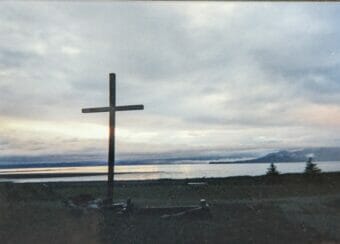
A cross by the shore at Echo Ranch Bible Camp in the early 2000s. A more recent photo of the same scene now illustrates the camp’s Facebook page. (Courtesy of Zack Winfrey)

Content warning: This article includes mentions of sexual assault and abuse that may be uncomfortable for some readers. Resources are available at the bottom of this post.

Two California men have come forward to say that Bradley Earl Reger — a man the FBI suspects of abusing dozens if not hundreds of boys over a period of decades — abused them on trips to Juneau’s Echo Ranch Bible Camp when they were children. 

FBI charging documents refer to Reger taking boys on “camping trips he led in Alaska,” and Reger has a long and well-documented association with the camp. The men’s accounts are the first, though, to allege that abuse happened at the camp. 

Earlier this month, former Juneau resident Troy Wilson, who says that Reger abused him on trips to California, told KTOO that Reger used the camp as a “mechanism” — a place where he could gain the trust of families so he could later travel alone with their children. But Wilson said he did not know if Reger had ever abused anyone at the camp. 

Zack Winfrey, who spent time at Echo Ranch from 2003 to 2006, says that he did.

“I was definitely abused at Echo Ranch,” he told KTOO in an interview last week.

A photo of Bradley Earl Reger from his detention memo. Reger, who volunteered on and off for years at Juneau’s Echo Ranch Bible Camp, was arrested last month on charges alleging he abused more than a dozen boys and young men. (U.S. Attorney’s Office photo)

Winfrey’s account is supported by another California man, Derrick Fox, who spent time at Echo Ranch during the same time period and also said Reger abused him.

Both men described a trusted, prominent church member operating with no real oversight. They say Reger abused them for years, and that his trips to Echo Ranch gave him access to children with little or no supervision from other adults — and it’s not clear if there were any protocols for keeping children safe.

After KTOO contacted the camp director to ask about Winfrey’s and Fox’s accounts, the camp replied with a statement saying it was taking the allegations seriously.

“We recently learned that alleged abuse may have taken place at ERBC,” the statement read. “As a result, Avant Ministries immediately contacted law enforcement agencies in accordance with our organization’s Child Safety Protection Policies and Procedures.”

“He did what he wanted”

Federal investigators arrested Reger on July 6 and charged him with “engaging in illicit sexual activity abroad, transportation of a minor with intent to engage in criminal sexual activity, and coercion and enticement.” They alleged that Reger abused more than a dozen boys and young men, often under the guise of medical care. But federal investigators believe he could have hundreds of victims, the Sacramento Bee reported in July.

Winfrey is one of the witnesses cooperating with the FBI in its investigation into Reger. He shared some of his correspondence with the FBI with KTOO, along with photographs that place him at the camp. Winfrey remembers Fox from the Alaska trips — and Fox, too, showed KTOO correspondence with investigators about the case.

Winfrey also said that he remembers Mio Rhein, a former Echo Ranch staff member who now lives in Ketchikan. Rhein spoke with KTOO to corroborate some of the details about Reger’s trips to Alaska. 

Winfrey said he was 10 years old when Reger first abused him, under the guise of a physical exam. Winfrey’s family attended the Susanville Church of the Nazarene. Reger led the church’s youth programming, including a group called SuzNaz Youth. Winfrey was a member.

Winfrey said that for him, the trips to Alaska started a year later, in 2003.

Winfrey and Fox both told KTOO that Reger would take about a dozen members of SuzNaz Youth to Alaska, and the trips would last for several weeks. In Juneau, the group would spend some time at Echo Ranch Bible Camp and some time staying in a building on the grounds of Auke Bay Bible Church. 

Zack Winfrey on the Chilkoot Trail in the early 2000s. (Courtesy of Zack Winfrey)

They also traveled around Southeast. Winfrey remembers kayaking trips and hiking the Chilkoot Trail. His photos from the trips are typical snapshots — kayaks pulled up on a beach, boys hiking in the forest, and Southeast landmarks like the Mendenhall Glacier and Main Street in Skagway. They also show recognizable scenes from Echo Ranch, like the cross by the beach that is still featured on the camp’s Facebook page.

Both men said Reger would sometimes bring the group to Echo Ranch when other groups weren’t there. During their stays, Winfrey said they would help build cabins and do maintenance around the camp.

Winfrey said Reger abused him several times on that first trip — in the campers’ cabins and at a nurse’s station. 

Fox also went to Echo Ranch for the first time in 2003. Like Winfrey, Fox said Reger abused him repeatedly, and always under the guise of medical care. 

“The abuse was very short in duration for the most part,” Fox said. “But almost constant — like, multiple times a trip.” 

A photo Zack Winfrey took of the Mendenhall Glacier during a trip to Alaska with his church youth group in the early 2000s. (Courtesy of Zack Winfrey)

Winfrey and Fox both said other adults would drift in and out of the trips, but none stayed for the whole time. Often, they said, Reger was the only adult around.

And between the work at the camp and activities in the forest, Fox said there were always injuries and illnesses that Reger could use as an excuse to be alone with a child. And there seemed to be no rules at the camp preventing that.

“There was never anyone that would have ever said, ‘Hey, you can’t take that kid over to the clinic,’” Fox said. “He did what he wanted.”

Reger’s relationship with Echo Ranch remains unclear

Avant Ministries, the camp’s parent organization, told KTOO that Reger never worked for the camp — only that he volunteered there “in the 1970’s and sporadically over years that followed.” But a 2014 history of the camp, written for its 50th anniversary, calls Reger a “camp supporter” and describes an involvement that spanned decades. 

Reger enters the history as “a former camper” who “volunteered as a boy’s counselor for several years” in the 1970s. And in 1985, the book describes Reger bringing a California youth group to the camp to help “build a bathhouse, septic tank, and leach field.” 

Winfrey, Fox and Rhein — the former staff member — all said Reger was traveling to Echo Ranch regularly in the early 2000s.

Echo Ranch Bible Camp in the early 2000s. (Courtesy of Zack Winfrey)

Winfrey said that Reger often either helped parents pay for the trips or paid for them entirely. He said his parents paid around $150 for the first trip — and nothing for subsequent trips.  

“Obviously, a lot of people couldn’t afford to just fly up to Alaska and stay up there for a couple of weeks,” he said. “He had a deal for all the kids in the youth group.”

Rhein said he managed the camp’s horse program from 1996 to 2006. He remembers Reger’s trips with SuzNaz Youth. He also said that he remembers Reger acting as the camp’s nurse for part of one summer — a memory that other sources shared.

The cover of “Echo Ranch Bible Camp: Celebrating 50 Years of Ministry,” published by the camp in 2014. The 195-page book includes several references to Bradley Earl Reger and describes him as a “camp supporter.” (Screenshot of the ebook cover)

Rhein described Reger as a kind of benefactor who donated medical supplies and an ambulance to the camp.

“Brad was a donor and was identified as a significant donor,” he said.

That’s consistent with how the camp history describes Reger. The book mentions a “donation of a large truck by camp supporter Brad Reger” in the 1990s, and it says that “Brad donated, from his Emergency Medical Services Company, a used 4-wheel-drive ambulance.”

Rhein said he wanted to share what he knew about Reger because he believes Christian organizations have a history of denying past harm in Alaska.

“Accountability is important,” he said. “We have not done a good job being honest about the bad things that happened in the church.”

Camp Director Randy Alderfer, who has been with the camp since 2009, said Friday that he couldnʼt confirm any details about Regerʼs time at Echo Ranch, or whether he made any donations. And Brynden Wiens, Echo Ranch’s camp administrator, told KTOO in an email that the organization would not comment on Reger as a donor. 

As a matter of policy, we are unable to share any details regarding individual (private) donations made to our organization,” Wiens wrote.

Alderfer did say that adults were never permitted to be alone with children at the camp, but he couldn’t say when that policy went into effect. Wiens’s email described child safety policies that are in place now, but he did not answer questions about what policies were in place when Winfrey and Fox visited the camp.

Echo Ranch has now updated its website to include a statement on Reger, along with a link to the FBI’s website for reporting possible abuse by Reger. 

“The same stuff from the very beginning”

Winfrey said that Reger continued to abuse him for nearly a decade, until he was 20. Fox said he was 17 when he had an exam from Reger that pushed him to start questioning what was happening. He called it “the first time I realized something was like — incredibly, incredibly wrong.” 

Fox said he told his parents, but they continued to hope that what he described was legitimate medical care. 

Both men described Reger as a respected and prominent member of the church. But both men also remember Reger behaving inappropriately in public during the trips — walking around in just his briefs, or walking into children’s hotel rooms unannounced.

“There have always been jokes,” Fox said. “Maybe everybody was uncomfortable with Brad.”

A cabin at Echo Ranch Bible Camp. Winfrey says his church youth group built the cabin during a visit to the camp with Brad Reger in the early 2000s. (Courtesy of Zack Winfrey)

And there were reports of abuse over the years. Reger was first investigated in California in 1986 for child sex abuse, then again in 2003, 2006 and 2007. None of those investigations led to an arrest. 

The Susanville Church of the Nazarene did not respond to KTOO’s questions about Reger’s role in the church or any donations he might have made.

After federal authorities arrested Reger in July, Winfrey was one of the witnesses who testified that Reger should remain in custody until his trial.

“I’ve slept very uneasily for over a decade knowing that Brad was out there free and able to do whatever he wanted to do, whenever he wanted to do it,” Winfrey wrote in a statement to the FBI. “I’d like to know, for the first time in my entire existence, that the man who ruined my life is finally in a place where he can’t hurt anybody else.”

Winfrey said he’s been in touch with other people who say Reger abused them — at least one person from every decade dating back to the 1970s. He says their stories, beginning with Troy Wilson’s, are all eerily similar — befriending boys around the age of 10 or 11, traveling with them unsupervised, and finding ways to enmesh them in his life until they reached young adulthood.

“It seems like we could put together a pattern of like — Brad basically did the same stuff from the very beginning,” Winfrey said. “He just got way more sophisticated about it.”

The FBI has an online form for anyone who wants to report that they — or their minor dependent — may have been victimized by Bradley Reger. 

In Juneau, survivors of sexual abuse can call AWARE at 907-586-1090 to find resources for support. There is also a national 24-hour phone and online chat hotline that offers counseling and support. 

Site notifications
Update notification options
Subscribe to notifications