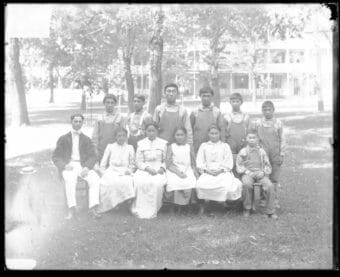
Anastasia Ashouwak, pictured third from right in the bottom row, was part of a group of Alaska Native children, pictured here, sent to the Carlisle Indian Industrial School in 1901. (Photo courtesy: Lara Ashouwak)
An Alaska Native girl who died more than 100 years ago at a boarding school in Pennsylvania will return home to Kodiak Island. Earlier this summer, the U.S. Army began the process of returning the remains of eight Indigenous children from the school to their families across the country.
According to records, Anastasia Ashouwak was taken from an orphanage on Woody Island in the Kodiak Archipelago and sent to the Carlisle Indian Industrial School after her mother died in 1901. Alutiiq Museum executive director April Laktonen Counceller says Ashouwak was part of a group of Alaska Native children sent to the school.
“There were 11 students that went on that journey,” Counceller said. “There’s records of their steamship travel, and the remainder of their travel once they hit the West Coast was by train.”
Indian boarding schools like Carlisle stripped Indigenous children of their culture and had notoriously poor conditions. Just last summer, the Department of the Interior announced it would be looking into the “troubled legacy” of Indian boarding schools in light of the discovery of 215 graves near a boarding school in Canada. It released its first report on the schools in May.
Ashouwak spent the next three years at the school before dying of tuberculosis at the age of 16.
She was buried alongside other children in the school’s cemetery. For more than a century she remained buried under a headstone inscribed with the name Anastasia Achwack.
Counceller says records indicate that Ashouwak was Sugpiaq/Alutiiq and had ties to the former village of Kaguyak on the southern tip of Kodiak Island, which was washed away in the 1964 tsunami. Her family then moved to the village of Old Harbor, where many people still share her last name.
Cassey Rowland is an Alutiiq artist from Kodiak and one of Ashouwak’s descendants. Her father, Ted Ashouwak, who is from Old Harbor but now lives in Maine, is Ashouwak’s great-nephew and closest living relation. Rowland says she never heard about the boarding schools from village elders when she was growing up.
“They just didn’t talk about it, it was just too painful for them,” she said.
Rowland has a daughter the same age as when Ashouwak left Kodiak Island for the Carlisle School, and she’s been honest with her daughter about what happened at Carlisle and other schools like it.
“We’ve been learning about the Indian boarding schools before we even learned about our ancestors being a part of it, and she’s been asking questions and I’ve been telling her the whole truth. I’m not the type of parent that’s going to hide away,” Rowland said.
Rowland and her daughter flew to Pennsylvania earlier in July where they gathered with other members of their family as Ashouwak’s grave was dug up in preparation for her reburial in Alaska. Members of the Alutiiq museum and a Russian Orthodox priest from Kodiak also joined the family.
Rowland said she brought paint to decorate the box that will carry the remains of Ashouwak home — she planned to incorporate Alutiiq and Russian Orthodox designs for the casket.
“And then the bright colors of the island just to bring her home — lots of bright greens and blues, oranges, pinks, so, just trying to make it look like a little girl,” she said.
The U.S. Army is in the process of identifying the children buried at Carlisle, and repatriating them to their families. (Photo courtesy of Lara Ashouwak)
Counceller said Ashouwak’s return to Kodiak is different. The U.S. Army oversees the cemetery at the Carlisle Indian Industrial School. It’s in the process of returning the remains of children who can be identified to their communities.
The Alutiiq Museum knows of another girl from Kodiak buried at Carlisle and hopes to bring her home next summer, Counceller said.
When Ashouwak returns to Kodiak, Counceller said she’ll receive services at the local Russian Orthodox church in the city of Kodiak and an Alutiiq ceremony at the museum. The Alutiiq Dancers — including Rowland’s daughter — also will perform. Ashouwak and her family will then be flown to the village of Old Harbor for a graveside service followed by a potluck.
Counceller says there’s a sense of relief among the community that Ashouwak will finally return home.
“As many of us Native people know, we’re kind of all related around the island so, although this is one individual, it’s a moment for all Alutiiq people to think about how important this kind of work is,” she said.
Rowland says a part of her will also be at peace when Anastasia is finally alongside members of her ancestors in Old Harbor.
“She’s gonna be where she is wanted. We need her home. And she’s gonna feel that, we believe. Her spirit will finally be at rest,” said Rowland.
Rowland says she’ll be processing why it took so long for Ashouwak to return to Old Harbor for the rest of her life.
Services and burial for Anastasia Ashouwak will be Saturday, July 9th, in Kodiak and the village of Old Harbor.
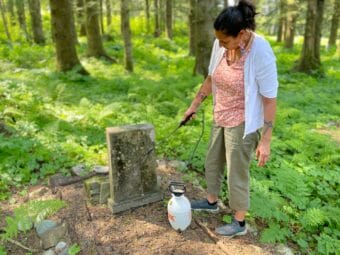
Jamiann S’eiltin Hasselquist sprays water on a gravestone in a neglected cemetery near Lawson Creek on Douglas Island, Juneau, on June 17, 2022. Hasselquist and other volunteers have been working for over a year unearthing and restoring gravesites in the area. (Photo by Lisa Phu/Alaska Beacon)
Jamiann S’eiltin Hasselquist plays a song from her phone at a gravesite near Lawson Creek on Douglas Island in Juneau. She rests the phone down on the ground.
“It was a T’aaḵu Kwáan song, the wolf song. I suspect that he’s of the T’aaḵu Kwáan, and so I’ve played the song to honor him and his people, and let him hear it through the ground,” Hasselquist said.
The stone grave marker has a Bible at the very top with the gates of heaven underneath, and a wolf under that. It has two names on it — Kitchoshan and Kakantan. The person was born July 5, 1850, and died June 3, 1901.
This is just one of the hundreds of mostly neglected resting places found off Douglas Highway, around the Lawson Creek area, many of which belong to Native people. Hasselquist is part of a group of volunteers who spends time restoring and uncovering Native gravesites, “not letting them be forgotten and keeping them from being built over,” she said. “We know that that kind of thing happened here.”
A gravesite in a cemetery near Lawson Creek on Douglas Island, Juneau, as seen on June 17, 2022. The gravestone has a Bible at the very top with the gates of heaven underneath, and a wolf under that. It has two names on it — Kitchoshan and Kakantan. (Photo by Lisa Phu/Alaska Beacon)
A little further south along Douglas Highway is Sayéik Gastineau elementary school, which was built upon a Native burial ground in the late 1950s.
Since last April, Hasselquist said volunteers have spent hundreds of hours on weekends and in the evenings “chopping their way through” all the growth and foliage — cutting down salmonberry bushes, weed whacking and cutting off tree limbs and old dead trees.
Juneau resident Hanna Schempf is another volunteer.
“You’d whack off enough bushes that you could clear the gravesite you were looking at. And then you’d look through the stems, and you can see other graves just keep going and going and going,” she said.
A 1995 City and Borough of Juneau report on historic cemeteries in Douglas says about 514 graves are within cemeteries that are recognized as “the Catholic, Eagles, Douglas Indian, Masons, Odd Fellows, City, Servian, Asian, Native, and Russian Orthodox.” Today, a few of these sections, like the Eagles and Catholic, are kept up well, but some of the others are not.
The volunteer group has restored or uncovered dozens of Native gravesites, Hasselquist said, including Chief Johnson, chief of the T’aaḵu Kwáan.
“His stone was completely over. We didn’t even know who it was. It was just toppled over,” she said.
Volunteers have found many indentations in the ground though not the markers for each. Some were buried inches underground and uncovered during cleanup. “So we suspect that there are other markers there; we just have to go and find them,” Hasselquist said.
Jamiann S’eiltin Hasselquist sprays water on Chief Johnson’s gravesite on June 17, 2022. He was chief of the T’aaḵu Kwáan. (Photo by Lisa Phu/Alaska Beacon)
“Everybody deserves a place of rest with honor, dignity and respect,” Hasselquist said. “We all have an inherent right and a responsibility to care for these areas whether we’re related to them or not. This is part of our community.”
‘Neglected, forgotten and destroyed’
Hasselquist was inspired to do this work from Sitka resident and cemetery restoration expert Bob Sam. She first saw his work with Sitka cemeteries on Facebook and later saw it in person. Last April, the two connected when Sam was in Juneau to work on the Lawson Creek cemetery.
For Sam, restoring and maintaining cemeteries — whether in Sitka, Juneau, or Japan — is his life work. “This is something I’ve been doing since I was a small child,” he said. The work is “not a one-time thing. It’s perpetual care.”
Sam, 68, has family buried in Juneau. He first started cemetery restoration in Juneau in the early 1990s at Evergreen Cemetery, specifically the Orthodox Church section. Then he started working at Lawson Creek after learning more about it from Lingít elder Marie Olson.
“The Native section of Lawson Creek was neglected, forgotten and destroyed. Every headstone was knocked down. There was little evidence that they existed,” Sam said. “It took years to cut brush, remove trash, upright headstones just to find the Native section of Lawson Creek. I could not have done this work without support from Elders who also donated tools and stuff.”
Sam said it’s a responsibility to take care and maintain the gravesites of ancestors.
“We’re all human beings and how we treat the dead defines our humanity,” he said. “If a cemetery looks neglected and forgotten, it gets abused. But if you clean it up, make it look real nice, it gets to a point where it takes care of itself, where people pick up after themselves and show respect.”
A neglected cemetery near Lawson Creek on Douglas Island, Juneau, as seen on June 17, 2022. A group of volunteers have been working for over a year unearthing and restoring gravesites in the area. (Photo by Lisa Phu/Alaska Beacon)
A healing process
Though the intent was to unearth and restore Native gravesites, Hasselquist and other volunteers have spent a lot of time on other neglected and forgotten resting places as well.
“We extended after we got the salmonberry bushes down from our ancestral area,” Hasselquist said.
But first, the group had to go through a healing process.
“A lot of things were said out loud, verbalized, just bringing out the frustrations about how we were not tended to and that we just will not be invisible anymore, we will be seen, they will be seen and remembered,” Hasselquist said.
“And so when we got through all of that, there was a weight lifted, and we were looking at the other areas, and we’re like, ‘Let’s go do it. Let’s start working on them.’”
Hasselquist would like to focus and work specifically on the Native section.
“But we’ve been so focused on other areas that it’s consumed our time. So if we could get others to take responsibility for the other areas, at least tending to them by mowing and weed whacking and keeping control of the salmonberry bushes and things like that because it’s just a jungle on that side.”
Hanna Schempf traces the engraving on a gravestone in a neglected cemetery near Lawson Creek on Douglas Island, Juneau, on June 17, 2022. Schempf is part of a group of volunteers who’ve been working for over a year unearthing and restoring gravesites in the area. (Photo by Lisa Phu/Alaska Beacon)
Schempf, one of the volunteers, is slowly working on a database of the cemetery that will eventually be public.
“All the information I’ve gathered is publicly available; much of it is accessible for free online. It is, however, very scattered. I’m hoping to pull it all together in a way that makes it easy for families to find their loved ones and find information about them more easily.”
“Many of the people buried in Douglas fought for recognition and respect in life, and fought to be remembered in death. It takes ongoing effort to support that, and a lot of the history of these cemeteries is already irrecoverably lost — loss of physical records, loss of living memories, and neglect of the cemeteries themselves have all played a part. It’s important to work on them now before more is lost,” Schempf said.
Whose responsibility is it?
The issue of maintaining the historic cemeteries in Douglas was most recently brought to the City and Borough of Juneau’s attention in 2018 when former mayor Merrill Sanford offered to transfer the well-maintained Eagles’ cemetery to the city at no cost with the understanding that the city would continue maintenance. The city explored what that process would entail but ultimately no action was taken. Sanford also asked the city to consider acquiring the other cemeteries in Douglas.
The cemeteries and gravesites near Lawson Creek in Douglas are owned by various parties and precise land ownership is not something the City and Borough of Juneau has ever been able to pin down.
A 2019 memo to the Lands Committee said, “There has been controversy concerning ownership of the cemeteries in Douglas since the late 1800s. Discussions about the upkeep of the cemeteries and whether or not they were city property began as early as the 1940s and the topic has been brought to the municipal governing body (Douglas City and the City & Borough of Juneau respectively) every decade since.”
According to the city, “there hasn’t been much movement” on the issue of maintaining Douglas cemeteries since the 2019 memo.
“I think this could be picked up again if the Assembly makes it a priority, which could be the outcome of citizens bringing it up,” lands and resources manager Dan Bleidorn said.
The city’s parks and recreation department currently maintains the Douglas Indian Cemetery, which is across the street from Sayéik Gastineau elementary school and set apart from the other cemeteries surrounding Lawson Creek. While the city doesn’t own it, the city’s been providing weekly maintenance of it since 2012 when a renovation at the school disturbed human remains.
Finding peace
Hasselquist said, for her, choosing to restore Native gravesites “has to do with my own personal life trauma.” The trauma stems from her ancestors and family attending residential boarding school institutions and “the things that were brought home and taken from us.” She’s the first generation of her family who didn’t attend a residential boarding school.
Jamiann S’eiltin Hasselquist brushes foliage aside from a neglected gravesite near Lawson Creek on Douglas Island in Juneau on June 17, 2022. (Photo by Lisa Phu/Alaska Beacon)
When the remains of hundreds of Indigenous children were found on the grounds of a former residential school in British Columbia last summer, Hasselquist said working on restoring gravesites “helped with the anxiety and the triggering that was happening.”
“It helps me find more peace,” she said. “And then it feels good to tend to our ancestors and take care of those places. They deserve to be resting somewhere that’s beautiful, and in honor and dignity and respect.”
The volunteers’ work has inspired others to join in through cemetery restoration and clean-up events posted on the group’s Facebook page. Hasselquist hopes to “ignite a spark” in younger people to take care of the areas.
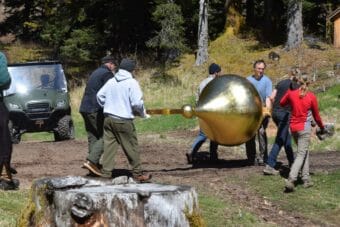
Monks and volunteers carry the dome that is now installed on the top of Spruce Island’s newest chapel. (Photo courtesy of Father Andrew)
The village of Ouzinkie on Spruce Island has an Orthodox church, and the far side of the island also has its own chapel over the grave site of St. Herman. But the three monks who live in the middle part of the island only have a small indoor chapel in their shared house.
Father Andrew is the superior of the monks living on Spruce Island. He said that even though there are places of worship on either side of the island, the new chapel will give the small community their own place of worship.
“This is our home,” said Andrew. “And we have guests, especially in the summer months, and now also, local people in our Sunny Cove area who attend church here.”
The chapel is nearing completion and should be finished sometime in the fall of this year. A golden dome has already been raised over the structure, but final artistic work still needs to be done. Father Andrew is hoping that it will be open for services in spring of 2023.
The chapel should be open for services in spring of 2023. (Photo courtesy of Father Andrew)
“Like other churches in Alaska,” Andrew said, “although it’s very remote, you can see some nice architecture and fine carpentry.”
Over 200 years ago, the first Russian Orthodox monastery in North America was founded in Kodiak, in the modern-day city of Kodiak. The head of the monastery at the time, Herman of Valaam — known today as St. Herman — renounced his position and took on the life of a hermit on Spruce Island.
“He ended up taking care of orphans, especially after the 1819 epidemic. Many orphans were sent to him, and he had a community down in Monk’s Lagoon, and there are now four chapels down there. And it is a place of pilgrimage where people come from all over the world,” Andrew said.
Father Andrew says many visitors from Russia and Ukraine typically pilgrimage to Spruce Island during the summer months. He doesn’t expect them this year due to Russia’s ongoing invasion of Ukraine, but he is still expecting summer visitors from around the United States and Alaska.
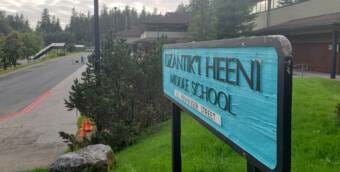
A woman walks a pair of dogs at Dzantik’i Heeni Middle School in Juneau on the evening of Aug. 11, 2020. “Dzántik’i Héeni” is a Tlingit place name for Gold Creek that means “river at the base of flounder hill.” (Photo by Jeremy Hsieh/KTOO)
Faculty at Dzántik’i Héeni Middle School in Juneau discovered a covered play area had been vandalized Tuesday morning. There were crude drawings, crude language, someone’s phone number — and a swastika.
Assistant Principal Laura Scholes said they’ve had a spate of vandalism at the school this year. She said the swastika feels like an escalation.
“It’s smiley faces, a couple of you know, sexually explicit kind of drawings, crude things, but not — not anything like this,” she said.
The swastika has had many meanings across many cultures in history. But for the last century or so, innocuous meanings have largely been displaced by associations with white supremacy and Nazi Germany’s mass murder of Jews and other minority groups.
Scholes said they painted over the vandalism immediately and, unlike past incidents, reported it to police.
Juneau police spokesman Lt. Krag Campbell said it’s being investigated. He said individual reports of vandalism are often logged to identify potential trends without much follow-up. But he said this case sticks out and will get more attention. In part because of the swastika, but also because the vandalism included references to a specific person and phone number, meaning this could be some kind of harassment.
Campbell wasn’t ready to call it a hate crime but didn’t rule it out either.
These were at my (Jewish) 8th grader’s school. Maintenance came & painted over them. This was the 1st “big one.” The others are little ones in the bathrooms. This is why race & Holocaust education a *IS* needed in schools. pic.twitter.com/j76Slz2XzY
Scholes doesn’t think it got much exposure and for now, doesn’t intend to address it with her school community. She said that could change, depending on what the police find out.
After KTOO contacted the Anti-Defamation League for comment, the organization said it would reach out to Dzántik’i Héeni to offer support. Miri Cypers is the league’s regional director and she said that could include age-appropriate discussions about history, trauma and the Holocaust.
“We always do advise and try to work with K-12 schools to examine and reflect on the incident that happened and think about how they could make it a teachable moment for their students and their broader school community about how they hopefully want to commit to having a school where all students feel a sense of belonging and there aren’t, you know, hateful acts of vandalism or other hateful acts that happen,” she said.
Cypers said bias incidents are ticking up in schools, which she calls microcosms of our communities. She said exposing these incidents creates opportunities for growth and conversation.
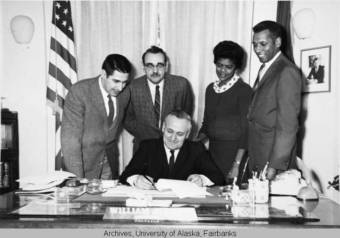
Photograph of Governor Egan signing the Human Rights Act. Identified are left to right Sen. Mike Gravel, Dick Hedberg-AFL-CIO, Maria G. Bowman and Willard Bowman-NAACP. (Photo courtesy of the William A. Egan Papers, Elmer E. Rasmuson Library, University of Alaska Fairbanks, (UAF-1985-120-555)
Stories of housing discrimination in the 20th century are often set in the lower 48, but Alaska has its own legacy of racial segregation. In his book “Black History in the Last Frontier,” Ian Hartman outlines how racial segregation looked in Alaska compared to the rest of the country.
For example, housing covenants in Anchorage and Juneau prohibited the sale of houses to anyone who wasn’t white. In some instances, they were specifically written to exclude Black Alaskans and Alaska Native buyers. And in some areas, those historical boundaries impact the ways that neighborhoods look today.
“In Juneau, again, with with the largest minority population being Alaska Natives, you’d probably find very explicit references forbidding the sale of a home to anyone who was not of quote ‘Caucasian extraction’ or whites only are able to sell or whatever the case would be. And then there would be these exclusionary clauses that would encapsulate the various minority populations,” he said.
Book cover of “Black History in the Last Frontier” by University of Alaska Anchorage history professor Ian Hartman.
Hartman is a history professor at the University of Alaska Anchorage. He said it took him some practice to know what to look for while he was looking through historical documents because the racial language was often extremely outdated.
“You have to kind of train your eyes to read these documents, but entire neighborhoods in Anchorage really bear the imprint of racially exclusive buying,” he said.
In 1948, the Supreme Court ruled that racial covenants like these were unconstitutional. That opened the door for Black families to move in. Hartman’s book details that in Anchorage, white supremacists burned down the homes of those pioneering Black families. Those fires, and the pushback from Black activists, led to the NAACP opening its first branch in Alaska in 1951.
In November of 1969, Ebony magazine printed an article saying Alaska’s prospects were open to Black Americans who were willing to work hard. However, the magazine also acknowledged that Black men were excluded from the fishing industry in Ketchikan, and Black Americans and Alaska Natives talked about encountering housing segregation in Juneau, Anchorage and Fairbanks.
Hartman’s book also details instances where Black Alaskans faced further discrimination and racial hostility in the 1970s and 80s as more and more white people moved to Alaska from the South and brought white supremacist views with them.
“I think that there’s a belief among Alaskans, right? The famous line, we don’t, we don’t care how they do it Outside, or, you know, we’re going to do it our own way. And that can have quite a costly impact on communities of color who may be steamrolled by the process — particularly again, in the Cold War era when Alaska really boomed in terms of its population. Then, of course, again, with the with the establishment of the trans-Alaska pipeline in the oil boom in the 70s,” he said.
But the 70s were also the time when Alaskans elected their first Black politicians.
The first Black state representative pushed for a committee to develop a survey on discrimination in Alaska — the group focused on Southcentral Alaska. Hartman details that final report, which showed high levels of housing segregation. It concluded that white residents had deliberately locked minorities out of the housing market and pushed them onto the least desirable land.
Hartman says he wrote the book after years of reading the same stories of the history of Alaska, which left out whole communities of people. And he says that while there’s a historical era of racial tension that has to be confronted, it’s also important to be realistic about the present.
“If you were to look at life expectancy, access to health care, access to quality education, generational transfers of wealth, things like that, I mean, you know, Alaska still does bear the imprint of the historical legacy of, of racism and racial inequality,” he said.
Hartman says he wants people who read his book to see the value in the state’s diversity. He’s expanding on his 2020 book with a new edition set to come out in the fall of 2022 “Black Lives in Alaska: A History of African Americans in the Far Northwest.”
Attendees of a vigil honoring missing and murdered Indigenous persons light lanterns at Overstreet Park on Feb. 14, 2022, in Juneau (Photo by Lyndsey Brollini/KTOO)
Valentine’s Day this year marked three years since Tracy Day went missing.
Day, who is Lingít, is one of several Alaska Native Juneau residents who disappeared and haven’t been found. About 30 people gathered on Monday night to share their stories and sing to their missing loved ones.
A row of seven portraits sat propped up near the whale statue in Overstreet Park in Juneau. All were of Alaska Native people who went missing in Juneau or nearby communities. Most have not yet been found or were found dead.
One of the missing people is Tracy Day.
Tracy Day has been missing since Feb. 14, 2019. (Photo courtesy of Juneau Police Department)
Mike Kanaagoot’ Kinville stood looking at the portraits, then turned to share his story about Day. His family and Day’s family have been close for generations, so he has a lot of them. Like, when Day was 14-years-old, and she ran away from home in Juneau and beelined for his house in Ketchikan.
“She had known that I was a drinker at one time and she came looking to drink with me,” Kinville said. “And I had gotten sober since then, so I was in a position to take her in and started doing foster care for her.”
Kinville said she stayed with the family for nearly three years. He said she had a lot of charisma — that she was joyful and mischievous at the same time — and that she was “kind of a smart aleck.”
Kinville’s family ended up taking care of Day’s daughters, too. The older one, when Day went away to nursing school; the younger one, after Day went missing.
“Our families are tied together really close,” Kinville said. My mom and dad took in Tracy’s mom when she was a teenager, too. That’s pretty Lingít too, the generational ties back and forth together,” he said.
Before Day disappeared, Kinville says she had her ups and downs. She struggled with substance use and her mental health. It’s the kind of thing a lot of families experience but don’t usually talk about.
“You learn to guard your heart to a certain extent with situations as much as you can, but you still get bruised,” he said. “And, in this case, heartbroken. It’s just, the heartbreak can’t heal because we don’t know what happened to her.”
Kinville said that what makes it even harder is that before she disappeared, Day seemed like she was getting some stability in her life.
“We were hopeful,” he said.
As he looked down the row of photos of Juneau’s missing again and talked about each of the families they left behind, he got choked up.
“You know, I said heartbroken, but what it feels like is an ache in my soul,” Kinville said. “It’s just so deep, you know, deeper than my bones. This sense of this unresolved pain that goes on and on. It’s really difficult. My heart goes out to the families of these missing people. I imagine I have their sympathy as well. The other part about it that’s difficult is, you know, life goes on for everybody else, and things go back to normal, and that part of us is still missing.”
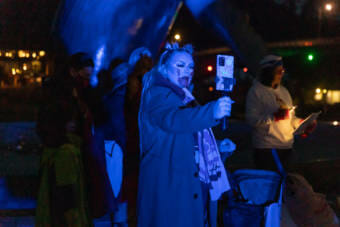
Jamiann S’eiltin Hasselquist drums at a vigil for Tracy Day and other missing and murdered Indigenous persons at Overstreet Park in Juneau. Hasselquist is part of the Strong Women singing group. (Photo by Lyndsey Brollini/KTOO)
Kinville said he’s hoping the vigil will help people understand what it’s like to love someone and not know what happened to them. It’s a wound that won’t close.
“It’s important for a community to come together and not give up on the people who are missing and not marginalize these people. What’s common here is race and income bracket, you know. That’s not the society that I want to live in, and I think we can do better than this,” he said.
The Strong Women group sings at a vigil to honor missing and murdered Indigenous persons in Juneau, Alaska. (Photo by Lyndsey Brollini/KTOO)
Several women sang throughout the night for those who have missing and murdered Indigenous relatives. They’re called Strong Women, and Rhonda Butler is one of them. Butler is the President of the Alaska Native Sisterhood Camp 2 in Juneau. She said she and the women who joined her sing to bring strength to families who are struggling from these losses.
“One of our strengths is our voices, and if we don’t use our voices, no one will hear. So we’re here to share a couple songs with everyone here in honoring Tracy Day and all the other missing and murdered Indigenous peoples,” she said.
Candles lit in honor of Tracy Day and other missing and murdered Indigenous persons at a vigil at Overstreet Park in Juneau. (Photo by Lyndsey Brollini/KTOO)
The temperature dropped as the sun went down, but people stuck it out. They lit candles and sheltered the flames from the wind. Then they started lighting flying lanterns.
Toward the end of the evening, as the snow started to fall more heavily, one woman said she wanted to sing a hymn for Tracy Day. Day’s twin sister Angela jumped up and ran over to join in.
They huddled together, rocking and shivering as they sang “How Great Thou Art,” as the flickering light from sky lanterns faded off into the distance over Gastineau Channel.
Close
Update notification options
Subscribe to notifications
Subscribe
Get notifications about news related to the topics you care about. You can unsubscribe anytime.