Spirit

Tongans in Juneau wrestle with how best to help loved ones affected by the eruption and tsunami

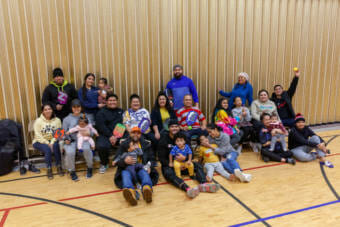
Melehoko Pauu Ma’ake talks to a friend during her family’s regular meetup to play pickleball on Saturday in Juneau. Most of the family is Tongan, and they’ve been trying to reach family and friends in the island nation after a volcanic eruption and tsunami. (Photo by Rashah McChesney/KTOO)

Melehoko Pauu Ma’ake has been dealing with two big problems since the volcanic eruption in Tonga. The first is reaching her uncle. He’s 84 and lives by himself near the capital, directly in the path of the tsunami.

She laid out the second problem in a Zoom call with some family members a few days after the eruption, as the group considered the best place to send aid money.

“The thing about Tonga is trying — is finding a very trustworthy source,” Ma’ake said. “You know, all of us here here, we’ve been to Tonga many times. And we know that when funds go to Tonga, sometimes it really doesn’t go directly to the people.”

She trusts the Red Cross and the Church of Jesus Christ of Latter-day Saints, but she’s still grappling with the problem of how best to fundraise in Juneau for her friends and family in Tonga.

So she called a group of her extended family to her home in Juneau to talk about what they know, to maybe figure out how they can help.

Ma’ake was born in Tonga but moved to the U.S. when she was four. Like many Alaskans, she and her husband moved to the state after a visit. She said she decided on Juneau because it’s a good place to raise a family — and they did. Now, when the family gets together, it’s always a sprawling intergenerational mix of babies, family born in the U.S. and family born in Tonga.

Members of the Ma’ake and Sekona and Paea families — and a few friends — meet up to play pickleball on Saturday in Juneau, Alaska. Most people in the group are Tongan, and they’re working to support their friends and family who have been affected by the disastrous volcanic eruption near the island nation. (Photo by Rashah McChesney/KTOO)

She estimates that around 200 Tongan people live in Juneau, and says it’s a tight-knit community. And they’ve got family and friends around the world who are doing the same thing everyone in Juneau is doing — checking social media, texting each other updates and sharing what they know. 

Telephone links between Tonga and the rest of the world are slowly being reconnected, but they’re unreliable, and the internet is still down.

“Everyone is trying to get a hold of someone in Tonga,” said Margaret Sekona. “So it’s going to be super hard and complicated, but you have to keep trying.”

Her father, Siua Sekona, said he’s been calling for days with no luck.

“There’s no connection,” he said. “It’s ringing, but there’s nothing like an answering machine or something that you can leave a message [on]. Nothing.”

Siua Sekona grew up in Tonga. Right now, his big concern is fresh water. He said most Tongans are not connected to city water, so they rely a lot on rainwater.

But a lot of the fresh water supply is tainted by volcanic ash and saltwater from the tsunami. A few aid flights have landed, and at least one ship has docked with supplies. But the family worries about there being enough to go around.

At one point, Margaret Sekona sits down at the dining room table hunched over her phone. Her father and Ma’ake huddle in.

Someone on the country’s main island, Tongatapu, managed to get a connection and live-streamed a drive through the devastation.

Margaret turns and looks at her dad. “Can you tell where this is?”

He pauses for a moment and then shakes his head. “I couldn’t really tell.”

She said she’s surprised to see buildings and houses standing, cars driving along the road. There are broken windows and downed trees, and everything is blanketed in this dark film of mud and ash.

“It’s a little comforting though, for sure, to be able to see at least something,” she said. “But you can still see there’s so much damage.”

Even though what she sees on the screen right now is terrible, it’s better than what she imagined.

Siua Sekona (right) watches a pickleball game on Sunday in Juneau. Sekona was born and raised in Tonga and, along with the rest of his family, has been waiting to hear from friends and family who still live there. (Photo by Rashah McChesney/KTOO)

Siua Sekona said it’s hard to know the extent of the damage right now, but he is hopeful. He has seen what happens after the islands take a hit. He said Tongans are resilient and won’t wait for the help that’s coming from other countries — they’ll help themselves and each other.

“They were sharing everything that they can share, and I was really touched by that,” he said.

He told the family that everything in life happens for a reason.

“I don’t belittle the experience that happens to them because I was one of those victims before. I feel for them, I pray for them. But, [at] the same time, I always look to see what’s coming behind the experience,” he said. “I know that they’ll feel the love and prayers of people everywhere — even people that are not Tongans. It’s amazing how this kind of catastrophe [brings] people together.”

This whole experience takes him right back to his own childhood. In 1982, one of the deadliest storms in Tonga’s history struck. Cyclone Isaac killed six people and left 45,000 people homeless.

When he sees the video on Margaret’s phone, his hand’s shake.

“It seems that I’m — I relive the experience again,” he said. “Because I know exactly how it feels.”

Siau Sekona says he was on one of the outlying islands at the time, on a mission for the Mormon church. He woke up at 2 a.m. as a storm surge swept him from his bed.

“You know, we were swimming because the wave was so high,” he said.

He remembers that most of the buildings were blown away, and everyone spent the night outside in the dark waiting for the sun to come up so they could figure out what was left behind.

He’s thankful that this time around, the eruption and tsunami happened during the day so at least people were able to see it coming.

As for Ma’ake’s uncle? She still hasn’t talked with him directly. But she finally heard from someone who heard from someone that he’s OK — one less person for her to worry about.

Bristol Bay sings for slavii, but celebrations look different this year

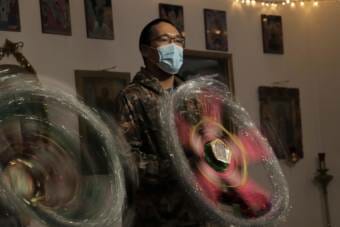
A man spinning a tinsel star
The beginning of slavii in Dillingham on Jan. 7, 2022. (Photo by Izzy Ross, KDLG)

The horizon glows deep orange under a cloudless, dark sky along Nushagak Bay.

Several people sing inside St. Seraphim of Sarov Orthodox Church.

It’s Christmas morning in the Russian Orthodox tradition, the start of slavii. And it’s the second year the parishioners are celebrating in a pandemic. That means they will have to celebrate an important part of the holiday differently.

The outside of a church in the night with an orange glow on the horizon
St. Seraphim of Sarov before sunrise. Jan. 7, 2022. (Photo by Izzy Ross/KDLG)

As the service continues, more people arrive. Some take disposable masks available in the church entrance. Two men move to the front of the room holding tinsel stars with pictures of saints in the middle. They start to spin the stars, and slavii begins.

A man in a church spinning a tinsel star, which appears green in the middle
Starring at St. Seraphim of Sarov. Jan. 7, 2022. (Photo by Izzy Ross, KDLG/Dillingham)

“Starring” symbolizes the birth of Christ and ushers in the new year. Normally, carolers twirl bright tinsel stars in households around their communities. Some travel to other villages as well.

“Slaviing this year is a little different compared to last year. If we do go slaviing – people need to give us a call. Invite us to their house,” said Subdeacon John Casteel.

He stands at the front of the church during a break in the service, explaining how this year’s celebrations would be different.

A group of people standing inside a church
People celebrate Christmas service at St. Seraphim of Sarov in Dillingham. Jan. 7, 2022. (Photo by Izzy Ross/KDLG)

During slavii, people usually go from house to house to sing, visit, eat and rest. This year, the parish used social media to announce the changes, and ask people to call if they wanted slavii carolers to visit. If the carolers do slavii at somebody’s house, they’ll ask the host how many people can enter.

“We’re going to sing and then leave right away,” he explained. “We won’t hug anybody, we won’t kiss anybody. It’s alright for them to give us a donation, it’s alright for them to give us a goody bag if they want to.”

""
People at St. Seraphim of Sarov’s Christmas service on Jan. 7, 2022. (Photo by Izzy Ross/KDLG)

Slavii is a Russian Orthodox tradition in what’s now Ukraine. But it has a long history in communities around the state, including Bristol Bay. Carols here are sung in Yup’ik and English as well as Slavonic, an archaic Russian dialect used by the Orthodox Church.
Marilynn Casteel’s family has practiced slavii for generations.

“My grandpa was John Nelson. He was the chief of the church, and he ingrained a lot of Christmas spirit into us, that we should go sing and make grace that the Christ is born and to open our homes to all the slavii-ers,” Casteel said.

Three people dressed in winter clothes, singing inside a church
Singing during Christmas service. Jan. 7, 2022. (Photo by Izzy Ross/KDLG)

They didn’t slavii in person last year, and she said this year, local public health officials discouraged doing so. Those changes are difficult.

“After church we’re used to hugging and kissing and carrying on, but you know, over the past two years, none of that’s been happening,” Casteel said. “We lost a lot of our Elders over the last two years, and that’s what makes it emotional, too. We love our Elders. And, you know, at this point, I think all we could do is say prasdnikom from the St. Seraphim of Sarov in Dillingham, Alaska.”

""
Parishioners masked up for Christmas service. Jan. 7, 2022. (Photo by Izzy Ross/KDLG)

This year, Casteel said, they’re trying to find ways to celebrate safely: they’ll still bring the star to people who ask for it, but they’ll limit the number of carolers who enter each house. They are also hoping to stream carols on Facebook Live for people who can’t receive the start this year.

“I feel like it’s really hard. It’s pretty emotional, because it’s not normal,” said another parishioner, LahRae Angasan.

Angasan always enjoys this time of year, and she said gathering is important, even if it’s from a distance.

“I think when everybody gathers together, it feels like home,” she said. “It feels like family, and it’s really good to see a lot of faces, and just like I said, it’s pretty emotional to keep our distance from everybody.”

Angasan and others will slavii until Jan. 14, when they will celebrate New Years with a bonfire in Aleknagik.

People standing inside a dark church with the rising sun appearing in one window
Sunrise during service. Jan. 7, 2022. (Photo by Izzy Ross/KDLG)

Troopers find mother of newborn found at Fairbanks intersection

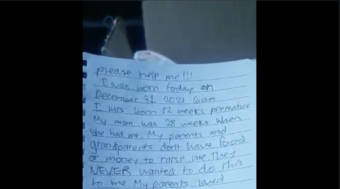
A note left with the newborn, identified as Teshawn, found at an intersection in Fairbanks on Dec. 31, 2021. (Screenshot from Facebook)

Update — Wednesday, Jan. 5, 2:48 p.m.

Alaska State Troopers say investigators located the mother of the newborn who was found New Year’s Eve in a cardboard box at a Fairbanks intersection.

Troopers say the mother, who is a minor, was brought to a hospital in the Fairbanks area for an evaluation and medical care.

“The investigation into the circumstances surrounding the baby being abandoned is ongoing, and no criminal charges have been filed at this time,” troopers wrote in an online dispatch.

Original story – Wednesday, Jan. 5, 12:43 p.m.

Efforts to find the parents of a baby left in a cardboard box on a west Fairbanks street corner on New Year’s Eve continue.

Alaska State Troopers say they are pursuing all avenues, including DNA analysis, to find the family of the newborn — whose name is Teshawn, according to a letter left with the child.

The baby was found near a bank of mailboxes at the intersection of Dolphin Way and Chena Point Avenue. The note refers to parents who lived nearby on Cormorant Street, but troopers say the newborn may have come from a different location in town.

The note said the family could not care for the baby, who was wrapped in a blanket inside the box. Troopers say the child appears to have been found shortly after being left.

The child remains in good health and is being cared for by the state Office of Children’s Services.

Abandoned newborn found at Fairbanks intersection

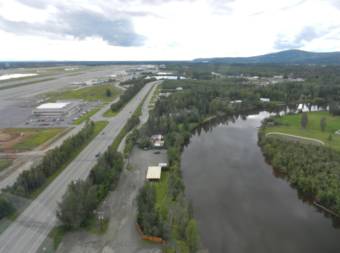
Fairbanks International Airport and Airport Way. (Photo courtesy Travis S/Creative Commons)

A newborn was abandoned in a cardboard box at an intersection in Fairbanks on Friday afternoon, according to a report from Alaska State Troopers 

Troopers say they got a report at about 2 p.m. that the child was left at an intersection near Chena Marina. 

When they found the child, who seemed to have been abandoned recently, they also found a note “indicating the parent could not take care [of] it,” the report said.  

Troopers say the child was taken to a local hospital, where they were found to be in good health. Fairbanks Memorial staff would not answer questions about the child’s condition. 

Troopers are still investigating the incident and have not yet responded to questions about the infant and the circumstances in which it was found. 

The temperature in the area was about 1 degree at the time. 

A Fairbanks woman named Roxy Lane posted on social media Friday night that she found the newborn near a row of mailboxes by her house.  In a video she posted, Lane shows a baby wrapped in a thick blanket. She also shows a note that says his name is Teshawn. 

According to the note, the baby was born at 6 a.m. on Friday and may be several weeks premature. The person who left him wrote, “My parents and grandparents don’t have food or money to raise me.”

The note also says that the family who left Teshawn behind lives nearby. 

Alaska does have laws in place for people who want to voluntarily surrender a child, but it has to happen under specific circumstances. The infant has to be younger than 21 days old and must be left with an emergency official, someone who has medical training or anyone the parent believes would keep the infant safe. 

Lane said Saturday that the parents may not have been aware of those safe haven laws or that they can call child protective services and surrender their baby without penalization. 

“Honestly this kind of stuff happens more often than you would think,” Lane wrote. “Somewhere along the line we’ve all failed this family…Everyone should have access to basic necessities and shouldn’t feel like they have to abandon their babies for it to have a better life.” 

Lane said that she has cycled through a lot of emotions — shock, anger and sadness — and is comforting herself by making wishes for his future. 

“He has endless possibilities in front of him, and who knows, maybe he can be reunited with his mother if she needs help and gets that help,” she wrote. 

In her post, Lane asked that anyone who knows Teshawn’s mother check on her. 

“She might be in a desperate situation, feeling abandoned herself,” Lane wrote. “Clearly someone in our community felt so lost and hopeless that they made probably the hardest choice of their lives to leave that innocent life on the side of the road with nothing but some blankets and a name.” 

This story has been updated to remove a link to Roxy Lane’s post which she has since taken down. 

Correction: A previous version of this story said the baby was found on the wrong day, it was Friday afternoon. 

Support is here for Alaskans who have experienced the loss of an infant or pregnancy

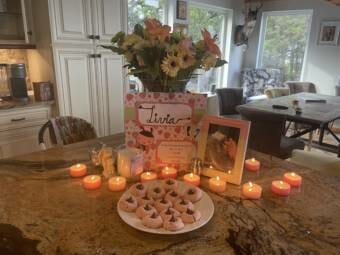
A plate of cookies, lit candles, a card, brightly colored flowers and a photo of a baby are arranged on a table as a shrine in memory of pregnancy loss.
Misty Fitzpatrick created a display in memory of the baby she lost in 2021, Livia Jo Burgess. (Photo courtesy of Misty Fitzpatrick).

It’s impossible to know how many pregnancies end in miscarriage because it can happen before someone even knows they’re pregnant. The March of Dimes has been tracking this issue for generations and estimates it could be as high as 50%. That means that someone you know has probably experienced pregnancy loss.

But until this year, there was no official support group in Juneau for people who had experienced the loss of a pregnancy or an infant. Doctors who had treated patients for miscarriages or stillbirth would reach out to Sara Gress at Bartlett Regional Hospital, looking for help.

“They would often come to us to see if we had any ideas about where to go,” Gress said. “And for many, many years, we came up empty-handed with that.”

Gress teaches birth preparation classes at the hospital and facilitates groups for new parents. And even though she’s really experienced in creating space for people to talk about all aspects of having a baby, she knew the topic of loss and grief was out of her expertise.

So, she teamed up with Teri Forst, a licensed professional counselor and a grief recovery specialist, to help facilitate the group, which supports people who have had recent losses or even losses in years past.

“There’s no timeline on grief,” Forst said. “Grief is a process that does not have a definition of time, and we will accept and support anybody.”

And the group doesn’t distinguish between early term pregnancy loss known as miscarriage or later term loss known as stillbirth. There are also people in the group who have lost infants after birth or even people who have been unable to get pregnant who really wanted to have a baby.

“If that feels to you like it’s a loss —because it is — that’s somebody who’s welcome to attend [the] group as well,” said Gress.

Forst says that we are lacking in rituals for this kind of death.

“When we lose somebody, you know, a parent or a sibling, there’s memorials, there’s funerals, there’s feast and potlucks and obituaries,” she said. “And with pregnancy loss, there’s rarely those things.”

She says she wants to change the taboo around pregnancy loss. And that starts with being willing to talk about it.

“I am trying to think back in 12 years of doing this job [if] I have ever heard anyone say, ‘I don’t want anyone to bring up my loss’,” Forst said. “It’s more of a ‘I just want them to be talked about and remembered and I want my experience to be validated’.”

That brings us to the holidays. It’s a time of joy and getting together with family that can be awkward — or triggering — for people who have experienced loss.

“Everybody typically wants to help and wants to have good intentions, but doesn’t know what to do and is afraid of saying the wrong thing,” Forst said. “So, it can be really helpful to just tell them what you need and want from them.”

She has advice for people who are grieving.

“I always recommend to not have the holiday dinner be at your house so that you can leave early or you can choose not to go at all, if you [don’t] want to. Give yourself some options — some plan B — to be able to remove as much unnecessary stress as possible,” she said.

And for friends and family who are there to support people who are grieving, Forst says be open to listening. And it’s better to say nothing than to let your discomfort lead you to say something insensitive. She says there are some things you should avoid saying.

“We hear some of the most common ones are: ‘Well, at least you have other kids’ or ‘Now you know you can get pregnant, so I’m sure you will, again’ or ‘Luckily, it was just early in the pregnancy.’ Those types of statements that are really not helpful. They’re not validating that this person, that this family, experienced such an enormous loss,” Forst said.

Instead, she says, offer to bring over dinner or babysit the kids so the grieving parents can have some time together.

Heading into the holidays the group has been sharing ideas with each other for ways to honor their loss — things like lighting a candle or setting a place for the baby at Christmas dinner, taking a photo with a pair of baby shoes or writing a poem, which are all ways of acknowledging the loss in a real and tangible way.

The group meets on the last Wednesday of every month at 6 p.m. on Zoom. You don’t have to be in Juneau to participate, but one-time registration is required.

Note: An earlier version of this story had the incorrect meeting time for the group. It meets at 6 p.m. the last Wednesday of the month.

Wrangell’s Dove Tree ceremony gives a chance grieve and remember at the start of the holidays

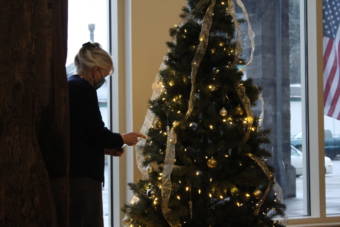
Alice Rooney adds a dove to Wrangell’s Dove Tree on Nov. 28, 2021. (Sage Smiley/KSTK)

For many, the winter holidays are a time of togetherness. But they can also be a stark reminder of the recent loss of loved ones. For nearly two decades, Wrangell has begun the holiday season with a ceremony of remembrance for those who have passed on.

In the high-ceilinged lobby of Wrangell’s Nolan Center, a small Christmas tree with gold and white decorations stands dwarfed between two 20-foot high totems. But its purpose isn’t small at all.

Known as the Dove Tree, it’s a nearly two-decade-old tradition meant to give community members a time at the outset of the holiday season to remember and grieve loved ones lost in the years previous.

Central is the symbolism of a white dove. Hospice of Wrangell’s Alice Rooney penned a story about the bird and its importance. Cindy Martin read the story at this year’s ceremony, which took place on Nov. 28. It concludes: “No matter what your religious beliefs are, and whether the dove means to you, we hope the dove brings you comfort.”

A list shows some of the names of those who have passed on this year. (Sage Smiley/KSTK)

The annual Dove Tree ceremony is an interfaith celebration. Pastor Sue Bahleda of Wrangell’s Island of Faith Lutheran Church delivered the homily.

“We — each of us — are unique and particular and special,” Bahleda said. “There is no one else who has lived our story, yet in all that diversity we hold one thing in common. We die. And that is what has gathered us here today — to hold for one moment longer, the memory of those who have died. They are our mothers and our fathers, our children, our spouses, our family, our neighbors, our friends. They were ordinary and amazing. Sometimes ornery and awful, and what will we do without them? I appreciate that the symbol that we use to mark this day is a dove. It is the symbol of peace. And as we speak of those who have died, we often express this hope, ‘May they rest in peace.’ They do. I have entire faith and confidence in this.”

Wrangell also celebrated and remembered loved ones with music. Wrangell assistant librarian Sarah Scambler sang the Rogers and Hammerstein tune “You’ll Never Walk Alone,” accompanied by Rooney.

The Dove Tree and ceremony were started by Wrangell nurse Trudy Johnson in 2003 after a triple murder-suicide rocked the community. The nature of the crime meant closure was difficult. The ceremony has carried on every year since, organized by Hospice of Wrangell.

Little has changed, except for precautions taken earlier during the pandemic when the tree was moved to an outdoor pavilion downtown. The paper doves were secured with wires so they wouldn’t blow away, and the 2020 program was broadcast on KSTK.

Doves hang on this year’s Dove Tree. (Sage Smiley/KSTK)

Wrangell tribal citizen Thomas Rooney, Jr. drummed as volunteers read the names of Wrangell’s loved ones who have passed on in the last year. Slowly, community members placed white paper doves on the branches of the tree.

After the reading of names and placing of doves, Bonnie Demerjian on cello and Alice Rooney on piano played “Heroes of Longhope,” a Scottish fiddle tune written to commemorate the crew of a rescue vessel who were lost in a storm.

The Dove Tree will stay in the lobby of the Nolan Center through the new year. Paper doves are available for anyone who lost a loved one to add their name to the tree.

Site notifications
Update notification options
Subscribe to notifications