KSTK is our partner station in Wrangell. KTOO collaborates with partners across the state to cover important news and to share stories with our audiences.
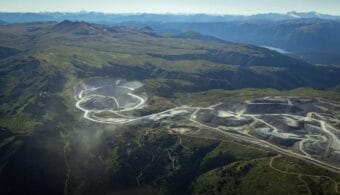
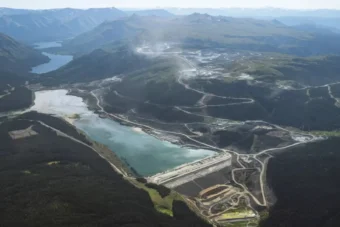
Red Chris Mine’s tailings waste facility and open pit in the headwaters of the Iskut River, a major tributary of the salmon-bearing Stikine River. (Photo courtesy of Colin Arisman)
Southeast Alaska tribes and environmental groups have delivered nearly 30,000 messages to British Columbia lawmakers about transboundary mining.
Earthjustice, the international conservation organization Re:wild and the tribal commission said the letters encourage British Columbia to pause mining developments in the headwaters of the Stikine, Unuk and Taku Rivers that drain into Southeast Alaska.
The Southeast Alaska Indigenous Transboundary Commission represents 14 tribal nations downstream from the mines. Executive Director Guy Archibald said it wasn’t just Alaskans who sent the letters.
“It was people from all over the country and all over the world that recognize that Southeast Alaska is a very unique and valuable place in the world for climate protections, for cultural protections and diversity,” he said.
The environmental groups urged British Columbia officials to freeze “mining activity in this region until SEITC member tribes are given free, prior and informed consent.”
They said the messages point to growing concern over mining in the region. This includes at least eight proposed and operating mines that threaten the transboundary watersheds.
Four mines in the Stikine River watershed
Archibald said there’s many active explorations going on with mines in British Columbia and eight is just the minimum. There are four mines the groups are concerned about in the Stikine River alone. They are Red Chris, Galore Creek, Schaft Creek and Red Mountain Mines.
“These mines pose a significant risk to the Stikine River, and so far, they’ve been permitted without any adequate consultation with the Southeast tribes,” he said.
Previous studies have shown that minimal regulation of mines leads to polluted watersheds. This affects where people who survive on subsistence food can hunt and fish.
British Columbia say they take their obligations ‘very seriously’
The British Columbia Environmental Assessment Office wrote in an email that they take their obligations “very seriously – including with tribes in the U.S.” They said they will continue to fulfill their constitutional obligations by consulting with U.S. tribes when mining practices impact aboriginal rights under the Canadian Constitution. Currently, the office said seven mines are permitted in the transboundary area.
This includes two fully operational mines — Premier Mine and Brucejack Mine — and five permitted for exploration or that have limited construction — Eskay Creek Mine, KSM Mine, Skip Mine, Scottie Gold and Galore Creek.
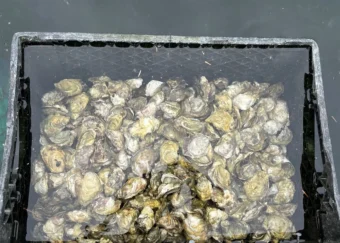
Canoe Lagoon oysters ready to be shipped to processing plant in Wrangell on April 27, 2025. (Colette Czarnecki/KSTK)
A charter cabin cruiser’s engine quiets down on the approach to Canoe Lagoon Oyster Farm about an hour and a half from Wrangell. The tide isn’t high enough to pass through the inlet right next to the farm though, so farm owner Brian Herman pulls over to wait.
“I’m not going to sneak in there, because of all these freaking logs,” Herman said. “We have oysters staged on that beach.”
Herman said there’s a huge demand for his product. But the shellfish isn’t native to the state and that makes it difficult to grow oysters that are hearty enough to reach dinner plates in state and Outside.
Herman bought the business in 2020 and has been refining his techniques through a lot of trial and error.
He buys the Pacific oysters as seeds to grow on his farm. He has a few different brands, including small Beach Bums and medium-sized Rose Islands. He said it’s not hard to find buyers.
“Every Alaskan oyster is in high demand. There’s not enough oysters in the market,” he said. “Cold water oysters are considered a premium oyster. And Alaskan oysters are so unique because there’s so few of them here.”
According to the McKinley Research Group report, Alaska’s oyster harvest was forecast to triple between 2023 and the end of 2025.
Canoe Lagoon is one of 16 active oyster farms that are part of the Alaska Shellfish Growers Association. The association, which represents oyster farms from all over coastal Alaska, from Ketchikan to Kodiak, has doubled the number of active farms it represents over the last decade. President Weatherly Bates said she thinks there’s room for a lot more.
“There’s not enough oysters produced even in the state to fulfill the state’s demand for oysters during the summer and cruise ship time,” she said. “Oysters are brought in from other places.”
She said that the oyster industry in Alaska consists mostly of small family farms, which makes it difficult to keep up with the demand, especially during tourist season at Alaska restaurants.
“I feel like the sky’s the limit since there’s a huge demand because oysters are growing in popularity,” Bates said. “And with fisheries worldwide declining, there’s more and more of a need to have aquaculture species available.”
She said Alaska’s oysters are in high demand in part because of the cold and pristine waters, since that can help lower risks of illness caused by oysters.
Newer growing methods
To take advantage of the demand, Herman has to get better at growing oysters. And he is improving. He’s found they grow better when they’re closer to the water’s surface with fewer oysters in float bags, the mesh bags oysters grow in that rest close to the surface.
“You’re trying to force something to grow that doesn’t really want to be here, but we’re proving that you can do it, and you can do it fast,” Herman said.
Canoe Lagoon Oyster Farm employee Matt Lemma (left) and owner Brian Herman (right) discuss farming techniques on April 27, 2025. (Colette Czarnecki/KSTK)
When the tide rises high enough to get to the farm, Herman’s full-time employee, Matt Lemma, gives a tour. He’s excited to see last year’s oysters growing so fast.
“All those brand new black bags there, this entire set, and that entire set, every single one, is the June ‘24 plant that I’ve been babying,” he said. “It’s crazy. It’s crazy.”
“They look better than the 2022’s,” Herman replied.
Matt Lemma tends to oysters at Canoe Lagoon Oyster Farm on April 27, 2025. (Colette Czarnecki/KSTK)
“No two oysters are the same.”
Many of the oysters will be harvested in a couple months, after a year of growing.
Herman said he’s expanded the business a lot over the last five years and that’s eaten into profits. He thinks the business will do much better this year though.
He said Canoe Lagoon’s oysters have more of a vegetable flavor to them, like a fresh cucumber.
“That’s what’s so cool about oysters is, yes, everybody on the West Coast is growing Pacific oysters, right? But no two oysters are the same,” Herman said. “So even the ones on Prince of Wales will taste completely different than ours, and they’re 20 miles away.”
If all goes well, he expects to ship oysters both in state and out of state. As of right now, he ships in state and to one restaurant in Arizona. He said some restaurants in New York have contacted him, but he needs to produce more and he thinks this year might be the year.
The open pits and waste rock pile at Red Chris Mine in the headwaters of the Iskut River, a major tributary of the salmon-bearing Stikine River. (Colin Arisman)
Editor’s note: This is the second part of a two-part series about the Red Chris Mine in Canada, which could contaminate Southeast Alaska waters. Read Part 1 here.
Red Chris Mine sits 25 miles from Alaska’s border in the Stikine River Watershed. It has operated for a decade, but its ownership changed two years ago.
Before the new company, Newmont, bought the mine, conservation scientists conducted research over a seven-year span. Newmont has made some environmental adjustments since it acquired the mine in 2023.
But Newmont is also hoping to expand the copper and gold mine, which is already bigger than Wrangell Island. That’s even after an environmental report was published in March.
It shows heavy metals have leached into a transboundary Alaska and British Columbia watershed. Communities downstream of the Stikine River are concerned about this, including Wrangell’s tribal government, the Wrangell Cooperative Association.
“It’s very difficult when you have colonial constructs imposed on you,” said WCA Tribal Administrator Esther Aaltséen Reese. She’s the president of Southeast Indigenous Transboundary Commission, which represents 15 tribal groups in Alaska and Canada. “We view the border as a colonial construct.”
She said downstream tribes are the ones that will get the ill effects of mining and they should have a say in how safe the mines upriver are.
A March report by SkeenaWild Conservation Trust researched the mine’s impacts over the first seven years of operation. It said that numerous contaminants from the mine, mainly selenium and copper, are elevated in the surrounding creeks and lakes. These levels are high enough to impact aquatic life, according to the report. Reese said she’s worried about the Stikine River salmon that so many rely on.
“Any kind of failure would just have a huge risk to downstream human populations – us here in Wrangell,” she said. “This is a very critical issue.”
Reese said they have requested to meet with Canada’s Tahltan Central Government since the mine is in its territory and the government co-manages it with Newmont. KSTK reached out to the Tahltan Central Government and hasn’t received a response.
Researcher hopes report will influence similar B.C. mining projects
Adrienne Berchtold is the primary author of the environmental report. She’s an ecologist and mining impacts researcher with SkeenaWild Conservation Trust.
She said her team made the report as a model for other similar proposed mining projects in British Columbia. Currently, there are eight active copper mines operating in the province.
The report states that the leaching contaminants have affected rainbow trout in the mine’s surrounding lakes, which are part of the Stikine River Watershed. Berchtold hopes the findings will encourage B.C. to improve policies and regulations.
“Our concern is that the provincial government has not required mine owners to address that and to really look into what impact those trends might be having on fish in the receiving lakes,” she said.
Newmont spokesperson Kievan Hirji said since the company acquired the mine in 2023, it has established a relationship with the Tahltan First Nation, co-managing the mine under an Impact Benefit Agreement.
“We’re very proud to be going through that process,” he said. “(We) have been working very, very closely with the Tahltan Nation since acquiring Red Chris in 2023 to build a really positive and strong relationship that’s really predicated on that consent as well as transparency and trust and a shared vision for the future.”
According to Hirji, about 15 percent of Newmont workers are members of the Tahltan Nation.
“We also pay royalty payments to the Tahltan Nation,” he said. “That mine is reaching its end of life within the next couple of years, and if that economic success is going to continue, the mine requires an extension to the life of mine.”
That extension, he said, would be an underground mine, or block cave mine. It would sit within the footprint of the existing open pit mine and is expected to last 13 years.
‘We will leave it to the province of British Columbia to continue with that engagement’
First, Hirji said, British Columbia and the Tahltan Nation must assess Newmont’s proposal. The tribal consortium testified this spring against the project.
As for the tailings dams, which hold the mine’s waste, there have been links drawn between the Mount Polley dam and Red Chris’s. Mount Polley’s tailings dam broke in 2014, contaminating nearby waterways. But Hirji said Red Chris’s is constructed differently, even if some of the materials are the same.
“We’ve looked very carefully at the structural integrity of the dam at the Red Chris Mine with Tahltan Central Government, and there is no concern with respect to structural integrity,” he said. “That dam is structurally sound, safe.”
An ongoing concern of downriver tribes is that they haven’t had much say in the mine’s operation. Hirji said that’s not the company’s fault – it’s up to the British Columbia government.
“We will leave it to the province of British Columbia to continue with that engagement,” he said. “We’re really focused on the relationship that we have with Tahltan Nation through the Impact, Benefit and Co-management Agreement, and really building a shared vision with Tahltan Nation.”
Shawn Larabee is the communications manager of BC’s Ministry of Mining and Critical Minerals. He said British Columbia takes environmental protections seriously. He wrote in an email that QUOTE “the scope of consultation the Province undertakes with U.S. Tribes may be different from its consultation with First Nations in B.C.”
Last year’s annual reports of Red Chris Mine are expected to be made available by the B.C. government in the coming weeks.
Red Chris Mine’s tailings waste facility and open pit in the headwaters of the Iskut River, a major tributary of the salmon-bearing Stikine River. (Photo courtesy of Colin Arisman)
This article is part one of a two-part series about the Red Chris Mine and its potential threat to the Stikine River.
The Red Chris Mine is already huge — at 89 square miles, it’s bigger than Wrangell Island. And the mine — which is just 25 miles from the British Columbia border on the Canadian side — could get bigger. British Columbia officials are expediting expansion plans due to the Trump Administration’s recent tariffs.
But a conservation group is raising alarms that the gold and copper mine is already leaching heavy metals into the Stikine River watershed. In a report released March 17, the SkeenaWild Conservation Trust says the mine is “releasing significantly more contaminated seepage” to the watershed than predicted.
Tribal groups downstream from the mine say the report speaks to their concerns about whether it could harm subsistence resources they rely on.
“We have long had concerns for the Red Chris Mine,” said Jill Weitz, who serves as a government affairs liaison with the Central Council of Tlingit and Haida Indian Tribes of Alaska. “Even before we knew that there was potential seepage coming from their tailing storage facility.”
Contamination found in lakes and creeks
The open pit mine extracts 11 million tons of ore per year. If it’s expanded to include an underground mine, that could increase to 15 million tons per year. Three tailings dams surround the mine to store the rock waste, which will exist in perpetuity.
Adrienne Berchtold, an ecologist who studies mining impacts for SkeenaWild, is the study’s primary author. Her team used data collected by the mine from the first seven years of the Red Chris Mine’s operation, from 2015 to 2022, to analyze environmental impacts from the dam.
Berchtold said they did not find evidence that the mine is contaminating the Stikine River or its two major tributaries, the Iskut and the Klappan. But she said toxins are contaminating lakes and creeks that are closer to the mine.
Tests at surrounding water bodies found that contaminants have seeped into the groundwater from tailings deposits since the mine began operating. The report also says contaminants have been seeping from the dam’s waste rock storage area since at least 2017.
The report says contamination levels have increased in Ealue and Kluea Lakes as well as Trail and Quarry Creeks, which flow into major tributaries of the Stikine River. Selenium and copper were the main contaminants found in the creeks and lakes, and the report says their levels were high enough to affect aquatic life.
Impacts to fish could affect human health
Berchtold’s team found that the potential impacts to fish in the area could also affect human health.
“There are rainbow trout in the lakes immediately surrounding the mine and people do fish in those lakes,” she said. “They rely on those rainbow trout for sustenance.”
Berchtold said that the area is naturally a highly mineralized environment, and selenium concentrations in fish tissues would already be elevated without the mine there.
“When you have a situation where those elements are already elevated for natural reasons, that’s even more cause to be even more cautious about how much more of those contaminants you’re putting into the system,” she said.
Berchtold said she doesn’t see risks to the transboundary right now, apart from the rare chance of a catastrophic dam failure.
“Our shared resources”
Berchtold said SkeenaWild is concerned about the province’s plan to fast-track the mine’s expansion.
“We’ve seen so much evidence of issues being overlooked,” she said. “I feel that deregulating and kind of pushing through these approvals just risks those types of issues falling by the wayside even more.”
And while SkeenaWild estimates that the mine will cease ore extraction in 13 years, tribal groups are concerned that it could last much longer.
“That mine is never going to close down,” said Guy Archibald, the Southeast Indigenous Transboundary Commission’s executive director. “It’s just going to keep going, and they’re going to keep asking for more permits and more extensions as long as they can.”
The Red Chris Mine is in the First Nations Tahltan Territory. The Tahltan Central Government has not responded to KSTK’s requests for comment.
But Weitz, of Tlingit and Haida, said she hopes SkeenaWild’s report will help raise awareness of environmental threats posed by Canadian mines in transboundary watersheds.
“With the relationship between Canada and the United States, we want to ensure that our shared resources are protected,” Weitz said. “This isn’t an ‘us versus them’. This is ‘us and the communities.’”
She said the communities near the Stikine depend on each other, as well as sharing the resources the river offers.
“The majority of these projects in Northwest British Columbia and even Southeast Alaska to date are gold interest,” she said. “What are we willing to risk for the expense of our clean water and our salmon watersheds?”
Wrangell’s landslide 11 months after on Oct. 13, 2024. (Colette Czarnecki/KSTK)
It’s been over a year since a landslide devastated the Wrangell community, killing six people. Last month, geologists presented their work from a visit to the slide over the summer.
Margaret Darrow, a professor of geological engineering at the University of Alaska Fairbanks, has been studying the landslide with her colleagues. She said their research is still in the works, but they’re inching closer to answers.
“My greatest hope is that whatever we find from this work will be able to tell the community of Wrangell why this slide might have happened, where it happened, where other slides could happen, so that you could use it in community planning,” Darrow said.
So far, they’ve found that the slope held an unusual amount of loose material waiting to be set in motion – and that the muskegs on top of the ridge may have played a role in doing that.
A surprisingly large volume of loose material
Their soil and rock samples are still being processed, but so far the researchers can say that the soil where the landslide happened is unusually loose. It sits on top of glacial sediment, which acts like a barrier against water. That could have been a huge contributor to the slide.
Annette Patton, a geologist at Oregon State University, said there was a surprisingly large volume of the loose material.
“A lot of the hill slopes around Southeast Alaska have really thin soils because it’s just so steep and material can kind of slide right down,” she said. “But part of why this landslide was so large is because there was actually a very anomalously thick layer of very loose material.”
She said the team looked at records of old landslides in the area. They think the 2023 landslide — which took out about 200 trees — happened right below what they think was an older slide.
“We just wanted to show this as an example of the fact that there is a lot of movement and activity that’s happened on this hill slope since the last glacial maximum,” Patton said. “And there’s a lot that we don’t understand about exactly how that might play out.”
She said there was a large storm the day of the landslide of a type known as an atmospheric river, but it wasn’t out of the ordinary for Southeast Alaska.
“Something notable here is that it wasn’t a really extreme storm,” Patton said. “It had a return period of about one year. So it’s like a big winter storm, but the kind of storm that maybe happens at least once a year.”
But the rainfall monitoring was done only at the airport, 11 miles away from the landslide and at sea level. That monitoring system recorded a little over an inch of rain during the six hours before the slide. Some Wrangell residents said they recorded three inches of rain that day, closer to the slide.
“These are really common types of storms,” Patton said. “Most landslides are triggered by atmospheric rivers here in Southeast Alaska. But not all atmospheric rivers trigger landslides.”
But Patton said there was a lot of water on the slope — and it mobilized all of that loose material.
More than twice as big as any known Wrangell slide
Her colleague, Josh Roering, a professor at the University of Oregon, said that the U.S. Forest Service started paying attention to landslides in the 70s, and a lot of their research came out of Wrangell and Prince of Wales.
“You’re really in the epicenter of a lot of amazing discoveries that have continued to affect how we think about these processes that led to the Forest Service mapping landslides every year across the region,” he said. “The map for Wrangell includes 256 landslides.”
He said it’s helpful to look at all the surrounding landslides in order to contextualize the massive one from 2023.
“It was more than twice as big as the next biggest slide that’s happened on Wrangell,” he said. “This was truly an extreme, anomalous event in terms of size, compared to what has happened here before. So this really led us to ask the question, ‘What is so different about that setting that allowed it to behave so differently?’”
He said they were also able to use the LIDAR data from the State Division of Geological and Geophysical Science. The department surveyed the area months before the landslide happened. The department also surveyed the area after the slide.
Roering said the first thing they noticed was some large ledges, or steps, exposing the bedrock.
“These are really big steps,” he said. “Looking at it from the road does not prepare you for how big they are in person.”
He said the erosion wasn’t consistent throughout the slide — most of it happened at the steep bedrock steps. And they even found living blueberry bushes right below some of those cliffs.
Roering said that implies the slide came down and almost launched from one ledge down to the next — which would only be possible if the soil was liquefied. And that would take an enormous amount of water .
“This field work occurred in August of 2024 so about six, seven months ago, and it was still really, really wet,” he said. “It hadn’t rained in a while, weeks before we were there. Yet there’s still what we call seepage – a lot of drainage from the landscape above the scarp that was coming into this side.”
The muskegs on the ridgetop
Roering said they wanted to know where the water came from, so they used previous LIDAR data to find the path from the top of the ridge to the beginning of the slide.
“As we follow these flow paths, they go up another set of bedrock ledges, and then they get up on top of the ridge,” he said. “We spent a lot of time up here on this ridgetop muskeg, trying to imagine the plumbing system for how this works, how the water goes up and down, how it spills out in some places and not others.”
He said they put in hydrologic sensors that test water levels that will help them understand when and how much water gets channeled down from the ridgetop muskegs. The researchers will get the sensors 14 months after installing them. They’ll see if the water levels remain constant or fluctuate a lot during the time period.
Roering said the muskegs only form here in areas of flat land — not where the ridge is too steep. And they can hold a lot of water and channel it downhill.
“In some ways, having channels to take that water out is a good thing, but in a lot of cases, having channels funnel water to one location where there’s a lot of loose material is obviously a really bad thing,” he said.
Roering wrote in an email that the likelihood of another landslide happening in the same area is low because the scar left behind doesn’t have much material left to be mobilized.
The researchers also gave tips for recognizing when a landslide might be about to happen — like sudden changes in water flow or color. Another indicator would be sound — some have compared it to a falling jet or a tornado. The researchers said that once people hear a landslide, they only have moments to get out of the way.
They also encouraged people to pay attention to weather forecasts, as landslides usually happen during intense rainfall. People can report a landslide on Alaska Landslide Reporter, an app that the state of Alaska recently released.
Major General Hilbert apologizes to Wrangell Cooperative Association on Jan. 11, 2025 for bombarding Ḵaachx̱aana.áakʼw 155 years ago. (Colette Czarnecki/KSTK)
A large group of people greeted each other with morning chatter at the end of a Wrangell peninsula on Saturday, where the Taalkweidí clan once resided.
They were there to witness the U.S. Army apologize to the Wrangell Cooperative Association for bombarding the Tlingit village of Ḵaachx̱aana.áakʼw in 1869. The tribe lost at least five people, a totem pole and multiple houses. And for the past 155 years, the tribe has been waiting for this apology.
This was one of several different stops on Saturday’s walk to where Tlingit clans once lived. The last was where a Tlingit man, Shx’atoo, was hanged at Fort Wrangel. Before he turned himself in to stop the bombardment, he stopped at each clan’s location to say goodbye. The group retraced his last steps on this walk.
After visitingTaalkweidí and honoring the clan through a small ceremony, footsteps and chatter took over the walk towards the second stop, where the Teeyhíttaan clan lived.
“When he stopped here, he talked to the clan leader, whose name I now bear, Gashx,” Teeyhíttaan clan leader Aak’wtaatseen Mike Hoyt said. “He brought his hat out and he brought out other at.óow to stand before. That’s how I’m feeling today, that we would bring these things out for him if he were here, and that his spirit is here.”
At.óow are significant tribal artifacts.
Continuing the walk
Fifteen-year-old Vincent Cordova from Ketchikan was holding a peace pipe on the walk. It’s one of the recently repatriated at.óow. It features the Gunakadeit, a sea monster in Tlingit culture.
“I got told to hold the pipe because I am the clan leader’s oldest nephew,” Cordova said. “I’m proud of this and I’m happy to hold such an artifact.”
Gaalgé Kevin Calahan lights Naanyaa.aayí pipe that Vincent Cordova and Major General Hilbert hold on Jan. 11, 2025 in front of Shakes Island. (Colette Czarnecki/KSTK)
After a few more stops, the group ended up in front of Shakes Island, where the Naanyaa.aayí clan lived. Clan leader Gaalgé Kevin Calahan said there were six houses on Shakes Island.
“I have my nephew, Vince. This is a Naanyaa.aayí pipe that belonged to Chief shakes,” Calahan said. “We bring it out when we do our smoke ceremonies. I thought it would be appropriate if the General will hold it, we won’t smoke out of it, but I’ll light it.”
“The body remembers the wrongs that were done to my ancestors.”
The group visited Kiks.ádi territory and then headed towards Fort Wrangel, which is now the post office. Wrangellite Heidi Armstrong said her parents lived for this day.
“As a native child, I’m half native,” she said. “You know the wrongs that were done weren’t necessarily done to me, but the body remembers the wrongs that were done to my ancestors.”
She said there’s a picture from the 1940s in the Wrangell Museum that shows a similar walk along Front Street after they raised Chief Shakes house.
“It’s a historic walk,” Armstrong said. “I’ve always looked at that and thought, man, I wish I was part of that. Sorry. I’m getting choked up. I never dreamt that I’d be part of such a huge, I don’t know, maybe huge is the wrong word, but such a meaningful time.”
When the group reached the last stop, at the old Fort Wrangel, clan leader Hoyt said this is where the altercation happened. Where the U.S. Army launched bombs into the village. Where Shx’atoo turned himself in. Where he was hanged.
“I want you to imagine thinking back to where we started,” Hoyt said. “If you look that direction, you can see the trees. You can see the point. I want you to imagine paddling across and turning himself in over here.”
Hoyt said before Shx’atoo walked to the gallows to face his fate, he sang a song. He played the only recording, sung by William Tannery in the 1950s. Tannery was the primary storyteller who was key to passing the bombardment story to future generations.
It sounded lonely, just his voice.
Arthur Larsen (forefront) sings with others on walk honoring Tlingit clans of Ḵaachx̱aana.áakʼw on Jan. 11, 2025. (Colette Czarnecki/KSTK)Tlingit tribal members gather to remember Shx’atoo before bombardment apology began on Jan. 11, 2025. (Colette Czarnecki/KSTK)
“This does not look like a conquered people to me.”
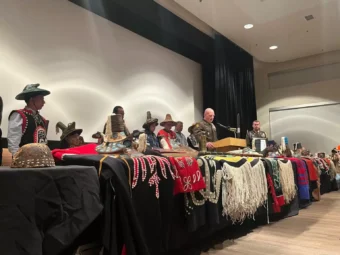
The group then walked to the Nolan Center, Wrangell’s civic center.Inside, there was a significant amount of historical at.óow in the front of the large room.
“It’s often said that we are a conquered people. This does not look like a conquered people to me,” Hoyt said. “This looks like a statement of who we are, a statement that goes back hundreds of years, thousands of years, and a statement that will continue to go forward accordingly.”
U.S. Army Major General Joseph Hilbert waited at the door to request permission to be on the tribe’s territory.
“Good afternoon. I’m Major General Joe Hilbert from the Commanding General 11th Airborne Division in the United States Army Alaska,” he said. “I live and work on the land of the Tlingit people. I request permission to enter the land the Shtaxʼhéen Ḵwáan.”
After accepting the request, the tribe sang a welcome song with a drum beat that filled the room.
Major General Hilbert of the U.S. Army requests permission to enter on tribal territory on Jan. 11, 2025. Wrangell Cooperative Association’s Tribal Administrator Esther Aaltséen Reese stands to the left. (Courtesy of James Edward Mills)
All of the clan leaders spoke in response to the Major General’s request, including Gaalgé Kevin Calahan with the Naanyaa.aayí clan.
“There really wasn’t a handbook out on how this happens,” Calahan said. “We’ve done plenty of Koo.éex’, plenty of feasts, we’re preparing to raise poles. This was a new thing. This is a great thing, but it was still brand new in new territory.”
He said the songs that they sing mean something big is happening.
“Some of the most beautiful songs are cry songs”
The tribe then sang a cry song, with a slow drum beat in the background.
“Some of the most beautiful songs are cry songs, but they’re songs you don’t hear because they’re so heavy,” Calahan said. “They serve a purpose.”
Some keynote speakers took turns speaking about how this event was historical, including U.S. Senator Lisa Murkowski.
“In order for us to move forward, the wrongs have to be addressed,” she said. “They have to be acknowledged, and we need that apology for us to move forward and to heal.”
She said the solemnity that the military presents is not casual and she hopes it’s recognized. She also honored the veterans in attendance.
“I’m grateful to those who have served,” Murkowski said. “Our treasured veterans, you have not always been treated with the dignity and the respect that should be afforded you.”
U.S. Alaska Senator Lisa Murkowski speaks during bombardment apology by the U.S. Army on why it’s necessary and long past due on Jan. 11, 2025. (Courtesy of James Edward Mills)
Later in the day, Major General Joseph Hilbert officially apologized to the clans. He assured everyone that the apology was written by human beings with hearts, even though it might sound formal.
“It is incredibly a heartfelt apology on behalf of the Department of the Army to acknowledge the 1869 bombardment of the Tlingit village of Ḵaachx̱aana.áakʼw by the United States Army,” he said. “And to offer an apology to the Tlingit people on behalf of the United States Army.”
He acknowledged that the U.S. Army’s bombardment on Ḵaachx̱aana.áakʼw resulted in death, suffering and generational trauma on the Tlingit people.
“I hope that today represents not an end, but a beginning,” Hilbert said. “A beginning of healing and a relationship between us going forward.”
Not every clan accepted the apology. The Taalk̲weidí, Khaach.ádi, Kayaashkeiditaan and Sik’nax̲.ádi accepted.
Three clans did not accept the apology
Aak’wtaatseen Mike Hoyt, with the Teeyhíttaan, did not. He said making peace is about rebuilding and restoring a relationship.
“I have heard your apology and I show as much respect as I can,” he said. “I really appreciate the words that you said in there that this is not the end, but a beginning, and to that extent, we can’t fully accept the apology so much as we see this as the beginning.”
Gaalgé Kevin Calahan who leads the Naanyaa.aayí clan said talking to others has deepened his understanding of the bombardment.
“I know it’s easy to sit back and think, ‘well, that happened so long ago, it didn’t affect you,’” he said. “I was like, ‘well, we’ve been asking about it every year since then.’ It affects us. It’s never left. You think about it every December.
Major General Hilbert said there needs to be continued communication to further establish the relationship between the Army and the Tlingit clans.
“I think where I was very much encouraged was it was an acknowledgement, and not a rejection, and a demonstration of a relationship going forward,” he said.
The other clans that did not accept the U.S. Army’s apology were the Kiks’adi and Naanyaa.aayí. In total, four clans accepted and three did not.
Close
Update notification options
Subscribe to notifications
Subscribe
Get notifications about news related to the topics you care about. You can unsubscribe anytime.