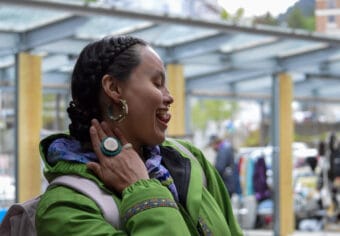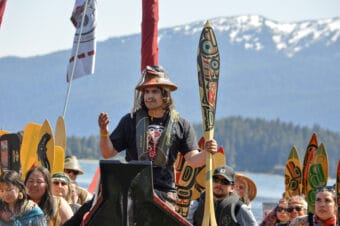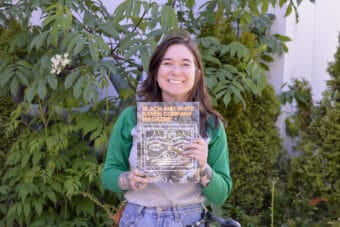
Local master Chilkat and Ravenstail weaver Lily Hope has been awarded a national fellowship that bolsters culture and tradition across the United States.
She is one of the United States Artists awardees for 2026, which means she gets $50,000 toward her work with no strings attached.
“It’s a wild gift to have somebody just hand you some money and say, ‘Do what you will,’” she said. “There is absolutely zero parameters on how it is used.”
The award is nomination-based. United States Artists partners with foundations and philanthropists to support artists and cultural practitioners of all disciplines. According to its website, Hope’s award was supported by the Rasmuson Foundation. Hope found out about the grant a few months ago, and she’s been thinking of what she can do with it ever since.
Recently, in a conversation with another weaver, Hope had a realization – she wanted to think deeply about the work she wants to do. That weaver was Shdendootaan “Shgen” George.
“I kind of had a coming to reality moment with Shgen,” she said. “And thank you, Shgen, for waking me up and being like, ‘hey, what if you made regalia for your clan members, your family and work that would stay in Lingít Aaní?’”
Hope is excited to find out what will come of that deep thinking. She closed her public studio downtown last fall to focus on weaving that will stay in the community.
Hope joins fellow Chilkat weaver Sainteen Anna Brown Ehlers, who was awarded the fellowship in 2006. Several other Southeast Alaska artists have received the grant over the years, including writer Shaankaláx̱t’ Ernestine Hayes, Perseverance Theatre Artistic Director Leslie Ishii and carver Nathan Jackson.
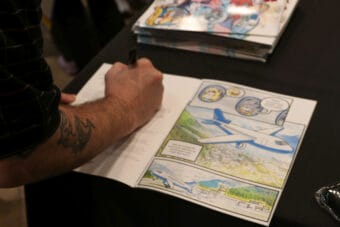
“Aanaq? Am I Your Sunset?” by Lani Hulse was written to support Typhoon Halong-impacted families in partnership with the Western Alaska Disaster Relief Fund. (Lani Hulse)
When writer Lani Hulse heard the news about Typhoon Halong, she was across the country in Hawaii, where she lives.
“I just, I couldn’t help with each video that I watched online — people posting about the disaster, and afterwards — I just could not just sit there,” Hulse recalled. “I was like, there’s something I can do.”
Hulse was in the middle of writing a novel, part of a journey to reconnect with her Yup’ik culture. The author, who spent periods of her upbringing in Bethel, has family roots in the Yukon Delta village of Kotlik, which suffered damage from the October storm. Her father was also a principal across schools in the region, including Kipnuk.
“I was like, wait, I could do something creative and connect with a nonprofit, and get something rolling, have something physical that’s positive and connects to my culture as well,” Hulse said.
Hulse began coordinating with the Alaska Community Foundation to host a fundraising sale of the children’s book she was inspired to write. It’s called “Aanaq? Am I Your Sunset?” and 50% of each sale goes directly to the Western Alaska Disaster Relief Fund to support families impacted by Typhoon Halong. The other 50%, Hulse said, will cover the cost of production and taxes involved.
The storybook was inspired by a moment Hulse experienced with her son, Ashton. At the end of a stressful day, Hulse said that the two went for a drive.
“During the drive, the most captivating sunset caught my attention and I paused. And I was like, ‘Oh my gosh.’ I was like, ‘Ashton, look at that sunset. It’s so beautiful,’ ” Hulse remembered. “And my son was quiet for a second, and he asked, ‘Am I your sunset?’ I lost my breath for a moment.”
Hulse said that the book came from this seed of connection and meaning between parent and child. The story follows the layout of a poem, an adult responding to a child asking the same question in a backdrop of Yup’ik culture.
“And then each page, it’s almost like a poem goes over like, ‘Yes, you are my sun. You are my moon.’ And there’s lots of culturally significant imagery in there as well, like eating salmonberries, tundra tea, as well as, like, fishing and Northern Lights,” Hulse said.
Hulse said that she hopes the book will find buyers among those looking to support relief efforts, but she also hopes copies find their ways into the hands of those affected by the typhoon.
The book features a journal section where families can record shared memories together.
“I can’t imagine what these families are going through right now, and I wanted to bring something positive to their life,” Hulse said. “The main part of this story is what matters most is family moments with your family, these sweet moments throughout your day.”
Raven helmet of Ḵ’alyáan in the Sheldon Jackson Museum, Sitka, circa 1906. Photo by William Thomas Shaw. University of Washington Libraries, Special Collections, NA2935.
More than 200 years ago, Lingít and other Alaska Native people waged battles against invading and oppressive Russian colonists in Sitka. To this day, those battles are a symbol of Lingít resistance to colonialism. A Kiks.ádi warrior named Ḵ’alyáan led the attacks, and in 1804 he wore a carved Raven helmet during one of the battles.
In the early 1900s, the helmet was separated from the Kiks.ádi. It’s considered at.oow — a sacred, living clan item — but the Raven helmet has been behind glass at the Sheldon Jackson Museum since 1906.
Listen:
Aanyaanáxch Ray Wilson is the Kiks.ádi clan leader and lives in Juneau. He said that at.oow hold spirits and clan members treat them like relatives.
“So when we don’t have our items, we can’t use them,” he said. “And there it is sitting right in a museum in Sitka and we can’t use it, and it belongs to us. It’s really hard to accept.”
Wilson is 92, and said the colonial legacy of the last two centuries have left Lingít people with only pieces of their history and cultural practices. But when they bring at.oow back into ceremonies, those items help restore what has been lost.
“The main thing is that it’s coming back to help our people. We all need help,” Wilson said. “These are really trying times, and they don’t seem to get any better. We need the culture to come back to make our people stronger again.”
According to recorded history, this is how the Raven helmet ended up in the Sheldon Jackson Museum: three Kiks.ádi men, including a descendant of Ḵ’alyáan, brought it to Alaska’s Territorial Governor John Brady. Brady co-founded the Presbyterian-run Sitka Industrial and Training School, which is now known as Sheldon Jackson College.
The helmet has been in the campus museum since. The state bought the museum and its collection in the 1980s.
But for years, Kiks.ádi leaders have said that isn’t how sacred clan items are given away. According to the Kiks.ádi’s recent petition for repatriation, at.oow are under cultural patrimony, which means all clan members own the item, and no individuals can give away sacred clan objects without the clan’s approval.
So for decades, the Kiks.ádi have been trying to get the helmet back from the state, arguing that it was not ever the state’s property. And last month, the Alaska State Museums finally agreed to start the process of returning ownership to the Kiks.ádi.
A spokesperson for the Alaska State Museums said in an email that the museums have been working with the Sitka Tribe of Alaska to “develop and nurture collaborative working relationships.” They said this repatriation is just one of several projects the two organizations are working on together.
Righting the wrongs of the past
Clan member Lduteen Jerrick Hope-Lang has been fighting to repatriate the helmet, just like his grandmother did two decades before. He said the process involved digging into the history of how the helmet changed hands.
“If you’re asserting you have the right to anything, there must be proof,” Hope-Lang said. “I want to see it.”
The written records claiming ownership start with the Presbyterian church, which ran the Sitka Industrial and Training School. Then, the Alaska State Museums bought the school’s museum and its collection in the 1980s.
Hope-Lang reached out to Jermaine Ross-Allam. He’s the director of the Presbyterian church’s Center for Repair of Historical Harms, and was instrumental in the fight to repatriate the helmet. Ross-Allam searched the church’s archives to find records of the helmet. He said he found records detailing how men brought the hat to the school.
“But, of course, there were no appropriate ceremonial protocols,” he said.
He said the act wasn’t authorized because it didn’t involve those protocols, so the church never had a right to the helmet in the first place. Therefore, the church didn’t have the right of possession when it sold the helmet as part of the museum’s collections to the state decades later.
Ross-Allam hopes righting the wrongs of the past inspires others to do the same, even if it feels like it’s too late.
“That should give people confidence to continue to engage in more acts of repair and solidarity,” he said. “No matter how big the repair job seems to be.”
Changing the narrative
Hope-Lang said it’s still painful for him to read the way the state dismissed his grandmother in documents from previous requests.
“When you look at the letters, when she’s asking for the piece, even just for cultural use at our bicentennial in 2004 and the way that she was spoken to,” he said. “The way that she was written about kind of as though she had no qualifications as a Kiks.ádi Lingít woman whose ancestors wore that piece, that’s still painful to read.”
Now, Hope-Lang looks forward to a future when the helmet will always be in Kiks.ádi hands. He said the knowledge of clan ownership makes a difference.
“It changes the narrative,” he said. “When you go in and you look at this piece, you’re not saying it belongs to somebody else, it belongs to you.”
He said young clan members won’t know the pain of not being able to claim it, and to use it for ceremony.
“The exciting thing is for the young people below us, who will become the caretakers, the future ancestors, that they won’t know this trauma,” Hope-Lang said. “This won’t be passed on to them.”
And Yeidikook’áa Brady-Howard, Sitka Tribe of Alaska chairwoman, said reclaiming this helmet is one story of many sacred items coming back to their people.
“And so those items that are scattered across the country are literally our ancestors living away from their homeland, in a sense,” she said.
Brady-Howard said the Raven helmet’s return comes at a time when the relationships between Indigenous people and organizations like churches and museums are changing for the better.
“I don’t feel that we can view the repatriation without also viewing it in the larger lens of colonialism and trauma,” she said. “But also truth, reconciliation and healing.”
The Alaska State Museums said there are still several steps before the repatriation process is complete. It must submit a notice to the Federal Registrar saying it intends to repatriate the item, and remove the helmet from its own collection.
Vera Starbard poses in a KTOO studio in Juneau on Nov. 24, 2025. (Photo by Jamie Diep/KTOO)
Listen here:
Lingít and Dena’ina writer and playwright Vera Starbard recently clinched her fourth Emmy nomination for the PBS Kids show, “Molly of Denali.” She was nominated for Outstanding Writing for a Preschool Animated Series for an episode called “Thanks-for-giving.”
The episode aired last November and follows Molly and her friends as they learn why some Alaska Native people don’t celebrate Thanksgiving.
“It was sort of a, ‘let me at it,’” she said. “You know, I want to tell a Thanksgiving episode from a Native perspective. I don’t personally celebrate Thanksgiving.”
In the episode, Grandpa Nat, Molly’s grandfather, talks about why he doesn’t celebrate Thanksgiving and calls it a time of mourning. He talks about “new people” who outlawed many Indigenous traditions and destroyed different cultural pieces.
“Ah, sometimes people do awful things when they don’t understand other people’s way of life,” he says in the episode. “Remembering it makes my heart feel heavy.”
Starbard said the scene explaining that traditions were outlawed was the core of what she wanted to convey with the story.
“It wasn’t something lost, like I think when we hear about it, it’s as if we forgot it, that Native people just sort of blacked it out for some reason. It was taken from us,” she said. “It was very forcefully and violently taken from us. And that is difficult to do in a show like ‘Molly’ when you’re trying to, you know, talk to four year olds and eight year olds. You don’t want to re-traumatize people with it, but you do want to tell the truth, and you want to tell the full truth that really hasn’t been told to us in our history books.“
In the rest of the episode, Molly and her friends host a community-wide celebration highlighting Alaska Native traditions. That includes time to mourn. In the episode, Molly asks her aunt about it.
“How can you be sad and celebrate?” Molly asks.
“When we remember our ancestors together and talk about what was lost, we know we’re not alone,” Auntie Merna replies. “Then we can all heal together and celebrate what we have.”
Communal grieving through ceremonies like a Lingít ku.éex’ — also known as a potlatch — was also outlawed. Starbard said she wanted to bring that into the show.
“I don’t see many people talking about communal grief outside of Native communities,” Starbard said. “I think Native communities, we talk about it a lot, and I don’t see that many other places. This, to me, was a gift the Native people could give the rest of the world. This is how you grieve together, and it’s a good thing to grieve together.”
Starbard said this fourth nomination means a lot to her. But it’s a bittersweet moment. She thought about her dad when she learned she was nominated again. She brought her mom and sister to the Emmy ceremony for her previous nomination and wished she could have brought her dad as well.
“He had said, ‘Oh, but next time you’re nominated, I’ll go to that one.’ And he passed away a couple months ago, and that was definitely on my mind, just that he was so confident that I would be nominated again for my work, but also sad that he can’t be there,” she said.
The winner of Outstanding Writing for a Preschool Animated Series will be announced at the Children’s & Family Emmy Award ceremony March 2.
S’eitlin Jamiann Hasselquist serves chili made with beef, deer, and mountain goat meat in the Traditional Foods and Medicine Kitchen on Nov. 19, 2025. (Photo by Yvonne Krumrey/KTOO)
This is Tongass Voices, a series from KTOO sharing weekly perspectives from the homelands of the Áak’w Kwáan and beyond.
S’eitlin Jamiann Hasselquist has been hosting weekly community soup nights this month in the Traditional Foods and Medicine Kitchen inside Sealaska Heritage Institute’s new Indigenous Science Building in Downtown Juneau.
She and her team use traditional Lingít foods to make soup for anyone who wants to try some — and maybe bring home the recipe to make themselves.
Last week, the group prepared chili with beef, deer and mountain goat meat. The last soup night is Wednesday from 6 to 7 p.m.
Listen:
The following transcript has been lightly edited for clarity.
S’eiltin Jamiann Hasselquist: Can you hear it sizzling? We have so many good things in here. We have g̱uwakaan, deer; jánwu, mountain goat and wasóos, cow.
And then cow, you know, wasóos. Most of us know cow. But we don’t know that it’s called wasóos in Lingít, and so to share that part is kind of fun.
Lingít x̱’éináxS’eiltin yoo x̱at duwasáakw. Yéilx̱ x̱at sitee. Deisheetaan áyá x̱at. Yéil S’aag̱i Hít dáx̱. My people come from Angoon and the Raven’s bones house and my Lingít name is S’eitlin. Most people know me by Jamiann.
I think it’s a really beautiful way to bring community together, especially in a time of need, when SNAP benefits have been delayed or whatever it is, it’s putting our families and members of our community into very stressful positions where they’re having to make choices between food and whatever else is important.
And so being able to provide a night where we can gather together and share a meal and just enjoy each other’s company and show each other like we’re not alone, that we’re here to support each other. I think that’s really important.
There was a child who was in here, I think last week. They had never tried deer meat before, so it was their first time. They were probably 10 years old, and others. I never tried mountain goat before. You know, I’ve been cooking with it now. It cooks a lot like deer, and it tastes pretty similar to deer, but a little bit different.
And then cow, you know, wasóos. Most of us know cow. But we don’t know that it’s called wasóos in Lingít, and so to share that part is kind of fun.
I think it’s really nice to be able to share these out with people in the community, because it should be a part of our regular diet, and because of, you know, harms that have happened, distances between relations of the Earth and us as people, and what we ate in our diets, what we use for plant medicines, there’s been a huge disruption in that.
And so to be able to bring it into a dish like chili, to share it with everyone and have them try it, I hear things like, “Oh, I remember tasting this when I was a kid,” or “I’ve never had this in my entire life.” So there’s a wide range of emotions that go along with feeding this traditional food to our people.
That animal, they had a life going on, and they give that life to be here. And so um I will thank it for its life and its spirit still being with us through this process, and tell it the healing that it’s bringing to the people.
That some people have never tried you before. They don’t know the taste. Some people, it’s going to transport them back to when they were children, 30 years ago. Maybe, you know, some people think that they never were going to try this again.
It makes me emotional when I’m talking to them, but I also feel it’s very appropriate, and it’s something that has to be done to be able to respect the spirit of whatever that is that’s here, to help us learn, to help us return, to re-remember.
A still from the screen adaptation of Velma Wallis’ 1993 novel, “Two Old Women.” (Deenaadàį’ Productions)
Fairbanks-based Alaska Native filmmakers from Deenaadàį’ Productions are bringing an award-winning 1993 book to the screen for the first time.
“Two Old Women” is an adaptation of Velma Wallis’ novel of the same name – and in the new film, the story is told entirely in Gwich’in. It premiered in Hawai’i last month, with homecoming showings scheduled in Alaska in December.
Wallis’s 1993 book is based on an Athabascan legend and takes place in a time before colonization. The story follows a pair of elderly women, Ch’idzigyaak and Sa’, who are left behind by their tribe, which faces starvation amid a harsh winter and shortage of food. The main characters then battle against the elements, relying on their ancestral knowledge and each other to survive in Alaska’s wilderness.
Filmmaker Princess Johnson remembers when she first read the book as a teenager, and she said adapting it for the screen is something she’s been wanting to do for more than 20 years.
“I felt that, when I initially read it, I could see it. You know? I could visualize it,” she said. “And, at that time, I was still very early in my filmmaking career and my filmmaking journey.”
In the years since then, Johnson has worked as a creative producer on the PBS Kids series “Molly of Denali” and produced six episodes of the latest season of HBO’s “True Detective.” Now, she’s added to her resume writing, directing and producing the 14-minute short for “Two Old Women,” a proof-of-concept for what she hopes to develop into a feature film.
In the screen adaptation, Ch’idzigyaak and Sa’ speak to each other in Gwich’in. In fact, the film is entirely in the Athabascan language, which is considered severely endangered.
Johnson said she got some pushback early on from production companies and others who thought the language piece would be a hard sell, but she said that part was non-negotiable.
“There’s just such a richness and a nuance. I think we would actually lose a lot if it was in English. It wouldn’t be as believable or, like, pull us into that authenticity of a pre-contact piece,” she said.
Gwich’in has about 300 speakers in Alaska, according to the Alaska Native Language Center, and 205 in Canada, per the country’s most recent census data, from 2021.
Taa’aii Peter, a producer on the project who also helped with the translation, is an advocate of Indigenous knowledges, languages and rights. He said experiencing Gwich’in on the big screen can be a source of pride, a way to uplift the language and even an educational tool.
“Art is such a powerful medium of communication. It’s inspirational, can be life changing and transformational for people,” said Peter, who also has a background in film production and previously served as the vice chancellor of rural, community and Native education at the University of Alaska Fairbanks.
Peter said the end product is just one part of what can give art that power. Behind the end product are the people – and the process – and he said the filmmakers brought together Gwich’in speakers and culture bearers so that, together, they could figure out how to best tell “Two Old Women” in a language that carried the story for thousands of years.
He said that decision “just makes complete sense.”
“And then it’s also this form of helping to make this contribution to advancing the important focus on language and language work that’s happening within our community and within a lot of other Indigenous communities,” Peter said.
The short film was shot in three days at Borealis Basecamp, north of Fairbanks, and at Gather, which is a social space downtown. But it’s been in the making for about five years. The filmmakers say, during that time, they used the project to build community in other ways, too, like running hide-tanning workshops where people could learn traditional practices while making clothing that appears in the film.
Like Peter, Johnson said the workshops, contributions and other inputs are just as important as what winds up on the screen.
“To me, like, in its best form, filmmaking can be a form of healing. It can be a form of medicine,” she said.
The film stars Margaret Henry John and Brenda K. Newman as Sa’ and Ch’idzigyaak, with Chief Galen Gilbert of Vashraii K’oo, Alaska, appearing as Chief Dajalti’. The 14-minute short will be screened in Fairbanks as part of an event at Morris Thompson Cultural and Visitors Center on Dec. 5, which starts at 5 p.m. It’ll also be shown at the Anchorage International Film Festival on Dec. 13 at 3 p.m.
Close
Update notification options
Subscribe to notifications
Subscribe
Get notifications about news related to the topics you care about. You can unsubscribe anytime.