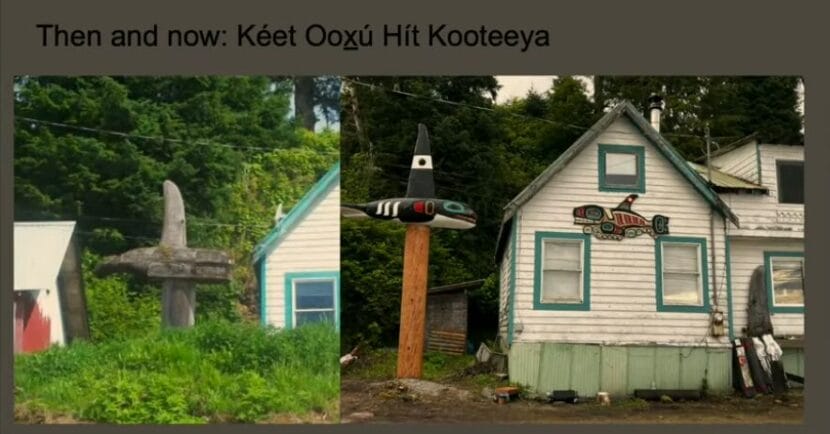
A screenshot from Shgendootaan George’s slideshow shows the kootéeyaa that was raised in the 1980s and the one raised this year. (Courtesy of presentation)
Addressing an audience in the clan house inside the Walter Soboleff building in Juneau, Shgendootaan George laid out the history of three killer whale totem poles that have stood next to her clan house in Angoon. The latest was raised in August.
For George, the history of the Killer Whale Tooth clan house and its kootéeyaa — or totem poles — are intertwined with her own personal history. She was nine years old when they raised a second pole commemorating the 100th anniversary of when the U.S. Navy attacked the village of Angoon.
“This picture is going to make me cry. This is my dad on top of the forklift helping place the killer whale as it goes on to the post,” George said, referencing a slideshow she presented during the lecture. “And this is me and my mom looking out the window.”
The 1882 bombardment destroyed the village, its clan houses, canoes and food supplies – just before winter set in. Six children died.
The memorial kootéeyaa depicted a black and white killer whale sitting on a tall stand. Master Carver Wayne Price carved it at Angoon High School. It replaced a similar pole that stood next to the house and was laid down before George was born.
“Then that’s where I spent the rest of my life after that,” she said. “Growing up with this totem pole next to our house.”
It aged too. She showed a photo of the same pole, with all of its paint worn away.
“And this is where, you know, it kind of ended up weathered and worn and moss growing on it,” George said.
When kootéeyaa begin to disintegrate, that is considered part of their life cycle, and they are taken down and laid to rest.
That also happened to the second pole in 2010. George led that process. The pole was laid to rest like a clan member: it was cremated.
Over the last decade, George also reconstructed the clan house that she grew up in and continues to live in each summer with her family.
And earlier this year, the newest killer whale kootéeyaa, carved by Joe Zuboff, was raised with the help of the people — and their descendants — who participated in the raising and lowering of its predecessor.
“One of the things that is really important to me in the raising of this most recent poll is to really be really thoughtful in thinking about continuity and really connecting with the past and bringing that forward into the future,” she said.
And now that the kootéeyaa is standing, and the house is restored, George has time to reflect on her experience.
“That was probably the biggest thing that I will ever be directly a part of in my life,” she said.
SHI President Rosita Worl attended the lecture, and applauded George and her community for the legacy they have carried forward.
“Look at the knowledge that you have, look at the practices that you can do,” Worl said. “It just warms my heart to see that Angoon has been the center and the stronghold of our culture.”
Last fall, the U.S. Navy issued a formal apology for the bombardment of Angoon, after clan leaders and Worl herself spent decades asking for one.
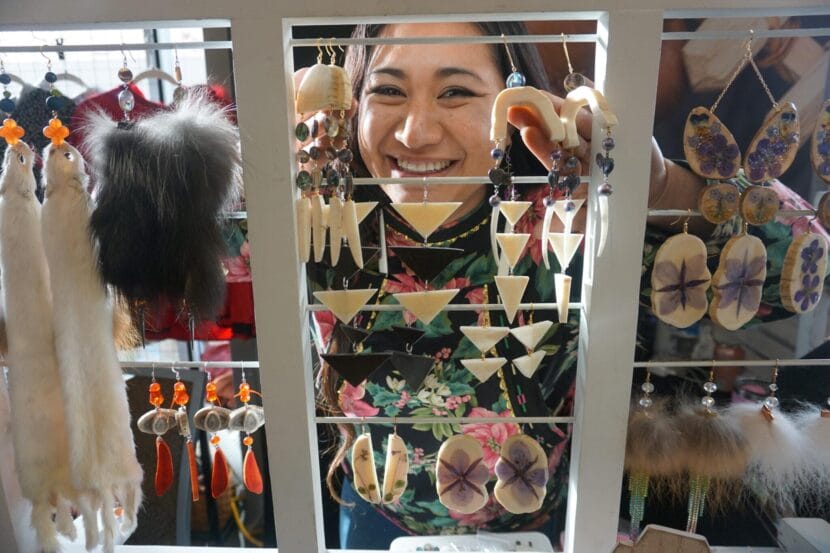
Britt’Nee Brower of Utqiagvik peers through hanging jewelry at her table at the Alaska Federation of Natives convention on Oct. 16, 2025. Brower creates works of art out of a variety of media. Among her skills is carving, sewing, beading, etching, fashion design and poetry. She is among the artists listed in the Alaska Native Arts Directory. (Yereth Rosen/Alaska Beacon)
A new online statewide directory has been launched to showcase and connect Alaska Native artists across disciplines.
The Alaska Native Arts Directory is the work of the nonprofit Alaska Native Arts Foundation. Listing is free. The directory went live last week, timing that coincided with the Alaska Federation of Natives annual convention in Anchorage.
As of Monday, about 200 artists were listed, most of them with photos and biographical information. The Alaska Native Arts Foundation said it is seeking to expand that number to more than 1,000 by next year.
The Anchorage-based foundation said it also has a goal of holding a first-ever Alaska Native Arts Economic Summit next year, bringing together artists, policymakers and other partners to work on building the Indigenous creative economy.
There are other artists’ directories in Alaska, some of them with a focus on Indigenous artists. One, the Collective49 Marketplace, enables member artists to promote and sell their work online. And there are numerous local artists directories, such as those in Ketchikan and Homer.
The Alaska Natives Art Directory, however, is intended to be more comprehensive. Along with being statewide, the directory includes writers, musicians and other performing artists along with those who create carvings, paintings and other physical works of art. It includes contemporary art forms as well as traditional Indigenous arts.
“The Alaska Native Arts Directory celebrates the full spectrum of Alaska Native creativity, visual and written arts, performance, design, and traditional practices, reflecting the diversity and vitality of Alaska’s Indigenous cultures,” Gail Schubert, chair of the Alaska Native Arts Foundation, said in a statement.
Launch of the Alaska Native Arts Directory represents a renaissance of sorts for the Alaska Native Arts Foundation.
The foundation was created in 2002 and for several years operated an ecommerce site and a gallery in Anchorage. But it shut down those operatioons in 2016 after losing state funding and encountering other financial problems.
The directory project and other new activities now have a variety of funding sources, according to the foundation’s statement. The effort is backed by grants and other support from organizations that include the Rasmuson Foundation, the U.S. Small Business Administration, the office of U.S. Sen. Lisa Murkowski, R-Alaska, the Alaska State Council on the Arts and the Municipality of Anchorage, among others, according to the statement.
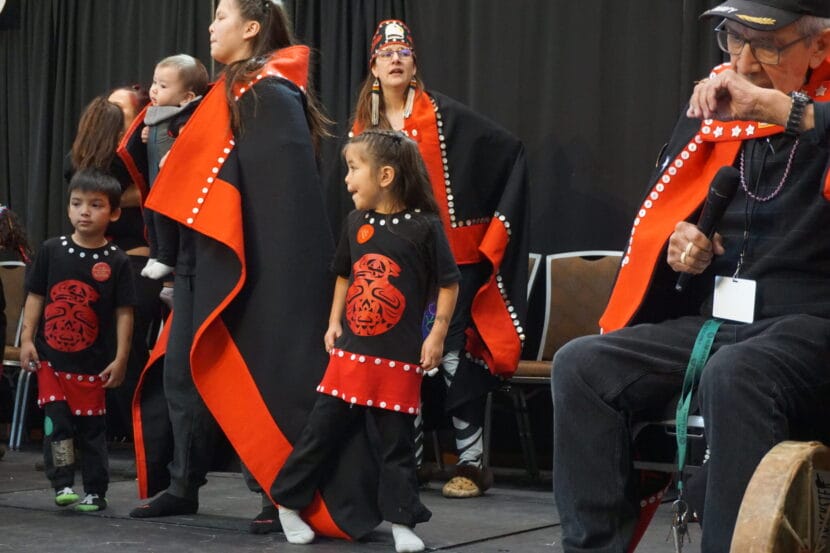
Members of the Tlingit, Haida and Tsimshian group Aanchich’x Kwaan perform on Oct. 18, 2025, at the Alaska Federation of Natives convention in Anchorage. The dance and singing group has members of all age groups, from young children to elders. The group was among several that performed traditional dances at the convention. (Photo by Yereth Rosen/Alaska Beacon)
The Alaska Federation of Natives convention in Anchorage, while it featured the usual cultural celebrations, socializing and discussions of state and federal policies, had a strong focus this year on a particular subject: the ravages on the Yukon-Kuskokwim Delta of ex-Typhoon Halong.
Speaker after speaker at the convention, the largest annual convention of any kind in Alaska and one of the largest Indigenous gatherings in the nation, referenced the storm. It has displaced more than 1,500 people, killed at least one person and dislodged houses from their foundations. Residents of stricken villages have been airlifted away, with hundreds getting temporary residency in Anchorage. The state’s largest city is about 490 miles east of the evacuees’ home villages, and vastly different in culture and character from the highly rural Indigenous communities.
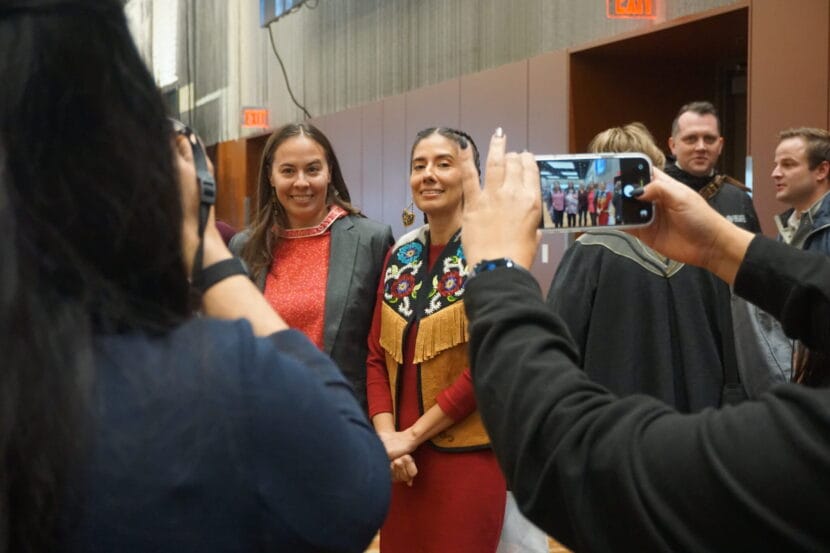
Natasha Singh poses for photos in the hallway of the Dena’ina Civic and Convention Center, site of the Alaska Federation of Natives annual convention. Singh, who is president of the Alaska Native Tribal Health Consortium, had just delivered her keynote speech on the opening morning of the convention. (Photo by Yereth Rosen/Alaska Beacon)
“My heart with everyone impacted by the recent coastal storms,” Natasha Singh, the president of the Alaska Native Tribal Health Consortium and the keynote speaker on the first day of the convention, said at the start of her address.
“While the damage is so vast, the love for our people is even greater. And even as we feel the pain and the loss, I also feel a sense of inspiration to see so many people reach out to help,” she continued.
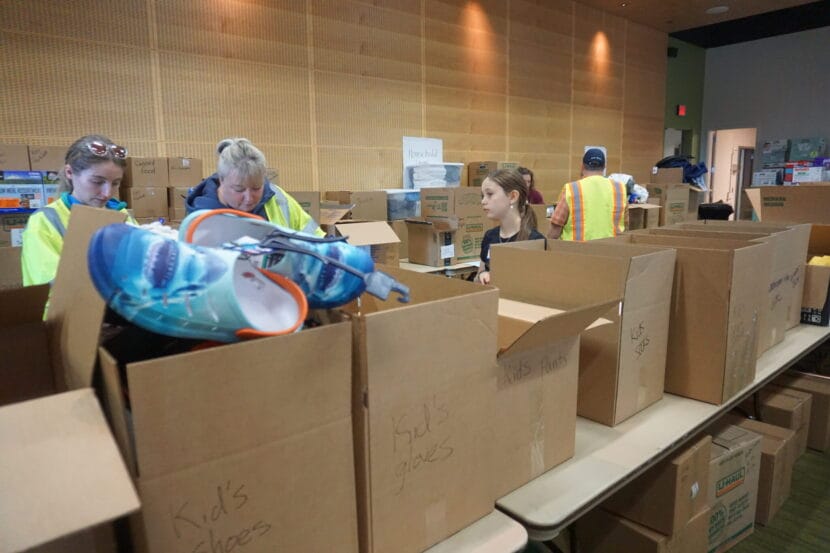
Volunteers work on Oct. 18, 2025, to sort donated items being collected in a room in the Dena’ina Civic and Coonvention Center, site of the Alaska Federation of Natives annual convention. Donations of diapers, clothing, hygiene products, bottled water, shelf-stable food and other items were being collected for Yukon-Kuskokwim Delta residents displaced by the remnants of Typhoon Halong. (Photo by Yereth Rosen/Alaska Beacon)
A special feature of the convention was a second-floor room at the Dena’ina Civic and Convention Center that was set aside to collect donations headed to the storm victims. Over two days, as convention proceedings unfolded in the third-floor ballroom, the collection room became filled with boxes of diapers, toiletries, clothing items, shelf-stable food and other necessities that were sorted by volunteers.
On Saturday, the final day, delegates passed a resolution seeking an immediate national disaster declaration, and investment by the federal government in better infrastructure in rural Alaska to protect against future disasters.
The ravages of the remnants of Typhoon Halong demand more than an emergency response, the resolution said. The disaster “has continued to expose vulnerabilities in infrastructure, housing, and emergency preparedness for rural Alaska/extreme remote America, and highlights the need for stronger tribal-state-federal collaboration,” it said.
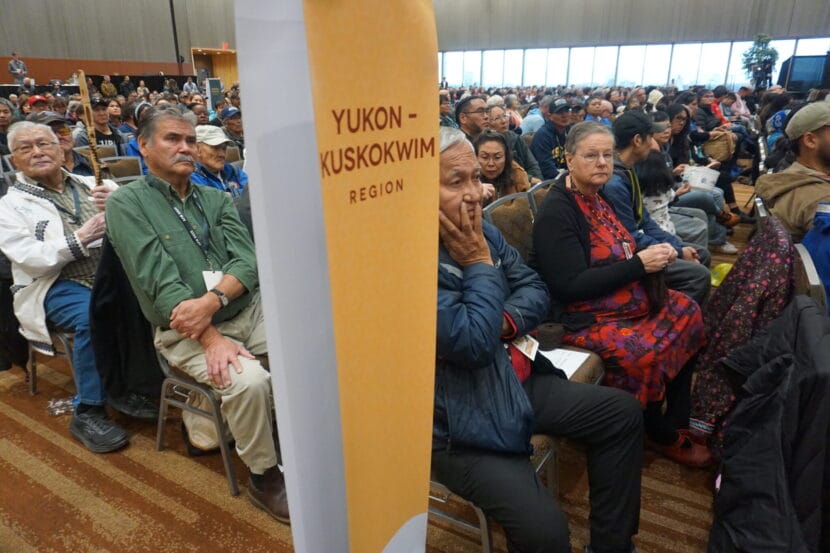
Alaska Federation of Natives convention attendees from the Yukon-Kuskokwim region listen on Oct. 16, 2025, to the keynote address delivered by Natasha Singh, president of the Alaska Native Tribal Health Consortium. (Photo by Yereth Rosen/Alaska Beacon)
The call for a national disaster declaration and the aid that would come with it was among a packet of resolutions passed on Saturday. Many of the resolutions concerned food security and efforts to ensure that Alaska Natives can safely practice their traditional fishing and hunting practices.
One highly anticipated convention speaker was former U.S. Rep. Mary Peltola, D-Alaska, who is considered a possible candidate for governor or U.S. Senate.
But Peltola made no campaign announcement.
“I want to preface everything I’m saying with: This is going to be very anticlimactic for everybody, I think,” she said at the start of her speech. “No big announcements, no big declarations.”
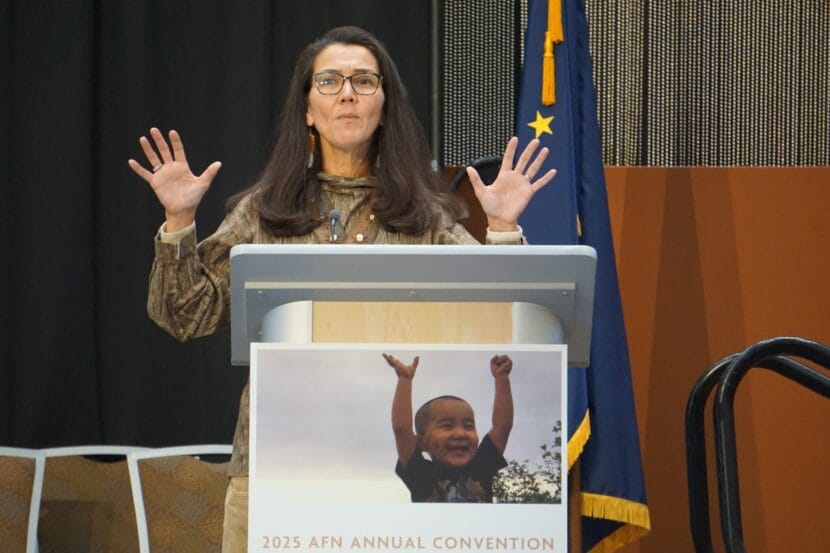
Former U.S. Rep. Mary Peltola, D-Alaska, speaks at the Alaska Federation of Natives convention on Oct. 17, 2025, about subsistence food gathering. Peltola is Yup’ik and from Bethel. (Photo by Yereth Rosen/Alaska Beacon)
Instead, she discussed subsistence – the traditional harvests of wild foods and arts materials – and the legal and environmental threats to its continued practice.
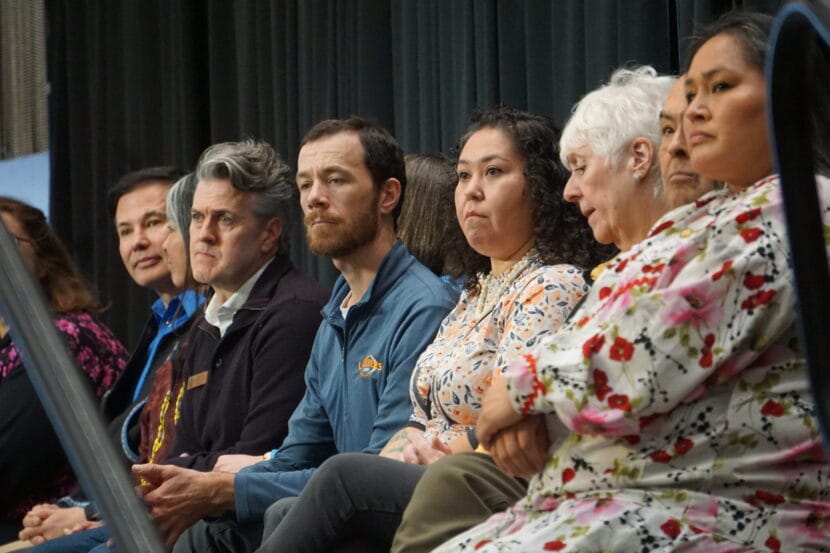
State legislators sit onstage at the Alaska Federation of Natives convention on Oct. 17, 2025, as House Speaker Bryce Edgmon, I-Dillingham, addresses the audience. Lawmakers pictured are, from the left, Rep. Neal Foster, D-Nome; Rep. Maxine Dibert, D-Fairbanks; Rep. Andrew Gray, D-Anchorage; Rep. Zack Fields, D-Anchorage; Rep. Robyn Burke, D-Utqiagvik; Rep. Louise Stutes, R-Kodiak; Sen. Donny Olson, D-Golovin; and Rep. Nellie Jimmie, D-Toksook Bay. (Photo by Yereth Rosen/Alaska Beacon)
She spoke about the way subsistence ties Alaska Natives to their home regions.
“Those spots, the places that we hunt and fish, they’re like another personality to us,” Peltola said.
She referred to a close friend who recently died. When she was on her deathbed, her family gathered around, Peltola said. “And at one point, they just talked about places. They just said the names of the places where they pick berries, or get whitefish, gather greens. And it was one of the most beautiful moments I’ve ever experienced, just reciting names.”
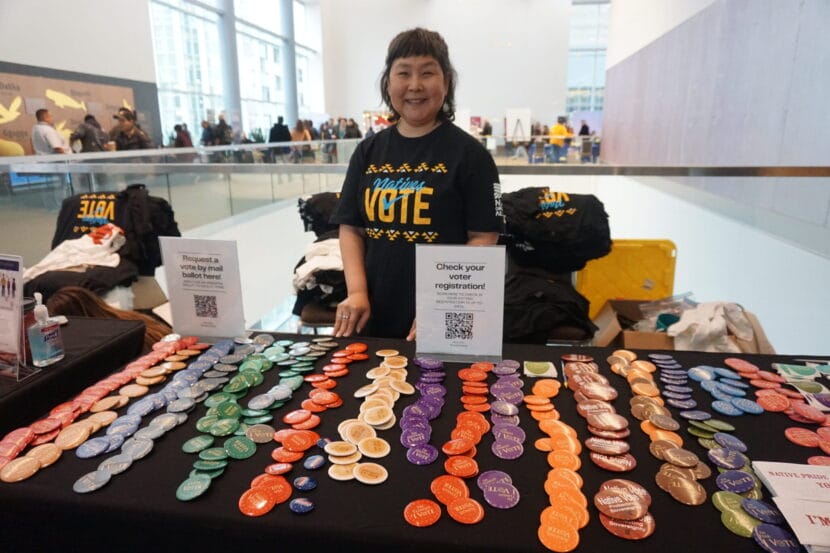
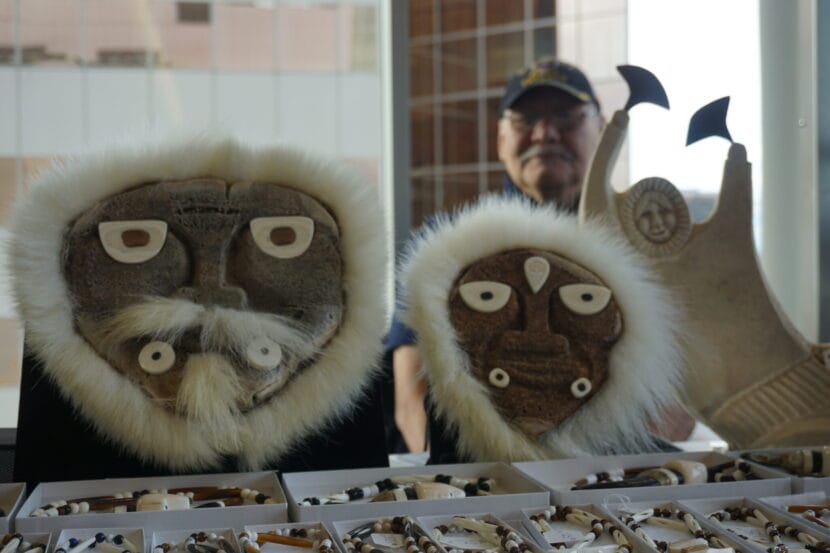
Kendra Berlin mans a pro-voting table at the Alaska Federation of Natives convention on Oct. 16, 2025. Berlin, originally from Bethel but now living in Palmer, was distributing T-shirt and buttons promoting the Natives Vote cause. (Phot by Yereth Rosen/Alaska Beacon)Victor Geffe sits behind a table displaying his artwoork on Oct. 16, 2025, at the Alaska Federation of Natives convention in Anchorage. Geffe, from Kotzebue, has been honored for his carvings of whalebones and other materials. He was one of the many artists displaying and selling work at the convention. (Photo by Yereth Rosen/Alaska Beacon)
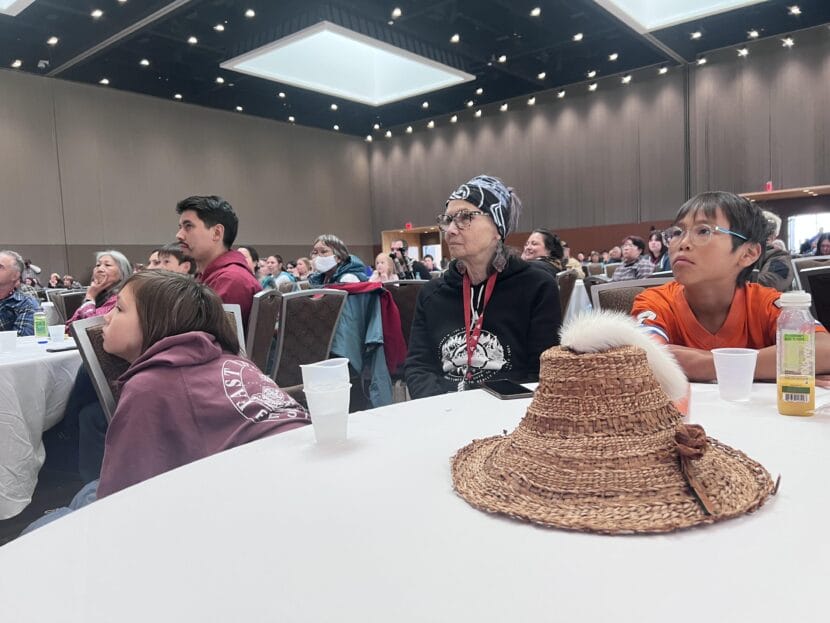
A group listens to a speech at the opening day of the Elders & Youth conference at the Dena’ina Center in Anchorage on Oct. 12, 2025. (Rhonda McBride/KNBA)
The Alaska Federation of Natives convention, which is scheduled for this week, always focuses on issues most pertinent to local Indigenous communities. This year, a catastrophic storm that battered predominantly Alaska Native villages in Western Alaska is already the center of the conversations.
The remnants of Typhoon Halong over the weekend left at least one woman dead in the Yukon-Kuskokwim Delta. Two people are still missing.
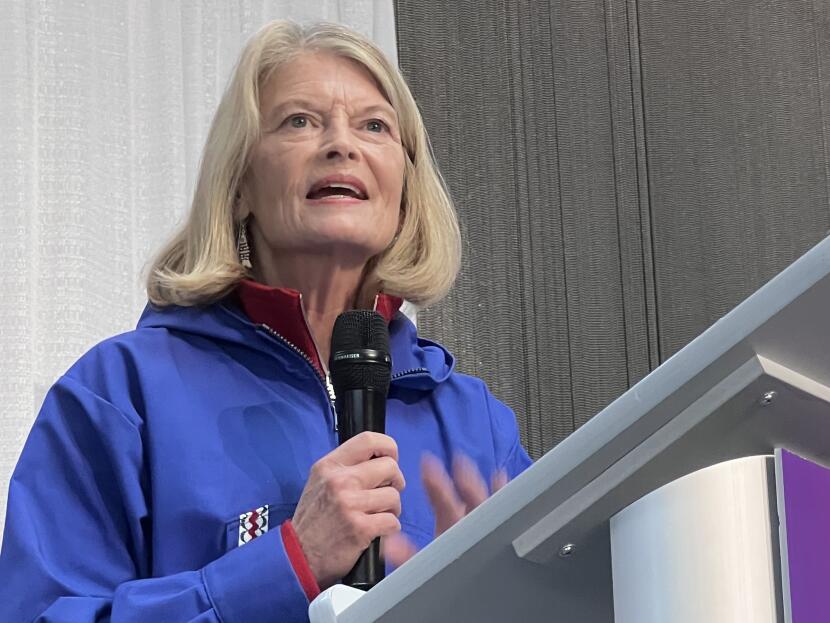
“As we gather for this sharing and this collective convening, let us keep in mind those that are in harm’s way and those who are out there to be with them and to help them,” Sen. Lisa Murkowski said at the beginning of the Elders & Youth conference, the traditional prologue to the main AFN event.
Sen. Lisa Murkowski speaks at the beginning of the Elders & Youth conference, thanking people who had traveled from across the state and have been supporting those affected by the Western Alaska storm. (Rhonda McBride/KNBA)
The storm has displaced more than a thousand people, who are sheltering at their local schools. Meanwhile, AFN and other local Indigenous organizations were looking for ways to help.
AFN was one of twelve mostly Indigenous organizations that formed the Western Alaska Disaster Relief Fund to provide assistance to villages. On Thursday, AFN planned to hold a blanket dance fundraiser for the disaster. And on Friday, the group said they will host a donation drive to accept water, food, hygiene products and other necessities.
Roy Agloinga is president of the First Alaskans Institute, which hosts the Elders & Youth conference. He opened the conference with a speech about the destruction from the storm. He told the gathering that the whole state must come together to help.
“It’s easy to feel distant, but I ask you to lean in, because while the storm may be hundreds of miles away, the people affected are our neighbors, our friends and our family.”
Marilyn Attla, a healer from the Interior who participated in the Elders & Youth conference, encouraged people to pray and acknowledge the stress of the situation. She also invited attendees – especially young people– to talk about what they feel and consider visiting a healing station.
“The youth could learn a lot and get a lot of healing from these people here,” she said. “You have to make up your own mind to be resilient. Any type of loss that you’re going to go through in your life, any type of happening problem, you have to make up your own mind to overcome it.”
The Elders & Youth conference is running at the Dena’ina Center in Anchorage through Wednesday. AFN is scheduled there from Thursday to Saturday.
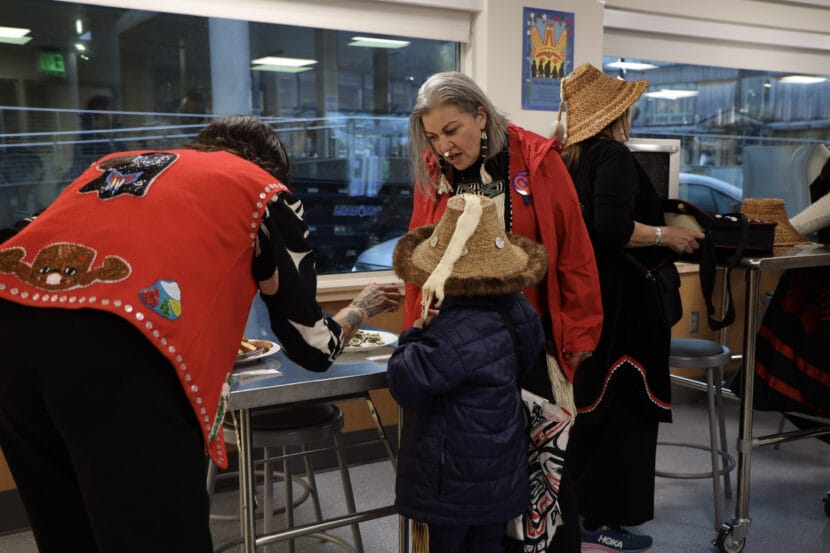
A child tries dried kelp at the opening of SHI’s new Indigenous Science Building on Oct. 13, 2025. (Photo by Yvonne Krumrey/KTOO)
At a ceremony on Monday, Lingít language Professor X̱’unei Lance Twitchell said that bringing traditional ways of being into the present isn’t a contradiction.
“It’s not a ‘living in two worlds’ situation,” Twitchell said. “It’s living as an Indigenous person with multiple languages and multiple identities, and being just fine with it. You don’t have to be just one thing.”
The new Sealaska Heritage Institute Indigenous Science Building carries that sentiment in all the services it offers.
The building on Heritage Way hosts a digital media lab with a podcast booth and video production software, an Indigenous science research lab that studies cultural resources like seaweed and clams and a makerspace with a digital woodcarving machine. That last one made nametags instructors wore as they led tours of the new building on Monday.
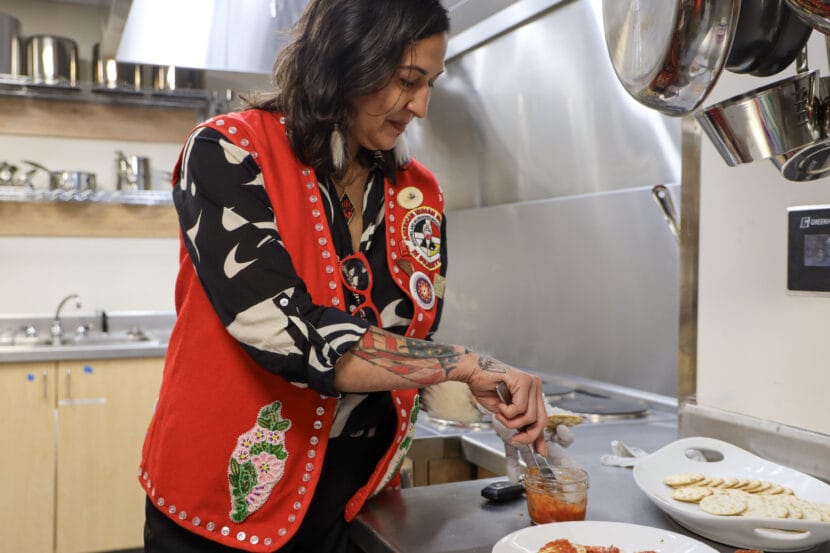
In the Traditional Foods and Medicine Kitchen, instructor S’eiltin Jamiann Hasselquist said she and others are bringing old ways to process and preserve food into the present.
“Whatever people can dream up that they would like to do in this kitchen,” Hasselquist said. “I think that we could try to make their dreams happen”
With freeze dryers, pressure cookers, dehydrators and space to build traditional drying racks, Hasselquist said they are making and preserving traditional foods that elders would make when she was a kid, like cheese kaháakw — a rich and smoky paste made of fermented salmon eggs.
S’eiltin Jamiann Hasselquist spreads some cheese kaháakw on crackers in SHI’s Traditional Foods and Medicine Kitchen on Oct. 13, 2025. (Photo by Yvonne Krumrey/KTOO)
She scooped some out of a glass jar, and spread it on a cracker for anyone who wanted to try it.
“Someone tasted that cheese kaháakw, and they took one bite, and they said, ‘Oh my gosh, I’m getting emotional. I haven’t tasted this for 30 years.’ It’s been three decades, and they thought that they would never try it again,” she said.
Elders have been approaching Hasselquist with foods they remember from childhood, but don’t know how to make.
“So if we could have workshops and share that knowledge,” she said. “And we’re rebirthing, you know, this, this Indigenous way of living and being.”
Next, she wants to find out how to make cold-pressed seal grease.
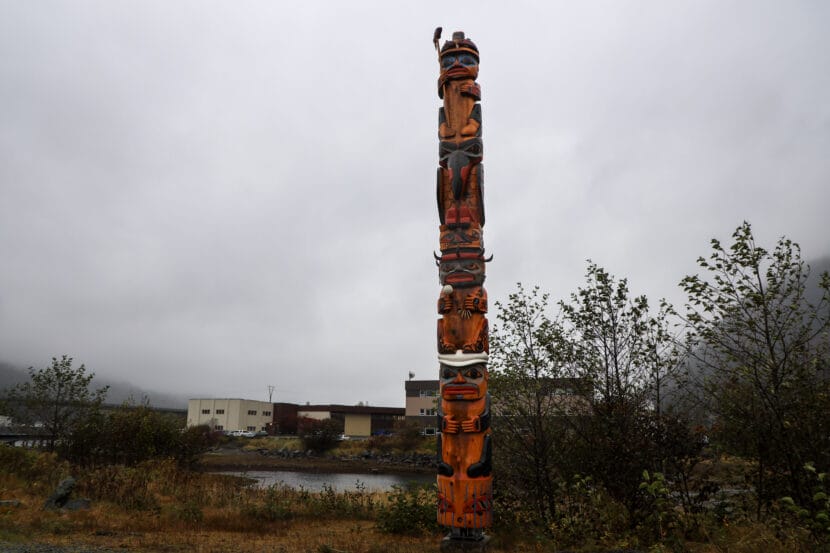
A totem pole representing the Sukteeneidí clan on Tuesday, Oct. 14, 2025. (Photo by Clarise Larson/KTOO)
Inside the clan house in the Walter Soboleff building, Sukteeneidí clan members stood in front of a large poster depicting a totem pole that represents their clan story. They offered thanks to other clans, carvers, and SHI leadership.
In a ceremony held on Indigenous People’s Day, the latest pole in Sealaska Heritage Institute’s Kootéeyaa Deiyí — totem pole trail — was dedicated.
The pole is called a kooteeyaa in Lingít and was funded by the National Parks Service. It was raised near Juneau’s Overstreet Park, but organizers held the dedication inside due to weather.
Edward Thomas is Sukteeneidí and he said he’s excited to see his clan join the handful of others already represented by the Kootéeyaa Deiyí. “As I look at the walk of the totem pole along the waterfront here, I’m proud to see that all of our clans are being represented,” he said.
Thomas went on to thank the carver, Lee Wallace, and his apprentices for the thought and work they put into the pole.
Wallace is a Haida master carver and lives in Saxman, but he said this kootéeyaa is a part of his family’s legacy, too.
“My great grandfather has a totem pole in the state building, Dwight Wallace. My grandfather, John Wallace, has a totem pole that was outside the city museum,” he said. “So now, with this particular kootéeyaa pole, there’s three generations of Wallace totem poles standing here in Juneau.”
Wallace was helped by apprentices, including his son Charles Peele.
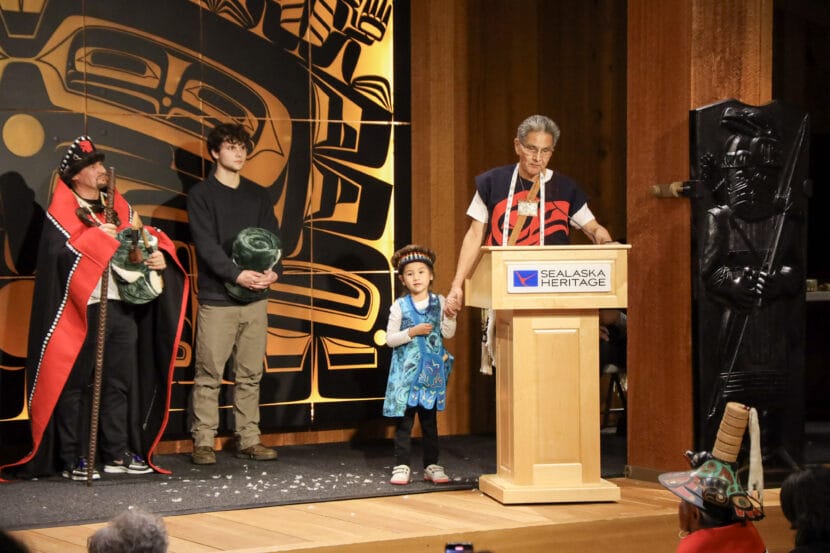
Master carver Lee Wallace holds his granddaughter’s hand as he speaks at the dedication of his pole on Oct.13, 2025. The pole represents the Sukteeneidí clan, and was raised as part of Sealaska Heritage Institute’s Kootéeyaa Deiyí. (Photo by Yvonne Krumrey/KTOO)
And Peele held the youngest member of the carving team — his five-year-old daughter Jáadsangaa Elizabeth — as he described the design of the pole.
“And at the top, we have the current clan leaders. We want to acknowledge that this is representation of a living people,” he said. “That this isn’t just something that’s from the past, this is something that’s tying history together. We often look at totem poles as things that are coming back from the past. And we wanted to add a piece that represents the present.”
Below the current clan leaders, the pole features a spirit man, Raven, and a box that represents the abundance of knowledge and history held in the Sukteeneidí clan, whose homelands are near Kake.
At the base is the clan crest — dog salmon swimming in tall grasses.
SHI plans to raise a total of 30 poles along Juneau’s waterfront. So far, 13 poles have been installed.
Close
Update notification options
Subscribe to notifications
Subscribe
Get notifications about news related to the topics you care about. You can unsubscribe anytime.