Alaska Native Arts & Culture

Southeast Alaska weaver threads together wisdom and technique

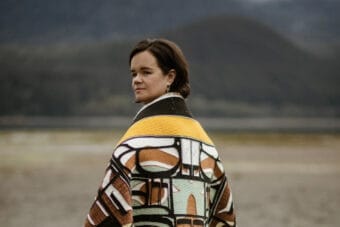
Lingít weaver Tleinax Shaawat Sydney Akagi poses with two of her creations displayed at the Sheldon Jackson Museum.
Lingít weaver Tleinax Shaawat Sydney Akagi poses with two of her creations displayed at the Sheldon Jackson Museum. (Ryan Cotter/KCAW)

Back when she was an art manager at the Sealaska Heritage Institute in 2017, Sydney Akagi would frequently spot people using weaving kits. Inspired by the weaving surrounding her, she scored a spot in Ravenstail and Chilkat weaver Lily Hope’s class, and Akagi was hooked.

“Weaving felt pretty, almost addictive at first. I couldn’t stop,” said Akagi. “I was up late at night. I’d be sitting in bed with tiny projects and wouldn’t go to sleep, and I kind of just lost time.”

Since then, Akagi continued to study under Hope’s tutelage as an apprentice in Juneau, mastering the intricate finger-twining steps of Ravenstail weaving and the geometric designs of the Chilkat style. As her skills improved, Akagi says she was able to find healing and empowerment in her own Lingít identity.

“I think it started to kind of heal some maybe cultural things, a little bit of cultural trauma that I had had from growing up and not feeling accepted and kind of keeping my culture kind of like just at bay and not fully accepting it,” Akagi said. “So it was kind of like my gateway into having that healing with my culture.”

With Hope’s encouragement, Akagi quit her job at the Sealaska Heritage Institute in 2020 to pursue weaving full-time. Now, with nearly a decade of weaving under her belt, she is excited to share her knowledge with Sitkans as the current Native artist resident at the Sheldon Jackson Museum.

There, visitors can view a killer whale Chilkat tunic Akagi completed in 2023. The tunic immediately captures attention as people enter the museum, with its vibrant yellows and blues blasting through its black and white borders to define the whale’s geometric shapes. The tunic’s design mirrors itself on either side in what is known as a distributive design. The tunic is a recreation of one Akagi observed at the Anchorage Museum back in 2022, in order to learn how to weave a traditional tunic.

“There’s not very many weavers that understand the process of creating the shoulders on that tunic, so it felt more almost 3-D versus the flat surface of like a robe that’s hanging on a loom,” said Akagi. “So what I really wanted to do was understand that shoulder, the techniques of creating that and that construction.”

Next to the tunic is one of Akagi’s works-in-progress – a black wall of thread with diamonds swimming across a budding yellow line below it across her weaving loom. These initial threads will eventually culminate into a Chilkat robe depicting a salmon. This robe is unique in that unlike Akagi’s previous pieces like the distributive killer whale tunic, this one will have a configurative design, or an asymmetrical design across the piece.

“So I might be a little anxious before starting that and just having that understanding, but again, that I think that’s part of my evolution as a Chilkat weaver, and like understanding that and gaining all that knowledge,” said Akagi.

Sydney Akagi demonstrates her weaving technique on her developing Chilkat robe. (Ryan Cotter/KCAW)

The salmon robe was inspired by Akagi’s experience as a resident of the Taku River near Juneau and her advocacy work as a Salmon Beyond Borders Ambassador fighting mining companies whose wastewater endangers the health of the river’s salmon.

“So I was kind of trying to figure out how the art I make, what I could make to kind of bring in a more traditional conversation to these conversations I’ve been having with the CEOs and presidents of these mining companies to ask them to respect our rivers and to do the cleanup,” Akagi said.

Akagi says the work she does, both on her loom and as an advocate for environmental justice, is connected.

“Every part of what I’m creating is from the earth, and so not protecting the Earth only affects what I am creating,” she said.

In addition to a lecture, as part of her residency Akagi will lead a sold-out weaving workshop where participants can create their very own keychains. Akagi is excited to introduce students to the wide-variety of benefits weaving has to offer.

“For kids, weaving can be used as a hands-on method to teach math,” Akagi said. “There’s pattern recognition for anybody older. Just understanding how to do this and use your hands, and even for the cultural reason of being able to connect with the culture or understand the culture. I think there’s so many things that anybody can benefit from learning about weaving.”

Amidst the chaos of balancing numerous other weaving projects with navigating grants and family life, Akagi is grateful to be present in Sitka and engage with the community, exchanging ideas like two threads being woven together to create something meaningful.

Tlingit and Haida confirms plans for casino-like gambling hall on Douglas Island

A “No Trespassing” sign hangs on a tree at the border of a Native allotment on Douglas Island on Wednesday, Aug. 6, 2025. (Photo by Clarise Larson/KTOO)

A site on Douglas Island could be the future home of a casino-like gambling hall after a proposal from the Central Council of the Tlingit and Haida Indian Tribes of Alaska was approved by the National Indian Gaming Commission.

Tlingit and Haida says the facility’s approval represents a step toward economic self-sufficiency and sovereignty for the tribe. 

The land is on Fish Creek Road, not far from Eaglecrest Ski Area on Douglas Island. It’s just a small piece of a Native allotment owned by tribal members who lease it to Tlingit and Haida. Rumors of the tribe developing something on that property have circulated for years. The tribe first cleared that area in 2018 and has hosted fireworks shops there on and off over the years. 

But, nothing substantive has been developed — until recently. 

Driving past the location in August, “No Trespassing” signs lined the area and a sign at the entrance warned of construction. Excavators, trucks and building material scattered the graveled area as the structure of a building was beginning to take shape.

Construction is underway at a Native allotment on Douglas Island on Wednesday, Aug. 6, 2025. (Photo by Clarise Larson/KTOO)

In an email this week, Tlingit and Haida spokesperson Dixie Hutchinson confirmed that the tribe is developing a gaming facility. According to Hutchinson, the plan “aligns with Tlingit and Haida’s broader mission to expand revenue-generating opportunities that support essential programs and services for tribal citizens.”

The tribe intends to offer Class II gaming, which covers things like pull tabs, bingo and slot-style electronic machines. It doesn’t cover games like poker or blackjack. Pull-tab gambling is common across Alaska, but what’s less common are electronic pull-tab machines. Tlingit and Haida’s gambling hall could resemble one that’s been operating in Metlakatla, on Alaska’s only Indian Reservation, for years. There, rows of slot-machine-like devices sit in rows, with stools in front of each machine.

The National Indian Gaming Commission’s acting chair approved the tribe for site-specific gaming at the location in January. The decision came just days before President Donald Trump began his second term in office. 

In Alaska, very few tribes have authority over land, so they haven’t had a way to open reservation-style casinos like tribes in the Lower 48. But many tribes in Alaska have sought to assert authority over Native allotments owned by individual tribal members.

For decades, federal officials — and state officials in Alaska — have said that Native allotments owned by tribal members in Alaska were not considered “Indian country.” Therefore, they are not under the jurisdiction of tribes and cannot be home to casinos or casino-like gambling halls under the Indian Gaming Regulatory Act.

That stance held firm during the first Trump Administration – the commission declined Tlingit and Haida’s request for gaming authorization at the site in 2020. 

But Michelle Jaagal Aat Demmert, a professor at the University of Alaska Fairbanks’ tribal governance department, says the legal interpretation of Native allotments shifted when former President Joe Biden came into office. 

“During the Biden administration, there was a solicitor’s opinion that evaluated the laws and made the determination that the laws supported that Indian tribes in Alaska have jurisdiction over allotments and other land that’s classified as Indian country,” she said. 

Demmert is also an attorney and Tlingit and Haida’s former chief justice. She said gaming serves as an important governmental function for many tribes in the U.S. 

“People look at it that it’s just this big money-making operation, but it’s so much more than that,” she said. “It’s an opportunity to make money and an opportunity to put that right back into your governmental system, to provide essential services to your citizens.”

The change in opinion during the Biden administration provided an avenue for tribes like Tlingit and Haida and the Native Village of Eklutna to move forward. In February, Eklutna opened a gaming hall on a Native allotment near Anchorage. 

However, just days after the Eklutna hall opened its doors, the State of Alaska filed a lawsuit to shut them down, arguing that the state still maintains primary jurisdiction over Native allotments. That lawsuit is still ongoing. 

Tlingit and Haida President Chalyee Éesh Richard Peterson expressed his support for the Eklutna Tribe’s gaming hall and championed the benefits it brings to the tribe. He did not respond to a request for comment on Tlingit and Haida’s proposed facility. 

In a statement, Juneau City Manager Katie Koester said the City and Borough of Juneau “respects the sovereignty of Tlingit and Haida, and recognizes that this parcel is not subject to CBJ jurisdiction.”

Hutchinson said the project is still in the early phases of development, and she did not offer a timeline for when it will open to the public. She said the tribe intends to reinvest the gaming hall’s revenue into essential tribal programs and services.

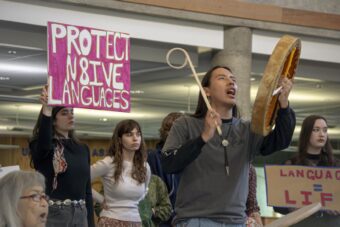
Native languages need radio, which is at risk of being lost

A woman wearing headphones speaks into a radio studio microphone
KUYI-Hopi Radio general manager Samantha Honani Molina on the air at the station in Arizona in June. (Photo by Deidra Peaches/High Country News)

Samantha Honani Molina was about 20 when KUYI-Hopi Radio first came on air. She was attending college, hours and miles from her home village, and every time she tuned in, she felt connected, hearing her community’s songs and language.

“I was struggling to find my place, because when you’re coming from the rez, you’re trying to find your space in a city or town, and there’s nothing of who you are and where you come from. You feel the sense of, not lost, but just uncertainty, and missing home and stuff like that,” said Molina. “By hearing language on the radio, it brings the sense of cultural identity that almost highlights and strengthens that — no matter where you are, even here at home. If you don’t hear yourself represented in large spaces, you’ll just get enveloped and folded into the mainstream.”

After graduating, she returned home and later became general manager of KUYI-Hopi public radio, a position she’s held for three years. Previously, she was the program director for the Hopi Foundation, the station’s radio licensee and parent nonprofit, which provides several year-round programs on topics ranging from youth leadership to community development. The station — located in Lower Sipaulovi, below Second Mesa on the Hopi Reservation in northern Arizona — made its on-air debut in 2000 and began broadcasting online in 2010. It is the only news outlet of its kind that focuses on the Hopi community, and uses the Hopi language, Hopìlavayi.

And now, as it celebrates its 25th anniversary, KUYI has to contend with the reality of losing a significant portion of its funding, possible cuts and changes to the ways it operates.

Currently, 42 Western radio stations are considered vulnerable because over 30% of their annual funding comes from the Corporation of Public Broadcasting. Twenty of those stations serve Indigenous communities and are located in the rural reaches of reservations and Alaska Native villages.

In May, President Donald Trump signed an executive order ending CPB’s congressionally approved funding of National Public Radio and the Public Broadcasting Service. NPR, PBS and various local stations filed lawsuits in response. In early June, Trump asked Congress to claw back the $1.1 billion it had already set aside for public media. The House of Representatives narrowly approved that legislation, which the Senate approved in mid-July despite receiving pushback from both Democrats and Republicans.

Molina said the bill would be “devastating” to KUYI.

“KUYI radio capacity is at a place where we’re able to provide all these avenues of service, which is safety, education and entertainment. We’re finally just beginning to really explore its possibilities,” Molina said. “If pulling public media funding is done, it would destabilize not only the progress made but also jeopardizes the essential safety and cultural services we provide daily.”


“By hearing language on the radio, it brings the sense of cultural identity that almost highlights and strengthens that …”– Samantha Honani Molina, general manager of KUYI-Hopi Radio


The station, which has five full-time staff members and a newly built modular studio, broadcasts at 60,000 watts across northern Arizona down to Winslow as well as online on its website. CPB funding accounts for over 48% of its operating budget, according to a June 30 letter the Hopi Tribe sent to the Senate, urging it to preserve funding for public media.

Native Public Media and the National Federation for Community Broadcasters have held summits over this, and Molina said that many broadcast organizations are already planning for cuts, regardless of whether the legislation is ultimately passed.

The immediate and significant budgetary impacts are obvious, but the long-term losses and their ramifications are incalculable. Stations like KUYI provide more than news and information: They’re community hubs where Indigenous languages can thrive, a space to preserve and grow Indigenous people’s connection to their culture and their own place within the world.

At KUYI, volunteer DJs host music and news segments, often providing bilingual weather and community updates, even a “Hopi Word of the Day” that introduces new words and tells listeners how to use them in conversation — mavasta, for example, which means “to aim” in the Hopi language.

KTNN in St. Michaels, Arizona — “The Voice of the Navajo Nation” — not only broadcasts sports events and other announcements, it also delivered essential information during June’s Oak Ridge Fire, all in Diné Bizaad, the Navajo language.

In Barrow, Alaska, the northernmost community in the United States, KBRW offers an hourlong five-day-a-week program called Uqalugaat Inupiat Stories that also teaches Inupiaq words and phrases. The late Fannie Kuutuuq Akpik-Piquk gave lessons on-air, explaining that misiġarriuq means “to make seal oil from blubber.”

Every day, the Talking Drum and Language Hour show on KWSO in Warm Springs, Oregon, plays Indigenous drum music and offers language lessons featuring the Ichishkin, Kiksht and Numu languages of the Confederated Tribes of Warm Springs.

In 2024, the United Nations Education, Scientific and Cultural Organization conducted a study recommended by the United Nations Permanent Forum on Indigenous Issues. UNESCO’s report highlighted the need for developing accessible Indigenous-produced media that provides news, entertainment and cultural programming. The report found that radio is the most widespread media and accounts for 34% of Indigenous media use. Indigenous media in general contribute significantly to the preservation and promotion of Native languages, cultural practices and traditional knowledge, helping “foster a sense of belonging and recognition.” But there are still barriers to providing Native language content on the radio, including technical hurdles, programming quotas and the heavy reliance on voluntary efforts that require long-term support.

Altogether, Indigenous radio and media help Indigenous communities engage and grow in their understanding of their language and show them how they can better connect with their culture.

Tiffany Lee, a Native American studies professor at the University of New Mexico, researches language reclamation and identity for Native youth. She promotes the benefits of immersive bilingual education for Indigenous students and adults, noting that having access to learning one’s language is key to revitalizing it.

“The number-one issue for language revitalization today is making sure our youth, our families, all have access to learning in some way and in multiple ways,” said Lee. “Just one isn’t going to work and isn’t always the best method for learning, so you need a diverse array of accessing the language and learning it.”


“If pulling public media funding is done, it would destabilize not only the progress made but also jeopardizes the essential safety and cultural services we provide daily.” – Samantha Honani Molina, general manager of KUYI-Hopi Radio


Indigenous language use on the airwaves bolsters the other places where Native languages are spoken, including schools and other immersion language programs. Examples in the Southwest include organizations like Saad K’idilyé — of which Lee is a board member — and Hopitutuqaiki, which teach Navajo and Hopi respectively in culturally relevant ways.

For Lee, learning one’s language is not just about being able to communicate within the community.

“I have this shirt that says ‘Indigenous language education is education,’ and I love that shirt and that saying because it’s so true,” Lee said. “It’s not just learning the mechanics of speaking your language — it’s an education unto itself. You’re learning your community and your culture’s worldview; you’re learning how language is tied to cultural practice, how it is cultural practice.”

No one understands the impact of sending Indigenous languages out onto the airwaves more than Navajo radio broadcaster L.A. Williams.

Williams, who’s been a radio broadcaster for 32 years, is widely known for reporting Phoenix Suns games in Diné Bizaad, providing play-by-play commentary, making the sport more accessible for people who speak only that language. Williams said the language continues to thrive largely because of its continued use.

“We’re not losing our language,” she said. “Our language is what puts us further in life as it makes us live longer into life by knowing the Navajo language.”

Throughout her career, Williams has seen broadcast opportunities as another way of encouraging use of Diné Bizaad at home, bridging the connection between elders who are fluent and youth who lack full command of the language. This creates a connection between past and future, reminding people that tribal history and culture will continue.

KUYI-Hopi Radio staff (from left) Darion Kootswatewa, Samantha Honani Molina, Brennyn Masawytewa, and Josh Sakenima. Molina and Masawytewa hold dolls of the station’s mascot. (Deidra Peaches/High Country News)

Despite the national threat to public media and funding cuts’ impact on rural and tribal stations, Williams is confident of the persistence and resilience of Indigenous languages.

“As far as the language, the tradition, the culture, that goes on,” she said. “That life goes on into the future.”

Meanwhile, Molina and Lee remain hopeful that current U.S. policy, including proposed funding cuts to Indigenous public media, won’t derail the conviction and resilience of people who are determined to preserve and reclaim their traditional ways of life.

KUYI is working on seeking alternative funding and keeping stakeholders informed. And Indigenous public media organizations such as Native Public Media, Vision Maker Media and Koahnic Broadcast Corporation, attended the National Congress of American Indians mid-year conference, seeking support from the organization.


“The number-one issue for language revitalization today is making sure our youth, our families, all have access to learning in some way and in multiple ways.” – Tiffany Lee, a Native American studies professor at the University of New Mexico


“Thankfully, we have a good parent organization, the Hopi Foundation, who is stepping up to see how they can supplement during this loss,” Molina said. “But they can’t carry us for that long. We’ll see what they’re able to do to help us fundraise or carry us for a little bit, but it’s not going to sustain — it won’t sustain.”

Despite the uncertainties and hardship, Molina said it’s been humbling to witness the outpouring of support from other radio stations and their listeners. The station’s 25th anniversary in August serves as a reminder of what really matters.

“That’s a really pivotal point for us to reflect on,” Molina said. “Then go forward with strength and resilience, just like our people have always done. It’s an opportunity for us to really show what we can do to support something so important, and I’m really excited to see what that looks like.”

We welcome reader letters. Email High Country News at editor@hcn.org or submit a letter to the editor. See our letters to the editor policy.

This article appeared in the August 2025 print edition of the magazine with the headline “Indigenous languages on the airwaves.”

This article first appeared on High Country News and is republished here under a Creative Commons Attribution-NonCommercial-NoDerivatives 4.0 International License.

Alaska’s ‘Nazi Creek’ is no more, as federal geographic names board approves traditional alternative

This map from the U.S. Geological Survey shows the former Nazi Creek on Little Kiska Island. (U.S. Geological Survey photo)

A small creek on Alaska’s Little Kiska Island has been renamed, more than 80 years after it was named after Germany’s Nazi Party by World War II soldiers fighting in the Aleutians.

Nazi Creek was the last landmark in the United States to bear the Nazi name. Its new name is Kaxchim Chiĝanaa, meaning either “gizzard creek” or “creek or river belonging to gizzard island” in Unangam Tunuu, the language of the Indigenous Unangax̂ people.

On Thursday, the Domestic Names Committee of the U.S. Board on Geographic Names voted 17-0 to approve the new name, without discussion.

The board’s decision allows the federal government to officially change the creek’s name in federal databases that are the official repository of geographic names. That repository is used by federal agencies and commercial companies that provide maps to the general public.

The board also approved the renaming of nearby “Nip Hill,” named by soldiers using a derogatory term for Japanese people. That hill was renamed “Kaxchim Qayaa,” or “gizzard hill,” again using the traditional name for Little Kiska Island, which is not far from Kiska Island, site of a World War II battle.

Michael Livingston, an employee of the Aleutian Pribilof Islands Association, has been working for almost two years to have the names changed. Moses Dirks, an expert on Unangam Tunuu, recommended the new names.

“I think that’s pretty awesome. I think elders … and others are happy about it. It really should have never been there in the first place,” Livingston said of Thursday’s vote.

“Like one of my teachers … used to say, if you know something that can make our community better, our villages better, be brave and stand up and say something about it, do something about it,” Livingston said.

The new names were previously recommended by the Alaska Historical Commission, which considered them in April. The changes were endorsed by local Native tribes and Native corporations, the Museum of the Aleutians, the manager of the Alaska Maritime National Wildlife Refuge, Congregation Beth Sholom of Anchorage, and the Alaska Chapter of the Japanese American Citizens League, among others.

Kiska Island is located 242 miles west of Adak, at the far end of the Aleutian Islands. The area has been mostly uninhabited since World War II, when invading Japanese forces took 42 people on Attu Island prisoner. More than half died in Japanese internment camps.

The United States forcibly relocated almost 900 Unangax̂ residents of the Aleutian Islands, housing them in unsuitable internment camps in Southeast Alaska and elsewhere. Many became sick and died from the conditions imposed by the government.

Aleutian Islands residents subsequently received reparations from the federal government under legislation that also paid reparations to Japanese Americans also interned during the war.

Livingston’s work isn’t yet complete. He’s also seeking to rename Quisling Cove, a small body of water named after the Norwegian Nazi collaborator Vidkun Quisling. That name change remains pending.

Utqiagvik residents gather to share joy and loss during this year’s whaling festival

Quincy Adams prepares to jump on a sealskin blanket during Nalukataq festival in Utqiagvik in June, 2025.
Quincy Adams prepares to jump on a sealskin blanket during Nalukataq festival in Utqiagvik in June, 2025. (Photo courtesy of Sarah Betcher/Farthest North Films)

Back in June, whaler Quincy Adams soared above a seal blanket at Simmonds Field in Utqiagvik, with a bag of candy in his hands. He leaped even higher and tossed the kaleidoscope of sweets, as the children around him whooped with joy and caught treats.

Quincy and his wife Bernadette Adams are the captains of the Aaluk whaling crew. They were among those who landed a bowhead whale this spring and threw a feast for the community – especially for elders and widows who can’t hunt for themselves.

“It’s all for the community, not just for us or our crew,” Quincy Adams said. “It’s to make sure everybody gets a bite to eat, to make sure that nobody goes hungry.”

Several coastal Arctic communities – including Utqiagvik, Point Hope, Wainwright, Nuiqsut and Kaktovik – hosted festivals throughout June to celebrate a successful whaling season. The event is often called Nalukataq, or blanket toss in Iñupiaq.

The Brower family enjoys muktuk during the 2025 Nalukataq in Utqiagvik. (Photo courtesy of Sarah Betcher/Farthest North Films)

In Utqiagvik, the festival this year spanned four days and included feasts, prayers, dance and a traditional blanket toss. Each day, the whaling crews served several courses of subsistence dishes: caribou, duck and geese soup, doughnuts, boiled whale meat, muktuk, akutaq, and a delicacy – fermented whale meat and blubber, or mikigaq.

Everyone on the crew had a task, even teenagers and children who helped serve coffee and tea. Flossie Nageak celebrated her 70th birthday on one of the Nalukataq days and said that having children participate helps them learn Iñupiaq traditions.

“We work together, trying to teach them our tradition,” she said. “We need to let them get into subsistence. They’ll be next in the future.”

When the feast was over, the whalers stretched a sealskin blanket, inviting everyone to jump on it. Then, the crowd moved indoors and continued with Iñupiaq dancing and drumming throughout the night.

Several whaling crews join in a traditional Inupiaq dance during Nalukataq. (Photo courtesy of Sarah Betcher/Farthest North Films)

This year’s Nalukataq also had an emotional side for Adams. A young member of his crew died by suicide earlier this year, and the crew dedicated their whaling season to him. They also opened one of the days of Nalukataq with a prayer and a message of hope.

Adams said it is still hard for him to process the loss of the crew member who was hardworking and always eager to learn.

“He always liked to learn, always asking, ‘What’s next?'” Adams said. ” He was a young man just starting his life out.”

Adams said his sons were friends with the young man and are struggling too, so he is encouraging them to share their feelings.

Historically, suicide rates in the North Slope region have been high compared to more urban areas and Alaska as a whole, according to data from the borough. Adams said he is worried about young people who have a hard time seeking out help.

“It’s just something we wanted to get out to the other people and to the young people and the teens, tell them that there is hope, there is family that loves them,” Adams said. “If they need to talk to somebody, talk to somebody.”

Nalukataq festival in Utqiagvik in June, 2025. (Photo courtesy of Sarah Betcher/Farthest North Films)

Whaling captain Herman Ahsoak said that dedicating Nalukataqs to those who passed is not new. He said the event is about the community coming together.

“We put on the blanket and jump,” he said, “and let it all out on the blanket and just jump for joy.”

If you or someone you know is in crisis, contact the 988 Suicide & Crisis Lifeline via call, text or chat.

Archaeologists find evidence of villages and one site from 7,000 years ago on Shuyak Island

Archaeologists with the Alutiiq Museum dig into layers on layers site at Karluk Lake called site 309, which revealed a ‘super structure’. This is separate from what was surveyed on Shuyak Island. (Courtesy of Alutiiq Museum Archaeology Department & Repository)

A archaeological survey of an island near Kodiak has discovered new Alaska Native village sites, including one believed to be the island’s oldest.

Shuyak Island is one of several located in the Kodiak Archipelago and like many islands in the area has a rich history. The Alutiiq Museum’s archaeological team has been surveying sites on the island for a couple years and they have pieced together more of the historical timeline of the island’s use.

Patrick Saltonstall, the archaeology curator with the Alutiiq Museum, is heavily involved in site surveys and excavations around the Kodiak Archipelago.

This spring, Saltonstall and staff from the museum’s archaeology team finished surveying Shuyak Island, which is located approximately 54 air miles north of Kodiak.

“A lot of the old research had focused on the northwest part of Shuyak Island and we surveyed the whole island. And we found a lot of really big villages on the east side,” he said.

Last summer they surveyed the western half of the island and this year they did the eastern half. Saltonstall said they surveyed one site that dates back to roughly 7,000 years ago, which he suspects is the oldest found on that island thus far.

“I think we found that one village that had 11 house pits, probably had two to three hundred people living in it, you know, 300 years ago,” he explained. “Shuyak has always sort of been a place where I think it seems like there were fewer people up there. But finding that, you know what your preconceptions are and what you actually find often don’t match.”

Alutiiq/Sugpiaq people have inhabited areas around Kodiak Island for at least 7,500 years, according to archaeologists. And thousands of archaeological sites have been documented across the archipelago.

According to the Alutiiq Museum, Shuyak Island was an integral part of that history with at least two established Alutiiq villages. But Russian fur trader Gregorii Shelikov destroyed one of the villages and by the late 1700s there were no communities left on the island.

By the 1920s the island was home to a herring saltery and family fishing operations providing food for human consumption and animal feed for a, “growing fox farming industry.” The Sklaroff & Sons smoked fish establishment from 1892, in Port William on the south end of Shuyak Island, was turned into a fish processing facility or cannery, which was operated by the Washington Fish and Oyster Company until 1976.

After the Exon Valdez oil spill in 1989, part of the cleanup work involved surveying and protecting various archaeological sites on the island. According to Saltonstall, many of those sites were reported to be eroding and at risk of disappearing into the water.

The word Suu’aq [Shuyak] in Alutiiq means “rising out of the water”. And true to its name, Saltonstall said the island itself is rising at a faster rate than the sea level is; so the threat of eroding sites is not as prevalent today.

“What we found up there is that’s not happening anymore. All the sites are much more stable,” he said. “You see grass growing on all the beaches, and it demonstrates…the land sank in 1964 and it’s rebounded ever since, and it’s outpacing sea level rise up there.”

Molly Odell, the director of archaeology at the Alutiiq Museum, said that growth provides natural protection for the sites on Shuyak Island.

“It’s really good news that the sites aren’t eroding as much as they were even 30-40 years ago, because it means they’re stable and they’re not being lost. And it also makes them a little bit more protected from looting,” she said. “You know people going and collecting artifacts off the beach or digging them up used to be more of a problem.”

Odell adds that people should not dig in archaeological sites and should not collect artifacts, which are owned by the landowner even if they’re on the beach. [WEB: If you come across artifacts or cultural sites around the island, you can report that information and share pictures with the Alutiiq Museum by calling 844-425-8844.

Most of the island is now owned by the state and is included in the Shuyak Island State Park.

Odell said the museum was doing survey work in partnership with the Shuyak Island State Park and Alaska State Parks system. Later this summer they plan to update the archaeology display at the Big Bay Ranger station on the island.

Site notifications
Update notification options
Subscribe to notifications