Alaska Native Arts & Culture

Canonized on the Kuskokwim: Orthodox faithful descend on Kwethluk for the glorification of St. Olga

Orthodox pilgrims and clergy gather in the old St. Nicholas Russian Orthodox Church cemetery to take part in the glorification ceremony for St. Olga in Kwethluk on June 19, 2025.
Orthodox pilgrims and clergy gather in the old St. Nicholas Russian Orthodox Church cemetery to take part in the glorification ceremony for St. Olga in Kwethluk on June 19, 2025. (Photo by Katie Baldwin Basile)

Shots rang out over the Kwethluk River as a mass of pilgrims lining the muddy banks sang a hymn of blessing on the eve of the summer solstice. At last, leaders of the Orthodox church had arrived in Kwethluk for the glorification of St. Olga – the first-ever Yup’ik saint and first female Orthodox saint in North America.

Metropolitan Tikhon, leader of the Orthoodox Church in America arrives in Kwethluk, Alaska for the glorification of St.Olga on June 19, 2025. (Katie Baldwin Basile)

For Kwethluk, the glorification is a long-awaited honor for Olinka “Arrsamquq” Michael, or Matushka Olga, a local midwife who gained a reputation as a gifted healer of deep-seated trauma during her life. Since her death in 1979, accounts of her miracles have spread throughout the Orthodox world, culminating in this historic moment.

In the crumbling cemetery of the old St. Nicholas Russian Orthodox Church, priests set Olga’s wooden casket on blocks, just feet from the spot where they exhumed her remains seven months earlier. It’s something that hadn’t been done in Alaska since the exhumation of St. Herman on Spruce Island near Kodiak in 1970.

As local priest Fr. Vasily Fisher explained, before Olga could be venerated as a saint, her final funeral rite, or panikhida, needed to be performed. Going forward, the day of her death will be celebrated instead as her birth as a saint.

“Everything is done as if going backwards; they come back to the church in the presence of life. Our faith is about life. Sainthood is about life,” Fisher said.

Some gathered in the cemetery had tears in their eyes. Others patted beads of sweat from their foreheads. Olga’s descendants stood transfixed among headscarved pilgrims from nearby villages and from as far away as Romania and Australia. The head of the Orthodox Church in America (OCA), Metropolitan Tikhon, traveled from Washington, D.C.

As Archbishop Alexei of Alaska read a passage from the Book of Psalms, a sudden gust of wind from nowhere cut through the otherwise still afternoon. It was hard to not get swept up in the feeling that something miraculous was afoot.

After the funeral rite, a procession featuring flowing robes, golden banners, puffs of incense, and a couple curious village dogs bore the casket along a short dusty track to the church in the section of Kwethluk known as downtown.

During the four-hour service that followed, it was standing room only, which worked out well for a religious tradition that doesn’t make use of pews. The chanting and choreography, what Alexei referred to as an “elaborate, beautiful dance,” ended when St. Olga’s casket was opened for pilgrims to kiss her sacred relics and receive her blessing.

One of Olga’s nieces, Bertha Howard, summed up her memories of her aunt succinctly.

“Ikayurluki yuut, naklegtarluni (she helped, she was compassionate), that’s all I can say,” Howard said.

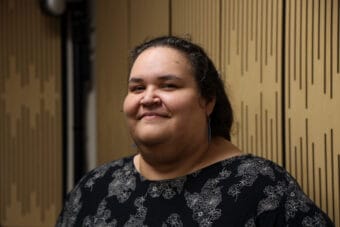
For Olga’s granddaughter, Atan’ Winkelman, the inclusion of Yugtun in many of the glorification services was a highlight.

Atan’ Winkelman, granddaughter of St. Olga. (Katie Baldwin Basile)

“It’s very cool to see actual Yugtun words… to recognize the Yupik people, to use the word ‘Elders’ in song. I’ve never heard that anywhere else in any of our venerating any other saint,” Winkelman said.

As pilgrims filed by outside the church, Winkelman said that the scene was a lot to process.

“I’m finding the whole exhuming of her body, the whole glorification, canonization, very strange. Because she was an actual person to me that would hold me, and piggyback me, and we would sit and eat together, or I would sit and watch her sew,” Winkelman said.

Olga’s youngest surviving daughter, Matushka Helen Larson, remembers the many women who would pay visits to her childhood home in Kwethluk to sit down to tea with her mother.

Matushka Helen Larson is the youngest daughter of St. Olga of Kwethluk, Alaska, who was glorified as a saint in the Orthodox Church in America this past week, June 19-20, 2025. (Katie Baldwin Basile)

“They’d talk for hours, but I wouldn’t listen because she wouldn’t want me to listen,” Larson said. “But I knew she was helping someone. [They would] come in looking very heavy, you know. And then when they go, they’re lighter.”

With Kwethluk cast further into the spotlight of the Orthodox world, Larson said that she hasn’t lost perspective.

“I still think of her as just my mom,” Larson said.

For many others, Olga has become “St. Olga, Matushka of All Alaska,” a symbol of compassion, modesty, and empathy that appears to resonate just as much across the Yukon-Kuskokwim Delta as it does the world.

Katie Basile contributed reporting to this story.

Lingít Word of the Week: Yaakw — Canoe

People carry a yaakw from shore in downtown Juneau on June, 4, 2024. (Clarise Larson/KTOO)

This is Lingít Word of the Week. Each week, we feature a Lingít word voiced by master speakers. Lingít has been spoken throughout present-day Southeast Alaska and parts of Canada for over 10,000 years.

Gunalchéesh to X̱’unei Lance Twitchell, Goldbelt Heritage Foundation and the University of Alaska Southeast for sharing the recorded audio for this series.

This week’s word is yaakw, or canoe. Listen to the audio below to learn how to say yaakw.

The following transcript is meant to help illustrate the words and sentences. 

Kooshdáakʼu Bill Fawcett: Yaakw. 

That means canoe.

Here are some sentences:

Kooshdáakʼu Bill Fawcett: Goodé sáwé yaa naḵúx̱ wé yaakw?

Where is that canoe going? 

Keiyishí Bessie Cooley: Haa x̱ooní Yanshkoowas.á amsikóo yaakw layeix̱í.

Our friend Yanshkoowas.á Jimmy Smarch knows how to build a canoe. 

Keihéenák’w John Martin: Ya aan, ldakát yá Lingít aaní yá átx̱ has alyéx̱ nooch, dutʼéek wé yaakw.

The village, all the Lingít villages, they all use it all the time, people paddle canoes.

Ḵaakal.áat Florence Marks Sheakley: Yá “blue canoe” áyá haa yaagúx̱ sitee.

This blue canoe here is our boat.

Kaxwaan Éesh George Davis: Du yaagú yíkt aawatʼík.

They are paddling in their canoe by themselves.

You can hear each installment of Lingít Word of the Week on the radio throughout the week. 

Additional language resources:

Find biographies for the master speakers included in this lesson here.

Learn more about why we use Lingít instead of Tlingit here.

Watch a video introducing Lingít sounds here.

Lingít Word of the Week: Taan — Sea lion

Sea lions sunning on a buoy near Juneau on August 29, 2019. (Photo by David Purdy/KTOO)

This is Lingít Word of the Week. Each week, we feature a Lingít word voiced by master speakers. Lingít has been spoken throughout present-day Southeast Alaska and parts of Canada for over 10,000 years.

Gunalchéesh to X̱’unei Lance Twitchell, Goldbelt Heritage Foundation and the University of Alaska Southeast for sharing the recorded audio for this series.

This week’s word is taan, or sea lion. Listen to the audio below to learn how to say taan.

The following transcript is meant to help illustrate the words and sentences. 

Kaxwaan Éesh George Davis: Taan. 

That means sea lion.

Here are some sentences:

Kaxwaan Éesh George Davis: Taan eech kut.áa.

The sea lion sits on the submerged boulder.

Keihéenák’w John Martin: Haa tuwaaxʼ kalitéesʼshán taan.

We think sea lions are interesting to look at.

Keiyishí Bessie Cooley: Taan dax̱dligéixʼ.

Sea lions are big.

Kooshdáakʼu Bill Fawcett: Taan xʼáatʼi áyá.

This is a sea lion island.

Ḵaakal.áat Florence Marks Sheakley: Yá taan yá has du x̱ʼadaadzaayí áyú yá shakee.át daa yéi too.úx̱xʼun. 

We always used to put sea lion whiskers on our shakee.át.

You can hear each installment of Lingít Word of the Week on the radio throughout the week. 

Additional language resources:

Find biographies for the master speakers included in this lesson here.

Learn more about why we use Lingít instead of Tlingit here.

Watch a video introducing Lingít sounds here.


A traditional subsistence site in Juneau is set to return to the Douglas Indian Association

Mayflower Island on Saturday, March 23, 2024. (Clarise Larson/KTOO)

In Juneau, a traditional subsistence site owned by the federal government is now one step closer to returning to its original tribal owners. 

On Monday, the Juneau Assembly unanimously approved a resolution to accept Mayflower Island from the U.S. Bureau of Land Management with the intent to give it to the Douglas Indian Association. 

Mayflower Island is a small, 3-acre island adjacent to Douglas Harbor and Sandy Beach, and connected to Douglas Island. Its Lingít name is X’áat’ T’áak, which means “beside the island.” 

DIA Council member Barbara Cadiente-Nelson spoke to the Assembly on behalf of the tribe’s president.

“This is a significant moment for the tribe, and one that, if we could, have all 800 members would be present to witness this,” she said. “It belongs to the tribe, and we thank you for all the due diligence and the work you’ve put forth since 2012 to this moment.”

Cadiente-Nelson referenced the year when construction workers accidentally unearthed three burial sites at Douglas Island’s Sayéik: Gastineau Community School. Since then, the city and association have collaborated on projects to acknowledge the historical trauma the tribe experienced.

Mayflower Island once served as a traditional subsistence site and yielded a herring run and spawn used by the Douglas Indian Village. The village was burned by Douglas’ city government in 1962. The City and Borough of Juneau formally apologized for the burning last fall.

Tribal member Dionne Cadiente-Laiti said the resolution was more than six decades in the making.

“Sixty-three years later, here we are today looking at this resolution,” she said. “Thank you for writing this resolution to affirm a promise made 63 years ago that this land will be restored to the tribe.”

The property has been under the federal government’s stewardship since 1890 under various departments, according to a spokesperson for the BLM. The island was originally reserved for the U.S. Navy to use as a naval station before it was transferred to the Federal Bureau of Mines, which built a mineral laboratory there. The BLM then took over the property in 1996 and the U.S. Coast Guard used the site under an agreement with the BLM until 2023. 

Alyssa Cadiente-Laiti-Blattner thanked the Assembly and city staff for working with the Douglas Indian Association to make the transfer possible. 

“Its return represents the restoration of a sacred connection and a step forward in healing historic harm following the city’s apology for the 1962 burning of our village,” she said. “This transfer shows what is possible when we work together with respect, truth and shared purpose.”

Dan Bleidorn, the city’s lands and resources manager, called the approval on Monday a critical step in the process. He said the property transfer will still likely take a few years to complete.

Sealaska Heritage Institute wants help identifying people in a late Lingít elder’s photo collection

A woman in a fur coat looks at the photographer, while a boy smiles at her. From the Cyril George Photo Collection.

In the basement of Sealaska Heritage Institute in Juneau sit thousands and thousands of photographs. They were taken by a Lingít elder who has since passed on, but for decades, he documented important events and everyday life. Now, the organization wants help identifying people and places in the photos.

Listen:

Ḵaalḵáawu Cyril George Sr.’s family unearthed the photo collection in the wake of his death 11 years ago. His granddaughter, Lillian Woodbury, says she was astounded at the volume of photos he kept in his small Juneau condo.  

“That tiny little room had been harboring all of these memories he captured in photo,” she said. “I mean, every time we thought we’ve got them all, we pulled out another box or another container, and I’m like, ‘oh my god, Mom, it’s another box of photos.’”

To Woodbury, George was “grandpa.” But Ḵaalḵáawu Cyril George Sr. left a mark on thousands of people in Southeast Alaska. He was a Lingít leader from Angoon who lived to be 92 years old. Videos of his speeches are used for Lingít language classes, and a collection at the University of Alaska Southeast library is named after him.

A family friend suggested to his family that they donate George’s photographs to Sealaska Heritage Institute, to preserve and store them. For the last few years, archivists like Emily Galgano have been combing through them. 

A boy jumps over a bar as his peers look on. From the Cyril George Photo Collection.

“There’s so much just joy in these photos,” she said. It’s one of my favorite things, looking through them and seeing people just having a good time, people dancing, people talking to each other, cooking out on the beach.”

Photos of everyday life

Some of the photos are now online, and printed in books that are available in Juneau and Angoon for elders to look through. 

SHI hopes people will recognize some of the faces.

“The first thing is, we tried to find photos where you could see people’s faces clearly, because the point of the book is really to try to get some identifications,” Galgano said.

There are 20,000 photos in the full collection. A lot of them are pet photos and landscapes. But of the 1,600 SHI has made available, most are of people: dancers in full regalia, fishing trips with strung up halibut, graduations and meetings. 

Two men and a boy look on from a boat. From the Cyril George Photo Collection.

The photos are full of life — basketball games and Fourth of July parades. They show Lingít people living, working, teaching and making art. They show elders, and babies, and elders with babies. And those babies may be elders now themselves.

Lingít photographer Brian Wallace helped SHI scan the photos. He knew George growing up, and looking through the photos, he was surprised by how many there are of everyday life. 

“They seem mundane at the time,” he said. “But looking back into the whole scope of things, it’s just an amazing body of work.”

Wallace said the photos of ku.eex and early Celebrations stand out to him — that they show how Southeast Alaska Native cultures have endured. 

“They’re thriving when he took the photos, and still thriving,” he said.

Cyril George Sr.’s legacy

Some of the photos were deeply personal for Wallace. 

“And then I loved finding the photographs that he had of my parents,” Wallace said. “And to see some of those photos, and then also lots of photos of my aunts. My aunties cooking dinner or singing songs or just in the background of photos. It was always fun to see those.”

An older man and woman sit together. Brian Wallace's parents Amos and Dorothy Wallace at the National Congress of American Indians in 2000. From the Cyril George Photo Collection.
Brian Wallace’s parents Amos and Dorothy Wallace at the National Congress of American Indians in 2000. From the Cyril George Photo Collection.

Woodbury, George’s granddaughter, said it was hard to part with the collection. The memory of his loss is still fresh, more than a decade later. 

“But we also didn’t want a lifetime of him making sure he carried that camera around to be lost,” she said.

She hopes that others, like Wallace, will look through the collection and find photos of loved ones who have passed on.

“I think if people walk away seeing these photos and they feel like he gave them that one moment in time back, that makes me happy,” Woodbury said. “And that will be a small part, a small part of this legacy.”

Another part of his legacy is Woodbury herself – she’s a photographer, too.

“I think I was 16, the first time he gifted me a camera. And that was all it took,” she said. “That was all it took.”

If you recognize any of the people, places or objects in the photos, you can contact SHI’s Archives and Collections Department at SHIArchives@sealaska.com

Here are more images from the Cyril George Photo Collection. You can expand by clicking on any slide. 


Lingít Word of the Week: Saak — Hooligan

Louie Wagner empties a net of hooligan into his boat on the Unuk River. (Jack Darrell/KRBD)

This is Lingít Word of the Week. Each week, we feature a Lingít word voiced by master speakers. Lingít has been spoken throughout present-day Southeast Alaska and parts of Canada for over 10,000 years.

Gunalchéesh to X̱’unei Lance Twitchell, Goldbelt Heritage Foundation and the University of Alaska Southeast for sharing the recorded audio for this series.

This week’s word is saak, or hooligan. Listen to the audio below to learn how to say saak.

The following transcript is meant to help illustrate the words and sentences. 

Keiyishí Bessie Cooley: Saak. 

That means hooligan.

Here are some sentences:

Keiyishí Bessie Cooley: Saak eex̱í aag̱áa yatee át akamdulgaaní.

People light hooligan grease.

Keihéenák’w John Martin: Táakw.eetíxʼ áyá yaa yaga.eich saak.

The hooligan always run in the spring.

Kooshdáakʼu Bill Fawcett: Ḵúnáx̱ áwé yaawa.aa wé saak.

The hooligan were really running.

Ḵaakal.áat Florence Marks Sheakley: Taakw eetíxʼ yéi daaduné saak.

People work on ooligan in the spring.

Kaxwaan Éesh George Davis: Saak eix̱í ax̱ x̱ʼéix̱ aawatée.

They gave me hooligan grease to eat. 

You can hear each installment of Lingít Word of the Week on the radio throughout the week. 

Additional language resources:

Find biographies for the master speakers included in this lesson here.

Learn more about why we use Lingít instead of Tlingit here.

Watch a video introducing Lingít sounds here.

Site notifications
Update notification options
Subscribe to notifications