Alaska Native Arts & Culture

Tongass Voices: Ldaan.aat Laurie Cropley and Yuxgitsiy George Holly on making space for tribal values

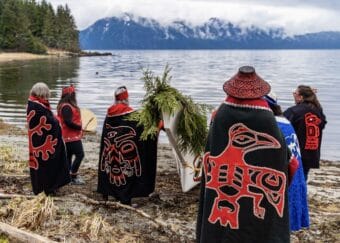
Elder Ldaan.aat Laurie Cropley and elder-in-training Yuxgitsiy George Holly will lead dawn prayers at the annual Elders and Youth conference in Anchorage this year. Oct. 8, 2025. (Photo by Yvonne Krumrey/KTOO)

This is Tongass Voices, a series from KTOO sharing weekly perspectives from the homelands of the Áak’w Kwáan and beyond.

Lingít elder Ldaan.aat Laurie Cropley and elder-in-training Yuxgitsiy George Holly are leading dawn  prayers at the annual Elders and Youth conference in Anchorage next week. 

The prayers are from 8 a.m. to 9 a.m. Monday through Wednesday, and they involve singing, dancing, sharing thoughts. This year, they plan to lead a talking circle about tribal values across Alaska Native nations afterwards.

Listen: 

The following transcript has been lightly edited for clarity.

Yuxgitsiy George Holly:  These are the words of Seigeige’i Emma Marks, when   she shared about an old way of greeting the morning, greeting each other in the morning. And she expressed that she said, though all those old peoples would say that “Again upon us, a day has broken.”

Maybe I can share with you the Dena’ina word for dawn prayers: Yetałqun duch’idatqeni. 

Dawn is for everybody. The whole earth turns itself towards the sun each morning, and you can hear the animals waking singing, and it is a time for everyone to enjoy. So dawn prayers is for everybody. It’s time for singing, it’s time for language. It’s time for making connections and really centering ourselves in a healing story.

Ldaan.aat Laurie Cropley: We all live by some values. We all have values that we live by. And in this particular case, we’re going to follow dawn prayers with tribal values circle, and we’re going to talk about how much we love holding each other up, how important it is to show reverence and respect for elders and others, and we’re going to spend some time just remembering and renewing our commitment to that way of life.

Yuxgitsiy George Holly: I don’t at all feel like an elder. I’m learning, you know, I’m learning. We all are learning. I mean, that, of course, is the truth. Lori is one of our elders.

Ldaan.aat Laurie Cropley: How old are you? 

Yuxgitsiy George Holly: 55. 

Ldaan.aat Laurie Cropley: He’s a cusp. I’m 80. So I’m claiming, I’m just recently claiming it. Really, it’s hard to be an elder. There’s pressure, there’s expectations, sometimes unrealistic. You maybe haven’t been able to practice your language or your lifestyle — like he mentioned — early in your childhood, and now here we are, you know, just trying to encourage and hold up others who are really focusing now on language and tribal values. And so, yeah, I’m an elder.

But that’s why this elders and youth conference is so important, working together with the young people who are really coming up in the language and the culture and elders who have some history and stories to share. 

What I found so interesting is that our values are such a way of life that when you ask a group of adults or youth, what are the values that they live by, they can’t mention them. They can’t verbalize them.

And so I found that talking circles about tribal values, it’s just like these lights go on, like, “Ah! we hold each other up, we’re reverent, we’re respectful.” It’s just our way of life. We’re all just relatives, we’re all family. We’re all beginning to realize that we have the same needs and wants. Want to be seen and heard and respected and held up and loved so all that kind of disappears in a talking circle because you’re sitting shoulder to shoulder. 

Yuxgitsiy George Holly: That’s so beautiful, Laurie. Gosh, yeah, it’s true. It’s all true. 

Juneau descendants of boarding school survivors sing to remember what wasn’t lost on Orange Shirt Day

People sing at an Orange Shirt Day event at the Zach Gordon Youth Center on Tuesday, Sept. 30, 2025. (Photo by Clarise Larson/KTOO)

Tuesday was Orange Shirt Day, a day of remembrance for Indigenous children who were separated from their language, families and culture and sent to residential schools across North America from the late 1800s well into the 20th Century.

At the Zach Gordon Youth Center, people wore orange shirts and came together to educate young people about the history of residential schools and to celebrate Native languages and cultures that thrive in spite of that history. 

There was drumming, singing and dancing, and tables with crafts like beading or tea-making. 

Ha’naxgm Ggoadm ‘Tsoal Naomi Leask stands at a table with a bowl of medicine — Labrador tea, which is called s’ikshaldéen in Lingít. 

Leask is with Haa Tóoch Lichéesh Coalition, a local nonprofit focused on healing.  She said 26 members of her family were taken to the first, and one of the most notorious, residential schools in the United States: Carlisle Indian Industrial School in Pennsylvania. It’s a part of her family’s history. 

“That’s where my grandma’s uncle escaped,” she said. “That’s over 3000 miles away. He ran and he ran and he ran and he ran, and when he made it back to British Columbia, they hid him away at grease camp.”

Ha’naxgm Ggoadm ‘Tsoal Naomi Leask asks the audience to answer her questions about the history of residential schools at an Orange Shirt Day event at the Zach Gordon Youth Center on Tuesday, Sept. 30, 2025. (Photo by Clarise Larson/KTOO)

Áak’w Ḵwáan elder Seikoonie Fran Houston said her mother went to the Wrangell Institute as a child. It was a boarding school in Wrangell intended to assimilate Alaska Native children into white culture. Years later, her family learned more about her time there.

“We looked at my mother’s report card,” she said. “You know what was on there? It had nothing to do with reading, writing, arithmetic, science, history, none of that. It was sewing, cleaning, cooking, washing clothes, being a housemaid, and if she didn’t do that, she got punished. Speaking her language, she got punished.”

Houston said she asked her mother for years why she didn’t teach her the Lingít language. Her mother told her she didn’t want Houston to experience the violence she did at school. 

As Xeetli.éesh Lyle James prepared to lead a song, with his drum in his hand, he said not every child made it back home. Many died at these schools, from abuse and neglect, and the government lied to their families. 

“We know that there were many families who were told that their kids ran away,” he said. “We don’t know what happened to them. They disappeared, but in reality, they had passed away, and they didn’t tell the truth.”

James said Indigenous families are left with the loss of loved ones, and that can’t be fixed. But gatherings like this, he said, help with building a path toward healing. 

“We’re not forgetting where they’re at,” he said. “That their memory doesn’t leave when they disappear, it’s going to multiply like sand every time we sing, every time we talk about our history.”

And as Leask said, those efforts to erase language and culture didn’t work. There is still singing. 

Declan Whitson, 2, and Emma Lott, 8, play drums at an Orange Shirt Day event at the Zach Gordon Youth Center on Tuesday, Sept. 30, 2025. (Photo by Clarise Larson/KTOO)

Ravenstail Labubus brings attention to Indigenous weaving

Master weaver Lily Hope holds up a Labubu decked out in Ravenstail weaving on Sept. 12, 2025. (Photo by Yvonne Krumrey/KTOO)

A Lingít master weaver is using viral monster dolls called Labubus to bring attention to Chilkat and Ravenstail weaving.

Listen:

In Lily Hope’s shop in downtown Juneau, she held up a tiny doll with an evil grin. 

“Some people are like, ‘why? Oh, please no. Why?’ It’s the you know, ‘what an ugly monster,’” she said. “And other people are like, ‘oh, please let me have one.’” 

Her shop was filled with pieces of weaving: earrings, formline robes, and pictures of models in more weaving. On her desk laid a green doll wearing a Ravenstail headdress, woven in pink, white and blue yarn.

“This one is Trans Pride, requested from an art collector in New York City,” she said.

A Labubu wears Trans Pride Ravenstail regalia, woven by Masterweaver Lily Hope. Sept. 12, 2025. (Photo by Yvonne Krumrey/KTOO)
A Labubu wears Trans Pride Ravenstail regalia, woven by master weaver Lily Hope. Sept. 12, 2025. (Photo by Yvonne Krumrey/KTOO)

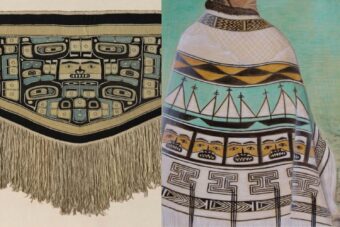
Hope is a master weaver. She has dedicated her life to reviving Chilkat and Ravenstail weaving, and through apprenticeships and classes, she’s helped hundreds of Alaska Native people form their own weaving practice.

She’s also a mom of five. And those two worlds collided when her kids started asking for Labubus. 

“My three small children introduced me to the dolls and said, ‘Please, Mommy, please, mommy, buy these for us,’” Hope said

You may have heard of them. The dolls are all over the internet, with their fuzzy bodies, big colorful eyes, and pointy teeth. They are based on storybook characters

Hope said they come in “blind boxes” — generic packaging that leaves the contents a mystery — so part of the fun is finding which Labubu is in the box.

“Oh, yes, this is the whole rage, right?” she said. “It’s like, ‘Oh, I got Lychee Berry. Oh, I got, I got the Green Grape. Oh, now we need to get Soy Milk, Mama, let’s get Soy Milk.”

But in the craze, she saw an opportunity to continue to push Northwest Coast weaving into the spotlight.

“When somebody sees an Indigenized Labubu in a Ravenstail regalia,” Hope said. “They can be like, ‘Oh, where does that come from? Oh, what are those? Oh, what is Ravenstail weaving? Oh, wait, it’s related to Chilkat. Let’s go.’”

Lingit regalia is sacred attire that represents ancestral heritage and cultural identity.

Hope’s doll-sized regalia sets go for more than $600, and fine arts collectors all over the country are ordering them.

Three Labubus in Ravenstail weaving on display, while a gigantic fourth one awaits his, at master weaver Lily Hope's studio on Sept. 12, 2025. (Photo by Yvonne Krumrey/KTOO)
Labubus in Ravenstail weaving on display at master weaver Lily Hope’s studio on Sept. 12, 2025. (Photo by Yvonne Krumrey/KTOO)

But for those who don’t want to shell out that much, Hope also sells kits for people who want to weave their own outfits for a doll. 

“It’s a way to get the work further into the world,” she said. “And kind of, you know, capture some people who wouldn’t necessarily come to Ravenstail weaving otherwise, but are like, ‘Oh, this is a way that I can dress my Labubu in traditional regalia, and I made it myself.’ That’s huge.” 

It’s a way of weaving your own story into the trend. And the little monsters look pretty cool, too. 

Annual TCLL field trip connects students to Lingít culture through foraging and language

A couple holds hands in the back of a large group of people walking near a road.
Families, students and teachers hold hands and walk toward a trail to pick tea leaves next to Eagle River United Methodist Camp near Juneau on Sept. 5, 2025. (Photo by Jamie Diep/KTOO)

Listen here:

Learning outdoors is nothing new for students in Juneau’s Tlingit, Culture, Language and Literacy program. That’s what they did on their first field trip of the year, where they learned about Lingít language and values through foraging and processing local foods. 

Students, teachers and families walk through squishy, mossy muskeg near the Eagle River United Methodist Camp north of Juneau. First grader Owen Roehl crouches over small, short bushes peppered throughout the area, putting green and yellow leaves into an empty yogurt container looped around his neck.

“We’re picking s’ikshaldéen, also known as Hudson Bay tea,” he said.

Owen said picking tea has been his favorite part of the day so far.

A child in a red rain jacket puts tea leaves in a yogurt carton hanging from his next on string.
First grader Owen Roehl picks s’ikshaldéen, or Hudson Bay tea, anear Juneau on Sept. 5, 2025. (Photo by Jamie Diep/KTOO)

Seventh grader Cassius Allen is one of the older students picking tea. Cassius said he thinks the tea will taste good once they process it. 

“Probably gonna have to mix it up with some other flavors so it tastes not plain and normal,” he said.

Cassius got help from eighth grader Leighton Heppner to identify the tea leaves. Leighton said he learned from friends and teachers.

“They said, ‘always make sure it’s yellow at the bottom, like fully yellow or partially yellow, and it will still work,’” he said.

Overall, Cassius appeared to have some fun while picking tea, getting part of a leaf up Leighton’s nose when holding it out for him to smell.

This is part of a longstanding field trip for students at Tlingit Culture, Language and Literacy, a Lingít language immersion school. It’s not just for the students. They’re joined by families and volunteers, as well as students from Haa Yoo X̱’atángi Kúdi, a Lingít language preschool. That’s a language immersion preschool where children primarily speak in Lingít.

Things have changed slightly after the program expanded to middle school. While it’s normally a day trip, it’s turned into an overnight field trip for the older students.

A student in a brown shirt sets clear plastic cups on a table full of individual servings of fish soup, berries and bread.
A student helps to set a table full of fish soup, bread and berries at Eagle River United Methodist Camp near Juneau on Sept. 5, 2025. (Photo by Jamie Diep/KTOO)

Naakil.aan Hans Chester is a biliteracy specialist at the school. He said getting students out of the classroom opens the door for a lot of learning. 

“In this context, it’s real living, and they hear us using the language with each other and communicating, or just even expressions, to say when you’re doing something, and it’s in context and it makes sense,” he said.

In addition to tea, students also learned to fillet salmon and make jam. Chester said the jam was going to be given to guests at a Ku.éex’ – or potlatch – the next day.

“When we do our Ku.éex’, it’s to honor our lost clan members,” Chester said. “And so, you know, it’s really important for us to teach these skills to our kids, so when they grow up and they lose their mom or their sister or their cousin or whoever that’s in their family, they’ll have these skillsets to rely on so that they can do what we do.”

Chester said this field trip makes him feel like the school is in a stronger place than it was before.

“Hearing them use the language more, some of them stepping up and becoming leaders out here, is really awesome to see”

A teacher with green and black hair scoops soup from a large stock pot into a paper bowl.
TCLL teacher Nae Tumulak scoops fish soup into a bowl at Eagle River United Methodist Camp near Juneau on Sept. 5, 2025. (Photo by Jamie Diep/KTOO)

In the camp kitchen, Lingít language teacher Nae Tumulak portions out bowls of fish soup. The middle schoolers filleted coho salmon for it the night before. Tumulak said she likes getting to know the students more, both new and old.

“Just seeing them in their element, being able to witness a lot of their growths and everything like that, it’s been a lot of fun,” Tumulak said. “They’re also incredibly hilarious. So it’s been entertaining.”

Once they’re back at school, Chester said they will process the tea and give it away to community members.

Tannery closures hinder Alaska sea otter hunters

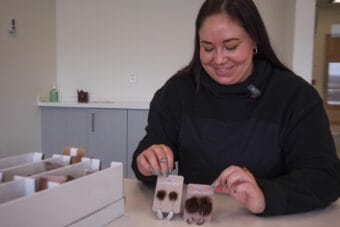
Sea otter handicrafts made by Anthony Charles on display at the Arts in the Cove festival on Prince of Wales Island on Aug. 8, 2025. (Hannah Weaver/KFSK)

For about a decade, Scott Jackson had a system. He was the owner of Rocky Pass Tannery in the village of Kake on Kupreanof Island, where he and his team tanned sea otter pelts.

He can still recite the steps in precise detail. Pressure wash the fat off the pelts for four hours. Put the pelts in a pressurizing machine called an auto-tanner for three hours. Hang the pelts until they swell. Shave them with a circle beaver fleshing knife. Put in a citric acid bath for three days. Neutralize with baking soda. Oil. Dry.

“It takes a lot more than you realize to make a good, soft, supple, sewing hide,” Jackson said.

About a year and a half ago, he closed the tannery. Jackson said trying to keep up with the high demand was unsustainable. At one point, Jackson said they tanned 187 hides in a month with fewer than a dozen employees.

“Pretty soon it becomes stress, and pretty soon it becomes unhealthy,” he said.

When Rocky Pass Tannery shuttered, that left their customers throughout Southeast Alaska with few options to continue their traditional cultural practices of hunting and skin-sewing sea otters.

Access to tannery services is just one of many barriers facing sea otter hunters. Federal rules restrict sea otter hunting to those who are a quarter or more Alaska Native or an enrolled member of a coastal tribe. Federal regulations also say that hunted sea otters must be converted into “authentic Native handicrafts.” These barriers are making it more difficult for hunters to tackle sea otter overpopulation, which is threatening shellfish populations in Southeast Alaska.

Shipping out-of-state

Now, many sea otter craftspeople ship their pelts to the only sea otter tannery outside of Alaska — in southern Idaho.

Aanutein Deborah Head is a skin-sewing teacher from Craig on Prince of Wales Island and one of Jackson’s former customers. She’s an experienced sea otter hunter and skin-sewer. But she never learned how to tan.

“I could have said, ‘Grandma, show me how to tan it so the hide doesn’t fall off of it,’” Head said. “I didn’t, and that’s lost to me.”

It was more convenient when she could send her sea otters to Kake, Head said. In particular, it costs her a lot more in shipping to send the skins on a thousand-plus-mile journey to southern Idaho.

Kootink Heather Douville in her skiff with sea otters she hunted near Prince of Wales Island, in a photo posted to her Instagram account on June 13. (Photo courtesy of Kootink Heather Douville)

Kootink Heather Douville learned how to skin-sew from Head while growing up in Craig. Now, she’s an avid hunter. Like Head, she also sends her sea otter pelts to Idaho so she can make and sell handicrafts like hats, pillows and fur ball earrings.

From the time she spots a sea otter in the water and aims for its head to when she finishes the last stitch on a handicraft, just about every part of the process is either expensive or time-consuming. She hunted 200 otters last year and about 120 this year.

“For me, it’s not just an investment as far as money goes, it’s your time,” Douville said. “I think that’s why we have so few hunters out there, in addition to the blood quantum limitations through the federal agencies.”

An alternative approach

In Klawock, just six miles north of Craig, Anthony Charles has found another way to save on tanning costs — by doing the tanning himself. He’s been running a sea otter product business for about seven years with his father. He used to ship to Rocky Pass Tannery before it closed, but decided to tan himself to save on shipping. Even though Kake is significantly closer than Idaho, it’s still about 100 miles by air from Klawock.

A couple of years ago, Charles bought tanning equipment and set it up under a tent. When his setup was destroyed in a windstorm, he was faced with a difficult decision.

“I almost kind of walked away from it after that,” he said.

Instead, he decided to rebuild and keep his tanning operation going.

“I had to really bite down,” he said. “It was worth it.”

But tanning in-house doesn’t work for everyone. Douville tried tanning on her own at one point, but felt that it didn’t produce a high enough quality pelt for sewing. She also prefers to focus her time on hunting and sewing.

“If I were to hunt and tan my own pelts, I would have a big stack of pelts, but no time to convert them and sell them,” she said.

Impact on sea otter overpopulation

Jackson said that since he’s closed the tannery, it seems like sea otter hunting has slowed down in Kake.

Douville said she feels like she’s not making much of a difference in the sea otter populations.

“They’re multiplying at a much faster rate than I can hunt them,” Douville said.

Despite the barriers, Douville remains committed to hunting and sewing as a way to connect to her Lingít culture. As she learned more about sea otter overpopulation and its threat to shellfish, she says it became even more meaningful for her.

“The last bucket of clams my dad dug was in 2011 and the last sea urchins we got was when I was a little kid,” she said. “When you remove access to a traditional food, you’re removing the ability to pass on that knowledge to the next generation on how to hunt or collect the food.”

The future of tanneries

Jackson, the former tannery owner, is unsure what the fate of local tanneries will be.

“Are we going to have tanneries around forever? I don’t know,” said Jackson. “I know that we all don’t live forever, and eventually we got to tap out.”

He’s not sure if he’ll reopen the tannery in Kake, but Jackson said he’d like to go to other towns and teach people how to set up a sustainable tannery.

“I think tanning would be number one, and teaching them how to sew is number two,” he said. “We got to open up our minds a little bit and say, let’s have a tannery in every community.”

Yup’ik climate advisor appointed by UN secretary general

Charitie Ropati, a young Alaska Native engineer with roots in Kongiganak, has been appointed as a youth climate advisor to the United Nations. (Photo courtesy of Charitie Ropati/KYUK Public Media)

Twenty-four-year-old Charitie Ropati is Yup’ik and Samoan, and has roots in the Bering Sea coastal village of Kongiganak. She said that the community has inspired her.

Following a flood event in 1966, many members relocated from the village of Kwigillingok to higher ground, a settlement which would become known as Kongiganak. Now, the permafrost under the village is thawing and Kongiganak is facing its own set of climate impacts.

“It really started with the story of my community,” Ropati explained. “And it’s because of that story of survival, I think, that brought me to where I’m at now.”

“Now” for Ropati means working in New York City as an engineer designing public housing infrastructure for Indigenous communities across the country. Ropati has also started her own nonprofit education organization called LilnativegirlinSTEM and was recently named to the Forbes 30 under 30 list.

Ropati said that she was back in Alaska, driving around Anchorage with her mom and her partner, when she got the news that she’d been selected as a youth climate advisor to the United Nations (U.N.)’s secretary general.

“It really meant a lot to be there, especially with my mom where these stories of survival really originated from her and specifically that story of relocation,” Ropati said. “Just our ability as Yup’ik people to do these type of things. Not only for survival, but for the love of each other and community.”

As a youth climate advisor, Ropati will be part of a cohort working with United Nations Secretary-General António Guterres to provide “practical and outcome-focused advice, diverse youth perspectives” around climate action, according to a press release from the U.N.

The youth advisor roles are pretty new to the U.N. In 2025, the number of selected advisors doubled from seven to 14. According to the press release, that’s to help support young people who don’t often have a seat at the table. Ropati is one of the first Alaska Native youth to be appointed as an advisor.

“I think this is a huge win, especially for youth in the Arctic,” Ropai said. “Because I don’t think we’ve ever been given this type of platform before.”

It’s a big year to be involved. The United Nations’ annual climate conference will take place this November in Brazil. Also this coming year, countries in the U.N. are required to submit new climate plans.

The plans will follow the Paris Agreement, a commitment to reduce greenhouse gas emissions to keep the global surface temperature below 1.5 degrees Celsius. It’s a figure the U.N. has emphasized as a tipping point for damaging climate impacts, a point Ropati said affects the human rights of Indigenous people in the Arctic.

“We know that if that happens, and if our world does do that, that’s going to have devastating impacts, not only on these nations or states, but it’s going to have devastating impacts on Indigenous peoples, and especially on us, on Yup’ik, on Inuit, on Inupiaq, on all of us in our state,” Ropati said.

Ropati said human rights form the foundation of her climate advocacy. She said that Indigenous people on the front lines of climate change are often left out of the discussion when it comes to climate solutions. But she said they’re a group well-equipped with answers.

“When we talk about the climate work we’ve been doing, this is work that has been carried on through generations,” Ropati said. “This is work that didn’t start with me. It started with my great grandfather, to my grandmother, to my mother, and now me.”

Ropati said that climate conversations in the Western world often involve looking for quick fixes. But in Yukon-Kuskokwim Delta villages facing relocation, Ropati said that it’s understood that climate solutions can take generations. The recent relocation of the village of Newtok to a new site, Mertarvik, was one that was decades of planning and discussions in the making.

“It’s not just up to our youth to do this, and it needs to be intergenerational,” Ropati said. “I think this is something we as Indigenous people have always understood and continue to do, especially in our communities.”

In her capacity as a U.N. youth climate advisor, Ropati will work for the next three years alongside appointees from around the world, including Kenya, Sweden, and Indonesia.

Ropati said that she’s looking forward to bringing Indigenous perspectives to the forefront of the international climate discussions.

Site notifications
Update notification options
Subscribe to notifications