Southwest

Hoffman says ‘it’s time’ as he prepares to wrap up 40-year career in state politics

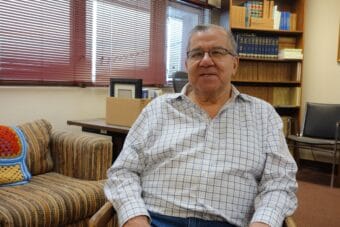
Alaska Sen. Lyman Hoffman (D-Bethel), the state's longest-serving legislator, sits in the Legislative Information Office in Bethel on Jan. 29, 2026.
Alaska Sen. Lyman Hoffman (D-Bethel), the state’s longest-serving legislator, sits in the Legislative Information Office in Bethel on Jan. 29, 2026. (Evan Erickson/KYUK)

Sitting in the Legislative Information Office in Bethel, full of hardbound volumes and photos of the state’s political history, Sen. Lyman Hoffman said he’s ready to close the book on his own four-decade career in politics.

“I think it’s, it’s time … the next closest person behind me is 14 years behind me,” Hoffman said.

Hoffman has spent most of his time in the Senate, representing Southwest Alaska. He said he thinks he’s made a difference in the lives of rural Alaskans.

“I funded weatherization, set up a weatherization program where close to 60% of the funds, about $700 million, went into weatherizing people’s homes. People have come up to me and said, as a result of the weatherization program, their heating bill went down by hundreds of dollars a month,” Hoffman said.

Hoffman also cited his creation of a billion-dollar endowment to protect rural electricity subsidies under the state’s Power Cost Equalization program. He does admit that the cost of living in rural Alaska remains staggeringly high.

Hoffman said that his priority in his final session is finding ways to fund the budget. He said that Gov. Mike Dunleavy’s idea of a sales tax is not one of them.

“I haven’t heard anybody that really likes that idea in the legislature,” Hoffman said.

Hoffman said that the proposal to add a 4% sales tax during the tourist season and a 2% sales tax during the other half of the year would run up against local taxing schemes adapted to rural needs.

“He wants no exceptions, no loopholes, no food, heating, fuel. Everything is going to be taxed. And I would say that that would put rural areas at a larger disadvantage because we already pay the highest cost for heat,” Hoffman said.

In Bethel, there have already been long-standing challenges collecting the 6% local sales taxes the city levies. Hoffman said that the governor’s proposal would mean the state would collect taxes on behalf of cities like Bethel, removing that burden. But he said this potential upside is far outweighed by the downsides.

Dunleay’s fiscal plan also proposes a constitutional amendment that would require half of the state’s yearly draw from the Permanent Fund to go toward paying higher dividends. Critics say that would make balancing the budget nearly impossible.

Hoffman said the state might be in a better position today if lawmakers hadn’t stripped down a 2018 bill that used Permanent Fund earnings to cover state operating costs for the first time. Hoffman said he supported a provision to set the dividend at a lower, more sustainable rate. But that idea was rejected.

“If we had passed that bill with that provision in it, the dividend would be $1,500 and continue to grow out in the future. Now, we’re fighting tooth and nail to try to get at least $1,000 in the dividend and fund government,” Hoffman said.

Hoffman said that he has encouraged Dillingham Independent Rep. Bryce Edgmon to run for his Senate seat in November. Edgmon is also the current Speaker of the House. Hoffman said it makes sense because of Edgmon’s record of rural and urban support, and the fact that he’s already represented Kuskokwim River communities within his district.

Hoffman said that he’s concerned that there will be less rural representation on the powerful Senate Finance Committee he co-chairs when he leaves. But he’s optimistic that the bipartisan Bush Caucus he has played a key role in can continue to wield power across the aisle, and that rural issues will continue to get attention statewide.

“The influence of people off the rail belt over the last three decades has been tremendous,” Hoffman said.

Hoffman said that it is critical that legislators form a better working relationship with the governor in 2026. When it comes to ways the state can support ongoing relief efforts following damage from Typhoon Halong, he said Dunleavy has given him an open ear. But Hoffman said specific ideas should come from affected communities.

“The decisions on what needs to be done has to be decided by the local people, and we have to see how we can implement them,” Hoffman said.

Soon, Hoffman will be stepping away from politics. On top of having more time to spend with his wife, Lillian, who he says has been his greatest source of support, Hoffman plans to take time for hunting and fishing around Bethel.

“I’m going to jump on my snowmachine and ride away into the sunset,” Hoffman said.

The 2026 regular legislative session is scheduled to wrap up by May 20.

Tustumena replacement project out to bid, new ferry to sail in 2029

A computer-generated mockup of the new Tustumena replacement vessel, which will be bigger, carry more people and vehicles as well as be more efficient.
A computer-generated mockup of the new Tustumena replacement vessel, which will be bigger, carry more people and vehicles as well as be more efficient. (Alaska Marine Highway System)

After years of delays, the build contract to replace the Alaska Marine Highway System’s ferry Tustumena is out to bid. The state’s project notice calls for the new mainliner ferry to be completed by the beginning of 2029 with an estimated price tag of more than $300 million.

The new ferry will be a more efficient, diesel-electric vessel with capacity for 250 passengers and 58 cars at a time.

“It is really delightful, even just to talk about. You can probably hear the smile on my face,” Louise Stutes said.

State Representative Stutes, a Republican from Kodiak, is a longtime advocate of the Alaska ferry system. Especially the more than 60-year-old Tustumena, which regularly sails from Homer to Kodiak Island communities.

Captain John Mayer (left) of the M/V Tustumena presented Rep. Louise Stutes (right) a hand painted piece of the Tustumena’s hull for her longtime support of the Alaska Marine Highway System in August of 2024. (Brian Venua/KMXT)

She commended Craig Tornga, the head of the state ferry system, for getting the Tustumena replacement project to this point.

“And there are several shipyards that are interested in it as opposed to the first time it went out where no shipyards were interested,” she said.

Gov. Mike Dunleavy first announced the project in 2021. The initial build contract went out to bid in 2022 – and no bids came in.

“So, they kind of had to reassess it, redesign a few things and we’re good to go,” Stutes said.

Tornga went back to the drawing board on the ferry’s design and overhauled the contract over the last several years. Tornga has previously said that one of the hurdles that delayed the project so long was a requirement that 70% of the money spent on the Tustumena replacement has to go to American companies.

Bidding closes May 28 according to the state’s public notice for the project.

Newly proposed legislation aims to curb Alaska bycatch

A crewmember on the fishing vessel Progress wraps up the 2025 pollock season in Unalaska. A storm caused millions of dollars in damage to the 130-foot trawler during the 2018 fishing season. Those kinds of incidents are rare, thanks in part to NOAA's marine forecast service.
The proposed legislation would establish a fund for fishermen to purchase updated technology and trawl gear to limit seafloor contact and bycatch. (Theo Greenly/KUCB)

Alaska’s congressional delegation introduced legislation Wednesday that aims to reduce bycatch in parts of southwest Alaska using better marine data, technology and gear.

The Bycatch Reduction and Research Act, introduced by U.S. Sens. Dan Sullivan, Lisa Murkowski and Congressman Nick Begich, would address research gaps in environmental data and improve monitoring of fisheries in the Bering Sea, Aleutian Islands and Gulf of Alaska. It would also establish a fund for fishermen to purchase updated technology and trawl gear to limit seafloor contact and bycatch. That’s when harvesters accidentally catch species they’re not targeting.

The proposed legislation builds on recommendations from the federal Alaska Salmon Research Task Force, which concluded in 2024 and aimed to better understand how humans cause declines in fish and crab species, including through factors like bycatch.

The legislation would revive the salmon task force under the new name of the Bycatch Reduction and Research Task Force. The group would review National Oceanic and Atmospheric Administration research on Alaska salmon and trawl gear impacts on the seafloor, and provide recommendations for future research.

“In recent years, Alaskans have witnessed unprecedented declines among some fish and crab species in parts of the state while, in other parts, runs have been strong and historic,” Sullivan said in a press release. “We need to get to the bottom of all potential causes of this increased variability, including concerns about bycatch and trawl gear habitat impacts, to strengthen the sustainability of our fisheries.”

For years, fisheries stakeholders have debated if and how fishing gear types, especially trawl gear, impacts marine species and seafloor habitats. Conservation and tribal groups and various stakeholders have pushed fisheries managers to take stronger action on limiting both bycatch and seafloor contact in trawling.

Representatives in the trawl industry have supported stricter regulations around bycatch, but also cautioned that more extreme limitations could be burdensome to the massive pollock industry, which is a major economic driver to some Western Alaska communities, including Unalaska.

The regional council that manages Alaska’s federal fisheries will discuss chum salmon bycatch management at its upcoming meeting in early February.

The proposed legislation still has to pass both the Senate and House before it would go to the president to be signed into law.

U.S. Supreme Court declines to hear case that could have upended Alaska subsistence fishing

The Kuskokwim River is seen in this image captured by scientists working on NASA's Arctic Boreal Vulnerability Experiment, or ABoVE.
The Kuskokwim River is seen in this image captured by scientists working on NASA’s Arctic Boreal Vulnerability Experiment, or ABoVE. (Peter Griffith/NASA)

The U.S. Supreme Court has rejected the state of Alaska’s latest attempt to alter Alaska’s decades-old system of subsistence fishing management.

In a one-sentence order Monday, the court said it will not review a decision by the 9th U.S. Circuit Court of Appeals, which ruled in August that Alaska cannot manage fishing on a stretch of the Kuskokwim River that flows through the Yukon Delta National Wildlife Refuge.

If the Supreme Court had taken up the case, it could have redefined Alaska’s unique system of hunting and fishing management, which allows the federal government to restrict subsistence hunting and fishing on federal land to rural Alaskans. The state is forbidden by the Alaska Constitution from offering the same preference.

Alaska Native organizations, including the Alaska Federation of Natives, praised the court’s decision, but the commissioner of the Alaska Department of Fish and Game said by email that it would continue to work with the federal government on the issue.

Monday’s Supreme Court decision ends a five-year dispute that began during a salmon shortage on the Kuskokwim River in 2021. The state of Alaska issued orders to open fishing that contradicted federal fisheries managers’ decision to keep it closed.

Salmon fishing is a critical aspect of Alaska Native culture, tradition and survival. Salmon returns have plummeted in recent years, straining managers who must balance the wants and needs of Alaskans and Yukoners pursuing the same fish.

On the Kuskokwim, the state claimed it was simply interpreting a U.S. Supreme Court ruling from 2019, but the federal government disagreed with the state’s interpretation and sued the following year.

Alaska Native groups sided with the federal government, and Alaska District Court Judge Sharon Gleason ruled in favor of the federal government in 2024.

The state appealed to the 9th Circuit, which again ruled in favor of the federal government. That prompted the state to appeal to the U.S. Supreme Court.

The Kuskokwim River Intertribal Fish Commission was one of the lead groups standing with the federal government.

“Our Fish Commission is very pleased with this historic victory in favor of the people of the Kuskokwim River. The victory not only upholds rural subsistence rights in Alaska, but upholds the participation of local people, elected by the Tribes, in the co-management of Kuskokwim salmon,” said the group’s chair, Martin Andrew, in a written statement.

Attorney Erin Dougherty Lynch worked on the case for the Native American Rights Fund, which represented the Association of Village Council Presidents.

By phone, she noted that even though this case is over, the Bureau of Land Management is considering changes to the subsistence program.

“What the state is seeking to accomplish now is basically the same thing through administrative processes. They’re definitely still going after subsistence. This won’t be the end, unfortunately, of their efforts to restrict subsistence,” she said.

Safari Club International, which petitioned BLM for regulatory changes, backed the state in the appeal that was rejected Monday.

In a written statement after Monday’s decision by the U.S. Supreme Court, the group said it believes the federal government “has increasingly superseded Alaska’s wildlife authority” and that the state and federal government should continue to work on the issue.

By email, Alaska Department of Fish and Game Commissioner Doug Vincent-Lang offered a similar comment and referred to the 1980 compromises between state and federal interests in the Alaska National Interest Lands Conservation Act.

“We will respect the decision of the U.S. Supreme Court to not address the legal issues regarding fish and game management authorities over navigable waters belonging to the State of Alaska,” he said. “This said, we will continue to work with the Secretaries of Interior and Agriculture to ensure the rights Alaska was given under its statehood compact and envisioned under ANILCA are safeguarded.”

State begins permitting process to build Izembek road

The end of the road leading out of King Cove. June 2024
The end of the road leading out of King Cove. June 2024 (Theo Greenly/KUCB)

A controversial stretch of road connecting two Eastern Aleutian communities is heading toward construction.

The Alaska Department of Transportation has applied for a U.S. Army Corps of Engineers permit to build the road and is taking public comments on the proposed work until Jan. 12.

The 19-mile road would pass through the Izembek National Wildlife Refuge, connecting King Cove residents to nearby Cold Bay. King Cove community leaders say the single-lane, unpaved road could provide life-saving access to Cold Bay’s all-weather airport, but conservation groups have fought the proposal for decades.

In October, federal officials announced a land exchange agreement with the King Cove Corp. to facilitate the road. That wasn’t the first time a swap agreement had been approved, but local leaders said it was the first time the land had actually switched ownership into the hands of the for-profit Native corporation.

The refuge will swap 490 acres of land for the road, in exchange for about 1,700 acres of the corporation’s land. According to the permit, King Cove Corp. also relinquished its selection rights under the Alaska Native Claims Settlement Act to 5,430 acres of land within the Izembek Refuge, which means it gave up its legal ability to select those parcels under ANCSA in return for the agreed land exchange.

Several environmental groups and dozens of Alaska tribes have called for the road to be stopped. They say the refuge shouldn’t be developed because it would threaten wildlife, some of which are precious subsistence resources for communities across the state.

Subsistence is also part of King Cove’s argument in favor of the road. The tribal government says the road would help them access their own subsistence lands, much of which is inaccessible except by boat.

According to the Corps, the road would cross numerous streams, some of which are home to spawning salmon. The project area also covers the habitat of endangered and threatened species, like the Steller’s eider and the short-tailed albatross.

The corps will consult with various organizations, including the U.S. Fish and Wildlife Service, the State Historic Preservation Office and federal tribes before issuing permits. They are also accepting public comments during the application process.

Comments can be submitted via email or sent to the Army Corps field office in Fairbanks. You can find more information on the Army Corp’s website.

Construction workshop gives Kipnuk storm evacuees new skills, new hope

Reggie Paul of Kipnuk holds frame in Alaska Works Partnership construction workshop in Mountain View.
Reggie Paul of Kipnuk holds a frame that he helped to build during an Alaska Works Partnership construction workshop in Mountain View. (Rhonda McBride/KNBA)

For several southwest Alaska communities, it will take years to replace what was lost in one night of hurricane force winds and floods, unleashed from the remnants of Typhoon Halong. Some may never rebuild completely.

How and where to begin is a question that seven trainees tackled at a construction workshop offered by the Alaska Works Partnership, a non-profit agency funded mostly by the state.

Alaska Works Partnership offered a one-week construction course at their headquarters in Mountain View for storm evacuees.
Alaska Works Partnership offered a one-week construction course at their headquarters in Mountain View for storm evacuees. (Rhonda McBride)

Most of the apprentices were from Kipnuk, one of the hardest hit communities. They evacuated to Anchorage after the storm struck the Western Alaska coast on Oct. 9.

“They just lost their homes,” said Tiffany Caudle, the training coordinator for Alaska Works Partnership. “They lost everything.”

But Caudle says the workshop comes at a good time.

“I do think this is really helping them stay positive and stay hopeful,” she said.

Hands-on recovery

The men were all volunteers, who signed up for 40-hours of training on how to frame a house.

Devon Mann, 19, works on building a house frame. His house was destroyed in a flood that picked it up and carried it more than five miles.
Devon Mann, 19, works on building a house frame. His house was destroyed in a flood that picked it up and carried it more than five miles. (Rhonda McBride)

They started on Oct. 20 at the program’s headquarters in Mountain View. They met in a big garage, empty except for a stack of boards, nails and tools. But soon, the constant clang of hammers and the buzz of electric saws filled the room with energy.

“This is the door, and this one’s going to be the window,” said Devon Mann, as he laid out the boards for his house frame.

Everything we’re learning in here and doing, it’s going to be useful for our village,” he said.

Trauma is still fresh

Devon, who is 19, looked sharp in his brand new hoodie. It was given to him after military planes airlifted him and almost his entire community of Kipnuk to Anchorage. Devon arrived with only the clothing he had on, but after a five-mile ride in a floating house, he still carried the baggage of trauma.

“The way the house was rocking, how fast we were going,” he said, “worst experience I ever had.”

Destruction in Kipnuk after the Oct. 9 storm.
Destruction in Kipnuk after the Oct. 9 storm. (Devon Mann)

Most of Devon’s family made it to the school, but he and his 16-year-old year old brother stayed behind to salvage valuables that were floating away. Suddenly the water came up and trapped them in their house. As the surge carried it off, the power went out and in the darkness, they jammed every bit of bedding, towels and clothing they could find against the wall in a desperate attempt to block the flow. They bailed the water out with buckets, but it rose up to their knees.

“I thought something bad was going to happen to the house, like break apart. I thought that would be it for us,” said Devon, who almost gave up. “But I had hope. I had hope.”

And it’s hope that keeps him going now.

Hope takes shape

“Leveling, framing, stuff we’re doing here in the training – it’s useful in the village,” he said.

Devon and the other trainees still don’t know whether Kipnuk will be rebuilt or eventually moved to higher ground, but they want to be prepared to help whatever the future brings.

Devon Mann, 19, evacuated from Kipnuk with only the clothes he had on. He and his mother are staying at a hotel in Anchorage, while the rest of his family is staying with relatives in Kongiginak.
Devon Mann, 19, evacuated from Kipnuk with only the clothes he had on. He and his mother are staying at a hotel in Anchorage, while the rest of his family is staying with relatives in Kongiginak. (Rhonda McBride)

“I want to step up,” Devon said, “And I want to know what to do in that moment.”

William Andrew, who has been an instructor at Alaska Works Partnership for almost 20 years, is impressed with Devon and the rest of his group. He calls them “naturals,” because they have been quick to catch on.

“From what they went through, I’ll be honest with you, their attitudes are awesome,” Andrew said. “They’re wanting to learn. They’re being great.”

As Andrew walked around the room, he peppered his students with questions about their work – quick to point out small mistakes that might later lead to bigger problems.

“I can’t stress it enough.Use your wrist. Use your wrist,” he reminded them, as he waved a hammer, to warn them about putting stress on their arm muscles.

Alaska Works Partnership hopes these Kipnuk apprentices will ultimately learn more than to build house frames but also build careers.
Alaska Works Partnership hopes these Kipnuk apprentices will ultimately learn more than to build house frames but also build careers. (Rhonda McBride)

Andrew knows it’ll take more than one workshop to teach his Kipnuk apprentices how to rebuild their village, but he hopes it will give them a good foundation to learn more.

“The class has been going so great, that I think they’re going to be telling all of their neighbors and all of their friends,” he said. “I think there’s going to be a lot more demand for training.”

New partners needed

Alaska Works Partnership is now in search of more funding to offer more classes for the disaster evacuees. The agency hopes it can attract some new partners, who will recognize that this group needs the help at a critical time.

Alaska Works Partnership instructor William Andrew hands Terry Anaruk a hammer.
Alaska Works Partnership instructor William Andrew hands Terry Anaruk a hammer. (Rhonda McBride)

Like his students, Andrew is Yup’ik and comes from a small village. He’s originally from New Stuyahok in Bristol Bay and knows, from his own experience, that far too many village construction jobs go to outside contractors, who hire very few locals. But Andrew hopes this time will be different.

“I’m excited about their future. And I’m hoping they get to rebuild it,” he said.

Site notifications
Update notification options
Subscribe to notifications