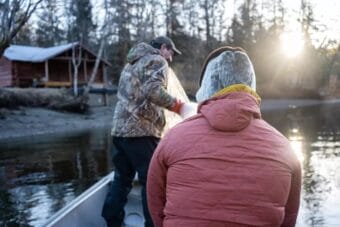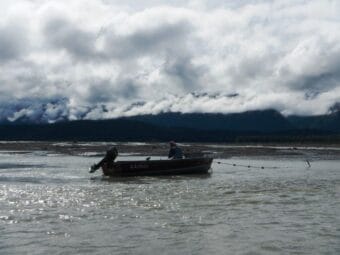
A subsistence fisherman checking his net in the Chilkat River. (Alaska Department of Fish and Game)
The federal government says 98% of rural Alaskans catch, hunt or gather at least some of their food. And much of that happens during the school year.
Now, students in Skagway are calling on their school district to adopt a policy that would let them take part in those activities — without it potentially counting against them.
The push originated with Ryder Calver, who is the treasurer of the Skagway student council. Calver said he’s gone moose hunting almost every year since he was six years old. But in his experience, taking part in an annual moose hunt eats up most of his allotted absences in one go – leaving little room for other absences later on.
“I’m gone for around 10 days each time, and the school only allows you to miss 15 days total per semester, whether that is a trip, you’re sick, excused or unexcused,” Calver said. “I got the idea to add a buffer.”
So this fall, Calver teamed up with Student Council Senior Parliamentarian Sam Munson to write a resolution they hope will push the school board in that direction.
Right now, students can be penalized after their fifteenth excused absence – unless they get a waiver from the superintendent or school board. The resolution makes a case for allowing students to take up to 7 “subsistence days” per semester, which wouldn’t count toward the 15 day limit.
The board’s policy committee took up the issue during a recent meeting. Munson, Calver and Student Council President Lina Hischer spoke, saying the policy should specifically provide flexibility around subsistence activities.
The fact that the current policy doesn’t do that “negatively affects kids who do subsistence hunt or gather,” Hischer said. “We want to make it more even, or equal.”
During the meeting, Skagway School District Superintendent Josh Coughran said the policy could be updated to mention subsistence activities – and to allow students to proactively request days off for a moose hunt or other trip that wouldn’t count against their attendance record.
In that case, he said subsistence days could be treated like travel days for sports or debates – which don’t count as absences.
“We know they’re not in school, but it’s on a school-sanctioned event. And so this would be the school sanctioning subsistence activities and not counting it against families,” Coughran said.
The board is set to discuss the issue at a meeting this week.
Coughran said in an email on Monday afternoon that it’s still “early days” for the idea. If the board decides to move forward with the proposal, it would go back to the policy subcommittee and then return to the full board for consideration.
Disclosure: Sam Munson, the student council parliamentarian, is the son of KHNS News Director Melinda Munson.
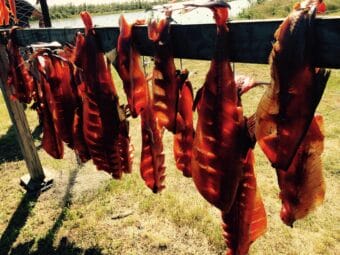
Kuskokwim River salmon drying on a rack at a fish camp near Napaskiak, 2016. (Rhonda McBride)
As the deadline for public comment approaches, the Alaska Federation of Natives is pulling out all the stops to block a national sport hunting and fishing group’s push to reform the federal subsistence board.
This comes after Safari Club International successfully petitioned the U.S. Interior and Agriculture Departments to review federal subsistence management policies.
AFN held a webinar Tuesday afternoon to give Native hunters and fishers an update on the status of subsistence management in Alaska and explain why it believes the Safari Club proposals pose a serious threat to the Native subsistence way of life.
Attorney Jaelene Kookesh, a longtime legal counsel for the Sealaska native corporation, was one of the presenters. She currently is senior legal counsel at the Van Ness Feldman firm. Kookesh says many Alaska Natives were elated last week, when the U.S. Supreme Court decided not to take up the State of Alaska’s challenge of federal subsistence protections under the Alaska National Interest Lands Conservation Act, or ANILCA. But Kookesh says, the battle goes on.
“It’s like you can celebrate for not even for a day, maybe, but then you can say, ‘Okay, we won that, but now we have to comment on this scoping at Department of the Interior,” Kookesh said. “And Safari Club also has draft legislation that they’re pushing at Congress. to amend ANILCA. So, we’re getting hit at every arm of government, so we can’t rest, even with the win at the Supreme Court.”
Kookesh says she worries most about the Safari Club’s campaign to limit the federal subsistence board to state and federal agency heads, a move that would undo recent efforts to diversify the board.
“So you had five federal agency representatives, who obviously are not subsistence users. And so, we worked very hard to have three tribally nominated members for the Federal Subsistence Board, with real concrete knowledge of these practices. And this just happened within the past year,” Kookesh said.
The Safari Club also wants to change the make-up of the Rural Advisory Councils to give sport hunters and fishers a voice in the process, as well as require federal wildlife managers to defer to the state’s regulatory decisions.
Regina Lennox, Safari Club International’s senior legal counsel, says it is seeking these changes to make ANILCA work as Congress intended.
“I don’t think anything that we have sought in any way diminishes the potential representation of Alaska Native voices anywhere,” Lennox said.
“We’re working on behalf of hunters within the state, subsistence and non-subsistence alike, just to ensure that the federal agencies don’t overreach,” she said. “Over 60% of Alaska is federal land, and so if you have agencies that are doing the wrong thing and, stepping on the toes of the state and closing down hunting opportunity, that’s a lot of acreage that’s potentially at risk.”
The Safari Club says one of its top priorities is to protect the resources, which benefits all hunters. It claims the federal government has ignored state data in some of its management decisions to the detriment of wildlife.
AFN and other Native groups say the federal government has done a better job than the state in balancing ANILCA’s rural subsistence priority with conservation.
Kookesh says AFN’s webinar will be a good Subsistence 101 on the decades-long fight to protect subsistence.
“It’s been a battle going on for many years, but it kind of goes quiet every once in a while, and then it comes back up again,” Kookesh said. “So right now, we’re heavy in the fight again. So, hopefully, we can take some steps forward and not some steps back.”
The deadline for public comment is February 13. AFN’s Jan. 20 webinar is posted on AFN’s website.
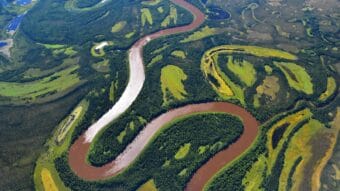
The Kuskokwim River is seen in this image captured by scientists working on NASA’s Arctic Boreal Vulnerability Experiment, or ABoVE. (Peter Griffith/NASA)
The U.S. Supreme Court has rejected the state of Alaska’s latest attempt to alter Alaska’s decades-old system of subsistence fishing management.
If the Supreme Court had taken up the case, it could have redefined Alaska’s unique system of hunting and fishing management, which allows the federal government to restrict subsistence hunting and fishing on federal land to rural Alaskans. The state is forbidden by the Alaska Constitution from offering the same preference.
Alaska Native organizations, including the Alaska Federation of Natives, praised the court’s decision, but the commissioner of the Alaska Department of Fish and Game said by email that it would continue to work with the federal government on the issue.
Monday’s Supreme Court decision ends a five-year dispute that began during a salmon shortage on the Kuskokwim River in 2021. The state of Alaska issued orders to open fishing that contradicted federal fisheries managers’ decision to keep it closed.
Salmon fishing is a critical aspect of Alaska Native culture, tradition and survival. Salmon returns have plummeted in recent years, straining managers who must balance the wants and needs of Alaskans and Yukoners pursuing the same fish.
On the Kuskokwim, the state claimed it was simply interpreting a U.S. Supreme Court ruling from 2019, but the federal government disagreed with the state’s interpretation and sued the following year.
The state appealed to the 9th Circuit, which again ruled in favor of the federal government. That prompted the state to appeal to the U.S. Supreme Court.
The Kuskokwim River Intertribal Fish Commission was one of the lead groups standing with the federal government.
“Our Fish Commission is very pleased with this historic victory in favor of the people of the Kuskokwim River. The victory not only upholds rural subsistence rights in Alaska, but upholds the participation of local people, elected by the Tribes, in the co-management of Kuskokwim salmon,” said the group’s chair, Martin Andrew, in a written statement.
Attorney Erin Dougherty Lynch worked on the case for the Native American Rights Fund, which represented the Association of Village Council Presidents.
By phone, she noted that even though this case is over, the Bureau of Land Management is considering changes to the subsistence program.
“What the state is seeking to accomplish now is basically the same thing through administrative processes. They’re definitely still going after subsistence. This won’t be the end, unfortunately, of their efforts to restrict subsistence,” she said.
Safari Club International, which petitioned BLM for regulatory changes, backed the state in the appeal that was rejected Monday.
In a written statement after Monday’s decision by the U.S. Supreme Court, the group said it believes the federal government “has increasingly superseded Alaska’s wildlife authority” and that the state and federal government should continue to work on the issue.
By email, Alaska Department of Fish and Game Commissioner Doug Vincent-Lang offered a similar comment and referred to the 1980 compromises between state and federal interests in the Alaska National Interest Lands Conservation Act.
“We will respect the decision of the U.S. Supreme Court to not address the legal issues regarding fish and game management authorities over navigable waters belonging to the State of Alaska,” he said. “This said, we will continue to work with the Secretaries of Interior and Agriculture to ensure the rights Alaska was given under its statehood compact and envisioned under ANILCA are safeguarded.”
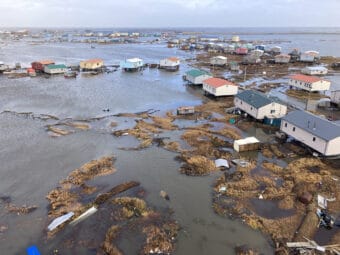
The village of Kipnuk, largely submerged by the remnants of Typhoon Halong, is seen from the air on Oct. 12, 2025. Alaska Air National Guard rescue personnel conducted search and rescue operations there, and the Alaska Division of Homeland Security and Emergency Management has worked with the Alaska Organized Militia and the U.S. Coast Guard in the response. (Photo provided by the Alaska National Guard)
It’s the second emergency hunt that Fish and Game has opened to help storm victims refill their freezers before winter deepens, and it’s only the latest example of how Alaska state agencies have helped in unlikely ways after last month’s disaster, which killed at least one person and displaced hundreds.
Elsewhere, officials from the Alaska Department of Education and Early Development have been coordinating new schools for evacuees who needed to move to Bethel or Anchorage.
The Alaska Department of Environmental Conservation has been helping wrangle fuel tanks set adrift in floods. Workers from the Division of Forestry and Fire Protection have been helping muck out homes, remove debris and deliver supplies to villages alongside the Alaska Department of Transportation and Public Facilities and the Alaska National Guard.
In Anchorage, hundreds of miles away from the villages hardest hit by the storm, about 20 employees of the state-owned Alaska Housing Finance Corporation worked for weeks to find long-term shelter for hundreds of Alaskans who lost their homes in the disaster.
On Monday, state and city officials in Anchorage said they had closed the last mass shelters being used by evacuees because everyone had found hotels or apartments suitable for long-term use.
“This isn’t something we normally have done,” said AHFC CEO/Executive Director Bryan Butcher on Oct. 22 of the push to help evacuees find housing. “There have been different times … that people have reached out to us and asked for assistance, and we try to help when we can.”
Butcher said AHFC employees spent time checking for available state-owned housing and tried to connect evacuees with available apartments and housing across the state.
“We’ll play whatever role we need to play,” he said in late October. “And at this point, it’s just the gathering of units and then trying to help kind of piece it together so it makes the most sense and has the least amount of disruption.”
At the Department of Fish and Game, Ryan Scott is the director of the Division of Wildlife Conservation, which oversees hunting practices and issued the emergency hunting order this week.
“Our staff has been in communication with the communities, plus people who evacuated to town. And you know, I’m very proud of them, but I’m super thankful that we could help out where we could,” he said.
Scott said the department frequently gets requests for emergency hunts, but they’re only allowed in places where the population of prey animals is large enough to support them.
While the two emergency hunts in Southwest Alaska are intended to help people affected by the disaster, any state resident can participate if they meet the guidelines.
The food generated by the hunt may even be able to help people who evacuated from the area; Alaska has a system of proxy hunting that allows someone to hunt on behalf of someone else who is elderly or disabled.
In addition, evacuees may be able to take advantage of winter hunts or small-game hunts, or other subsistence activities, Scott said.
“We get into this type of work not only for the wildlife resources, but across the board it’s about the people too, you know? And then whatever we can do to help Alaskans, that’s what we want to do.”
Tazia Wagner and Louie Wagner III cast a net for hooligan on the Unuk River. (Jack Darrell/KRBD)
When hooligan start running in Southeast Alaska at the end of winter, the Wagner family heads to the mouth of the Unuk River.
Tazia Wagner steers the skiff as her uncle throws a weighted cast net into the muddy water. He hauls up a net full of wriggling, oily little fish. They’re aiming to fill five five-gallon buckets. That’s their hooligan allotment under federal regulations for subsistence in the river. It used to be a lot higher, until the population collapsed around 2004. The Wagners blame that collapse on mining operations that started upriver in the 1990s.
After the buckets are filled, they take them back to the Melodee Dawn, the family’s old commercial seiner.
It’s docked near a rising sun petroglyph painted onto the rocks above the river. Tazia’s grandfather Louie Wagner says that sun is thousands of years old and is a family crest of their ancestors, the Tlingit brown bear clan, or Teikweidí.
“It’s not just fish,” Tazia says of her family’s legacy on the Unuk, and what’s at stake. “It’s a loss of cultural identity and a loss of connection to the land and to our people.”
To save what’s left of this hooligan run for future generations, the Wagner family helped form the Southeast Alaska Indigenous Transboundary Commission, or SEITC. It’s currently a coalition of 17 tribes with the goal of securing a seat at the table in how proposed mining projects are managed on Canadian soil if they directly impact watersheds in Alaska.
Louie Wagner, Jr. in front of the rising sun petroglyph at the mouth of the Unuk River. (Jack Darrell/KRBD)
In April, British Columbia’s ministry of the environment sent the SEITC a letter in response to their request for consultation on the Eskay Creek mine, a large gold mine at the headwaters of the Unuk. It was in production in the ‘90s but was eventually shuttered. The SEITC say the lower Unuk River is still recovering from the downstream impacts. Now, a Canadian mining company is in the permitting stage for reopening the mine. Skeena Resources, Ltd, the company in charge of the project, said the mine is “extremely high-grade” and could produce up to 2.8 million ounces of gold and 80 million ounces of silver in a little over a decade.
Guy Archibald, SEITC’s director, said there is a lot of administrative language about statutes and process in the letter, but the way he read it was simple.
“Different groups of Indigenous people, apparently, are only eligible for different levels of human rights,” Archibald said.
Essentially, the letter said that British Columbia is developing a process for consulting with US tribes that would be “distinct” and “differentiated” from Canada tribes.
Esther Reese, SEITC’s president, said it felt like a continuation of a “colonial divide-and-conquer” tactic. She said the tribes across the border were their neighbors and equals before their ancestral homelands were split by an international boundary, which now feels like a wound.
David Karn represents the Environmental Assessment Office of British Columbia’s Ministry of the Environment. He didn’t agree to a recorded interview but sent a long email response. Karn said in the email that the province’s goal is to honor the Canadian Crown and “act with good faith to provide meaningful consultation appropriate to the circumstances.”
Karn also said that the tribes across the Canadian border are interested in being part of deciding what that consultation for SEITC will look like. Those tribes include the Tahltan, whose territory encompasses the headwaters of the Unuk and Eskay Creek, the site of the proposed gold mine the SEITC are pushing back against. The Tahltan tribal government has publicly supported the mine.
Archibald said that time is not on SEITC’s side here. While British Columbia’s tribal consultation policy is being developed, Archibald expects Eskay Creek to go into the environmental application stage. That’s one step before a lease is granted.
“And so they kind of skipped over the whole idea that the Southeast Alaska tribes do have rights that need to be recognized,” said Archibald.
The coalition’s greatest leverage comes from the Desautel case, a 2021 Canadian Supreme Court decision that set the precedent that Indigenous people who live outside of Canada can be granted the same rights as those in the country if their traditional territory lay within what is now Canada.
“I think if we interpret Desautel, it’s very clear from the evidence we’ve submitted that we meet the threshold legal test for recognizing SEITC and its tribes as protected under the Canadian Constitution,” said Ramin Pejan, an attorney for Earthjustice, a nonprofit environmental law group representing the SEITC.
Earthjustice and the SEITC believe British Columbia’s policy is in direct opposition to the Desautel decision. And they have since been joined by the Lummi nation in Washington, who say that British Columbia is expanding a large port on a river that threatens their fisheries.
“Although this is an issue of Indigenous rights in which Lummi, Alaskan and many First Nations find common cause,” Lummi Nation Chairman Anthony Hillaire said in a prepared statement, “it also affects every person who lives here and who depends on the clean waters, the rivers, and the fish of this region.”
Meanwhile, SEITC and British Columbia are in the briefing stages of a potential case with the Inter-American Commission for Human Rights. The tribal coalition submitted a petition in 2020 accusing Canada of violating their human rights, including their right to a healthy environment on the Unuk River and the international commission accepted it for further review.
Archibald said the next steps for SEITC and the Lummi Nation are clear.
“We’re going to push back in every administrative way possible,” he said. “Is this eventually leading to a lawsuit? Very possibly. But we would like BC to do the right thing.”
Tazia Wagner holds a pair of hooligan. (Jack Darrell/KRBD)
Hooligan grease is made by fermenting and cooking down tons of hooligan. It’s an important food culturally for Tlingit, Haida, and Tsimshian peoples. Largely because, as Tazia’s mom Lee Wagner says, it’s delicious. She describes it as rich and fishy, like an umami butter.
The family called it “liquid gold.” But further up the river, there is real gold. And the Wagners say that’s the problem. It’s why they helped form the SEITC.
“We thought we were kind of alone in all of the effects of our subsistence and our cultural rights and our way of living being slowly stripped away,” said Lee Wagner. “But we’re discovering that we’re not the only ones, and that’s really, really scary.”
The five buckets they filled today won’t be enough to make grease.
“Not at all. Maybe a little drop,” Lee Wagner laughed.
But Tazia Wagner chimed in to say that the hooligan represent more than that. They mean ancestral rights, food sovereignty, agency.
She’s sitting in the captain’s chair of the Melodee Dawn, her grandfather’s chair. The evening view out the pilothouse windows was a pod of sea lions. Behind them, snow-capped mountains and the yawning mouth of the Unuk.
“It’s to feed, not only ourselves and our bodies, but also our souls, and to be able to share all of that with each other — that’s that connection,” she said. “It’s really, really frightening to think about how one day without any of this, how it would look for any of us, Native or non-Native. I don’t know what that is supposed to look like.”
Skiffs line the bank near the lower Yukon River community of Emmonak in the summer of 2019. (Anna Rose MacArthur/KYUK)
As the 2024 Yukon River salmon season kicks off, there will once again be little to no opportunity for communities along the Western Alaska river to harvest any actual salmon.
One small exception is summer chum. If the run hits half a million fish, residents of the lower reaches of the Yukon may have the chance to take to the river with dipnets and other non-traditional gear for a brief window like they did in 2023.
But as Holly Carroll, the Yukon River subsistence fishery manager for the United States Fish and Wildlife Service noted in April, these types of opportunities may not be worth the effort for many along the river.
“Who’s going to spend nine bucks a gallon to go out fishing with a dipnet?” Carroll asked. “It might take them four or five hours to get seven chums. Whereas if they had been given their six-inch gillnet, they put it out for a minute, minute and a half, and they’re done. They’ll have 100. Then they’ll spend the next couple of days cutting and smoking, and they’re done for the season.”
While communities cannot count on these types of heavily restricted opportunities to meet their subsistence needs in 2024, one thing they can count on is a total closure of chinook salmon fishing for the next seven years. Carroll said that the recently signed Alaska-Canada agreement was overdue.
“For me as the federal manager, I see this as the bold step that needed to be taken. We’re just not seeing the returns off those runs that we would have liked. I really felt that it was time,” Carroll said. “I also think we really needed to listen to our tribal stakeholders who have been telling us for years that this annual approach is not a great way to manage.”
The seven-year agreement calls for rebuilding chinook stocks to the point that at least 71,000 of the fish cross into Canada each year. It is technically not a moratorium, as meeting this number at any point in the next seven years would in theory lift the closure. But in 2024, fewer than 15,000 fish are expected to complete the journey.
Many believe that trawler bycatch plays an outsized role in keeping chinook and chum from returning to the Yukon River. But Carroll said that the fish are up against a lot in terms of a changing environment.
“I think they’re dealing with a lot more climate changes, certainly warming oceans, different food sources, the food is moving to different areas,” Carroll said. “We’ve seen less healthy fish. Their gas tanks are less full when they go to make that migration. We’re seeing heat stress, we’re seeing warm temperatures when they come into the river.”
Since 2019, Carroll said that chinook numbers recorded on the upper Yukon River at Eagle have fallen drastically below corresponding numbers far downriver at Pilot Station. Biologists believe one thing that may be killing them off somewhere along that nearly 1,100-mile journey is the disease-causing Ichthyophonus parasite.
According to a 2022 report by federal and state biologists to the Alaska Board of Fish, the severity of Ichthyophonus infections has been found to peak somewhere near the midway point of the river in Alaska. But going further upriver, severely infected fish were rarely found, the report said.
Carroll said that scientists are also researching chinook salmon eggs to try and identify potential threats to future stocks. They want to know whether low levels of the vitamin thiamine that have been linked to early salmon mortality are further impacting the fish.
In 2024, the clock is ticking as scientists try to understand what is happening to Yukon River salmon. But as Carroll acknowledged, the clock is also ticking when it comes to communities along the river simply being able to feed themselves.
“How can we get people more food? And if it is with selective gear, how do we get people using them? Because they’re not traditional, they’re not easy, they’re not efficient,” Carroll said. “We all need to get to the table and figure out how to get people some food while still protecting the chinook while we rebuild them.”
The first chinook of the season are likely entering the lower Yukon River at this moment. With luck, they’ll make it to their natal streams, protected by the efforts of communities with whom they are inextricably connected.
Close
Update notification options
Subscribe to notifications
Subscribe
Get notifications about news related to the topics you care about. You can unsubscribe anytime.