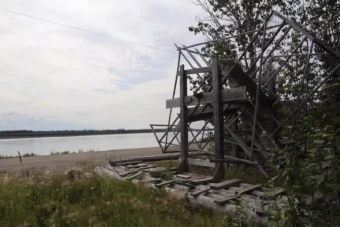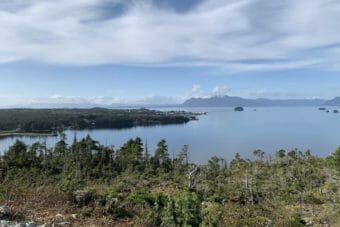
Metlakatla is seen in the distance in 2020 from a turnout on Walden Point Road on Annette Island. (Eric Stone/KRBD)
A federal lawsuit over fishing rights for the people of Alaska’s only Native reservation is likely heading for trial. The case could have broad implications for fishermen throughout Southeast Alaska.
Metlakatla is a community of about 1,500 people at the southern tip of Southeast Alaska. Its federally recognized tribe, Metlakatla Indian Community, sued the state in 2020, saying the law that created the reservation included an implicit right to fish in nearby waters outside the reservation’s boundaries. That’s based on a long history of the tribe fishing in those areas after emigrating from British Columbia in the late 1800s.
Because Congress was aware of the tribe’s reliance on fishing when it created the reservation, the tribe argues its fishermen shouldn’t need state permits to fish in areas near Ketchikan and Prince of Wales Island in what are now designated by the Alaska Department of Fish and Game as Southeast Alaska Districts 1 and 2.
The state says allowing Metlakatla fishermen to circumvent the state’s permitting system would make it difficult or impossible for wildlife officials to manage fish populations.
The state also argues that the community has no historical fishing rights in its current home. That aspect of the case went to the U.S. Ninth Circuit Court of Appeals, which disagreed with the state in 2023, saying the case rests not on the tribe’s long history but the circumstances surrounding Congress’s creation of the reservation.
The three-judge Ninth Circuit panel hearing the case wrote that the 1891 law creating the reservation, called the Annette Islands Reserve, doesn’t explicitly mention fishing rights, but a 1918 U.S. Supreme Court decision recognized that, without off-reservation fishing rights, the community would not be able to sustain itself.
The state brought the issue up again at the district court level after the Ninth Circuit ruling. The appellate court wrote that “Metlakatlans and their Tsimshian ancestors asserted and exercised a a right to fish in these waters since time immemorial.” The state argued the Ninth Circuit panel’s use of the phrase “since time immemorial” meant that the tribe had to prove that its members historically fished in the southern panhandle to the exclusion of others.
But District Court Judge Sharon Gleason disagreed, writing in a footnote to Friday’s ruling that, in a legal context, the phrase “simply means ‘[a] point in time so far back that no living person has knowledge or proof contradicting the right or custom alleged to have existed since then,’ or ‘[a] very long time.’”
“Simply because the Circuit Court discussed the Metlakatlans’ historical use of off-reservation fishing grounds — which it noted that it should do to determine the reservation’s purposes — does not transform this case into one which requires proof of aboriginal rights given that the implied fishing right here stems from the 1891 Act,” Gleason wrote.
However, precisely where members of Metlakatla’s tribe should be allowed to fish without state permits is in question. That’ll be the subject of a trial in the coming months.
Metlakatla Indian Community Mayor Albert Smith said he’s confident the tribe will be able to prove its fishermen have long plied the waters of the southern panhandle.
“We know that the facts are on our side,” Smith said. “This long battle is ongoing, but we are fast closing in on restoring the fishing rights Congress gave to our people.”
The state Department of Law did not respond to a request for comment.
Attorneys for the state and Metlakatla are scheduled to meet in an Anchorage courtroom on June 25 to set a trial date. The parties could settle in advance of a trial, but Smith said he’s not aware of any active negotiations.
Rep. Mary Peltola in her Washington, D.C. office. (Liz Ruskin/Alaska Public Media)
Alaska Congresswoman Mary Peltola introduced two bills Wednesday that aim to deliver on one of her campaign themes: Reducing the number of salmon that the Bering Sea fishing fleet catches by accident.
One of the bills would curtail the use of fishing nets that scrape sensitive parts of the sea floor. It would require regional fisheries management councils to designate bottom trawl zones and limit that kind of fishing to those areas.
It also attempts to crack down on fishing gear that hits the sea floor but goes by a different name. Peltola said areas that are closed to bottom trawling off Alaska’s coast are too often open to pelagic trawling, which in theory means the nets are in the mid-water.
“I think 40 to 80% of the time, that ‘pelagic’ gear is actually on the bottom,” she said. “So I think that defining these terms and having a more accurate definition of what bottom trawl is, and the percentage of time that those nets are on the bottom, is really important.”
A second bill would increase the money available for a grant program that funds research and equipment to help fishing fleets reduce bycatch. That program would get up to $10 million per year, $7 million more than its current cap.
Peltola acknowledges that her bills are unlikely to become law this year. But she said they elevate the national discourse on fish. And, she said, the pollock industry is starting to get the message and is taking voluntary measures to avoid salmon. She credits, among other things, her own election for a recent drop in bycatch.

“The fact that Alaskans elected a member of the congressional delegation who ran on a platform of fishing and bycatch — that fact alone has really caught the attention of many in the industry,” she said. “Fifty percent of bycatch has been reduced, especially when it comes to chum salmon.”
It shows, she said, that the industry can make improvements.
The Alaska Pollock Fishery Alliance says the bottom trawling bill would impose “unworkable and burdensome new federal mandates on regional decision-makers.”
Stephanie Madsen is executive director the At-Sea Processors Association, which is part of the pollock alliance. She said the bill goes against the science-based approach that the North Pacific Fisheries Management Council takes.
“The council has been looking at pelagic gear definitions, the enforceability, and they continue to look at that,” Madsen said. “And that’s where we think the work needs to be done.”
Organizations representing smaller-boat fishermen and subsistence users, on the other hand, have endorsed Peltola’s bills. Those organizations include the Alaska Longline Fishermen’s Association, SalmonState and the Kuskokwim River Inter-Tribal Fish Commission.
Linda Behnken, executive director of the Longline Fishermen’s Association, said Alaska fishing communities and conservationists have been asking the North Pacific council for years to redefine pelagic trawling in a way that limits sea-floor contact, to no avail. Even if the bills don’t become law, Behnken says they help.
“I think they certainly send a strong message that Rep. Peltola is hearing concerns from Alaskans and is providing direction to councils to take action to address those concerns,” Behnken said.
Quincy Adams slices through bowhead whale meat to distribute to his family and community members in Utqiaġvik on April 24, 2024. (Valerie Lake/Alaska Public Media)
For the Aaluk Crew, last Wednesday was cooking day.
The night before, the whaling crew, captained by Bernadette and Quincy Adams, had landed the first bowhead whale of Utqiaġvik’s spring season. The crew flag, featuring a harpooned bowhead tail framed by a sunset, waved above the Adams’ two-story home, signaling the successful hunt.
The garage door rolled up and steam flooded out into the yard.
Inside was a picture of a jubilant chaos. Late 2000’s pop music blasted from a bluetooth speaker as crew members and family bustled between huge pots, tending to different cuts of meat — boiling slices of bowhead blubber and skin, or uunaalik, heart, tongue and intestines.
Children ran underfoot, people fed babies tiny pieces of cooked meat. A husky named Avvaq sat tied up in the snow, hoping for scraps. Laughter ricocheted off the walls. Everyone buzzed with excitement for Utqiaġvik’s first spring bowhead.
Natasha Itta laughs with the other members of the Aaluk Crew while preparing bowhead meat to share with the community of Utqiaġvik on April 24, 2024. (Valerie Lake/Alaska Public Media)
“Whaling brings so much joy,” said Natasha Itta, a member of the Aaluk Crew.
Meat from this catch will feed the crew and their neighbors for months to come. It will also be sent to other North Slope villages and even family in the Lower 48.
“The bounty just goes all over the place,” Itta said.
An ulu sits on top of a silver tray stacked with pieces of boiled maktak from a bowhead whale after being cooked by the Aaluk crew in Utqiaġvik on April 24, 2024. (Valerie Lake/Alaska Public Media)
For Inupiat communities on the North Slope, bowhead whaling is a central part of spring. But climate change is adding an extra element of uncertainty to the whaling season.
Warmer temperatures are driving a decline in the region’s sea ice, which is forming later in winter and thawing earlier. Whalers say the shorefast ice, or the ice still attached to the coastline at this time of year, is becoming thinner and less predictable. That poses an extra challenge — and possible danger — for crews, who must cross the ice to reach open water and then rely on it when they pull in whales that can weigh more than 60 tons.
Tomi Phillip squeezes a piece of bowheat muktuk to check for firmness while boiling the meat before distributing the food to the community of Utqiaġvik on April 24, 2024. (Valerie Lake/Alaska Public Media)
Itta said a possible future without stable ice and successful spring hunts is scary to think about.
She said whalers are thinking about how to adjust if the shorefast ice won’t support spring whaling in the future, like potentially going out earlier in the season when the ice is firmer — but then there’s a risk that whales won’t be migrating yet.
“It’s going to take a lot of adapting,” Itta said. Traditionally, bowhead whaling starts in late March or early April, with feasts and festivals following in the summer. Losing that rhythm would be hard, Itta said. “It’s almost like you lose a piece of your identity. Because that’s who we’ve always been, that’s who we’re going to be.”
Donald “Button” Adams of the Aaluk Crew, talks about how it felt to bring home his first bowhead whale and share it with his community of Utqiaġvik on April 24, 2024. (Valerie Lake/Alaska Public Media)
But this season is already a success. It also marked an important milestone: the 31-foot-whale caught by the Adams crew was landed by 17-year-old Donald “Button” Adams — his first as striker.
Donald is the son of the Aaluk Crew captains Bernadette and Quincy Adams. He’s not one to brag.
“I don’t know. It’s pretty cool,” he said with a shrug, in a crowded kitchen.
But his parents couldn’t hide their quiet pride.
“It’s a big deal. He’s been working really, really hard,” said Bernadette Adams, Donald’s stepmom. In 2014, Bernadette became the first known woman from Utqiaġvik to land a bowhead.
Bernadette Adams, co-captain of the Aaluk crew, shows off the tip of the harpoon she used to catch her first bowhead whale during a family gathering at her home on April 24, 2024. (Valerie Lake/Alaska Public Media)
Donald has been going out on the ice since he was seven years old, learning from his parents: “What to look for on the ice, when to go out, when not to go out, which way the wind direction is going,” he said.
For several years, he’s been training to take on the role of striker from his father, Quincy. The striker stands in the bow of the boat and launches the darting gun to harpoon the bowhead.
On the night of the successful hunt, the crew set out just before midnight, Donald said. They prayed with the boat and then launched it from the ice.
“The water was pretty flat, almost glass,” he said. “Then we saw a whale along the tuvak — that’s the edge of the ice where the ice and the water meet.”
That first whale quickly disappeared. But soon, the crew spotted another one, about 300 yards out. As they sped towards the second whale, Donald said, they saw it spout just 20 feet away, and closed in to where they expected it to surface next.
“Sure enough, right beside us the whale popped up,” Donald said. He threw the harpoon. “It was a good shot, too.”
Members of the Aaluk Crew proudly wear their branded hoodies and jackets while cooking the meat of the bowhead whale they caught the night before. (Valerie Lake/Alaska Public Media)
Experienced hunters themselves, Donald’s parents know what it takes to be a successful striker.
“We told him you gotta show us you can do it,” Bernadette said. “We made him go and help cut multiple whales. ‘You got to ask questions,’ I said. ‘It’s not just from us you’re gonna learn, it’s from everybody else.’”
Donald was ready to serve as striker last fall — until he broke his leg in an accident on the boat. Just then, the crew spotted a whale. Despite his broken leg, Donald refused to let them turn around, Bernadette said.
“He was like ‘just go after it!’” Bernadette recalled.
Quincy said it’s hard to express how it felt to watch his son take on this new role.
“I don’t have any words for that,” he said. “I don’t have any words for watching that happen. It’s just so humbling to see.”
Quincy Adams, co-captain of the Aaluk crew, directs a group of men as they divide up the bowhead whale they caught the day prior. The meat will be distributed to members of the community of Utqiaġvik on April 24, 2024. (Valerie Lake/Alaska Public Media)
The crew towed the 32-ton whale back to their camp and heaved it onto the ice with the help of snow machines. It took about 40 people another six hours to process the catch to bring into town, Donald said.
In the garage on cooking day, teenagers darted in and out with massive sheet trays, sliding batches of cooked meat into plastic totes lined with trash bags to share with anyone from the community who stopped by.
In the yard outside the Adams’ house, big chunks of meat lay scattered in the snow, waiting to be processed. Quincy and a few other men cracked jokes while they portioned out cuts for crew and family.
Whaling is about providing for others, Quincy said.
“It’s just built in us. It’s something that we yearn to do,” he said. “If we’re not successful, then we find other ways to feed the community. But doing this and feeding the community is what it’s all about.”
This first bowhead was an auspicious start to Utqiaġvik’s spring whaling season. Since last week, crews have caught five more.
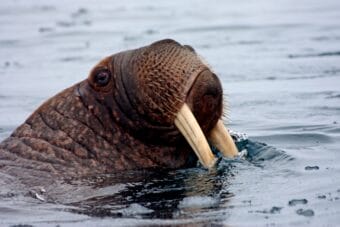
A walrus is seen in Alaska’s Chukchi Sea in June of 2010. Research by a University of Alaska Fairbanks student found microplastics, mostly tiny fibers, were lodged in muscle tissue, blubber and livers of walruses harvested by hunters from St. Lawrence Island and Wainwright. (Sarah Sonsthagen/U.S. Geological Survey)
Vi Waghiyi grew up in the village of Savoonga on St. Lawrence Island, where meat from walrus, seal and bowhead whale sustained her family through long winters.
“My people continue to live off the land and ocean like we have for millenia,” Waghiyi said. “Our elders call the Bering Sea our farm.”
Today, as an elder herself, Waghiyi wants her grandson to have access to the same traditional foods. But food security in the Arctic is increasingly threatened.
The burning of fossil fuels is heating the region four times faster than anywhere else on the planet. Warming waters are disrupting the food chain, and melting sea ice is erasing animal habitat and making hunting more dangerous.
“And we are some of the most highly contaminated people on the planet because of our reliance on our subsistence foods,” Waghiyi said.
Because plastic waste piling up across the planet is making its way up to the Arctic. Plastics contain toxins that have been linked to long-term health problems like cancer, hormone disruption and damage to the heart, liver and kidney, which threaten Alaska Native communities. That’s according to a new report from Alaska Community Action on Toxics and the International Pollutants Elimination Network.
Waghiyi, who is the director of environmental health and justice for Alaska Community Action on Toxics, is a co-author on the report, along with other scientists and Alaska Native leaders who are calling for an end to new plastic production worldwide. They’ll represent Alaska’s Arctic communities at a meeting of the United Nations later this month.
Pamela Miller, a long-time Alaska scientist who works with both organization, is also a co-author. She said strong currents in the ocean and the atmosphere naturally move from lower latitudes to the poles, carrying plastic and other pollutants along with them.
“We now know that there are microplastics in fish, in walrus, in ring seal, bearded seal, spotted seal, and many different whale species,” Miller said. “These are the animals that have been relied on for centuries for sustenance.”
The accumulation of plastics in the Arctic is made worse by climate change.
“We also know that with climate warming happening so rapidly that the highest concentrations of microplastics are found in those areas where there’s the most rapid melting of sea ice,” Miller said.
The melting of sea ice, permafrost and glaciers also release plastics and chemicals that have long been bound in ice.
In 2022, the United Nations set out to write a treaty on how to deal with growing plastic waste. They’ve held several meetings to hash out the terms, including one happening later this month in Ottawa, Canada. There, the authors of the new report will join representatives from more than 170 other countries.
Miller says there’s only one real solution to the plastics problem.
“The first thing is to curb the production of chemicals and plastics,” she said. “Since they’re reliant on fossil fuel production, that also means curbing fossil fuel production.”
But not everyone agrees with her.
Most plastic is created with chemicals derived from fossil fuels. And as demand for oil and gas in transportation or home heating drops with the switch to cleaner energy, many in the fossil fuel industry see plastics as a way to support their future business.
Waghiyi says she hopes that Arctic Indigenous communities are able to push back against those industry interests.
“Our people have done all we could to make sure our land, airs and waters are protected,” Waghiyi said. “These multinational corporations do not take human health into account.”
She says she’s headed to Ottawa to fight to protect the health and food of her grandson.
A fish wheel sits up on the bank of the Yukon River in Galena. (Emily Schwing/KYUK)
Alaska and Canada have agreed to a seven-year moratorium on Yukon River chinook salmon fishing.
According to a release from the Alaska Department of Fish and Game, the in-river closure for one full king salmon life cycle is outlined in an agreement signed April 1 by the state agency and its Canadian counterpart. It halts the harvest of kings on the mainstem of the Yukon, as well as Canadian tributaries, in an attempt to recover the long-depressed stocks.
The agreement sets a 71,000 Canadian-origin chinook annual border passage target, and allows for consideration of limited subsistence harvest if the target is projected to be reached. It’s been seven years since that many kings crossed the border into Canada, and last year’s passage estimate was under 15,000.
Regardless of run size, the new agreement allows for consideration of limited chinook harvest for ceremonial and cultural purposes.
Another part of the agreement requires development of a Yukon River chinook salmon rebuilding plan.
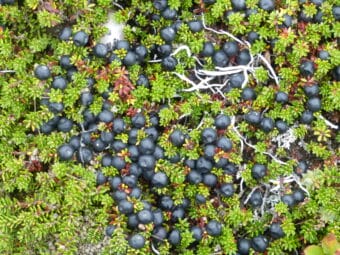
Crowberries in Izembek National Wildlife Refuge are seen on Oct. 5, 2016. House Bill 178 is intended to allow Alaska families to spend more time engaged in subsistence activities, such as berry picking. (Kristine Sowl/U.S. Fish and Wildlife Service)
Alaska schools could start the academic year in September if a new proposal is approved by the state’s lawmakers.
Senate Bill 178 would establish the first Tuesday of September as the earliest a state school could begin classes. Sen. Jesse Bjorkman, R-Nikiski, introduced the bill and said the later start date would allow students to spend more time on subsistence activities and working in construction or tourism jobs.
“I believe it will go a long way to de-conflict those things for kids who would like to stay on their summer jobs, as well as with families who would like to travel around the state and enjoy all that Alaska has to offer,” he said.
The change would affect the vast majority of school districts.
He said the time is right to push the start day back because schools have more flexibility to choose when they administer standardized tests, so they no longer have to start the school year earlier to maximize teaching time before testing dates in the spring.
“Nothing that stops a district from starting their district later except inertia,” he said. “Instead of fitting the character and culture of Alaska, we have calendars that fit a small group of people.”
A teacher himself, Bjorkman pointed to colleagues who rely on summer careers, including construction, to fill out their yearly income.
Sen. Jesse Kiehl, D-Juneau, pointed out that there are differing harvest times across the state and wondered if those regional differences should be considered. He noted that in his district, berries come in earlier than in Southcentral Alaska and moose hunts open in mid-September.
Bjorkman said those differences would be taken into account with a waiver process for districts that would like to differ. He pointed to the tourism industry in Southeast Alaska that may provide summer jobs and travel opportunities for students as a reason to consider a later start date.
Deb Riddle, operations manager for the state’s Department of Education and Early Development, said that there is already a waiver program in place within the department. She gave the example of the Lake and Peninsula School District, which starts in September and ends the year earlier than other districts for subsistence reasons.
Lon Garrison, executive director of the Association of Alaska School Boards, said the organization has no stance on the bill, but advocates that the committee give it careful consideration.
“The broad impacts of that language really have to do with local control,” he said, adding that though the bill’s language is simple, it could have a variety of effects around the state.
Bjorkman said there can be flexibility in the bill, but that a statute change is necessary.
“I think that guidance is needed from the state Legislature to encourage local districts to overcome the inertia that has settled in and drafting calendars that, unfortunately, work for some school bureaucrats, but don’t work very well for Alaskan families,” he said.
He noted that schools may have to adjust how they measure teaching time or how many hours per day school is in session in order to meet state requirements between Labor Day and Memorial Day.