Subsistence

Amid salmon crash, Alaska’s Yukon River residents say a new pact with Canada leaves them behind

The Yukon near the Alaska village of Eagle last summer, when the river was unusually empty of boats due to bans on fishing for chinook and chum salmon. (Photo by Bathsheba Demuth for Northern Journal)

This reporting was supported by a Carnegie Foundation Fellowship.

Writers Olivia Ebertz and Bathsheba Demuth boated more than 1,000 miles up and down the Yukon River last summer, hearing the stories and perspective of residents and tribal leaders along the way.

ALONG THE YUKON RIVER — The midsummer air is hot after a long day of sun and stillness in the middle river village of Grayling, and the cutbanks seem to slouch closer toward the Yukon River below. Rachel Freireich says her mother moved here permanently from the Athabaskan village of Holikachuk, up a nearby tributary, in the 1960s to be closer to schools and salmon eddies.

“They came over with steamboats every summer to fish the salmon,” said Freireich, a resident of Grayling her entire 43 years.

In summers while she was growing up, Freireich says the village was a ghost town.

“The whole community would become kind of abandoned, because everybody would bring their whole families out and they went to the fish camp. Everybody was busy,” she said.

But in the summer of 2023, fish camps are empty. The few boats in the lower river are mostly in a search party looking for a missing person. From the mouth of the Yukon at the Bering Sea to the river’s headwaters in Canada, no one is fishing — the consequence of the second-lowest king salmon run on record. The worst was just a year prior, a grim milestone in the wake of decades of ebbing runs that have robbed Indigenous residents of both traditions and nourishment.

Empty fish nets on the banks of the Yukon, not far from Alaska village of Eagle. (Photo by Bathsheba Demuth for Northern Journal)

“After they cut off fishing, there was lack of work, lack of jobs, people in poverty. People really struggled. And we continue to struggle,” said Freireich.

Amid these devastating numbers, American and Canadian regulators are poised to sign a new international agreement they hope will help rebuild Yukon king stocks and reverse years of cultural and ecological damage. The agreement contains a weighty request: that all Yukon River subsistence harvesters cease fishing for a full seven-year life cycle of king salmon, also called chinook. This new burden would follow tight restrictions on subsistence fishing in the U.S. since 2008, and total closures since 2021.

In Canada, where First Nations set many of their own fishing restrictions, some communities have kept their chinook nets out of the water since the turn of the 21st century.

In January, the Alaska Department of Fish and Game and the Canadian Department of Fisheries and Oceans soft-launched the new draft agreement. Their goal is to get 71,000 chinook across the border. It’s been seven years since that many chinook swam into Canada; last year, managers estimated the number was about 15,000.

It’s an ambitious target, one that has to contend with a host of complexities. In Alaska, where the state is the primary manager of Yukon salmon, some tribal leaders are so frustrated by their exclusion from decision-making that they’re requesting federal oversight of fishing on the river. There are also fears that the agreement will open the door to hatcheries. And then there’s the greatest challenge migrating salmon face: the ocean. As they grow at sea, Yukon River chinook must eat enough to propel themselves as far as 2,000 miles up the longest salmon spawning river in the world — while facing predators, trawlers, and rapidly warming waters.

A thunderstorm brews over the Middle Yukon, between the villages of Tanana and Ruby. (Photo by Bathsheba Demuth for Northern Journal)

Cooperative management of the Yukon by the U.S. and Canada was borne from a dramatic chinook crisis in the late 1990s.

In 2001, the two countries formally signed the Yukon River Agreement, an annex to the 1985 Pacific Salmon Treaty. It requires the harvest to be equitable on both sides of the border, and that a “minimum sustainable escapement” of fish reach Canadian spawning grounds each season. The agreement also created the Yukon River Panel, a binational advisory body made up of American and Canadian representatives.

Panel members have haggled over escapement goals as runs have shrunk. For more than 20 years, the Alaska Department of Fish and Game, has opened — or closed — commercial and subsistence fishing so the target number of salmon can reach the Canadian border.

But this year, facing another summer of crisis on the Yukon, Canadian federal and American state officials want their draft agreement to shift the focus from escapement numbers to rebuilding the chinook population.

Relief can’t come soon enough for families like Freireich, who face deep economic and cultural losses with so few fish. The last several years have been particularly hard, as fishing for another staple subsistence species — summer and fall chum salmon — has also been partly or fully closed due to low runs.

Meanwhile, prices have surged at the local store. With food so expensive, fishing is essential to balance rural budgets. The rituals and cooperative work that come with the annual summer harvest also are part of what Freireich describes as “a very good life.”

“Our kids knew the definition of work and working together as a family,” she said. “At the end of the season, you came home with all of your fish and all of your stuff and your freezers were full and grandparents and families were happy.”

Doug Vincent-Lang (Photo provided by Alaska Department of Fish and Game)

The draft agreement would not put many more fish into local hands right away. But there are limited opportunities to harvest for “ceremonial use and the transmission of cultural knowledge,” subject to managers’ discretion.

“We don’t want to completely kill culture for seven years while we try to rebuild these things,” says Doug Vincent-Lang, Alaska’s fish and game commissioner and the state’s top Yukon River negotiator. “We want to have a culture that’s preserved so that when the stocks do rebuild, that culture is alive and vibrant.”

Many Alaska tribal leaders oppose the new agreement in part due to a lack of tribal decision-making

Canadian First Nations members and Alaska Natives’ opinions on the draft agreement mirror their differing relationships with fisheries management on the two sides of the border.

In the Yukon, First Nations retained their own Indigenous subsistence rights in their overarching land claims agreements with the Canadian government. Closures to chinook harvests there must be agreed upon by First Nations and federal managers.

This leads to “a much better relationship than what I see on the Alaskan side,” says Elizabeth MacDonald, fisheries manager for a Whitehorse-based consortium of Yukon First Nations.

Rather than yielding to federal restrictions, First Nations like the Teslin Tlingit Council, southeast of Whitehorse, have voluntarily ceased fishing. Or they’ve strictly limited their catches to ceremonial use, as at a “first fish” camp run each summer by the Dawson City-based Tr’ondëk Hwëch’in government.

MacDonald, who previously worked for the federal Canadian Department of Fisheries and Oceans, is also a Yukon River Panel member.

Canadian rules barred her from speaking directly about the new draft agreement. But generally, in the Yukon, she said, “First Nation governments have to be consulted on things.” Federal managers, she said, will tell First Nations leaders: “‘Hey, guys, we’re thinking of doing this. What do you think?’ Or, ‘You want to do this. Can we help you?’”

The Alaska Native Claims Settlement Act grants no comparable set of harvesting rights to Alaska Native people, meaning that fisheries closures imposed by the state do not legally require the same level of tribal consultation as in Canada.

On the lower river, near the Bering Sea, such closures are recent and raw — in part because until the recent chum salmon crash, those fish were helping to keep residents’ freezers full even amid the absence of chinook. Closer to the border, in Alaska communities like Fort Yukon or Eagle that have been closed out of the king harvest for longer — and where chum don’t spawn — orders to stop fishing are still delivered by state managers, and come with the threat of net seizures and fines.

Alaska tribal members and organizations object to the lack of a formal consultation process by the Fish and Game Department, and the new draft agreement is no exception.

“They had ample opportunity to consult or present this agreement to tribal leaders, tribal organizations, tribal communities. But yet, they chose not to,” said Brooke Woods, a tribal member and salmon advocate in the Alaska village of Rampart.

Woods says the state doesn’t formally consult with tribes at all.

Vincent-Lang acknowledged that the state “hasn’t done a good job of incorporating some of the tribal information into our processes.”

But, he added, “We’re trying to figure out how to correct that.”

While tribes were not included in early draft negotiations, Vincent-Lang said he would consider taking their suggestions to Canada if they feel critical.

Tribes push for a federal takeover of Yukon salmon management

Robert Walker, the chief of the tribal government in the village of Anvik, says his family used to put away 150 king salmon every summer. (Photo by Olivia Ebertz for Northern Journal)

Along the lower Yukon, in the Deg Xitʼan Athabascan village of Anvik, Chief Robert Walker voices an opinion that’s echoed up and down the Alaska side of the river.

“Damn, I wish I was born earlier,” he said. “I would never have agreed on state waters.”

Walker is talking about the state of Alaska’s exclusive authority to manage Yukon fisheries on the American side. He fears that low salmon runs, which he blames in part on the state’s decisions, are making it impossible to carry on Deg Xit’an traditions.

Already, the Catholic Church and its historical policies of forced assimilation cast a long shadow over Indigenous culture along the lower and middle Yukon, where schoolteachers once intimidated residents, including Walker, who spoke Deg Xinag at local mission schools.

“When we were kids, when we talked in our language, they would whack us,” Walker said.

Summers spent at fish camp, away from church oversight, gave Walker and his family the chance to freely practice Deg Xit’an culture. Tending their smokehouse downriver kept the family busy during the chinook and summer chum runs. They’d put away about 150 chinook every season.

Today, there are not enough fish just for families to sustain themselves, and the Deg Xinag language is so endangered that the state says there are just two fluent speakers.

“I hear elders say, ‘God, I just really wish I had a fish head. Or even half of one,’” said Walker.

The frustration with the state has driven a desire among village residents to have the federal government take over fisheries management on the Yukon.

Tribal members see pros and cons to the idea.

The state allows any Alaska resident to subsistence fish on the river when it is open for harvesting, which is helpful for the many Native people who have moved away to larger cities or villages for work. Federal government subsistence rules only grant fishing rights to people who live along the river. But the state has not heeded calls to grant equal decision-making power to tribes, a practice called co-management. Co-management is when tribes and a state or federal entity jointly make decisions like run closures or allowable net sizes.

The only state-managed harvests in Alaska that fit this definition are for migratory birds, according to Sky Starkey, a longtime Anchorage-based Native rights attorney.

“And they’re mandated to do it by federal law, because there’s a treaty in place,” he said.

The federal government, meanwhile, has struck numerous co-management agreements with tribes. Just south of the Yukon River, on the Kuskokwim River, the U.S. Fish and Wildlife Service has formally co-managed salmon runs with a regional inter-tribal fish commission since 2016.

Earlier this month, the Yukon River Inter-Tribal Fish Commission filed a special action request with the Federal Subsistence Board, asking for federal management of the 2024 Yukon salmon run.

The request, according to commission chair Karma Ulvi, is for the federal government to “help us become stewards or co-managers of the river.”

While Ulvi and others may wish for co-management with the feds, Vincent-Lang fears the loss of state authority. One reason he’s eager to sign the draft agreement, Vincent-Lang said, is because he heard that First Nations entities were considering petitioning for Endangered Species Act protections for Yukon River chinook. Such protections could limit infrastructure development or natural resource harvests in communities along the river, Vincent-Lang said.

He said he did not know which First Nations were considering a push for those protections, however, and none of the First Nations members, their spokespeople, nor Canadian managers interviewed by Northern Journal said they had made such a request, or knew of one.

Alaska tribal leaders say cutting them out of the management process has dire consequences for the salmon, and they say that animals stop returning when people stop respecting them. Up and down the Alaska side of the river, residents decry the western practice of catching fish and throwing them back — a directive from state managers when a person fishing for other species accidentally catches a chinook in their wheel or net.

Benedict Jones is an elder from the village of Koyukuk. (Photo by Olivia Ebertz for Northern Journal)

Benedict Jones, an elder from the village of Koyukuk, said the Indigenous Koyukon people are closely related to fish. “The elders told us when we were kids, they said, ‘Don’t bother the salmon. Don’t manhandle it. If you catch it, you gotta harvest it. Don’t throw it back in the river alive.’ And that’s what Fish and Game is doing,” he said.

The draft agreement calls for the U.S. and Canada to prioritize traditional and local ecological knowledge about chinook health to “better understand the causes of low run abundances and to identify possible solutions.” But U.S. tribal members are worried that with no formal consultation or co-management agreement, the bullet point could easily be ignored.

“That’s what our biggest goal is, co-management with the river, with tribes,” said Ulvi, chair of the inter-tribal fish commission on the Alaska side. “We feel like that’s the only way that we’re going to get conservation at this point, and using local and traditional knowledge and western science.”

Alaska Department of Fish and Game workers catch salmon to tag — part of a catch-and-release project to track chinook survival once they enter the Yukon River. Chinook have been disappearing in large numbers between counts at Pilot Station near the river’s mouth and the village of Eagle near the Canadian border. (Photo by Bathsheba Demuth for Northern Journal)

Vincent-Lang said co-management already happens on the Yukon through advisory bodies up and down the river, and because of a public comment process at Alaska Board of Fisheries meetings.

But the advisory boards and Board of Fisheries both lack designated seats for representatives from tribal governments, and their decision-making processes do not include any consultation requirements with tribal leaders.

The new agreement could lay the groundwork for hatcheries along the river

The language in the draft agreement is not explicit, but Vincent-Lang said the shift toward a rebuilding goal may lead to new hatcheries on the river — a concept Canadian Yukon Panel members and First Nations leaders generally support, at least at a small scale.

Because Canadian First Nations are farther up the river, they’ve already endured decades of salmon shortages, unlike Alaska villages on the lower river. That’s created more openness to human intervention, according to three Canadian Yukon Panel members.

But on the Alaska side of the border, tribal members and some scientists are more skeptical, often citing evidence that hatcheries lead to increased prey competition at sea and make it more difficult for wild salmon to compete — along with other evidence that they’re simply not working.

Hatcheries run the gamut from tiny projects in spawning streams to industrial facilities with fish pens. Officials on both sides of the border say they are planning for small-scale, conservation-style hatcheries to preserve genetic diversity among fish. The ecological health of the Yukon watershed requires salmon, which is one reason Canadian First Nations are willing to entertain such proposals, according to MacDonald.

“They think it’s more important to have salmon there and continue to fill that ecosystem need, feeding the birds and the environment, than to let them spawn naturally and go extinct,” she said.

Salmon nourish eagles, ospreys, bears, lynx and a host of organisms in the waters where they die after laying their eggs — and their bodies, rich with nitrogen from the sea, fertilize the boreal forest along spawning streams.

There is already one hatchery in Whitehorse to help compensate for fish that die at a city dam, but MacDonald says its small scale has minimal impact and is not meant to provide commercial or subsistence harvests. MacDonald said she worries about what could happen if the U.S. were to one day use hatcheries on the Yukon River to boost the commercial fishing industry, as it has done elsewhere in Alaska.

A state-run fish hatchery in Anchorage. (Alaska Department of Fish and Game photo)

“There should be quotas and limits on what each country can send out in the ocean,” she said.

Hatcheries in Alaska release more than a billion salmon into the ocean each year.

“Flooding the rivers and oceans with hatchery fish is not going to solve our problems,” said Ulvi, the chair of the Yukon Inter-Tribal Fish Commission.

Vincent-Lang has expressed excitement about the idea of hatcheries on the Yukon since as early as August 2021, three months into the crash in chum populations. “I’ll be dreaming of hatchery chinook and [chum] tonight!!!” he wrote in an email obtained through a public records request.

Vincent-Lang said fears over hatchery fish are misplaced, and he disputes the science that hatchery fish are competing with Yukon River chinook for food. The draft agreement, he said, isn’t contemplating “large-scale hatchery production right now on the U.S. side of the border,” and he added that the public would be involved in any discussions about significant hatchery expansion in the future.

One leading Alaska fisheries scientist, however, said he’s skeptical that any new hatcheries on the Yukon will help the struggling chinooks.

If hatcheries could restore river populations without causing more problems for wild fish at sea, they would have reversed the low chinook runs in Washington, Oregon and California by now, said Peter Westley, a biologist and professor of conservation and ecological studies at University of Alaska Fairbanks.

“It would be working, and it’s not,” he said. “Responding with a hatchery is a Band-Aid on a gushing wound.”

Westley said he is “embarrassed” that state leaders are considering hatcheries on the Yukon. The draft agreement also includes provisions for habitat restoration, which Westley considers a superior goal.

“Should you invest in hatcheries or should you invest in habitat? No brainer: Any effort going to hatcheries should go to habitat restoration and protection,” he said.

Yukon residents say agreement does not go far enough in addressing issues at sea

Along the Yukon, communities see constant signs of climate change — from unpredictable wildfire seasons to a mountain lion that musher Jody Potts-Joseph says has been spotted not far from her home in Eagle Village.

“We’re seeing the Yukon River widen,” Potts-Joseph told a group of University of Alaska Fairbanks students this past August. “You’ll also see a lot of erosion because of permafrost thawing.”

She described salmon dying of heatstroke in an overly -warm river.

The Yukon has been too warm for salmon in “many of the recent years,” as measured at Pilot Station in the lower river, said Katie Howard, a state biologist. “We’’re seeing temperatures there that could cause heat stress.”

A fish camp on the lower Yukon, with its smokehouse empty, in the summer of 2023. (Photo by Bathsheba Demuth for Northern Journal)

Salmon are cold-adapted fish — and they eat other cold-water species. In the ocean, rising temperatures are shifting the Bering Sea’s ecosystem away from chinook’s usual prey. Fish that eat less may lack the fat and muscle they need for the long swim back to their spawning streams, and a warmer Yukon makes the journey more taxing. Weaker fish may also be more susceptible to ichthyophonus, a disease that is killing growing numbers of salmon in the Yukon before they can spawn.

But Alaska fishery managers and scientists do not have the power or authority to manage climate change. Nor was the Yukon River Salmon Agreement designed to tackle a warming world: Its purview is freshwater, not the many years kings spend at sea.

Alaska managers can only control how many fish people catch in the state’s ocean waters — which extend just 3 nautical miles offshore — and whether hatcheries are putting fish back into the ocean. They can create and restrict. Yukon River residents say the state is handing most of the restrictions down onto them — including in the new draft agreement with Canada.

“I think the biggest revision that the people want to see incorporated into that agreement was more managing marine activity,” said Serena Fitka, the executive director of the Yukon River Drainage Fisheries Association and a member of a tribe in the village of St. Mary’s.

Ulvi, the chair of the Yukon River Inter-Tribal Fish Commission, agrees.

“A lot of our issues are happening in the marine environment with bycatch and intercept fisheries, and we really need to concentrate on that area,” she said. “And not make the tribes along the Yukon the ones that have to bear the burden of conservation.”

Last summer in Galena, a flat, dusty, low-lying Alaska village bookended by rolling hills, Gilbert Huntington ate a lunch of sheefish he fileted and pondered the trawl industry killing Yukon River fish at sea.

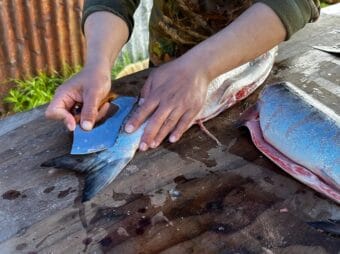
Gilbert Huntington cuts sheefish into strips in mid-June. (Photo by Olivia Ebertz for Northern Journal)

Those factory vessels catch huge numbers of pollock, a flaky whitefish that’s made into fish sticks and sandwiches.

But the ships also accidentally scoop up chinook and chum salmon as “bycatch” in their large commercial nets. Chinook bycatch limits are set by the North Pacific Fisheries Management Council, a federal commission that requires observers to record each salmon killed by trawlers at sea.

Huntington says bycatch is being prioritized over human life. Like other residents, he connects fishery closures in the 1980s to increases in suicides along the river at the time, as residents were disconnected from traditions, culture, and meaningful work.

“We’re killing people. Just so we can have some imitation crab,” Huntington says, referring to one of the products made from pollock. “I don’t care how many billions of dollars anybody’s gonna make. If it causes one person to lose their life, forget it.”

The pollock industry markets itself as sustainably managed, for both pollock and salmon. Between 2017 and 2022, chinook bycatch in pollock nets averaged some 20,000 fish per year, under the federal limit of 33,318 kings. Genetic testing indicates that between 1% and 2% originate in the middle and upper Yukon, while fish born in coastal Western Alaska rivers — which includes the lower Yukon and other areas — varies from less than 9% to over 50% depending on the year.

Bering Sea trawlers have substantially reduced their chinook bycatch numbers in the past few years, said Eric Deakin, chief executive at Coastal Villages Region Fund, a Community Development Quota group that includes pollock fishing in its portfolio.

Established in 1996, CDQ groups like Deakin’s are nonprofit corporations that were granted shares of each Bering Sea fishery to support economic development and other programs in Native communities within 50 miles of the Western Alaska coast. That means some of the Yukon River residents who criticize the trawl industry live in communities that benefit from its profits — and it means that Deakin’s organization is especially sensitive to those complaints.

If salmon start showing up their nets, he said, trawlers now leave the area — an expensive decision that can cost vessels more than $100,000, he added.

It’s not just for optics, he said. “As far as CDQs go, we want to see as many fish get back to the river so future generations are stronger”

The almost 3 billion pounds of pollock harvested each year is, by weight, the largest fishery in North America.

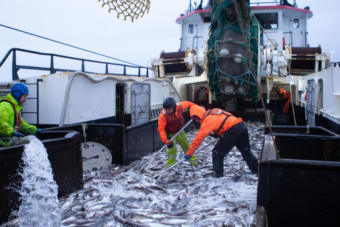
Crew members shovel pollock on the deck of a Bering Sea trawler last year. (Nathaniel Herz/Alaska’s Energy Desk)
Crew members shovel pollock aboard a Bering Sea trawler during a fishing trip in 2019. (Photo by Nathaniel Herz/Alaska Public Media)

But the very scale of the trawler fleet might feed back into the ocean’s broader warming problem. A 2021 study by U.S. and Canadian researchers contends that the drop in fish biomass caused by industrial fishing worldwide has reduced the ocean’s ability to store carbon. And it says the impact is most acute in cold-water ecosystems like the Bering Sea.

Potts-Joseph, in Eagle Village, says climate change makes it even more important to “do something about bycatch,” as it’s an issue that can be addressed quickly. Like many Yukon residents, she thinks it is now imperative that every chinook possible survive to spawn — meaning any fish caught in the river or at sea is one too many. It’s a sentiment widely shared along the river, where Indigenous fishers note that even a low bycatch year — like 2023, with fewer than 12,000 chinook reported killed at sea — was more than Canadian First Nations have caught for subsistence any year in the past 20.

Deakin says the focus on bycatch is because “it’s a lever to pull.”

“The climate change lever is a lot harder to pull,” he says. But he warns that the pollock fleet harvests so few Yukon-bound salmon that even a complete closure wouldn’t allow Yukoners to start fishing — while it would destroy jobs and other programs that CDQ groups like his fund in Western Alaska.

“In terms of upriver, I don’t know what to tell them,” Deakin says. “If we caught one fish and that was it, would they still like us to shut down because they can’t catch one?”

Deakin argues that the real threat to Yukon salmon comes from intercept fisheries and the billions of hatchery fish that Russia, Japan and the U.S. release into the sea. Along the river, residents share concerns about the impact of intercept fisheries and hatcheries, as well as bycatch.

Basil Larson, a fisher and dog musher in the village of Russian Mission, notes how many years Native communities have been barred from fishing, while the trawlers continue. “We’ve been doing it, so it’s their turn to try to do it,” he says, referring to fisheries closures. Larson says he gets frustrated when state managers point to climate change as the main cause of salmon decrease. “I guess [they] try to deflect attention away from where attention has to be,” he says, “the wanton waste with the commercial industry.”

In the middle river village of Kaltag, where the population has shrunk by one-fourth over the last two censuses, Justin Esmailka also attributes the low salmon runs to the big businesses at sea.

“The greed of the people out there in the ocean is killing our way of life,” he says.

Cutting summer chum salmon in the village of Emmonak, near the Yukon’s mouth, during a brief open period for subsistence harvesting in June 2023. (Photo by Bathsheba Demuth for Northern Journal)

Vincent-Lang, the fish and game commissioner, is expected to debut the new draft agreement to river residents at a town hall-style listening session Tuesday in Fairbanks. But he has made it clear he intends to come to the next Yukon River Panel meeting, in April, with the agreement signed by both sides.

“It sounds like it’s a done deal already. It sounded like they just wanted to let everybody know,” said Fitka, the nonprofit director.

Though the draft agreement allows for salmon fishing for certain cultural exceptions, Woods, the advocate in the village of Rampart, says culture does not occur only at funerals or at potlatches. It’s a summer spent at fish camp, cutting hundreds of fish to put away for elders who can no longer harvest their own. It’s pulling dry fish from the freezer to take on a winter moose hunt. It’s daily life.

“Our kids, they need to grow up with the taste of salmon and to be out on the land and water with their family,” Woods said. “We need the mental, physical, spiritual and cultural benefits of salmon.”

Olivia Ebertz is a public radio reporter and freelance writer. Reach her at oliviaebertz@gmail.com. Bathsheba Demuth is a writer and environmental historian, and an associate professor at Brown University. Reach her at bathsheba.demuth@gmail.com. 

This article was originally published in Northern Journal, a newsletter from Nathaniel Herz. Subscribe at this link.

Bill backed by Southeast communities would tighten hunting and fishing residency requirements

Rep. Rebecca Himschoot, I-Sitka, right, sits before the House Resources Committee alongside Alaska Department of Fish and Game Commissioner Doug Vincent-Lang, second from right, on Jan. 24, 2024. (Eric Stone/Alaska Public Media)

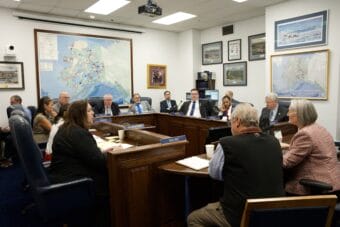
Lawmakers are considering a measure that would tighten residency requirements for Alaska hunting and fishing licenses. Backers of the measure say it would close a loophole that makes it difficult for state wildlife troopers to prosecute nonresidents who obtain the cheaper resident licenses.

Currently, to obtain a resident license, an applicant has to live in Alaska for at least 12 consecutive months. They then remain a resident as long as they maintain a home in the state, intend to return and don’t claim residency elsewhere. Rep. Rebecca Himschoot, I-Sitka, pitched the proposal to the House Resources Committee on Wednesday.

“They could come for as short as a few weeks. They could keep a boat on a trailer somewhere in the state, use that boat to live on for a few weeks, and hunt and fish as much as they would like as residents,” Himschoot said.

The deputy director of Alaska Wildlife Troopers, Maj. Aaron Frenzel, told the committee that the current residency requirements make it difficult to prosecute people suspected of illegally obtaining resident licenses.
The bill, House Bill 201, sponsored by Himschoot and Rep. Sara Hannan, D-Juneau, would restrict resident licenses to people who are eligible for a Permanent Fund dividend. To qualify, you have to spend at least six months in the state every year, subject to exceptions for military service, college students, and so on.

Himschoot said the idea for the bill came from constituents on Prince of Wales Island. Several local fish and game advisory committees and local governments in Southeast Alaska submitted letters of support.

Rep. Kevin McCabe, R-Big Lake, said he was concerned the bill could exclude some Alaskans who leave the state for more than six months a year.

“I intend to remain an Alaska resident till I die,” McCabe said. “However, I also intend to get a motorhome, maybe after I fully retire, drive around the Lower 48 and see some things for the wintertime so I don’t have to shovel piles of snow. And I would likely be out of state for more than 180 days. This would seem to exclude me from my home state, the state where I intend to remain, from fishing and hunting and that sort of stuff.”

Himschoot replied that the bill is meant to protect fish and wildlife for people who rely on them.

“The resources needed by the people who are living here year round have a very high value, and the cost of living here is very high,” she said. “If somebody is choosing to live and work out of state, that’s a choice they’re making.”

During public testimony on Friday, the vast majority of commenters — including a large number of Prince of Wales Island residents — asked lawmakers to pass the bill.

The bill remains pending in the House Resources Committee. A similar bill has yet to receive a hearing in the Alaska Senate.

Tribal groups applaud Alaska Native appointments to federal fisheries advisory panel

Crew members shovel pollock on the deck of a Bering Sea trawler last year. (Nathaniel Herz/Alaska’s Energy Desk)
Crew members shovel pollock onboard a trawler on the Bering Sea in 2019. (Nat Herz/Alaska Public Media)

Amid alarmingly low salmon returns in Western Alaska, calls have grown for tribes to have a greater say in the way fisheries are managed. Many say that the recent appointment of three Alaska Native members to the panel tasked with advising the top regional federal fisheries council could be a step in the right direction.
A recent press release from the Arctic-Yukon-Kuskokwim Tribal Consortium, representing 98 tribes directly impacted by salmon crashes in Western Alaska rivers, said that it was encouraging to see more Alaska Native faces than ever before on the North Pacific Fishery Management Council’s Advisory Panel. But it also called out the council for having a “voting majority with an economic interest in the trawl fleet,” as well as a total lack of Alaska Native representation.

“It’s something that we’ve been fighting for and asking for for many years. The fight for Alaska Native subsistence rights is getting a lot of attention right now because things are crashing,” said Eva Dawn Burk, who was recently appointed to a three-year term on the advisory panel, holding its first-ever designated Alaska Native seat.

“I sit on at least four Alaska Native advisory councils, and it’s like, yeah, I’m an advisor, but I don’t have decision-making power,” Burk said.

Burk is Dene’ Athabascan, from Nenana and Manley Hot Springs, and currently holds advisory positions with both the Alaska Department of Fish and Game and the Federal Subsistence Board. She has also spearheaded multiple educational projects in her region aimed at preserving traditional knowledge and ensuring food security.

“It kinda was naturally like this is the next thing to kind of bring all those perspectives together,” Burk said.

The first appointee to the tribal seat now occupied by Burk was Shawaan Jackson-Gamble, who is Lingít and Haida from Kake. He resigned the seat just months after being selected amid sexual assault charges stemming from a 2019 incident in Washington state.

Not all of the current Alaska Native members of the advisory panel are fresh faces. Mellisa Johnson has served on the panel since 2020 and was reappointed for a three-year term in December 2023. She is Iñupiaq and a member of the Nome Eskimo Community. In 2023, she was passed over by Gov. Mike Dunleavy for a voting seat on the 11-member council she currently advises.

The third Alaska Native appointee is newcomer Tiffany Andrew, assigned a one-year term. She is a Yup’ik tribal council member of the lower Yukon River village of Alakanuk, and handles government affairs for the Yukon Delta Fisheries Development Association, a non-profit corporation with a vested interest in the Bering Sea pollock fishery.

This is thanks to a long-standing federal community development quota program aimed at boosting the economic and social prospects of Western Alaska communities. The program allocates a percentage of the allowable commercial catch of various federally managed fisheries to non-profit corporations like Andrew’s.

According to her resume, Andrew is a lifelong subsistence harvester, growing up fishing for salmon on a river that in recent years has been nearly completely closed to salmon fishing. But she also represents a CDQ group with proven results stimulating the region’s economy, largely thanks to its stake in a pollock fishery accused of fueling the salmon crisis. She said that bringing together different points of view is critical.

“There’s too much subsistence needs not being met, and CDQ issues going on as well that we all need to see from all perspectives,” Andrew said.

Paralytic shellfish poisoning toxin is high in some subsistence harvests, according to Knik Tribe’s data

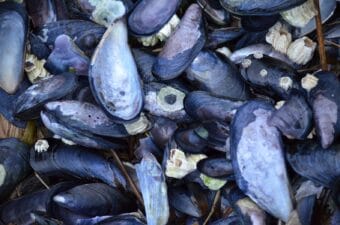
Blue mussels. Mussels and other shellfish were tested for the Paralytic Shellfish Poisoning toxin this year by the Knik tribe. (Credit Photo by Kathy Kartchner)

High levels of the toxin that causes paralytic shellfish poisoning showed up in samples of shellfish last year from the Aleutian Islands, according to an analysis by the Knik Tribe.

The Southcentral Alaska tribe’s scientists looked at shellfish samples from Sand Point collected in 2023, and some showed levels of the biotoxin almost 50 times higher than the U.S. Food and Drug Administration’s recommended limit. The Knik Tribe’s analysis of samples from Juneau, Kodiak, King Cove and Chignik Lagoon also showed some had levels of PSP toxin higher than the FDA’s cutoff.

The shellfish samples included clams, mussels, crab and cockles.

The toxin comes from algae and can collect in shellfish and the fish that eat them. If humans eat shellfish with high levels of the toxin, they can get sick. At its worst, PSP can cause partial or full paralysis and lead to death.

Though its traditional territory is not near abundant shellfish, the Knik Tribe tests samples that Alaskans send in from all over the state through its grant-funded program.

Not all of the state is at the same risk for PSP, said Bruce Wright, the Knik Tribe’s chief scientist. I’s especially a concern in places with relatively warmer water, he said.

“Right now the area that seems to be most affected is from Juneau to Unalaska,” Wright said. “Further out the Aleutians, the levels seem to be pretty low. It’s a different oceanography out there. Water temperatures are usually colder out there. And then up north, we’re starting to see more PSP activity.”

The tribe is working with public health officials in Nome to measure toxin levels in crabs, as well, Wright said.

Commercial fisheries also test shellfish for the toxin, he said, but there’s always some risk if people eat a subsistence harvest of shellfish.

“The best we can do is, you go out and you collect your clams, take them out of the ocean, throw them in the refrigerator or the freezer and contact us at Knik Tribe and get us a sample, and we’ll test them,” Wright said. “And then we’ll tell you what we think the risk factor is of eating that harvest.”

It’s important to test individual harvests, and the tribe does that for free for Alaskans, Wright said. Shellfish harvests even a quarter-mile away from each other might have very different levels of the PSP toxin, he said. And, Wright said, even if you see people eating shellfish from a beach, that doesn’t mean it’s safe.

“There’s a lot of wives’ tales out there that people use, one being that if you eat clams during the months with an R in them, because those are the colder months, that the clams will be safe to eat,” he said. “But that’s not the case. And that’s especially not true with butter clams. Once butter claims become toxic, they can maintain their toxicity for well over a year.”

Alaskans who want to test their subsistence harvests of shellfish can contact the Knik Tribe. You can also request data from the tribe about the harvests already tested.

State’s high court rules against Sitka Tribe of Alaska’s herring claim

Herring eggs. (Katherine Rose/KCAW)

After over a year of consideration, the Alaska Supreme Court has sided with the state in a lawsuit over the management of the Sac Roe Herring fishery in Sitka. The five-justice panel upheld a 2021 ruling by a Superior Court judge who denied a claim by the Sitka Tribe of Alaska that Department of Fish & Game managers had violated the state constitution.

The Sitka Tribe of Alaska first sued the state in 2018, alleging that the commercial fishery management put herring stocks and traditional harvesting in jeopardy. After winning on statutory and regulatory claims, the Tribe argued that the Alaska Department of Fish and Game had a constitutional obligation to provide the “best available information” which it failed to do when it did not provide an independent scientific report to the Alaska Board of Fisheries. The report recommended a number of improvements for the method the department uses to estimate fish in Sitka Sound. The state countered that the report was highly technical and would not have been directly relevant for the Board of Fish in its decision making.
In 2021, Juneau Superior Court Judge Daniel Schally determined that the state hadn’t broken any constitutional rules by not providing the report, as there was no requirement in the “sustained yield clause” of the state’s constitution for the state to provide the “best available information.” The Tribe appealed the decision before the Supreme Court in December of 2022.

In a 23-page opinion issued on Dec. 29, the Court upheld Judge Schally’s decision to deny Sitka Tribe of Alaska’s constitutional claim. Law already requires agencies to provide all “relevant information” in resource management issues, and by not releasing the report to the Board of Fish, the Court said the Department of Fish and Game was exercising its own discretion.  The Court also denied Sitka Tribe of Alaska’s request for a preliminary injunction under the “public interest,” and upheld Judge Schally’s decision to deny the Tribe’s attorney fees for its earlier claims. The Court determined that neither the state nor the Tribe had “bested” the other since both achieved victories in the case. Determining the prevailing party in a case, the Supreme Court wrote, is at the Court’s discretion.

In a press release, Tribal Council Chair Lawrence “Woody” Widmark responded to the ruling, saying, “While we are disappointed that the Supreme Court did not agree that the Alaska Constitution requires the state to use the best available information in fisheries management, the Tribe’s litigation still resulted in substantial improvements in management of the commercial sac roe herring fishery in Sitka Sound.”

“And while we will not receive attorney fees, we do not regret using our resources to defend the Tribe’s sovereignty over natural resources in our traditional territory,” he continued. “Our people have stewarded and protected the yaaw (herring) since time immemorial, and we will continue to do so.”

In a press release from the Alaska Department of Law, Attorney General Treg Taylor applauded the Court’s decision, “supporting the Department of Fish and Game’s work to provide the Alaska Board of Fisheries with guidance that is helpful and well-grounded in science, so that our fisheries will continue to produce for generations to come.”

And ADF&G commissioner Doug Vincent Lang wrote that the department takes its constitutional mandate to manage ‘consistent with sustained yield principle’ as its cornerstone. “It’s refreshing to see the courts recognize us for those efforts,” Vincent-Lang said.

Alaska’s newest Supreme Court Justice Jude Pate, who is from Sitka and is a former public defender and tribal attorney, was not on the court when the case was argued a year ago.

Western Arctic Caribou Herd population decline continues

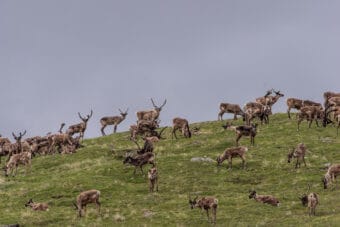
A group of Western Arctic Herd caribou pause in front of mountains in Kobuk Valley National Park during fall migration in 2016. The Western Arctic herd, one of the largest in the world, has been in decline for the past two decades. The 2023 census shows that the decline is continuing. The population is now only about a third of what it was in 2003. (Photo by Kyle Joly/National Park Service)

The caribou herd that used to be the largest in Alaska and, at times, the largest in North America has continued to shrink, fitting an Arctic-wide pattern that scientists have linked at least in part to climate change.

The Western Arctic Caribou Herd population now stands at 152,000, down from 164,000 last year, according to the most recent survey conducted by the Alaska Department of Fish and Game and its partners.

The herd’s population numbers and trends were detailed last week at the annual meeting of the Western Arctic Caribou Herd Working Group, an advisory organization representing village residents and hunting and conservation organizations.

The herd, which roams over a vast territory that ranges from the North Slope and Chukchi Sea coast to Interior Alaska, has long been a source of food and culture in many Indigenous communities. That makes its welfare an issue of food security and cultural preservation in some areas.

This year’s count, calculated through photographic records, represents a continued downward trend since 2017, when the herd size was estimated at 259,000.

“Within that short timeframe, we’ve lost 100,000 caribou within this population, which is significant,” Alex Hansen, Fish and Game’s Kotzebue-based biologist who monitors the herd, told the working group last Wednesday during the Anchorage meeting.

The Western Arctic herd size peaked at 490,000 in 2003. Over the past half-century, its size has veered between extremes, nosediving from 242,000 in 1970 to 75,000 in 1976 before rebounding after strict hunting rules were put in place.

Hunting has also been sharply restricted in recent years, and the working group endorsed continued limits.

Caribou herd forage in 2019 on vegetation at the ledge of a hill adjacent to the Hulahula River in the Arctic National Wildlife Refuge. The Porcupine herd may now be the largest in Alaska. (Photo by Alexis Bonogofsky/U.S. Fish and Wildlife Service)

It is not just the number of caribou hunted that’s important to the herd’s potential recovery, Hansen stressed in his presentation. It is also important to avoid taking females out of the population, he said.

“One cow has a lot of potential to produce more caribou,” he said. The message in his PowerPoint presentation was boiled down to a succinct phrase: “Let cows live.”

But Hansen acknowledged that there are reasons that some hunters might prefer to target cows during their harvests, which tend to be in autumn, when the bulls are hormonally charged and geared toward mating.

“Cows are fat. They’re better to eat. Nobody wants to eat a rutty bull,” he said.

Working group members said they believe tools exist to help turn around the decline.

“By slowing down the decline now, hopefully it won’t bottom out at the low level that it did in 1976,” said Charles Lean, a working group member from Nome.

Within the total population estimates, there are other trends.

For adult females, survival rates are lower than the long-term average. However, the rate of birth of new calves is a bit above the long-term average.

Migration patterns have changed significantly over recent years, Kyle Joly, a National Park Service biologist who studies the herd, said in a presentation to the working group.

Caribou in the herd are generally staying farther north in the fall and winter, according to monitoring conducted by radio collar signals. A much smaller percentage of collared animals even venture south far enough to cross the Kobuk River, a site that used to be a regular transit point during the fall migration, the data shows. Among those that do cross the river, the season’s first crossings are now a month later than they were 10 years ago, he said.

Herds declining across North America

The Western Arctic herd’s decline is part of a wider pattern.

Caribou herds across North America have been shrinking, as are wild reindeer herds in Arctic Eurasia. Scientists say climate change and industrial development are factors adding to what are the normal wide swings in population. Climate change adds risks like increased rain-on-snow events, which makes travel and food foraging difficult, and is replacing low-lying lichen and other vegetation that caribou eat with woody shrubs. Meanwhile, industrial development is fragmenting habitat, creating roads and other infrastructure that have become impediments to caribou movement.

Some of the most extreme caribou herd crashes have been in Canada.

The George River Caribou Herd, which ranges in land in Quebec and Labrador, was about 800,000 animals in the 1990s but is now down to only 7,200 as of last year. It was once the world’s largest herd.

The Bathurst Caribou Herd in Canada’s Northwest Territories declined from 186,000 in 2003 to 6,240 in 2021, according to the territorial government. Some Canadian herds have already been declared extinct, and several are classified by the government there as at risk.

Along with the Western Arctic herd, other major Alaska herds have declined, as Joly pointed out in a presentation to the Western Arctic Caribou Herd Working Group.

The Fortymile herd in eastern Interior Alaska has declined by over 50% in six years; the Nelchina herd, also in eastern Interior Alaska, has dropped by over 80% in four years; and the Mulchatna herd in Western Alaska is down by 98% from its 1990s size, according to his presentation.

With declines in the Western Arctic and other herds, that leaves the Porcupine Caribou Herd as potentially the largest in North America. The Porcupine herd ranges between northeastern Alaska and neighboring parts of Canada, and it is known for using the narrow Arctic National Refuge coastal plain for annual calving.

However, recent figures for the Porcupine herd are not available. The last official photo census, which put the population estimate at over 218,000, was in 2017.

Like the Porcupine herd, two other North Slope herds appear to have bucked the decline trend.

The Central Arctic Caribou Herd, which has fluctuated widely in its size over the years, peaked in 2010 at 68,000 animals, then shrank to 23,000 in 2016 before increasing to over 34,000 by 2022, according to the Alaska Department of Fish and Game. The Teshekpuk Caribou Herd, which spends the entire year on the North Slope, The Teshekpuk Caribou herd grew from 40,000 in 2011 to 61,500 as of 2022, according to the Alaska Department of Fish and Game and the U.S. Bureau of Land Management.

This story originally appeared in the Alaska Beacon and is republished here with permission.

Site notifications
Update notification options
Subscribe to notifications