Subsistence

Filming of reality show near Petersburg could interfere with subsistence hunting

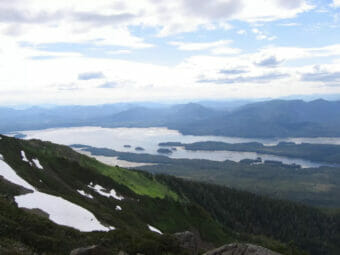
Little Duncan Bay and Duncan Canal as seen from Portage Mountain west of Petersburg. (Photo by KFSK)

“Outlast” is a survival show where contestants are dropped into the Alaskan wilderness to compete for a cash prize — it’s kind of a Hunger Games for adults. It’s only had one season so far, filmed on Chichagof Island, and the competition was cutthroat. Acts of sabotage were commonplace between contestants — including, infamously, setting rival campsites on fire.

The U.S. Forest Service authorized Netflix and the BBC to shoot the second season of Outlast in Little Duncan Bay, a popular fishing, hunting, and recreation area about 20 miles southeast of Petersburg.

Ray Born is Petersburg’s District Ranger. He said a few charter pilots, boat captains, caterers, and Borough officials told him that this would be an economic boon for Petersburg.

“They’re bringing in about a million dollars into the community for this project,” said Born. “So, there’s economic value that way, as we look at it. And part of our mission is to help take care of the community.”

But not everybody in the community is happy — least of all, subsistence users.

“[It] seems misguided,” said Lee Gilpin, a Petersburg subsistence hunter. “There’s going to be some grumpiness.”

Gilpin was speaking from the exact location Outlast is set to take place. He was out hunting moose in late September and saw the film crew staking out the coast. He said he’s not thrilled about them setting up shop right in the middle of the Sitka blacktail season. He said it’s a high traffic hunting spot — especially for local kids.

“My daughter grew up hunting in this area,” said Gilpin. “Every deer she’s ever killed has been inside the area that’s being discussed here. She’s not the only one. There’s a lot of kids in Petersburg that this is where they get to go deer hunting for the first time because the access is very, very easy.”

The federal government usually prioritizes the interests of subsistence users over commercial in rural areas — but not in this case.

In its decision memo, the Forest Service said the filming will affect access to subsistence resources within the proposed area. But the scale of the impact on subsistence is not significant within the overall traditional use area.

Bob Lynn sits on the Petersburg Borough Assembly, and his house overlooks Little Duncan. For weeks, he’s watched the film crew’s charter boats and planes come and go from the area. At an assembly meeting in late September, he said he was concerned for local hunters — and for the safety of the contestants.

“I can see a conflict really quick here, where somebody gets shot — not intentionally, but it could happen,” said Lynn. “I think you might want to take a look at a different time of the year. I think we’re asking for some problems we don’t need.”

Bret Uppencamp oversees special use permits for the Petersburg Ranger District. He said the Outlast crew has to follow a long list of rules to use the area.

“Essentially, like, if they can cut trees down, or if they can have fires, how they’re going to dispose of human waste,” said Uppencamp. “And for wildlife interactions, like — they need to ensure they’re not overly harassing wildlife.”

Uppencamp said those federal stipulations amount to basic “leave no trace” principles, but there’s not much on the list that specifically pertains to safety.

The Forest Service opened up a week-long comment period to gather feedback on the permit. They notified about 450 interested parties on an email chain, and addressed Petersburg’s Borough Assembly and the local tribe, Petersburg Indian Association. About 50 people responded, and feedback was fairly mixed.

Subsistence users weren’t the only ones taking issue with the project. One commenter noted that the area is sacred to Indigenous people. Uppencamp said the district is looking into this claim, but he and Ranger Born believe the filming activities won’t compromise the physical integrity of the site.

Altogether, Born said it was a tough call to make — but the land doesn’t just belong to Petersburg locals.

“This is a relatively high-use area,” said Born. “A lot of people do go through there, but it’s not a closed area. Forest Service land belongs to all the American people. So, everybody has the right to be in there.”

Gilpin said it all feels a little exploitative — and that even if the Outlast crew “leaves no trace” on the land, they’ll leave behind a lost season.

“If you’re growing up […] in Petersburg, you have one season of deer hunting that you can’t get to during high school,” said Gilpin. “That’s a quarter of your easy access hunting area, gone. A quarter of the time you can hunt has been put away so somebody could make a few dollars.”

And it’s not the first go around Petersburg residents have had with reality TV shows in their backyard. In recent years, some have opposed the Discovery series, Alaskan Bush People, which they say casts the region in a negative light.

The Outlast cast and crew will film around Little Duncan until mid-November. By that time, one determined contestant will have won their million dollar prize — but some locals will have missed their chance to get a prize buck.

A year after Typhoon Merbok, some coastal Alaskans struggle to find beloved subsistence foods

Kavlakuaraq, also known as black berries or crowberries, are noticeably absent from the tundra that surrounds Chevak and Hooper Bay. Many residents believe salty flood waters from Typhoon Merbok’s storm surge and a cold, rainy summer have kept the plants from producing the berries, which are normally plentiful. (Emily Schwing/KYUK)

In Hooper Bay and Chevak, kavlakuaraq, also known as blackberries or crowberries, are missing from the tundra.

“Uh, there’s almost next to nothing,” said Victoria Hill, who works for the Hooper Bay Tribal Council. My dad said he went out there towards back of town and there was maybe scattered all over. Not like a carpet like it used to be; they were just scattered. You had to go far.”

A massive storm in 2022 brought flood waters to this part of Alaska, and the tundra was inundated with salt water for days. Add to that a cold and rainy summer, and Roy Bell said that it’s the perfect recipe for a blackberry crash.
“I noticed that the areas where they flooded, some of the plants, many, like the medicines and the berries, they’ve all gotten bad,” Bell said. And he said that it’s not just the crowberries. Lowbush cranberries are also missing, and many of the medicinal plants he uses don’t look healthy.

“It’s probably the salt water,” Bell said.

In Hooper Bay, Bell’s family and friends in Hooper Bay call him “the botanist.”

When he was very young, his parents and elders discovered that Bell had a knack for understanding and identifying the plants.

“I’m one of the last generations that took that talent test with the Elders, and my talent was the plants,” Bell said.

Now in his fifties, Bell has spent his whole life studying the land and plants that blanket the tundra along Alaska’s Bering Sea coast.

“No mechanics, no boats, no nothing. Just land and plants,” Bell said.

This area has flooded before, but Bell said that previous floods haven’t had nearly the impact on local foods. It’s not just the plants that haven’t returned this year.

“It’s either foxes, or the owls, or the hawks,” Bell said.

Lots of residents are also reporting fewer birds of prey and predators on the landscape. And that may be because those animals haven’t been able to find their own food: mice.

Much of the low lying land that stretches nearly 20 miles from Hooper Bay inland to Chevak was flooded: a catastrophic scenario for a mouse. The tiny rodents store up plant roots for the winter months. Locally it’s called mouse food, and it’s a delicacy out here in Cup’ik country. Mark Ulroan in Chevak said that it’s his favorite.

Chevak’s Mark Ulroan has been adding mouse food to his seal soup all his life. His father taught him how to find winter caches built by mice on the tundra when he was a kid. This year, he says he hasn’t been able to gather any mouse food at all. (Emily Schwing/KYUK)

“They’re called teardrops. We call them utngungssaq and then those long roots, we call it marallaq. So those are the two main ones that we get every year for ingredients, like if we cook our seal soup. At the end of it, we add those.”

Ulroan said that they taste both sweet and nutty and they have a good crunch. But this year he wasn’t able to find any.

“No, nothing. Zero.” Ulroan said. “ I don’t know if there’s gonna be any mouse out there because all that Merbok just drive ‘em up to the high ground, I guess, or kill ‘em.”

Some people haven’t been able to get out on the water since the storm.

Stella Lake lives in a house that overlooks the Ninglikfak River in Chevak. All summer and into fall, she has watched friends and neighbors head out to go catch fish and hunt seal. Her boat motor was submerged in floodwaters for three days after last year’s storm, and efforts to repair it haven’t been successful.

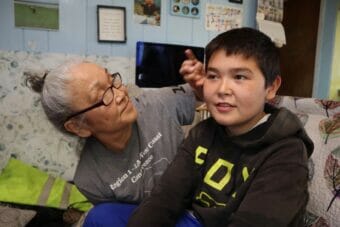
Stella Lake and her son, Kade, who is 12, lament this summer season. Lake’s boat motor was damaged after it was submerged in flood waters following Typhoon Merbok. The motor still isn’t fixed and her family has not been able to fish, hunt for seal or moose, or head for their warm season camp on the Ninglikfak River this year. (Emily Schwing/KYUK)

“Here’s a season where boats go for and everybody’s excited to go, like berry picking season, moose hunting season. And I watch the boats. I can see the river here,” Lake said, pointing to her kitchen window. “It gets me emotional. We can’t go. My baby, he loves hunting, and he breaks my heart to listen to him, man. Why can’t we go?”

Lake’s son, 12-year-old Kade, sat next to her on a cozy couch, looking toward the window. “We don’t get to go to our fish camp, or seal hunting, or go to camps, or get eggs, or pick berries, or go moose hunting. We can’t do all of that because our motor’s not fixed,” he said.

Kade said that being out on the land is his favorite thing to do.

This reporting was supported by a grant from the Center for Rural Strategies and from the nonprofit media organization Grist.

Yukon River salmon runs remain low, but chum improvements allow for some fishing

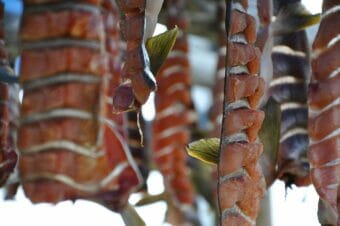
Strips of dried salmon are seen on June 25, 2009. Chum salmon runs on the Yukon River improved enough this year to allow some subsistence harvesting in Alaska, but chinook returns did not show a similar improvement. Returns of Canada-origin fish were particularly weak. (Photo by A.R.Nanouk/U.S. Fish and WIldlife Service)

Salmon runs on the Yukon River continued to be anemic this year, federal and state agencies reported, and there are far too few fish reaching Canada to meet goals set in a treaty between that nation and the United States.

The ongoing fall chum salmon run is the fifth lowest on record for the nearly 2,000-mile river, and the coho run has turned out to be the second lowest on record, the Alaska Department of Fish and Game reported on Tuesday.

There are enough fall chum salmon to allow subsistence fishing in one upriver area, the department reported: the Teedriinjik River, also known as the Chandalar River, a Yukon tributary. A subsistence harvest opened there in mid-September.

However, all other areas of the upper Yukon River basin, whether in Alaska or Canada, remain completely closed to chum or coho salmon fishing, the department said.

The Yukon River’s fall chum run followed a summer run that, though low, was substantially better than those of the past two years, according to a report issued jointly by the state Department of Fish and Game and the U.S. Fish and Wildlife Service.

The summer chum run, as measured by sonar at Pilot Station near the Yukon River’s mouth, was about 846,000 fish, within the range of the preseason forecast and within the goals for “escapement,” the term used to describe salmon returns to spawning grounds, said the report, issued Sept. 30. It was enough to allow for some subsistence harvest in Alaska this summer, and it was a marked improvement from the record-low 153,497 summer chum salmon counted at Pilot Station in 2021 and nearly twice the 463,806 summer chum counted there in 2022.

Chum salmon, one of Alaska’s five salmon species, return to spawning rivers in two general pulses categoried as summer and fall runs.

Unlike chum, chinook salmon failed to show significant improvement this year in the Yukon River, according to the joint state-federal report.

Only 58,500 chinook salmon were counted by sonar passing through the river at Pilot Station, just above last year’s record-low count of 48,439 Chinook according to the joint state-federal report. That is only about a third of the recent 10-year average for Yukon River chinook.

A section of the upper Yukon River flowing through the Yukon-Charley Rivers National Preserve is seen on Sept. 10, 2012. The river flows through Alaska into Canada. A U.S.-Canada treaty aims to ensure that Alaskans and Canadians have enough Yukon River salmon to meet their needs. (Photo provided by National Park Service)

Of those chinook swimming through the river, only about 15,300 Canada-origin fish made it through the sonar station at Eagle, near the Canadian border, the report said. That is only about a third of the escapement goal, the report said.

As has been the case in past years, chinook and chum returns failed to meet targets under the U.S.-Canada Yukon River Salmon Agreement, an annex to the Pacific Salmon Treaty.

There are several potential causes of the Yukon River salmon problems, according to biologists.

Chum returns, both in summer and fall, were about normal until recently, said Christy Gleason, a Fish and Game area biologist for the Yukon River region.

“Then in 2020, something happened in the North Pacific and all the stocks on the Yukon River crashed,” Gleason said.

Along with ocean problems, there seem to be changes in the upriver spawning areas that are particularly harmful to fish originating in Canada, she said. “The last couple of years, we’ve seen poor run strength of the Canadian stocks,” she said.

She pointed to an incident in 2016 in which rapid retreat of a Yukon Territory glacier abruptly changed the course of a river. That incident, which scientists refer to as a case of “river piracy,” has caused some of the sloughs where chum salmon typically spawn to run dry, she said.

For chinook, there are concerns that a parasitic disease is killing fish before they reach their upriver spawning locations. Government agencies and other entities have been investigating the level of infections caused by the parasite Ichthyophonus. Salmon acquire the parasite from prey eaten in the ocean, and severity of infections during river migrations increases with higher water temperatures, according to the Department of Fish and Game.

There are also concerns that too many Yukon River salmon are being intercepted at sea by large fishing vessels harvesting pollock and other species. That interception is known as bycatch. At its just-concluded October meeting, the federal North Pacific Fishery Management Council approved an analysis of potential rule changes aimed at limited chum salmon bycatch in the Bering Sea pollock harvests.

This story originally appeared in the Alaska Beacon and is republished here with permission.

A young leader fights for Yukon River salmon, her community — and herself

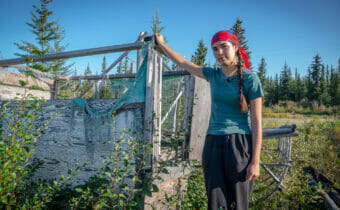
Kenzie Englishoe stands by an idle fish wheel once used by her community in Gwichyaa Zhee on Aug. 31, 2023. (Matt Faubion/Alaska Public Media)

In August, MacKenzie Englishoe returned home to a place she’s never actually lived.

Englishoe is 20 years old, a student at the University of Alaska Fairbanks. As summer waned, she packed her bags and boarded a nine-passenger plane for the hour-long flight to her mother’s hometown: Gwichyaa Zhee, also known as Fort Yukon, a village of less than 500 people on the upper Yukon River. The plan is to move here permanently.

“I feel like I’ve been waiting my whole life to come back here and be in my community,” Englishoe said.

For Englishoe, this move has been a long time coming. Her mother’s family has lived in Gwichyaa Zhee for generations, but Englishoe herself grew up with her dad and brother near Chandalar Lake, in a remote stretch of the Brooks Range. She moved to Fairbanks when she was 12 to attend school. But she visited regularly. Gwichyaa Zhee is where she feels most rooted.

Like most of the village, Englishoe is Gwich’in. She grew up deeply connected to the land up at her father’s cabin near Chandalar Lake, trapping and hunting from a young age. But she feels like she missed out on being in the village, among her people.

“I just wish I had a little bit more of a stronger connection to [Gwichyaa Zhee] when I was younger,” she said.

Now that she’s back, she’s making up for lost time.

Gwichyaa Zhee sits on a flat network of dirt roads that hug the Yukon River. The speed limit is 15 miles per hour, and most people greet each other as they pass.

“Everybody here waves to each other,” Englishoe said, driving through town the day after she arrived. “We’re pretty much all family here.”

Running errands, she runs into relatives and elders: at the local AC store, the post office and during open house at the school.

“I’m back for good,” she told each one with pride.

The town of Gwichyaa Zhee. (Matt Faubion/Alaska Public Media)

But Gwichyaa Zhee today is very different from the village she remembers visiting as a kid.

Life here used to revolve around salmon. The first kings would arrive in late June, swimming up the Yukon River from the Bering Sea to their spawning grounds. Chum salmon would follow in late summer. Both species had struggled for decades. But four years ago, the runs abruptly collapsed, with fewer fish than ever returning to the Yukon River. State and federal fishery managers have all but shut down fishing for communities like Gwichyaa Zhee ever since.

Researchers say climate change is driving the collapse, as warmer river and ocean water temperatures wreak havoc with the salmon’s biology and prey species. Residents say it’s made life here unrecognizable. For Englishoe, it means she can’t participate in the very culture and traditions she came home to learn.

Along the bank of the Yukon River, at the edge of town, it’s quiet. That’s not what August used to feel like, Englishoe said.

“Everyone would be hopping on boats to go to fish camp or visiting each other, or giving fish to each other, smoking fish together,” she said.

Now, on the riverbank, half a dozen fish wheels lie idle, in what Englishoe calls the “fish wheel graveyard.”

Twenty feet across, the fish wheels look like big windmills, with nets that would scoop fish out of the river as they swim upstream.

“You could tell they’re getting kind of old, and a little bit more fragile,” Englishoe said, picking through the tall grass growing up through the nets.

Standing on one of the toppled wheels, she imagined what it was like when fishing was allowed.

“You would probably sit right here and you would just watch the nets catch the fish,” Englishoe said. “I bet my grandpa was just smiling, watching it, knowing that he was going to be supplied for the winter.”

In Gwichyaa Zhee, salmon are more than just food — they’re culture and community.

Englishoe’s uncle Michael Peter is second chief of Gwichyaa Zhee. He said going to fish camp is how young people build a connection to their family and their heritage. It’s an essential part of passing on traditions.

“You take your kids out, teach them and show them what we were taught,” Peter said. “We were taught how to cut and preserve and smoke fish.”

Peter has kids of his own who haven’t been to fish camp in years. He worries that knowledge is being lost for the next generation, including young people like Englishoe.

“She’s still learning how to cut fish. And she hasn’t really been to fish camp,” Peter said.

“I wish I could go to fish camp,” Englishoe said.

Kenzie Englishoe (right) with her uncle Michael Peter outside their home in Gwichyaa Zhee. (Matt Faubion/Alaska Public Media)

As a kid, she wasn’t around enough to learn to use a fish wheel and catch salmon herself. And now that she’s finally here full time, Englishoe worries she never will.

Every generation of her family before her has fished on this river. And now it’s her turn and she can’t.

“It’s hard,” she said. “I almost feel like I’m missing a part of myself.”

This loss has fueled a sense of purpose. Englishoe said she feels a responsibility to help save her community from existential threats like climate change. She’s become an advocate for climate justice and Indigenous rights. She serves as an Arctic Youth Ambassador, a program through the U.S. Fish and Wildlife Service that helps young Alaskans spread awareness about challenges in their communities. This spring she was chosen as an Emerging Leader for the Tanana Chiefs Conference.

She’s particularly focused on fighting for more Alaska Native control over fishery management.

It’s a lot of pressure: advocating for action on climate change and more tribal sovereignty. She’s considering putting her undergraduate studies on hold to take a position in the village mentoring youth.

“It’s overwhelming, but I’m happy to do it,” Englishoe said.“Because if our generation doesn’t do it, then there’s no one to be able to get that fish back for our future. It’s something that we have to do now.”

On a rainy September morning, Englishoe sat with her grandfather, Sonny Jonas, at his kitchen table with a cup of coffee. Photos of their family going back generations line the wood-paneled walls of his house.

For years, Jonas taught kids in Gwichyaa Zhee how to fish and make fish wheels. If Englishoe had grown up here, or if fishing were open now, he’s the one who would have taught her.

Jonas has watched climate change transform the Yukon Flats, just in his lifetime. It’s not just the salmon. Thawing permafrost has caused houses to cave in. He says summers are unrecognizably warm.

Sonny Jonas (left) at his home in Gwichyaa Zhee sharing stories of his younger life with his granddaughter Kenzie Englishoe. (Matt Faubion/Alaska Public Media)

“There’s a lot of changes around here, I’ll tell you,” Jonas said.

The changes are alarming, he said. But he sees hope in his granddaughter.

“I’m glad for what she’s doing right now,” Jonas said. “She’s really trying to get into our culture. And I’m really proud of her for that.”

As for Englishoe, she’s still learning that culture — and she’s determined to keep it alive, for herself, and future generations.

“That’s why I moved back. Because I know this is where I’m meant to be and I’m meant to have my future family,” she said. “And try my best to give them a better life.”

‘Too hot’ for salmon: How climate change is contributing to the Yukon salmon collapse

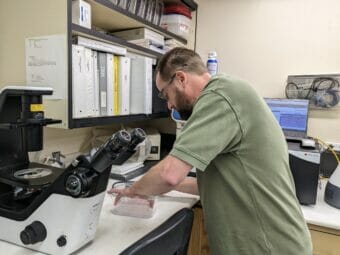
A sample of heart tissue from a Yukon king salmon infected with ichthyophonus sits under a microscope at the Alaska Department of Fish and Game laboratory in Anchorage on Aug. 17, 2023. (Kavitha George/Alaska Public Media)

Scientists know one thing for sure about the collapse of Yukon River king and chum salmon: there’s more than one culprit.

“It’s really hard and probably unrealistic to just point your finger at one thing and say that’s what’s doing it,” said Jayde Ferguson, a fish pathologist with the Alaska Department of Fish and Game.

Researchers have identified many threats facing Yukon king and chum salmon, and those threats pop up at each stage of the salmon life cycle — when salmon hatch in freshwater streams, as they swim down the Yukon to the ocean, where they spend most of their lives and on their arduous journey back upriver to spawn and die.

Scientists think many of these threats are connected to climate change. Ferguson studies one of them, a parasite named ichthyophonus, at the Alaska Department of Fish and Game lab in Anchorage.

Under a microscope, salmon tissue infected with ichthyophonus appears mottled with big white dots, each one a single parasite that will grow, draining the fish’s resources and causing cells to die.

The parasite can’t harm humans, but it does kill fish. As salmon are making their journey upstream, they’re especially vulnerable.

“Their immune system is not as good, their bodies are just breaking down,” Ferguson said. “And so the parasite actually starts replicating then within the fish.”

Many infected fish don’t survive long enough to lay eggs.

“It’s almost like an arms race,” he said. “Can they get to the spawning ground before they die prematurely?”

Often, infected fish look completely normal from the outside, but their flesh will have a spotted or patchy white pattern where the parasite is growing inside. Importantly, infected fish aren’t good to eat.

Researchers saw a big spike in king ichthyophonus levels in the early 2000’s, when around 30% of kings showed detectable levels. Levels dropped off for more than a decade. And then in 2020, the parasite was back. In recent years more than 40% of the Yukon king run has shown detectable levels of ichthyophonus.

Fish pathologist Jayde Ferguson places cell samples on a microscope at the Alaska Department of Fish and Game laboratory in Anchorage on Aug. 17, 2023. (Kavitha George/Alaska Public Media)

It’s unclear what’s driving the spike. Other researchers have found that Yukon king salmon eggs are low in a vitamin called thiamine, which may cause weakened immune systems. Ferguson said warming river water might also play a role.

In fact, the Yukon is warming twice as fast as rivers further south as a result of climate change.

“It’s crazy to be at the northern-range extent of salmon and talking about it being too hot for them,” said Vanessa von Biela, a U.S. Geological Survey ecologist.

Salmon are cold-blooded, meaning they can’t regulate their internal temperature. When the river gets above 65 degrees Fahrenheit, that’s a problem.

When it’s too hot, Von Biela said, the proteins that keep salmon cells functioning normally start to lose their shape. Warm water also makes it harder for their hearts to pump oxygen to their bodies.

“Their whole physiology, their whole body is designed to be in cold water,” she said. “So when that water is warm, they just really hit these limits.”

In a 2020 study, von Biela found that in an average year half of all Yukon kings swimming upriver have heat stress.

And it’s not just the river that’s warming. The ocean is heating up too. Climate change is bringing on more marine heat waves, or periods of severe ocean warming.

Jim Murphy is a NOAA fisheries biologist who has studied salmon at sea for 20 years. He said marine heat waves are disrupting the availability of salmon prey species. It’s not totally clear what’s happening at sea, Murphy said, but when he examines fish, one thing is clear: all salmon — but especially chum — are not getting enough to eat.

“Their stomach contents, the amount of food that they have in their stomach has been declining with warming temperatures,” Murphy said. “They’re likely feeding less in these warm years than in cooler years.”

Scientists say all three of these factors — disease, heat waves, a lack of food — exacerbate each other. A fish that didn’t eat enough is already weaker as it starts its journey up the Yukon. Add a parasite and heat stress, and that fish is a lot less likely to make it to its spawning grounds to reproduce, which means fewer fish next year.

Yukon River fish also have the longest salmon migration paths on Earth, traveling as much as 2,000 miles to get to their spawning grounds.

On top of all this, people along the river have another frustration — commercial fishing. Many residents point to Bering Sea pollock trawlers and a commercial salmon fishery along the Aleutians known as “Area M” that they argue are intercepting salmon at sea that would otherwise be bound for the Yukon.

“It kind of pisses me off a little bit thinking about it. Because it’s the double standard,” said Basil Larson, a subsistence fisherman and resident of Russian Mission, on the lower Yukon. He spoke to a weekly Yukon River Drainage Fisheries Association teleconference for river updates this summer.

Larson said it’s infuriating to see commercial fishermen pulling in hundreds of thousands of chum each season while Alaska Native communities like Russian Mission have gone four summers barely able to fish.

“We’ve been getting restricted and restricted and restricted, and it’s not even funny anymore,” he said.

In recent years, Western Alaska fisheries groups and residents of the Yukon and Kuskokwim Rivers have clamored for tighter regulations at sea, like a cap on chum fishing in Area M and stricter chum bycatch limits in the Bering Sea — but so far, regulators haven’t taken much action.

Meanwhile, commercial fishers point to data that show only a small percentage of the Bering Sea bycatch salmon and Area M salmon are headed to Western Alaska rivers.

But Murphy, with NOAA, said even though environmental factors driven by climate change are probably the main culprit for the Yukon collapse, right now, commercial fishing is the one contributor we have control over.

“Most people recognize that [commercial fishing] is not what is causing the collapse of these runs, necessarily. But it is something that can be regulated to mitigate the effects of declining production,” Murphy said.

For now, Yukon River residents are in limbo, waiting to see if fish return. Murphy said it doesn’t look like kings will come back anytime soon. But he said there’s hope for chum.

A 2016-2019 Bering Sea heat wave hit chum salmon particularly hard, but since then, ocean temperatures have subsided and Murphy said, juvenile chum are starting to look healthier.

He said signs are good for a stronger chum run in 2024.

New ‘berry booklets’ for Alaska pickers combine traditional knowledge and science

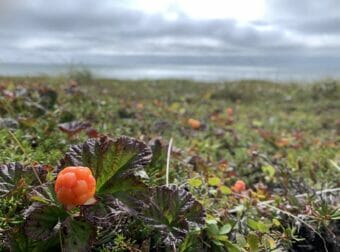
Cloudberries are the focus of a new booklet out this month that includes information on how climate change is impacting Alaska’s berries statewide. (Emily Schwing/KYUK)

A team of scientists at the University of Alaska Fairbanks just released its first “berry booklet.” It’s part of a larger project that digs into the future of Alaska’s wild berries as the climate warms.

Berries, regardless of species, are a huge part of rural Alaska’s subsistence lifestyle. They are often the only fresh, local fruit available in remote villages. Their value is not lost on the Alaska Climate Science Center’s tribal resilience liaison, Malinda Chase.

“Well, berries mean to me joy,” she said from her home in Fairbanks. Chase grew up between Anvik and Anchorage.

“To see your berry bucket get full, to know that this is part of our beautiful land. It’s food that is delicious, it’s something that we do as families, as communities, as good friends,” Chase said.

A warming climate means where and how people harvest berries is changing. And over the years, communities across Alaska have developed climate change adaptation and mitigation plans.

Two years ago Chase’s colleague, University of Alaska Fairbanks Research Association professor Katie Spellman, started reading them.

“Malinda told me, ‘You go read all the climate adaptation plans and start there, because that’s where the important research needs to be,’” Spellman said.

Among dozens of plans she read, Chase said that she only found two references to scientific research specific to berries.

“It made it really clear that the science on berries, which is a topic that Alaskans care a lot about, was not accessible,” Spellman said.

“Scientific papers are really hard to read if you’re not trained to read them,” said Christa Mulder, a plant ecologist at UAF. “They’re really dense. They’re full of difficult words, so what we decided to do is essentially a translation project.”

Mulder said that the team set out to learn everything they could about how climate change could affect the plants people care about.

Mulder, Spellman, and Chase held three listening sessions with berry pickers representing 50 communities. And this month, they’ve released the first in a series of six booklets. The aim is to blend scientific research with traditional knowledge and current observations on how climate change is altering where and how berries grow in Alaska. Chase said that it’s a good start.

“You know, we have so many beliefs and traditions around berries, and they’re so central to many of our family time together, our time on the land, and that is significant,” Chase said.

The first berry booklet, which is focused on cloudberries, was released earlier this month. Also known as akpiqs in Iñupiaq and atsalugpiaq in Yugtun, cloudberries are soft, round bright orange berries that grow on Alaska’s tundra. Many people also call them “salmonberries.”

Spellman said that they’re fascinating.

“It has male and female flowers, and so if the weather during pollination time is off, then it’s gonna really affect how many fruits, how many berries, are produced in that year,” Spellman said. “I just think it’s a really beautiful and fragile berry that really relies on those pollinators.”

Those pollinators can’t fly in colder temperatures, according to the cloudberry booklet. But a warmer climate may help pollinators.

Mulder said that the team worked hard to make sure to include the potential benefits of a changing climate. She said that the booklets include advice on how people who rely on berries can help them thrive.

“So very simple pruning, for example, of blueberries can give a gazillion blueberries on a single plant. And that’s not a solution for everything, of course, but if you have Elders who can’t go very far, having patches of forest where sort of cultivate, semi-cultivate, have a bit of a food forest could be a really good thing,” Mulder said.

Five other booklets are due out in the coming months. Those will focus on blueberries; lingonberries, also known as low-bush cranberries; crowberries, also known as blackberries; and red currants. They’ve already garnered so much interest that the team is looking at ways to combine all the booklets into one main resource.

Site notifications
Update notification options
Subscribe to notifications