Subsistence

Qayassiq’s walrus hunt, once banned, now carries traditions of sharing and management to the next generation

A group of walruses on a flat rock at Qayassiq. June 2022. (KDLG photo)

Thirty miles off the coast of the village of Togiak in Southwest Alaska sits Round Island, known in Yugtun as Qayassiq. Surrounded by the Bering Sea, the island’s steep, grassy slopes are covered in shrubs, lichen, and wildflowers, ending in rocky beaches. Seabirds like kittiwakes, murres and cormorants nest here in the spring and summer. During that time, the island becomes home to thousands of massive white-tusked Pacific walruses, which swim to its beaches to rest after the breeding season.

Frank Woods, who is Yup’ik, first hunted walrus at Qayassiq in 1997, though his family has harvested walrus there for generations. “It was an El Niño year, it was really warm in October. Beautiful weather,” recalled Woods, who lives in Dillingham and now works at the Bristol Bay Native Association.

Qayassiq had “the most concentrated herds of walrus in the Bay, and that’s where they traditionally hunted,” Woods said. During that season, 15 walruses were harvested, and the hunts didn’t seriously disrupt the haulout.

Native people in Bristol Bay have harvested walrus at Qayassiq for thousands of years for food, clothing, tools and artwork. But they weren’t always able to hunt there. For decades, starting in the 1960s, the state banned hunting at the island as part of its efforts to preserve walrus habitat. It did so without consulting the tribes, even though state policy cut off their access to traditional hunting grounds. As a result, tribal leaders had to fight for years to regain access to the hunt and in doing so, created a model for communities to act as equal management partners that still exists today.

Woods’ 1997 hunt came soon after the ban was lifted. It was one of the first in more than 30 years. He wanted to go because of his family.

“My family still loves walrus,” he said. “And it was like a spiritual experience to actually have that – being able to take an animal, harvest it efficiently, and then dish it out to the community when you get back.”

Walruses rest on one of Qayassiq’s beaches. June 2022. (Izzy Ross/KDLG)

A sanctuary for walrus

Over the past two centuries, Alaska Native walrus hunting traditions like those in Woods’ family have faced acute threats. In the 1800s, commercial hunting – especially by non-Native whalers – decimated the species, and as a result the federal government banned commercial hunting in 1941. After Alaska became a state in 1959, it also took extreme measures to conserve walrus habitat – without differentiating between who was responsible for the plummeting populations.

In 1960, the Alaska legislature created the Walrus Islands State Game Sanctuary in Bristol Bay and took over management of seven islands in the area. The state banned all hunting at Qayassiq, one of the main walrus haulouts in North America.

During this process, however, the state didn’t hold hearings in Togiak or any other Bristol Bay village before making the decision. This was consistent with the state’s approach to conservation at the time, according to State Lands and Refuges Manager Adam Dubour, who stepped into the role in 2022.

“I think opinions and attitudes and practices in the 1960s were a lot different than they are now,” he said. “I wouldn’t be surprised if there wasn’t any formal consultation with those groups.”

Peter Lockuk Sr, who serves on the Togiak Traditional Council, recalls how the sanctuary was created with no communication between the state and the tribe.

“The community of Togiak never knew Qayassiq Island became a sanctuary. People never knew of it, and some folks got arrested,” he said. “They got in trouble for it, to go down and get walrus.”

The closure lasted for over 30 years.

Read more: The Round Island Walrus Hunt: Reviving a Cultural Tradition

A community effort

Walrus hunting revolves around the community — providing food, but also teaching new hunters how to harvest safely and efficiently. Hunts are grounded in cakarpeknaki, or “with respect and without waste.”

Lockuk said if crews haven’t hunted for a time, the excitement to go out can be palpable.

“You could notice when people are getting restless: ‘When, when, when is that walrus hunt going to be happening?’” Lockuk said.

People used to travel in skin-covered kayaks to hunt walrus at Qayassiq, which means “a place to kayak” in Yugtun.

Now, 18-foot skiffs are common, and depending on where they are, some hunters even use 32-foot power boats to get the walrus back to town. Anywhere from five to 20 people can make up a hunting crew, and they need to decide ahead of time who will shoot, who will drive the boat, and how exactly to wrangle the carcass of a two-ton walrus.

“You got to have everything planned, because to us, it’s a big thing. And it’s only seasonally,” said Mickey Sharp, a Twin Hills hunt captain and a commissioner on the Qayassiq Walrus Commission. (Sharp hunts at another island in the sanctuary and hasn’t been hunting at Qayassiq yet, though he hopes to go one day.)

It takes about two hours to get to Qayassiq from Togiak, riding out into the Bering Sea across open water, which means calm conditions are best.

Daryll Thompson, who has participated in Togiak’s community hunts on and off for years, said it’s better to show newer hunters how to hunt on beaches. It’s easier, and they can choose which animals to kill and butcher quickly.

“It’s a little bit more adventurous when they’re all in the water,” he said. “You got to take your boat and get up and get the good shot, and then you got to harpoon them. With a harpoon, you keep them from sinking, and you can retrieve the animal.”

Hauling a walrus onto a boat can be like “dead weight lifting,” Sharp said. It’s also important for the crew to start gutting the walrus immediately. Otherwise the meat can spoil. Working nonstop, several crew members can butcher a walrus in a few hours.

“It’s just really a lot of work,” Sharp said. “Holy, yeah. It makes butchering a moose like a piece of cake.”

After a successful hunt, the crew will bring the meat back to the village, where it can feed people all year. “We help each other and cut it up into smaller pieces. So we could distribute first of all to the elders, and to the folks that can no longer hunt,” said Lockuk.

Mickey Sharp’s son, Ivan, quartering walrus meat to give away in Twin Hills. (Photo courtesy of Mickey Sharp)

Fighting for the hunt

In the decades following the 1960 hunting closure at Qayassiq, the Togiak Traditional Council and other tribes in the region went through the state’s regulatory system and federal courts to regain access to walrus hunting.

The state limited walrus hunting in western Bristol Bay until 1972, when the federal Marine Mammal Protection Act passed. That act acknowledged Alaska Natives’ right to hunt walrus and other marine mammals as long as the populations were healthy.

But the state regained management authority of Pacific walruses several years later, and again limited hunting outside the sanctuary in western Bristol Bay. The people of Togiak sued, challenging the state’s authority to do so. They won in 1979, when the court ruled that the federal law means Alaska Native people must be allowed to hunt. Because the state held that its constitution couldn’t include such exemptions, walrus management in Alaska returned to the federal government.

Peter Lockuk Sr. stands outside the Togiak Traditional Council office in Nov. 2022 (Izzy Ross/KDLG)

Still, because Qayassiq was in the state game sanctuary, the state was able to keep it closed to hunting.

In 1991, Togiak’s elders petitioned the state Board of Game for a limited hunt on Qayassiq. They had to petition three times to get the hunt authorized. Larry Van Daele, who worked as the regional wildlife biologist in Bristol Bay at the time, said some of his superiors told him not to work with people there. But he thought there was room to compromise.

Recalling the state’s hardline approach, Van Daele said his supervisors would say “they’re going to tell you that they have to be able to hunt on Round Island, because that’s their traditional area. Say no, you can’t have that. Hunt anywhere else you want, but don’t come to Round Island, because that’s illegal to go there.’”

After one rejection of a proposal to establish a subsistence hunt on the island from the state Board of Game, two Togiak residents – Marie and Adam Arnariak – went out to the island and shot a walrus in civil disobedience. That became known as the Arnariak Case, which challenged the state’s authority to regulate walrus hunting at the sanctuary. The case — and the potential of an unauthorized hunt at the island — further pressured government agencies to negotiate with hunters.

Finally, in 1995, tribal leaders from Togiak and other villages successfully advocated for the state to reopen a subsistence hunt. Now, Alaska Native commissioners on the Qayassiq Walrus Commission manage a fall hunt every year on equal footing with state and federal agencies.

“Co-management meant you had equal say in what was going on,” Van Daele said. “That’s what walrus on Round Island ended up being, was a true co-management program.”

A work in progress

At last May’s Qayassiq Walrus Commission meeting at the Bristol Bay Native Association in Dillingham, commissioners gathered around a conference room table near a large screen that displayed the names of the co-management partners. At the far end of the room was a Ziplock bag of herring eggs on kelp that someone had brought from Togiak. A hunter had supplied fresh beluga muktuk, and there was also soy sauce, crackers and salmon dip.

The commission was working to change the hunt dates so that hunters could go out to Qayassiq earlier in September – an effort to avoid some of the stormy fall weather. Members were also re-upping a resolution to restrict the trawl fishery near Togiak to address long-standing concerns about the fleet’s impact on clambeds that walrus feed on.

Understanding how to be part of decision-making within co-management is vital, said the Dillingham hunter Frank Woods, who sat in on the May meeting.

“This type of activity is just as important as the subsistence activities outside the room,” he said in an interview after the meeting.

The Eskimo Walrus Commission is another Alaska Native organization pursuing that work. It was part of the task force that examined the potential of renewing a hunt at Qayassiq in the 1990s and eventually signed the co-management agreement when resurrecting the hunt.

Randy Alvarez speaks during a Bristol Bay Marine Mammal Council meeting, as Moses Toyukak and David Williams, right, listen. May 2023. (Izzy Ross/KDLG)

As communities adapt to the changing climate, the need for Alaska Native organizations to have sufficient support and funding is greater than ever. Sea ice is melting, meaning that female walruses must travel further in order to calve on ice floes. Along with a shrinking habitat, less sea ice means more shipping traffic.

“The issues that we’re facing are becoming bigger and more broad, because we’re also experiencing climate change effects on our communities and the environment,” said Vera Metcalf, the executive director of the Eskimo Walrus Commission. She had just returned to Nome after a June trip to Washington, D.C. to talk with the congressional delegation about funding for co-management agencies.

Read more: 2019 Marine Mammal Commission co-management report

Renee Roque, subsistence outreach specialist for the Bristol Bay Native Association, coordinates the Qayassiq Walrus Commission meeting in May 2023. (Izzy Ross/KDLG)

The ability to meaningfully participate in co-management – traveling to meetings, giving public comments, and conducting research – is closely tied to capacity as well. For instance, Metcalf has sometimes been the commission’s only full-time staff member. She said the responsibilities of co-management must be shared equally by partners in order to best serve Alaska Native communities and the species they rely on.

“We’re facing harmful algal blooms, shipping disturbances and all these things that are affecting us, and we want to ensure that the walrus population and other marine mammal resources are healthy,” she said. “If the environment is healthy, so will our communities remain healthy.”

A hunter looking toward a group of walruses on Hagemeister Island, off the coast of Togiak. (Photo courtesy of Mickey Sharp)

Looking ahead

At 27 years old, David Williams of Ekwok is the youngest member of the Qayassiq Walrus Commission. At the May meeting, he and other members talked about organizing a joint hunt between Bristol Bay communities and involving more young hunters.

“If we could get 20 hunters within the region as one joint hunt, and get 20 walrus for all of our communities, I think that would definitely help everybody here, especially the elderly,” Williams said. “Personally, I would love to get my very first walrus and provide my community with my very first walrus.”

Another key part of sustaining co-management is teaching and involving young people. Last October the Eskimo Walrus Commission held the Young Hunters Walrus Summit, the first of its kind.

Metcalf, the executive director, said the idea for the hunters summit came after she heard about a young fishermen’s summit at the Alaska SeaGrant Advisory meeting.

Along with a focus on laws around co-management, Metcalf said, she also wanted the discussions at the summit to help prepare the young hunters to respond to environmental changes and meaningfully engage in management.

The fundamental purpose of the walrus commission, Metcalf said, is to protect their right to harvest walrus for food and ivory for artwork. She said there are extensive traditional practices around harvesting and sharing the harvest, and doing those things helps to strengthen communities’ traditional values.

“One of our goals is local self-regulation of walrus harvest management,” Metcalf said last year. “Helping to ensure our Indigenous food sovereignty and security is there for us for many years, well into the future.”

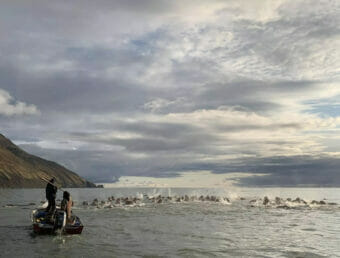
Three walruses in the water around Qayassiq. June 2022. (Izzy Ross/KDLG)

This story was made possible through a field reporting grant from the Institute for Journalism and Natural Resources.

An Alaska district aligns its school year with traditional subsistence harvests

Students from the Yupiit School District learn how to prepare freshly caught salmon. (MaryCait Dolan/KYUK)

Seventy miles inland from the Bering Sea, on roadless lands beside the Kuskokwim River, three Yup’ik villages are perfect examples of the educational challenges faced in Alaska.

Teacher turnover in the state runs 25% to 30% a year, and poor attendance and low test scores have been constant issues in many rural schools.

In the mid-1980s, the villages of Akiachak, Akiak and Tuluksak, broke away from a bigger district to form the Yupiit School District. They wanted to provide an education that more fully embraced traditional Yup’ik Native knowledge.

Salmon caught near Akiachak, Alaska is processed with an uluaq. June 23, 2023. (MaryCait Dolan/KYUK)
The Akiachak School in Akiachak, Alaska. June 23, 2023. (MaryCait Dolan/KYUK)

This year, the district was allowed to operate on an academic calendar that’s aligned with seasonal subsistence harvests. School leaders spent much of 2022 working to get it approved by the state.

It starts a week later than other districts in the state, and classes finish 10 days earlier. They make up the difference with an extra half hour of instruction each day.

Students can now take part in the fall moose hunt and the spring migratory bird harvest. The strategy is to pass along traditional knowledge that cannot be gained in the classroom, and attendance was already poor during seasonal harvests.
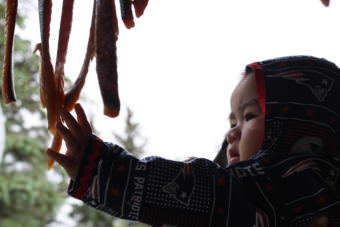
Students from the Yupiit School District go drift netting for salmon. June 23, 2023 in Akiachak, Alaska. (MaryCait Dolan/KYUK)

Summer culture camp

In the summer, Yupiit schools offer culture camp.

On an overcast day this June, teachers and elders meet students at a large cutting table near teacher housing near the river. Originally, the morning catch of salmon was supposed to be processed at a nearby community fish camp, but those plans were scrapped because a black bear was hanging around.

Literacy coach Evelyn Esmailka wields a large ulu as she explains the differences between chum, chinook, and sockeye salmon to the small group of children. After this lesson, the kids will board drift boats to go fishing for salmon on the river.

Barron Sample, principal of the Akiachak School, prepares to take students out drift netting. June 23, 2023 in Akiachak, Alaska. (MaryCait Dolan/KYUK)
Fish hangs to dry at a fish camp near Akiachak, Alaska. June 23, 2023. (MaryCait Dolan/KYUK)

“They’re getting ready to go out. This will be for the winter supply of fish, [to] supplement the lunch program,” Esmailka said.

After the fish are cleaned, they are loaded into the back of a beat-up truck to be dropped off at the school’s walk-in freezer. Salmon blood, to be returned back to the river, sloshes around in plastic totes as the truck lurches along Akiachak’s heavily potholed main drag.

Woody Woodgate, the school district’s federal programs director, said that staff favor indigenous foods in the district’s cafeterias.

“Not really taking anything away from the [United States Department of Agriculture] and the school lunch program, but most of that stuff that’s on those menus is designed for people in big cities, the lower 48, and a lot of it just goes into the trash can because kids don’t wanna eat the food,” Woodgate said. “So if we can supplement with fish and moose, and especially fish and moose that the kids catch.”

A student from the Akiachak School holds up a king salmon. June 23, 2023 in Akiachak, Alaska. (MaryCait Dolan/KYUK)

Taking part in the harvest

With the exception of sockeye, the salmon runs on the Kuskokwim River are crashing, and the day the kids were out was one of the limited opportunities to fish for them. As time ticked away on the 12-hour salmon fishing opener, the order of the day was making sure that every student gets a chance to take part in the harvest.

Barron Sample was in charge of the drift net fishing component of the summer culture camp. He is in his third year as principal at the Akiachak School.

Salmon caught near Akiachak, Alaska. June 23, 2023. (MaryCait Dolan/KYUK)
A fish camp near Akiachak, Alaska. June 23, 2023. (MaryCait Dolan/KYUK)

“For some of them, it’s the first time actually out here on the river doing this, and the first time they’re actually pulling a net,” Sample said.

The 24-foot boat is one of three owned by the school district.

“There’s three schools in our school district: Akiak, Tuluksak, and us, Akiachak. So, kind of in a little competition, like, ‘how many did you catch today?'” Sample said.

After a 150-foot gillnet was unfurled, the boat drifted slowly down the river. The children intently watched a line of buoys for signs of life.

Students from the Yupiit School District learn how to prepare freshly caught salmon. June 23, 2023 in Akiachak, Alaska. (MaryCait Dolan/KYUK)

“Fifteen more minutes and then we’re gonna reel it in,” a fourth-grader informs the crew.

While the first drift only yields two fish, the second brings in around a dozen: a mixture of reds, kings, and chums. The students scream in delight as the squirming salmon are picked from the net, landing with a thud in a plastic tote.

“I wanna fish again. This is actually a good spot to fish,” a fourth-grader chimes in.

Students from the Yupiit School District go drift netting for salmon. June 23, 2023 in Akiachak, Alaska.

After two drifts, there are plenty of fish to be processed and stored at the school for the coming winter. All the kids can talk about is going out again.

During the narrow window when fishing was allowed, the village of Akiachak felt like a ghost town. But along the river, the fish camps buzzed with activity as families processed the day’s harvest in a way that has changed little over the centuries.

Marshall’s tribal president speaks on the cultural toll of the Yukon River salmon crash

Christian Mulipola reaches for king salmon strips his grandmother, Diane Ishnook, has hung up to dry. Her king salmon were caught far downriver from Koliganek. (Photo by Avery Lill/KDLG)
Christian Mulipola reaches for king salmon strips his grandmother, Diane Ishnook, has hung up to dry. (Avery Lill/KDLG)

Salmon runs on the Yukon River have been dwindling for years. And the loss of commercial and subsistence fishing has hit communities hard. KYUK sat down with Tribal President Nick Andrew Jr. of Marshall on Aug. 9 to talk about what the salmon crash means for people who have relied on the fish since time immemorial.

Andrew has fished for salmon commercially and for subsistence since he was five. He spoke about the emotional and cultural toll that the salmon crisis has taken on his community.

Listen:

This interview has been edited for clarity and length.

Nick Andrew Jr.: My name is Nick Andrew Jr. I am a tribal citizen of Marshall. I am also the tribal president, but what I have to say is not necessarily a statement on behalf of the tribe.

I’m from Marshall, born and raised. I’ve been part of the salmon fishery, the commercial and subsistence, since I was five years old. I helped my family, my grandparents, my uncles, my aunts, my nieces, my cousins, we all worked together in the past. And yes, salmon does define who I am. It does define my ancestors, my family, my relatives, everyone on the river.

Nick Andrew Jr., Native Village of Marshall Tribal President. (Dean Swope/KYUK)

We’ve been in conservation mode for king salmon for about 40 years. And that’s a long time. I’ve seen the years of plenty. I’ve seen the years of scarcity, and it’s a political issue now.

Loss of salmon hit us really hard on the cultural side. There went our connection to the ancestors. We also lost that family connection. Because a lot of people went fishing and processing, they involve the family. And the last four years have been hard, especially the years we were in strict conservation mode. It was felt in the community and the region on the lower Yukon River. We had a sense of helplessness.

Basically, not knowing was the biggest thing. We thought that the salmon were going extinct, that was one of the thoughts. And we also had a sense of despair. We didn’t have salmon, dried salmon, smoked salmon, salmon strips, salmon dry-fish, king salmon, salted fish, and salmon for the freezer, for the winter. That took a big emotional toll on our people.

Our subsistence rights are not negotiable. We only take a small fraction of any of the runs that pass the river. And it’s not too hard to ask that more be done for the salmon. Because if nothing’s done, within 50 years we’re gonna be on the endangered list, probably extinction at the rate things are going. So we just need a voice at the table, especially on the North Pacific Fishery Management Council. Our input is important. Our traditional knowledge is important. And we, the Native peoples along the river on shore, we matter too. That needs to be kept in mind.

Francisco Martínezcuello: How has this year’s run been?

Nick Andrew Jr.: Well, when we look at the run we get information from the Alaska Department of Fish and Game on their Facebook page and the faxes we’re getting to the tribe, and they’re showing lower and lower numbers. That’s very concerning. And on a different note, we were allowed to harvest the summer chum. And that really helped a lot of people. And that put reassurance that hey, we do matter. Hey, we’ll have salmon for the winter, even though it’s not the king salmon we’ve desperately been wanting for years. So that’s where we are.

Francisco Martínezcuello: What about your memories as a kid fishing around here, to give people like me who are complete outsiders an understanding of how things used to be, especially for your people, your family?

Nick Andrew Jr.: Growing up was a different time. We had plenty of fish: king salmon, summer, fall chum, and the silvers. The village would empty. Families went to fish camp during those years. Everyone was happy. The dogs that were needed for our transportation and subsistence activities back in the day were fed, they relied on salmon too. All the bears, the birds, meaning the eagles and falcons, seagulls, they were happy too, and the world was complete then. So, on any given day, dried salmon, salted salmon were eaten three or four times a day.

Nowadays, as the salmon started to dwindle, people had to find other species. But still that left the void, the void meaning a big part of our staple was gone. And it’s still, the puzzle isn’t complete today because we got all these factors, and that affected our culture, our physiological and our mental well-being as well. You know it does weigh heavily on our minds, and our very DNA are in tune with salmon as our diet, our identity, our culture. So as the salmon continue to dwindle, that’s impacting just about everyone in our region and on the lower Yukon River because it was the common denominator that made us whole.

KYUK’s Evan Erickson helped with this story.

New Sitka research could help berry pickers adjust to climate change

Slow bluberries
Slow developing blueberries in a Douglas Island yard in early July 2021. (Photo by Matt Miller/KTOO)

Lisa Sadleir-Hart has filled her freezer with berries from her backyard in Sitka for more than 25 years. But this year, that freezer will be emptier. 

“The crop looks terrible,” Sadleir-Hart said. “I hardly have any on my bushes.”

She said her bushes developed differently as spring turned to summer. 

“I noticed that leafing out of the salmonberries seemed to take longer. It happened later,” Sadleir-Hart said. “And then boy, we sure didn’t have the number of flowers and buds that we did last year.”

Scientists and harvesters alike believe that berries have declined in Southeast Alaska in recent years, as human-caused climate change has reshaped the environment. A new project at the Sitka Sound Science Center will closely monitor berry plants throughout the seasons, to help both recreational and subsistence harvesters plan for the future.

In Southeast Alaska, and across the state, climate change is bringing more rainfall, less winter snowfall and hotter temperatures. According to the project’s lead researcher Alex McCarrel, those changes disrupt berry development because a berry plant’s life cycle is precisely tuned to its environment. 
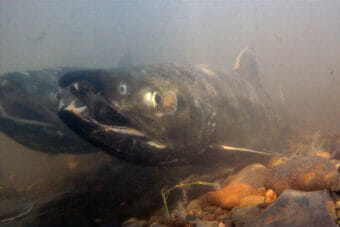
Each stage of development corresponds with the way the weather unfolds throughout the seasons. 

“When the leaves are budding out, or when the flowers are going to be blooming,” McCarrel said. “When can we expect the berries to ripen? Or when is that best week you want to be picking berries.” 

The study of those seasonal life stages is known as phenology. And it’s the foundation of some of the most important interactions in nature. 

For example, a flower will typically bloom when pollinators are awake and hungry. And a knowledgeable harvester will typically know what time of year a bush will be most full of berries. 

“Timing is everything,” McCarrel said. “And that is changing.” 

To track those changes, McCarrel and collaborators at the U.S. Forest Service have deployed 16 trail cameras that are pointed at berries all season long. The cameras take thousands of time lapse photographs that can capture the precise timing of each critical life stage.

Each camera is placed next to a monitoring device that records precipitation, humidity and soil temperatures across a variety of microclimates in Sitka. McCarrel can pair that climate data with the photographs at the end of each summer to see how changes in the environmental conditions shape berry development. 

The project also engages harvesters. Throughout the summer, volunteers like Sadleir-Hart noted how many ripe berries they could pick in the five minute time period, returning to the same patch once a week. Those records give McCarrel a more concrete idea of when maximum berry yield occurred for each bush.

By recording that data year to year, McCarrel and her team can start to identify patterns and trends that link specific climate conditions to changes in berry availability and timing.

That data is especially valuable for protecting food security. Sadleir-Hart, an educator for the Sitka Local Food Network, said that many rural Alaskan households rely on wild berry harvests. 

“You know what berries cost in the grocery store,” she said. “They are not going to be able to replace that.”

And tribal natural resource departments have identified wild berries as one of the top resource concerns under climate change.

But without data, it’s challenging to develop concrete adaptation and mitigation strategies. McCarrel said that the results of this research could help to solve that. Her hope is that the data could be used to inform new harvesting strategies. 

“They can make decisions like, ‘I guess I’ll have to go out one week earlier than I did 10 years ago,’” McCarrel said. “Or I might need to look for better berries, higher up. Another 500 feet of elevation, because my spot is getting too hot.”

And if berry harvesters know how to change, it could help keep their freezers full. 

Trooper citations for salmon discards add grist to regional Alaska fishery dispute

Two chum salmon show the distinctive stripes that emerge after they enter freshwater to spawn. Chum salmon are important to the diets of Indigenous residents of Western Alaska. (Photo provided by NOAA)

For years, residents along the Yukon and Kuskokwim rivers have accused fishers operating in marine waters north of the Alaska Peninsula of intercepting too many river-bound salmon, sometimes in hidden ways.

Now a trooper enforcement campaign by the Alaska State Troopers wildlife division gives some credence to those accusations.

The campaign, carried out in June and July in the region known as Area M, resulted in nine citations issued to captains and crew members for allegedly dumping unwanted salmon overboard, the Alaska State Troopers said in a statement issued Thursday.

The species of discarded salmon was not disclosed, but it was potentially chum salmon bound for the Yukon and Kuskokwim rivers, where there have been devastating chum crashes in recent years.

“I think many people from along the Yukon knew it happened,” Serena Fitka, executive director of the Yukon River Drainage Fisheries Association. “It does occur, and we’re glad it’s finally getting acknowledged.”

Kevin Whitworth, executive director of the Kuskokwim River Inter-Tribal Fish Commission, referred to the practice as “chum chucking.” The fishermen want sockeye, and “they don’t want to keep the chum salmon, so they throw it overboard,” he said.

The trooper citations add to the long-simmering dispute over salmon that travel through the Bering Sea to spawning grounds in the Yukon and Kuskokwim drainages. As chum and chinook salmon returns in the rivers have dwindled and harvests have closed, residents have blamed Area M interception for contributing to those problems. But the Area M commercial fisheries are vigorously defended by Alaska Peninsula and Aleutian residents who depend on them.

Attempts to resolve the disputes reached the Alaska Board of Fisheries last February. The board considered proposals to restrict Area M fishing and ultimately approved rules that the Yukon-Kuskokwim advocates characterized as too weak but that the Aleutians East Borough, the regional government for many communities dependent on Area M harvests, deemed appropriate.

The meeting was emotion-charged, with both Yukon-Kuskokwim fishers and fishers from the Alaska Peninsula and eastern Aleutians testifying about the need to protect their well-being, communities’ stability and cultures.

Scientists believe that the Yukon and Kuskokwim salmon crashes have more to do with climate change impacts in the ocean and possibly in the upriver spawning areas than with bycatch, the term for unintended catches of fish during harvests of other targeted species. However, interceptions could be exacerbating the problem, some say.

In a brief statement Thursday, the Aleutians East Borough criticized the cited salmon discards.

A docking facility is seen in 2009 in Sand Point. The community on the Alaska Peninsula is part of the Aleutians East Borough and is highly dependent on the fish harvests conducted in the region known as Area M. (Photo provided by the Alaska Division of Community and Regional Affairs)

“We absolutely do not condone this type of reckless and illegal behavior. We believe the State of Alaska’s enforcement division will handle this to the harshest extent of the law,” the borough statement said.

Area M is a difficult place to conduct fishery patrols, said Major Aaron Frenzel, deputy director of the Alaska Wildlife Troopers.

Unlike the Bristol Bay or Kodiak fisheries, where vessels can be crowded together and where troopers aboard a patrol vessel can easily see practices and behavior, the Area M harvests are conducted by boats separated by vast distances.

A trooper helicopter proved key to the Area M enforcement effort, he said. But availability of that helicopter and other assets limits any enforcement in the region because wildlife troopers need to patrol other fisheries, Frenzel said. That means some strategic movement of ships, aircraft and people to the places where they are most needed, he said.

“It’s kind of like a chess game,” he said.

The outcome of the citations is yet to be determined. The fishers cited, some of them from Washington state, have court appearances scheduled for later this month in Anchorage. The violation is considered a class A misdemeanor punishable by fines of up to $15,000 and jail terms of up to one year, Frenzel said.

The Board of Fisheries is not expected to hold another Area M-focused meeting for three years, according to the meeting cycle. The next scheduled meetings are focused on Cook Inlet and Kodiak fsh.

Citizens may ask the board to consider subjects outside of the normal cycle. The next deadline to request that consideration is Aug. 14, and requests are to be considered at the board’s scheduled October work session.

Aside from their special Area M operation, wildlife troopers conducted their regular summer patrols in the Bristol Bay fishery, source of approximately half of the world’s harvested sockeye salmon. The Bristol Bay operation involved multiple patrol boats and aircraft, the trooper statement said. Over 400 commercial vessels working in Bristol Bay were boarded, with thousands of fishermen contacted, 150 citations issued and thousands of pounds of salmon seized, the trooper statement said.

On the Yukon, Alaska and Canada are bound together by salmon – and their collapse

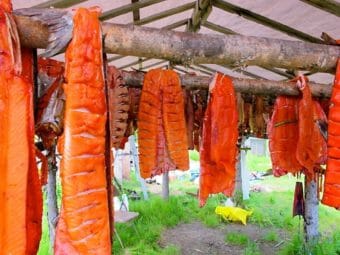
Salmon filets hanging from a drying rack
Yukon river residents are going on four years of severe chum and chinook subsistence harvest restrictions. (Shane Iverson/KYUK)

The Yukon River covers a lot of ground on its nearly 2,000 mile journey to the sea. The river’s headwaters are in the mountains of northern British Columbia, just 50 miles from Skagway. From there, the river winds north through the Yukon, crosses the border near Eagle and flows all the way across Interior Alaska until it finally reaches the Bering Sea.

And for as long as anyone can remember, salmon fed everyone along its course.

“For most of our lives, it was king salmon,” said Rhonda Pitka, First Chief of the village of Beaver in the upper Yukon Flats. “That was the majority of our diet, and what we traded and what we processed.”

Pitka remembers busy childhood summers with her family at their fish camp about ten miles outside the village, helping her grandmother catch and process fish.

But today, she can’t continue that tradition with her own family.

Rhonda Pitka, first chief of the Yukon River village of Beaver, speaks at an event in Fort Yukon. (Courtesy Rhonda Pitka)

Since the mid-1990’s, runs of king and chum salmon — the two primary species harvested on the Yukon River — have become more unpredictable. King salmon numbers have seen a long, slow decline, while chum runs have sometimes seemed to bounce back, only to fall again. Now, both species are in a historic collapse.

In the last four years, the numbers of king and chum salmon in the river have dropped so low, state and federal fisheries managers have all but closed subsistence fishing. The causes of the decline aren’t fully understood, but researchers say a parasite targeting kings and warming waters due to human-caused climate change are possible factors. Harvesters also blame salmon bycatch in the Bering Sea commercial pollock fishery and the large commercial chum salmon fishery off the Alaska Peninsula known as “Area M.”

The closures have been devastating for communities along the river, said Pitka, who remembers trading salmon for caribou or muktuk with relatives in Arctic Village and Utqiaġvik back when fish were abundant.

“It’s been a real challenge for families to get enough food for the winter and enough food to share,” Pitka said.

The salmon collapse is changing life on the Yukon — and not just in Alaska.

Communities along the upper Yukon, stretching deep into Canada, have borne the brunt of the salmon collapse, in part because only a fraction of the fish make it that far upriver. Some Canadian First Nations have restricted fishing for decades.

Still, the U.S. and Canada depend upon each other to conserve this vital resource.

Pitka serves on the Yukon River Panel, a body of representatives from both Alaska and Canada that advises fishery managers on both sides of the border. The panel was established by the landmark Yukon River Salmon Agreement, a treaty the U.S. and Canada signed in the early 2000s after more than a decade of negotiations. The treaty aims to ensure a healthy salmon population and access to fishing for communities in both countries.

It’s been a challenge to discuss resource allocation for a river that’s not actually meeting anyone’s subsistence needs, Pitka said.

“Our Canadian counterparts haven’t fished for at least 20 years, if not longer,” Pitka said. “And that’s a tragedy all in itself. It’s been really difficult. It’s been really tense.”

As part of that agreement, Alaska committed to letting a certain number of fish cross into Canada, said John Linderman, the panel’s U.S. co-chair.

“Each country has its own responsibilities under the treaty agreement,” Linderman said. “For Alaska, one of our most important responsibilities is to annually provide to the Canadian border the escapement goal and the Canadian harvest share.”

That means allowing enough fish to make it back to their spawning grounds to ensure a healthy salmon population and, in better years, ensuring an additional number of fish cross the border to allow a fair harvest up and down the river.

Those requirements can sometimes sound like a burden for Alaskans, said Holly Carroll, the Alaska subsistence fisheries manager for the U.S. Fish & Wildlife Service – especially during the last four years, when managers have heavily restricted subsistence fishing. But, she said, that’s the wrong way to look at it.

“People will say, ‘Just let us fish. I don’t take more than I need, my family does not take more than I need.’ And every family will tell you that, and they mean it and they are honest,” Carroll said. “But here’s the problem: when our runs are too small to meet everyone’s needs, we have to close.”

Lately, there aren’t even enough salmon returning to the river to ensure healthy runs in the future. And that means everyone on the river  — Alaskan and Canadian — has had to sacrifice.

The treaty keeps both sides working together to protect their salmon. But that doesn’t mean it’s easy, Pitka said.

She recalled a potlatch after two recent deaths in Stevens Village, near her village of Beaver. It was painful to hold such a gathering without its traditional center.

“It was so hard to see families not have salmon to give out at potlatch,” Pitka said. “There should have been salmon on everybody’s plate. They should have been able to give salmon out to visitors that were leaving.”

“That’s the cultural connection that we’re missing right now,” she said. “The ability to share and to feed our families our cultural foods.”

Site notifications
Update notification options
Subscribe to notifications