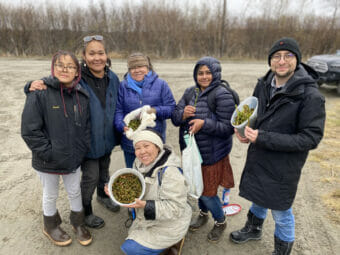
Participants in the Finding Fiddleheads Ethnobotany Walk hosted by the Kuskokwim Consortium Library show off their harvest on Thursday, June 1, 2023. (Evan Erickson/KYUK)
Among the many harvestable wild foods on the Yukon-Kuskokwim Delta, fiddlehead ferns are revered for their nutritional value and taste. Before fern fronds have unfurled, they peek out from the previous fall’s decay in tight coils to greet the coming of spring. This short period is when the harvest takes place, and 20 or so participants in the June 1 Finding Fiddleheads Ethnobotany Walk in Bethel showed up just in time to catch them.
Sharmin Shompa and Aiden Keller were both rewarded for showing up on the cold and drizzly Thursday evening. Shompa said that she was able to gather about 100 fiddleheads in an hour, while Keller had brought a larger container and estimated his take to be about 200 fiddleheads.
“[I] didn’t know anything about ‘em until they posted on Facebook. No one’s ever brought it up; I’ve never seen it posted anywhere,” Keller said. “People sell the berries online, people put the fish online, things like that. Whale, seal, furs — never seen fiddleheads online.”
Bethel Community Services Foundation Food Security Coordinator Carey Atchak led the event, which was hosted by the Kuskokwim Consortium Library. She met the group of foragers at a wooded stretch of land along BIA Road.
“I like picking the ones that are close to the ground and they look just like that,” Atchak said as she swept aside a layer of dead leaves to reveal a cluster of recently emerged fiddleheads.
While unsafe to eat raw, fiddleheads are a delicacy boiled, sautéed, roasted, braised, or even deep-fried. If you’re a fan of asparagus, artichoke, and string beans, you’re in luck because the fiddleheads have been compared to all three. They can be tossed into pasta and salads, placed atop pizzas, or on the Y-K Delta, mixed into whipped fat as traditional akutaq.
Just as soon as the attendees had identified the plant, they split off in different directions, trudging through thick stands of alders and willows in search of the fiddleheads. Participant Margaret Herron met back up with Atchak after an hour’s worth of foraging.
“There you are. Oh man you gathered lots over there,” Herron said. “I almost chickened out, but I’m glad I didn’t.”
It is recommended to only harvest fiddleheads from plants with healthy numbers and to leave at least half of the fiddleheads on each plant crown undisturbed to ensure sustainability.
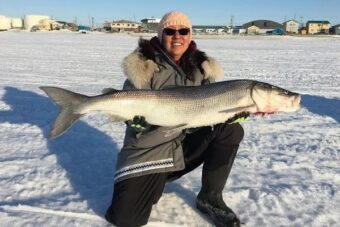
Siikauraq Martha Whiting ice fishing for sheefish. (Katrina Liebich/U.S. Fish and Wildlife Service)
Lance Kramer describes himself as an avid outdoorsman. The 52-year old loves traditional methods of hunting, fishing and trapping. His home is right next to the ice where many Kotzebue residents fish for sheefish. It gives him a bird’s-eye view to gauge when the fish are coming in.
“I get to watch every day, you know, out my window,” Kramer said. “My barometer is binoculars. If they’re pulling them up, then it’s time to go. If they’re not, stay in and drink coffee.”
Kramer is among many people living in Alaska’s Northwest Arctic who depend on sheefish as a staple in their diets. The fish, right now, are abundant. Residents’ freezers are filled with them after another successful season. But scientists warn that it may not always be this way. They say warming waters and permafrost thaw could lead to population declines. It’d be a double-whammy for a region already dealing with recent population declines in another key food source: caribou.
“When you don’t have any caribou in your freezer all year long, you know, sheefish is a huge reprieve,” said Kramer.
‘Sheefishing is a science’
Sheefish, or simply sii, are a whitefish found only in certain waterways in the Northern Hemisphere. In Alaska, they’re found in the Yukon and Kuskokwim drainage areas. In the Northwest Arctic, their spawning grounds are along the upper Kobuk and Selawik rivers. Here, individual sheefish are significantly larger than their counterparts elsewhere in the state. A single fish can measure 3.5 feet and weigh 60 pounds.
One fish is enough to provide several meals to a large family. They’re valued for their taste. The flakey white meat is oily and slightly sweet which makes it versatile in many dishes.
“There’s so many ways to eat them,” Kramer said. “It’s like Forrest Gump. Remember how he talked about the shrimp?”
Kramer, like many people in the region, fishes using a combination of traditional methods with modern equipment. He travels by snowmachine to the ice and, using an auger, drills a 10-inch hole. He looks for a “wedge” in the brackish water, where the fresh and salt waters meet. During winter, the sheefish tend to stay in the relatively warmer freshwater, occasionally venturing into the colder marine water to hunt for their next meal.
“Sheefishing is a science,” he said.
To catch the fish, Kramer uses a jig — a bent handle about a foot long with a line and hook attached. Sheefishing is typically done with a jig or net, not the rod and reel commonly used by many sports fishermen. Kramer uses the Iñupiaq words for his jig. His aulasuan, or handle, is made from wood or walrus ivory. For the ipiataq or fishing line, he uses a more heavy-duty 80-pound test line which attaches to the niksik, or hook. Kramer said he’s addicted to what he calls “the tug” — that initial feeling of hooking a sheefish on the line.
“It’s a direct connection between the energy of that huge incredible sheefish and your hand,” he said. “It’s the energy.”
A threat from thawing permafrost
Although sheefish are abundant now, they could be threatened by warming Arctic temperatures, according to Bill Carter, a fish biologist for the Selawik National Wildlife Refuge, based in Kotzebue. His focus is on the refuge’s aquatic habitat. For eight years, he and a group of Fish and Wildlife colleagues studied a potential threat to sheefish: the permafrost thaw slump.
“It’s basically a big mudslide where a south-facing slope has started to thaw into water, turning what used to be firm ground into mud and concrete — basically wet concrete,” Carter said.
Following a slump, the water becomes cloudy and full of sediment potentially suffocating the eggs of spawning sheefish. Sheefish are long-lived fish. It takes 10 years for the sheefish in the Northwest Arctic to reach sexual maturity which means that the threats to spawning could have longer lasting repercussions.
According to Carter, there have been several slumps in the region. One of the most concerning on Selawik River — about 10 miles upriver from sheefish spawning grounds — was massive.
“[It was] over 500,000 cubic meters, which is basically a 25-story building with a footprint the size of a football field,” said Carter. “That’s what’s come out of it. So it’s really big, over a half a mile across.”
He said there are several more permafrost thaw slumps in the region.
Kramer said he has the same concerns as Carter. He believes that along with warming waters and harmful algal blooms, the permafrost thaw slump will pose a threat to sheefish in the future. Carter and a group of scientists are planning a two-year project this summer to study how the thaw slump has affected sheefish populations.
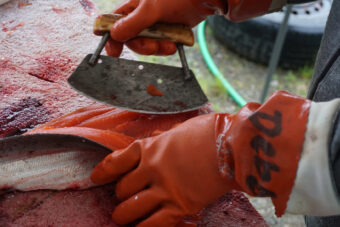
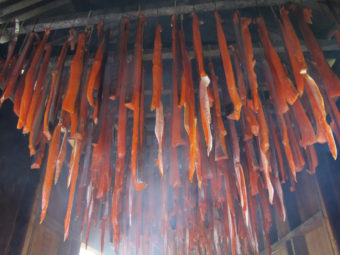
Debbie Coolidge of Aleknagik cuts sockeye salmon with an ulu in July 2021. (Stephanie Maltarich/KDLG)
A total of $50 million is now available to tribes across the country to support harvesting, processing and packaging Indigenous meats, like salmon, moose and caribou in Alaska. The new federal program is called the Indigenous Animals Harvesting and Meat Processing Grant. Applications are open until July 19.
The U.S. Department of Agriculture worked with tribes over the past two years to find ways to support Indigenous food gathering traditions, according to Julia Hnilicka, the Alaska director for the USDA’s Rural Development program.
“It was really out of this consultation, especially as we were moving out of the pandemic, and seeing the worries that a lot of tribes have for food security and food sovereignty, that informed this program,” she said.
The grant is part of the USDA’s Indigenous Food Sovereignty Initiative, which began in 2021. The initiative works with organizations that serve tribes to get Indigenous perspectives on how to improve federal food programs.
The grant doesn’t set limits on the amount of money tribes can apply for, but there are a few restrictions: Projects must involve Indigenous animals and meat processing activities and can’t be used to buy land, meat or animals.
The Indigenous Animals Grant is the latest in a long line of community and government efforts to support Native food sovereignty across the country, including Alaska. In many areas, the issue became more urgent during the pandemic. For instance, leaders of the Organized Village of Kake worked to establish an emergency subsistence hunt to counter a food shortage in 2020. In other regions, like Western Alaska, families struggled with record-low salmon runs, and received donations from places like Bristol Bay.
Projects through the Indigenous Animals Grant can help expand a tribe’s capacities for working with animals. The list of examples includes building or upgrading facilities or buying and installing traditional or other equipment, like mixers, grinders, smokers or freezers.
“There is just so much flexibility within this money, it can be something from like a four wheeler to move animals, to an entire distribution center,” she said. “It really, really depends on what the tribe’s needs are.”
The program doesn’t award grants based on location or population. But Hnilicka said the USDA may prioritize projects that focus on certain goals — like strengthening tribal food access or using Indigenous-informed design principles rather than projects that focus on financial gain.
Grants are available for tribes across the country, and Hnilicka said there’s a good chance tribal nations in Alaska could tap into much of what’s available.
“I do know that they are really looking for networks that can reach across the nation, but also across tribes, as well,” she said. “So there is an opportunity with these monies for tribal governments to band together and to submit co-applications.”
The program’s application assistance can help tribes decide if they would like to submit a joint application across a region, Hnilicka said.
The mid-July deadline is in the middle of summer fishing and harvesting, already a busy time in Alaska.
“It’s unfortunate that the window falls during this time frame from now until July 19,” Hnilicka said. “But this could be the only time, so I really, really encourage everybody who can apply for this to do so.”
More information on the grant and how to apply can be found at the USDA’s website.
Strips of silver salmon hang in Valerie Davidson’s smokehouse on the Kuskokwim River in Bethel, Alaska. (Photo by Annie Feidt/APRN)
WASHINGTON, D.C. — The U.S. Department of Agriculture announced Wednesday it would – for the first time – offer grants for harvesting, processing and storing Indigenous meats such as bison, reindeer, moose, elk and salmon, offering a boost to tribes working to improve food sovereignty.
The change will expand USDA funding, which had been available only for meats the department regulates, such as beef, pork or chicken.
“We are thrilled that we’re going to invest in Indigenous animal processing,” said Heather Dawn Thompson, the USDA’s director of the Office of Tribal Relations. “We have heard loud and clear in our consultations with tribal governments that they want to make sure that they have proteins that are based on Indigenous animals for their communities. This is the first time that our funds are going to be available for those animals. We’re changing the course of history together.”
The department’s Indigenous Animals Harvesting and Meat Processing Grant Program will provide up to $50 million to improve tribal nations’ food and agricultural supply chain resiliency by developing and expanding infrastructure related to meat from Indigenous animals. The program will fund projects that focus on expanding local capacity for the harvesting, processing, manufacturing, storing, transporting, wholesaling, or distribution of indigenous meats.
“USDA is proud to offer this investment in tribal nations’ food chain resiliency as a part of USDA’s broader efforts to restore Indigenous food ways,” USDA Under Secretary for Rural Development Xochitl Torres Small said in a statement. “By expanding and enhancing local processing capacity, these projects will provide culturally appropriate food and community food security to tribal communities.”
Eligible applicants are tribes as well as wholly-owned arms and instrumentalities, and joint or multi-tribal government entities. There is no maximum dollar figure for a grant application nor a minimum. Additionally, there are no matching fund requirements. The deadline for applications is July 19.
The new grants announced Wednesday are part of USDA’s Indigenous Food Sovereignty Initiative, which promotes traditional food ways, Indian Country food and agriculture markets, and Indigenous health through foods tailored to American Indian/Alaska Native (AI/AN) dietary needs.
The USDA is partnering with tribal-serving organizations on the projects to reimagine federal food and agriculture programs from an Indigenous perspective and inform future USDA programs and policies, officials said. The USDA Food Sovereignty Initiative was announced in 2021.
“USDA is committed to empowering tribal self-determination and bringing Indigenous perspectives into agriculture, food, and nutrition,” said Agriculture Secretary Tom Vilsack.
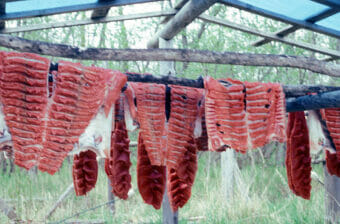
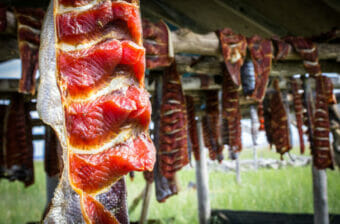
Kuskokwim River Chinook salmon dries on a rack near Bethel in 2001. (Photo courtesy of U.S. Fish and Wildlife Service)
A Superior Court judge in Bethel has dismissed a lawsuit accusing state officials of unconstitutionally mismanaging Yukon River and Kuskokwim River salmon fisheries, leading to a crisis on those rivers.
Judge Nathaniel Peters, an appointee of Gov. Bill Walker, said in a 16-page ruling on Thursday that plaintiff Eric Forrer failed “to identify any specific policy or action on the part of the Board (of Fisheries) or Commissioner (of the Alaska Department of Fish and Game) that could in any way be viewed as a violation of the sustained yield principle.”
That principle requires the state to manage its resources sustainably, and Forrer — represented by Juneau attorney Joe Geldhof — had argued that salmon declines in Western and Interior Alaska were evidence that the state was failing to meet its constitutional obligation.
Peters further concluded that Forrer, a Juneau resident, was asking the courts to direct the management of fisheries.
“The Alaska Constitution has delegated the management of this State’s natural resources to the legislature, not the judiciary,” Peters said.
Geldhof said during courtroom arguments last month that he intended to appeal any unfavorable decision to the Alaska Supreme Court. He did not immediately respond to a text message seeking confirmation of that intent.
In a prepared written statement, the Alaska Department of Law noted that Peters concluded that the state “engaged in reasoned decision-making” when considering the fisheries.
“The state’s inseason management, area management plans, and statewide regulations reflect the department’s world-renowned science-based fisheries management,” said Fish and Game Commissioner Doug Vincent-Lang in the statement. “Over the last two years, the Yukon and Kuskokwim fisheries have faced historically low salmon runs and the department has managed the fisheries to preserve the stocks in the face of this crisis.”
Summer chum salmon drying on a fish rack. (Matthew Smith/KNOM)
Proposals to limit chum salmon bycatch in the Bering Sea are moving ahead, but slowly. After reviewing recommendations over the weekend, the North Pacific Fisheries Management Council asked for further analysis to help develop possible chum bycatch limits or additional regulations on the Bering Sea pollock industry.
It’s a small step in a slow federal fishery management process.
Supporters of bycatch limits say reducing the accidental catch of chum and chinook salmon in the Bering Sea could help improve runs along the Yukon and Kuskokwim Rivers, which have seen record-low returns in recent years. But the pollock industry is pushing back.
Mellisa Johnson is government affairs and policy director for the Arctic-Yukon-Kuskokwim Tribal Consortium and a member of the council’s advisory panel. She said while the council is moving in the right direction, the motion doesn’t immediately address villages along the Yukon and Kuskokwim that have been hit hardest by the chum and chinook crash.
“Indigenous people … have provided testimony [that] they have not been able to fish for three years,” she said. “There’s a high possibility that they may not be able to fish with 2023 being the fourth year.”
Salmon is central to life in Western Alaska. Residents, environmentalists and other pro-subsistence advocates spent hours testifying in favor of bycatch limits last week, describing the devastating impacts to food security and Indigenous culture without it.
“Hopefully there’s enough other salmon species runs that will work to accommodate the food security issues, but it’s really hard to say … that [Western Alaskans are] going to get their needs met,” Johnson said. “More than likely, that’s not going to happen.”
The Western Alaska salmon crash is likely driven by a number of factors, including climate change. It’s not certain new bycatch limits would improve the runs, since only about 10% of chum intercepted in the Bering Sea are headed for Western Alaska, according to genetic studies.
But the council’s motion acknowledges that the Bering Sea pollock trawl fishery is responsible for keeping some proportion of chum salmon from returning to Alaska rivers.
Chinook bycatch limits are already in place in the Bering Sea, and the number of chinook accidentally caught remains low. Brent Paine, executive director of United Catcher Boats, said the idea of adding chum bycatch limits is “scary” for the groundfish trawlers he represents.
He said the impact to trawlers depends on what the council ultimately decides, but a constraining hard cap could close the fishery.
“The Bering Sea pollock fishery is one of the largest, valuable fisheries in the world,” he said. “So there will be huge losses, huge revenue losses, and lots of jobs loss.”
The Bering Sea and Aleutian Island pollock fishery was valued at $448 million in 2019, according to a NOAA Fisheries report.
Paine noted that the fishery supports coastal communities with processing plants like Dutch Harbor, Akutan and Sand Point. Sixty-five Western Alaska villages also participate in the Community Development Quota, or CDQ, program, which allocates a percentage of pollock and other species for those communities to harvest.
Tim Bristol, executive director of the pro-subsistence advocacy organization SalmonState, said he’s disappointed with the council’s process, which he said prioritizes the pollock fishery above subsistence harvesters.
“You have this industry that I think the government, via the council, sees as too big to fail. And I just worry that that has really disturbing implications for everybody else who counts on that ecosystem for their livelihood and their way of life,” Bristol said.
Meanwhile, last week, Tanana Chiefs Conference and the Association of Village Presidents, represented by Earthjustice, filed a lawsuit against the National Marine Fisheries Service, arguing that current federal fishery management plans are outdated and don’t adequately prioritize the needs of subsistence users.
Kate Glover, senior attorney at Earthjustice, said they’re pushing for the agency to consider different ways to approach fisheries management.
“That might include things like looking at changes in bycatch, or what could be done as far as catch limits go and how that affects other fish that are not being targeted by the fisheries but are important to subsistence users,” Glover said.
The analysis the council requested over the weekend will go through a series of reviews and public comment periods. Its first review is scheduled for the council’s October meeting. Brian Ritchie, chair of the council’s advisory panel, said final action on the proposals is scheduled for June 2024. If a bycatch limit does pass, it won’t be active until the 2025 season.
“It’s a complicated process,” Ritchie said. “Sometimes effecting real change and actions like this — it can take time.”
Close
Update notification options
Subscribe to notifications
Subscribe
Get notifications about news related to the topics you care about. You can unsubscribe anytime.