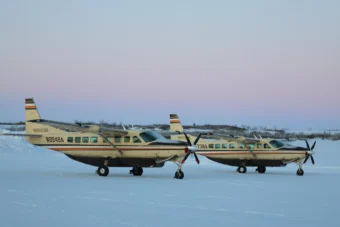
The Cessna Caravan is a mainstay in Bering Air’s fleets. Caravans were parked at the Nome Airport on Friday, Feb. 7, 2025, as a massive search was ongoing for the plane that went missing the day before on its way from Unalakleet. (Ben Townsend/KNOM)
The pilot and all nine passengers died when Bering Air Flight 445 crashed on sea ice on its way from Unalakleet to Nome.
A preliminary report from the National Transportation Safety Board found that the Cessna Caravan was overweight when it flew into icing conditions. The agency hasn’t yet determined the cause of the crash.
The family of one of the passengers, JaDee Moncur, filed the first wrongful death lawsuit in Nome Superior Court last week.
Two more lawsuits followed in Nome Superior Court in the days after – one filed by the family of passenger Talaluk Katchatag and another one by the families of Donnell Erickson and Kameron Hartvigson.
All of the complaints are based on the NTSB preliminary report and assert claims for wrongful death.
In a statement, Bering Air President Russell Rowe said it would be inappropriate for the company to comment on the lawsuit now “out of respect for the legal process and the families involved.”
“Bering Air continues to cooperate fully with the NTSB, the FAA, and all other appropriate authorities as their investigations continue,” Rowe wrote.
The NTSB expects to release a full report into the crash in early summer.
The Cessna Caravan is a mainstay in Bering Air’s fleets. Caravans were parked at the Nome Airport on Friday, Feb. 7, 2025, as a massive search was ongoing for the plane that went missing the day before on its way from Unalakleet. (Ben Townsend/KNOM)
The family of one of the victims who died in a Bering Air plane crash last year is suing the regional airline. The news came a day before the anniversary of the crash, which killed all 10 people on board and shook communities in Northwest Alaska.
Bering Air Flight 445 was on its regularly scheduled route from Unalakleet to Nome when it crashed about 30 miles southeast of Nome.
The family of JaDee Moncur, one of the passengers, filed a wrongful death lawsuit in Nome Superior Court on Thursday.

“It’s a hard week one year the same week after the accident,” said Casey DuBose, an attorney with Aviation Law Group, which is based in Seattle and represents the family. “But as we’ve done our investigation, we have enough evidence, and we decided it’s time to get moving forward with this litigation so that their family can get answers and some justice out of this terrible incident.”
Bering Air did not respond to a request for comment as of Thursday.
The federal National Transportation Safety Board has not released its full investigation into the crash. However, a preliminary report found that the Cessna Caravan was almost a thousand pounds overweight when it flew into icing conditions.
The plaintiffs argue that led to the crash.
“This aircraft flew into an area of known ice, and we think that that’s ultimately the cause of what had the aircraft lose control,” DuBose said. “As you fly into icing conditions, that ice, as it accumulates on the airframe, adds an incredible amount of weight, very rapidly.”
The court complaint also alleges that the plane flew without adequate safeguards for the conditions, though that has not been confirmed by federal investigators. DuBose said the allegations are based on the NTSB’s preliminary report and an independent investigation by the law group.
JaDee Moncur. (Moncur family photo)
The crash victims included a mentor to new teachers, a school counselor and two employees with the Alaska Native Tribal Health Consortium who were traveling to service a local water plant. Moncur, 52, was one of six victims from Southcentral Alaska.
Moncur was born in Wyoming and moved to Alaska in 2008, his family had said in an obituary. An avid outdoorsman and church volunteer, Moncur worked as a project engineer and lived in Eagle River. He is survived by his wife and three adult children.
The family said in a written statement that they appreciate the outpouring of support they have received throughout the year.
“In the wake of this tragedy, we have taken legal action to seek answers and accountability regarding the circumstances of the crash,” the family said. “We hope that through this process, we can contribute to greater aviation safety so that others do not have to endure what we have.”
NTSB officials said they anticipate the final investigation into the crash to be released in early summer.
Caribou crossing the Kobuk River as it freezes up during the fall migration. (Used with permission from Jim Dau)
The latest estimate for the Western Arctic Caribou Herd is 121,000, a steep drop from 2023. The last time the herd’s numbers were this low, Jimmy Carter was president — almost 50 years ago.

Once one of the world’s largest herds, its range is the size of California, stretching across a large swath of Northern and western Alaska. For the remote communities of the region, caribou are not only a central food source. They also have considerable cultural significance to the remote communities of the region.
Alex Hansen is a Kotzebue-based wildlife biologist with the Alaska Department of Fish and Game. He said the latest population count from earlier this year is down considerably.
“Basically, based on the last count in 2023, we’ve lost 20% of the population,” Hansen said.
Hansen’s department announced the findings at the annual meeting of the Western Arctic Caribou Herd working group held in Anchorage this month. The working group makes recommendations about the herd to federal and state regulators, who then set policy and bag limits for hunters.
This year’s population count led the working group to classify the herd as “critical, declining.” It’s the lowest population tier in their management plan. The designation directs managers to intensify efforts to the maximum extent possible for the survival of the herd.
Hansen also urged the working group to be pointed with their recommendations to the Alaska Board of Game, which meets every three years. Under state law, that board is ultimately responsible for any regulation changes.
Hansen says if the board doesn’t act in 2027, the herd’s steep declines could continue unabated for another three years.
“Six years we’ve lost the number of caribou that we have currently,” Hansen said. “So we can kick the can down the road. ‘Another few more years, let’s not do anything for the Board of Game this time. Let’s wait til the next time.’ That’s about five or six years from now. What do we have at that point? Maybe nothing.”
At last year’s Board of Game meeting, the caribou working group recommended that the board dramatically reduce the caribou harvest for the region’s hunters to four animals per year, with just one permitted cow or female caribou.
The Board didn’t follow that recommendation, which disappointed many subsistence users throughout the herd’s range. Instead, it set the limit at 15 caribou per year (only one of which could be a cow). The Board also opened up hunting to up to 300 non-resident hunters to take one caribou a year through a draw permit for Game Management Unit 23, which covers most of the Northwest Arctic. Typically, non-resident hunters don’t hit that limit.
Charlie Lean is a member of the working group that advocates for the herd. He represents the Nome region.
“I think we need to make suggestions, as we did two years ago at the Board of Game,” Lean said. “Maybe the Board of the Game will see the light.”
The working group voted again to recommend a limit of four caribou per year and to close hunting for non-residents for the management area that includes most of the Northwest Arctic. They also recommended if the herd population drops to 75,000, all hunting would automatically cease. Hunting could resume if the population rebounded to 100,000 caribou or a level that allows for a healthy sustained population.
The Western Arctic Caribou working group has classified the herd in a “critical, declining” state. This designation helps determine management plans. The working group recommended a hunting moritorium if the population declines to 75,000. The hunting ban would not be lifted until the herd reached a “preservative, increasing” tier of 100,000 caribou. (Western Arctic caribou working group meeting packet)
Tom Gray, who represents reindeer herders, shared the same sentiment of many of the working group members.
“It’s not my freezer that I’m worried about, it’s the caribou herd itself,” Gray said. “We need to keep that in the back of our heads as we’re trying to preserve this caribou herd.”
The working group also recommended a proposal to the Board of Game to make it legal for private citizens to shoot animals that predate caribou from aircraft within the herd’s range.
Those who support reduced harvest limits could also request an emergency action through the Federal Subsistence Board, which is scheduled to meet in April.
On the state management side, next the Board of Game meeting is scheduled for January 2027. The deadline for proposals to the Board is May 2026.
Alaska Organized Militia members remove debris while supporting storm recovery operations at Kotzebue, Alaska, Oct. 15, 2025. (Photo courtesy of the Alaska National Guard)
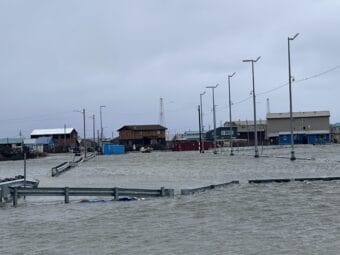
It’s been nearly three weeks since a storm caused major flooding and erosion damage in Kotzebue and other Northwest Arctic communities. That was before the remnants of Typhoon Halong made their way through the region.
After assessing the damage in multiple communities, officials said the region is moving quickly to make repairs as winter sets in.
Kelly Hamilton is the emergency manager for the Northwest Arctic Borough. He says more than 150 homes in Kotzebue have already been assessed for damage after the Oct. 8 flood and the remnants of Typhoon Halong a few days later.
The region saw similar flooding last year, too. Hamilton said many of the homes that needed repairs last year will have to go through the same process again, tearing out and replacing damaged flooring and insulation.
This year, he said the borough had a better game plan to start that work immediately.
“If at all possible, help the residents de-water, dehumidify, dry out their house, and then help them to the extent the borough can and get things buttoned up for winter,” Hamilton said.
Temperatures in Kotzebue are already in the low teens and 20s this week, making repairs more challenging.
“The residents need a dry place to live, and winter is on the way,” Hamilton said. Otherwise, they’re just living on an ice block.”
According to Hamilton, a coordinated response between the borough and multiple local, state and even national agencies — including Maniilaq, NANA and the City of Kotzebue— helped assess the damage.
Hamilton said the borough’s Village Public Safety Program also helped, but now about a dozen of the borough’s VPSOs are deployed in the Yukon-Kuskokwim Delta to help with emergency response efforts there.
Damage in Kivalina and Deering
Kotzebue wasn’t the only community in the Northwest Arctic to experience damage.
In the community of Kivalina, over 280 residents sheltered at the school during the night of the Oct. 8 storm. Several returned home to flood damage.
The Alaska Organized Militia, including Alaska National Guard members, deployed eight people to Kivalina for repairs and assessments, according to Jeremy Zidek, a public information officer with the Alaska Division of Homeland Security.
Emergency officials said Kivalina also received help from the nearby Red Dog Mine, which was able to transport water, non-perishable food items and diapers to the community via helicopter. Many Kivalina residents have already applied to the state’s individual assistance program for financial help.
Zidek said the community of Deering had erosion near their health clinic.
Erosion in Kotzebue
Zidek also said emergency officials are working with Alaska Native Tribal Health Consortium on Kotzebue’s sewage lagoon, which had just undergone repairs.
“Those repairs were just completed about a week before the storm from last year’s storm,” Zidek said.
Representatives from the Alaska Department of Transportation and Public Facilities said there was significant slope erosion in Kotzebue, especially along Ted Stevens Way. The road is closed because of the severity of the erosion, and repairs are ongoing.
“We’re working on the repairs between the bridges, and we’re working as fast as we can,” said Angelica Stabs, a public information officer with the division. “We just saw a lot of erosion.”
Kotzebue resident Matt Bergan said his home experienced damage from the flooding. He spoke at a recent Kotzebue City Council meeting. Bergan said he thinks there should be more of an effort for long-term planning.
“It seems like there’s plenty of money to respond to emergencies and fix things like we’re doing now, but it seems harder to get the money for preventive measures before disasters happen,” Bergan said.
Residents have until Dec. 9 to apply for state individual assistance and can apply for federal individual assitance until Dec. 22.
State of Alaska Individual Assistance (IA) – Deadline is December 9, 2025
To register for State of Alaska Individual Assistance:
Call 1-844-445-7131, Monday – Friday, 8 a.m. – 4 p.m.
Or apply online https://ready.alaska.gov/Recovery/IA
FEMA Individual Assistance (IA) – Deadline is December 22, 2025
To register for FEMA Individual Assistance:
Call the FEMA dedicated Alaska Center at (866) 342-1699
Or apply online at https://disasterassistance.gov Red Cross Assistance
To Register for assistance through the American Red Cross:
Call 1-800-RED-CROSS
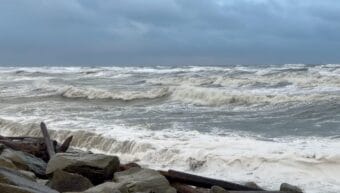
Waves crash into the shoreline of Nome as a low pressure system moves through the region. (Ben Townsend/KNOM)
Western Alaska is bracing for another strong storm system this weekend as the remnants of Typhoon Halong are expected to move into the Bering Sea late Sunday into Monday. The storm will potentially arrive just days after a strong low pressure system prompted a mandatory evacuation in Kotzebue.
According to the National Weather Service, the upcoming storm could cause strong winds, high surf and coastal flooding across the Bering Strait region.
Typhoon Halong is currently off the coast of Japan. National Weather Service Meteorologist Carter MacKay said the typhoon is expected to move east before turning north toward the Bering Sea.
“The confidence is high that it will work north into the Bering, but exactly the track of where it goes once it gets to the Aleutians is a bit more uncertain,” MacKay said.
MacKay said models predicted that tides would drop several feet below normal before surging back up as the system passes through the Bering Strait.
“It actually shows water receding to like 2-to-6 feet below the low tide line. So it’s drawing out a lot of water from our coastal communities only then to, pretty much a day later, bring it all back with the winds,” MacKay said.
The weekend’s potential storm is reminiscent of 2022’s ex-typhoon Merbok, which caused millions of dollars in damage across Western Alaska. But MacKay said it was too early to accurately compare the two storms.
Rick Thoman is a climatologist with the Alaska Center for Climate Assessment and Preparedness. He said the region has been hit with several big storms this week, and he’s also watching this next one.
“To have another one come along, seems like it’s worth starting to get folks thinking about, ‘Okay, what if we have another big storm over the weekend,'” Thoman said.
Nome officials met throughout the day Wednesday to discuss the storms. Emergency shelters and supplies will be made available in case of extreme flooding.
The city is encouraging residents to build emergency kits with water, warm clothes and food in case they have to evacuate. The city also advises residents to take pictures of property and secure any loose items outside.
Residents can find the latest forecast by visiting weather.gov/afg.
Roads near Kotzebue’s dock were flooded Wednesday afternoon. (Desiree Hagen/KOTZ)
The city of Kotzebue is under mandatory evacuation orders. That’s as the community prepares for flooding the National Weather Service warns could be worse than last year’s flood, which led to dozens of evacuations and two families losing their homes.
Flooding had already begun by Wednesday afternoon, and the Weather Service forecast said water could rise as high as 10 feet above the high tide line. Flood waters are expected to peak around 8 p.m. Wednesday night.
Forecast from National Weather Service, issued at 2:20 p.m. on Wednesday. (Courtesy of National Weather Service)
The city said Wednesday afternoon that the mandatory evacuation was issued to assist elders and to prepare residents to evacuate before dark. On Tuesday night, 28 residents stayed at Kotzebue Middle High School, which is the local evacuation point.
Kotzebue mayor Derek Haviland-Lie said first responders might not be able to reach people’s homes during the worst of the flooding.
“There may be a point, sometimes within the next 24 to 48 hours, that emergency services might not be able to make it to your home,” he said. “If that is the case, if you don’t go to the shelter, you’re going to have to shelter in place.”
As of this afternoon, barricades had been set up on the road past the airport and in other vulnerable areas of town. Haviland-Lie says the community should be prepared for power outages to several areas around town – including the airport area. Flights in and out of Kotzebue are also canceled.
“They’re worried about the water getting into their transformers that are out in the airport area. So there is going to be at some point where at least the airport is going to be without power. They have no choice,” he said.
The Kotzebue Electric Association is asking residents to report all outages and says that crews will respond when conditions are safe.
Flooding has already been reported in multiple sections of town including Front Street and the areas near Kotzebue’s airport and hospital. School is canceled Thursday. Both the city and borough closed early on Wednesday for non-essential workers.
Kotzebue’s Front Street around 4 p.m. on Wednesday, October 8. (Desiree Hagen/KOTZ)
The state also issued a notice Wednesday afternoon that it had activated its emergency operations center in preparation for a series of storms that are set to hit Western Alaska through the weekend. Kotzebue and other communities, including Kivalina, Shishmaref, Golovin, and Nunam Iqua, are expected to be among the hardest hit.
Residents in other Northwest Arctic communities have also reported that they’ve begun evacuating in preparation for the flooding. Kivalina residents are evacuating to higher ground at the school, located seven miles from the community.
This is a developing story. Check back for updates.
Close
Update notification options
Subscribe to notifications
Subscribe
Get notifications about news related to the topics you care about. You can unsubscribe anytime.