Northwest

After fatal plane crash, Northwest Alaska communities embrace victims’ families and Bering Air

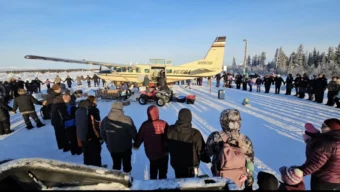
Noatak residents hold hands and form a circle around a Bering Air plane on Sat., Feb 8. 2025. People in Noatak and other villages across Northwest Alaska came out to their airstrips to support the airline employees and pay respect to the victims of the crash of flight 445 that happened near Nome. (Photo courtesy of Juanita Onalik)

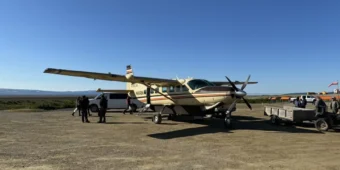
A Bering Air plane descended into Golovin on Feb. 8, two days after the fatal crash near Nome. Ten hearts were spray-painted next to the village airstrip. Residents painted them, one for each victim.

As officials were starting to look into the crash and examine the state’s long-standing aviation safety challenges, people in Northwest Alaska were standing by each other. Golovin was one of at least 19 villages where residents honored the victims and expressed their support for the pilots and staff of the regional airline.

In Shungnak, people held hands and circled the plane after it landed. In Brevig Mission, residents made signs and posters. In many places, people prayed, and in others they sang in Alaska Native languages.

“That’s what our people do, you know?” Shungnak resident Leona Commack said. “We are there for one another in times like this.”

A resident hugs one of the Bering Air employees as they exit the plane on Feb 8, 2025. (Photo by Mary Ungott)

The idea came from a health aide in Savoonga, Lara Wongittilin.

“I wanted something uplifting after the heartbreak, for the families, friends, Bering Air staff, search and rescue, and everyone else involved,” Wongittilin said. “I wanted to show our appreciation, respect, prayers and to let them know, we are standing with you all during this difficult time.”

People in Savoonga greeted a plane with a song that late Nathan Noongwook translated into St. Lawrence Island Yupik in the early ‘70s after his son died, his granddaughter Justina Noongwook said.

Since then, the community has been singing it during funerals. This time, they sang it to wish the victims of the crash an everlasting life, Justina Noongwook said.


Gambell residents sing while greeting the Bering Air plane on Sat., Feb 8. 2025. (Gambell residents sing while greeting the Bering Air plane on Sat., Feb 8. 2025. (Photo by Mary Ungott)

Four people on board flight 445 lived in Northwest Alaska. Others had close local ties, said Velma Jones from Noatak, a community of about 500 where 50 people showed up to the airstrip.

“We feel it, and we feel for their families,” Jones said.

Investigators have emphasized that the cause of the Bering Air crash, which killed all 10 on board, is still unclear. But documented gaps in the state’s weather reporting system have already been drawing attention, including by national transportation officials and Alaska’s congressional delegation. The group held a press conference earlier this week, where they brought up infrastructure issues in the state, which also has the highest rate of crashes in the nation.

Specifically, Sens. Lisa Murkowski and Dan Sullivan pointed to known issues with Alaska’s Automated Weather Observing System, which helps pilots decide if it’s safe to fly.

Many of the system’s stations are located off-the-road and use outdated technology, said University of Alaska Fairbanks Climate Specialist Rick Thoman. On any given day, 10% to 20% of the stations are down, and repairs are hard, he said. Thoman added that efforts and funding for weather station improvements have been limited.

“From my perspective, OK, that’s a start, but the amount of money that’s been allocated is nowhere near sufficient to systematically address the problem,” Thoman said.

Bering Air is the predominant air carrier in Northwest Alaska and is often the only way for residents to get to medical appointments, basketball games and other communities, as well as to receive mail, groceries and medical supplies. More than 80% of Alaskan communities are off the road system, making similar, small regional air carriers an important lifeline.

Jones said that pilots who commute people back and forth become a big part of their community.

“You get to know them personally, like you would know your neighbor,” Jones said.

Two Shungnak residents hold a sign that thanks Bering Air on Feb. 8, 2025. (Photo by Aretha Lee)

Kaylee Fagerstrom was one of dozens Golovin residents who welcomed the Bering Air plane, holding signs made by a local 7-year-old boy. Golovin said she wanted to express her support to victims’ families and pilots after the crash.

“We’re just showing our love to Bering Air so they don’t give up on us and don’t lose hope,” Fagerstrom said.

The National Transportation Safety Board has been investigating the cause of flight 445 crash. The preliminary report can take up to 30 days after the incident, and the final report can take up to several years.

Here’s what we know about the victims of the Bering Air plane crash

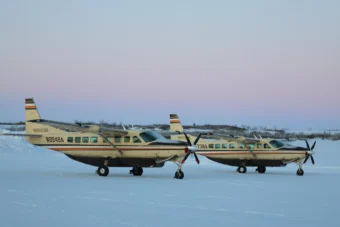
The Cessna Caravan is a mainstay in Bering Air’s fleets. Caravans were parked at the Nome Airport on Friday, Feb. 7, 2025, as a massive search was ongoing for the plane that went missing the day before on its way from Unalakleet. (Ben Townsend/KNOM)

The 10 Alaskans killed in the plane crash near Nome Thursday include a mentor to new teachers, a school counselor and two employees with the Alaska Native Tribal Health Consortium who were traveling to service a local water plant.
The plane was on its way from Unalakleet when it quickly lost elevation over the sea iceAs the investigation into the cause of the crash continues, family, friends and colleagues of the victims are sharing stories of the lives lost.

Here’s what we know so far about the Alaskans on board Bering Air flight 445.

If you would like to share memories of any of those on board the flight for this story, please reach reporter Alena Naiden at anaiden@alaskapublic.org.

Rhone Baumgartner, 46, Anchorage

Rhone Baumgartner (Courtesy of Fiona Horne)

Rhone Baumgartner was one of two Alaska Native Tribal Health Consortium employees on the flight who had traveled to Unalakleet to service the water plant.

Originally from McGrath, Baumgartner was also a bush pilot with enormous love and pride for Alaska, his friend Fiona Horne said.

Baumgartner was comfortable and happy living in extreme environments and dedicated his time to helping others, Horne said. In 2017, he and Horne met on the island of St. Thomas in the Caribbean while helping with recovery and rebuilding efforts after the catastrophic hurricanes.

“With his expertise in diesel generators Rhone was absolutely invaluable after the storms for many and he was so generous and kind with his time helping others,” Horne said. “He is one of the kindest and most pure hearted souls I’ve ever met.”

David Beveridge, a vice president of ANTHC’s Division of Environmental Health and Engineering, said that both Baumgartner and Kameron Hartvigson, the other ANTHC employee, were motivated by a commitment to the health organization’s mission.

“They had the skills to help people across Alaska and the devotion to do so under any conditions. These two members of our team lost their lives serving others,” Beveridge said. “The loss of these two incredible individuals and everyone else on board the plane will be felt all over Alaska.”

Natasha Singh, ANTHC interim president and CEO, also said that Baumgartner and Hartvigson were passionate about the work they did and the communities they served.

“They were the best at what they did and had just flown into Unalakleet to help address heating and mechanical issues in the depths of winter,” Singh said. “They gave the ultimate sacrifice for the people we serve in the work we do. Everyone at ANTHC feels a sense of shock and loss because they were so crucial to our Rural Energy and Tribal Support teams.”

Baumgartner’s family asked for privacy during their grieving time.

Donnell Erickson, 58, Nome

Donnell Erickson was a Bering Strait School District mechanic who serviced school and city vehicles in Unalakleet, said Warren Katchatag, a Unalakleet resident and janitor at the local school who used to work with him.

Nome resident Michael Nichols also worked with Erickson.

“I was a fuel truck driver, and he was a mechanic,” Nichols said during a vigil in Nome on Friday. “He took care of the whole fleet and, not just here in Nome, but he actually traveled around the village taking care of a lot of stuff. Really good guy.”

Kameron Hartvigson, 41, Anchorage

Kameron Hartvigson, the ANTHC employee, was also a father of two boys, said his friend Michelle Russo.

“His boys were his entire world, and every decision he made was rooted in his love for them,” she said.

Russo said Hartvigson was known for being kind, generous and open.

“Kameron lived with an openness and sincerity that made everyone around him feel valued and loved,” she said. “Those who knew him will forever remember his ability to make people feel seen, his unwavering support for those he cared about, and the warmth he brought into every space he entered.”

Talaluk Driscoll LaRoi Katchatag, 34, Unalakleet

Talaluk Driscoll LaRoi Katchatag (Courtesy of Rachel Frankson)

Talaluk Driscoll LaRoi Katchatag, known as TK by many, was a soft-spoken, wise and strong man who loved his family, his sister AyyuSue Katchatag said.

“Not only strong in stature, but in mind, and spirit. His soul was genuine, and he lived life so matter-of-factly,” AyyuSue Katchatag said.

His ex-wife Rachel Frankson described him as a strong-willed, hardworking and loving person, dedicated to his children.

“He worked hard. He loved hard,” she said. “My kids loved him with their whole heart and the news of this has been devastating for them.”

Carol Mooers, 48, Unalakleet

Carol Mooers (Courtesy of Unalakleet school)

Carol Mooers was from San Antonio, Texas, but was a member of the Unalakleet community, her brother Adrian Mendiola said.

As a Unalakleet school counselor, she worked in every classroom and supported student activities even during weekends, school officials shared on social media.

Mooers was generous, dedicated and kind, Kelsi Ivanoff, Unalakleet’s city administrator, said.

“She was a pillar in our school, advocating for healthy minds and bodies for our youth,” Ivanoff said. “If there was a school event, you can guarantee she was there.”

Mooers supported students in all the ways she could — creating activities for them, fundraising and making sure every child had food to eat, Teri Paniptchuk said.

“She always made sure that our kids here were taken care of,” Paniptchuk said. “If needed she would be there right away to comfort our kids if they were having a hard day. Carol is one that we will never be able to forget.”

School secretary Myrtle Ivanoff Smith said Mooers was like a sister to her. She said she has recently found herself almost waiting for Mooers her to come into her office, so they can talk and share a laugh. School staff and students have filled the walls and windows of Mooers’ classroom with paper hearts and messages addressed to her.

Liane Ryan, 52, Wasilla

Liane Ryan (Courtesy Nome Public Schools)

Liane Ryan was a retired teacher who mentored young educators in rural Alaska.

“She had such a cheerful and bubbly personality, and dedicated her post-retirement life to growing new teachers and encouraging them through those first incredibly tough years,” said Jamie Burgess, superintendent for Nome Public Schools.

Before retirement, Ryan worked as a science teacher and a volleyball coach at several schools in the Matanuska-Susitna Borough School District. She shared her enthusiasm with her students and helped them find their confidence, said her colleague Lisa Vrvilo.

After retiring, Ryan joined the Alaska Statewide Mentor Project and visited rural schools to support new educators.

In Unalakleet, she was mentoring the fifth-grade teacher, said Warren Katchatag, the school janitor.

“She was always so friendly and always smiling and down-to-earth,” he said. “She will be greatly missed at the school.”

Ryan was also a devoted wife, mother, grandmother and daughter, said Vrvilo who also worked closely with Ryan’s family.

“She poured love into every moment with her family, and my heart aches for them,” Vrvilo said. “Her legacy of faith, kindness and unwavering support for others will live on in the hearts of those who knew her. My hope is that we honor Liane by continuing the work she loved so much — lifting up educators, empowering students and making a difference, one classroom at a time.”

Chad Antill, 34, Nome

Chad Antill was the Bering Air pilot of flight 445. He grew up in Idaho and first came to Dutch Harbor in Alaska when he was 14.

“He fell in love with fishing,” his father William Antill said.

Chad Antill split his time between Nome and Southcentral Alaska and often volunteered to support Nome’s basketball team, his father said.

He was close to his three young children and family, his great uncle Jim Antill said.

“Chad had a very adventuresome heart and he loved to help people,” he said.

The other Alaskans who died in the plane crash are 30-year-old Andrew Gonzalez of Wasilla, 45-year-old Ian Hofmann of Anchorage and 52-year-old Jadee Moncur of Eagle River. Attempts to reach their relatives and friends were unsuccessful as of Saturday.

This story has been updated.

Fundraisers, prayers and songs: Western Alaska mourns crash victims

Dan Grimmer, Nome city clerk, speaks during the vigil. (Ben Townsend/KNOM)

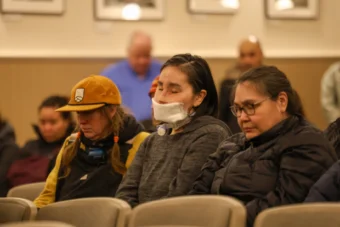
Tears, prayers and words of support filled Old St. Joseph’s Catholic Church in Nome Friday, where people gathered for a vigil to honor the people who died in the crash of Bering Air flight 445 and to support their families.

The plane, carrying nine passengers and a pilot, crashed on its way from Unalakleet to Nome on Thursday afternoon. Following a search by several agencies and volunteers, the U.S. Coast Guard found the Cessna 208B Grand Caravan 34 miles southeast of Nome on Friday. Responders were working to recover the victims, who are all presumed dead, on Saturday.

Nome resident Terry Komonaseak came to the vigil to support friends whose families have ties to the passengers.

“My grandpa always said, Iñupiaq will help Iñupiaq, which makes a lot of sense. Human beings should help human beings,” Komonaseak said. “You never know basically when you’re going to go – this incident has proven that. Hopefully, it’s gotten people closer together.”


About 60 Nome residents gather at the St. Joseph Catholic Church in Nome Friday, Feb. 7, for a vigil to honor the people who died in the crash of Bering Air flight 445. (Ben Townsend/KNOM)

Nine religious leaders from local churches spoke to around 60 people in the pews. Each of them shared a prayer and encouraged residents to rely on their community and local counseling services to help process their grief. Around the region, people were gathering and organizing fundraisers as they began processing the tragedy and searched for ways to heal.

Nome City Clerk Dan Grimmer said that the response to the crash was reverberating across the Nome community, so they wanted to encourage people, regardless of their religious beliefs, to gather.

“It is very difficult to live in this great state without brushing shoulders with your neighbor, without getting to know people from other communities, without becoming friends with them, without becoming family with them. So how do we find comfort when we need comfort?” Grimmer said from the stage. “As we see that others are hurting or they have been traumatized, it is important for us to lend them our strength, to show them love, kindness, patience – all the virtue that we can so that they can lean upon us until they become strong again.”

The crash was not the only tragedy affecting people in the room and in the region. Religious leaders spoke about other recent deaths that residents might be still processing.

“Nome has had its amount of trauma, and this is just something piled up upon trauma which has been here before,” said one of the residents, Stan Burgess.

But a tragedy of this magnitude has not happened in the region in years, said Unalakleet resident and Norton Sound Health Corporation representative Tony Haugen.

“And even to have lost one is one too many,” he said.

Haugen was in Nome because his flight home was canceled. Bering Air suspended its operations after the crash but resumed flights Saturday.

Haugen, who is also a board member of the Alaska Native Tribal Health Consortium, was learning about victims he might have known.

“Two of our employees were among those who perished,” he said.

Haugen said that people have been coming together in communities across Western Alaska.

“When the region has something that occurs like this here, it doesn’t only affect one community,” Haugen said. “We feel the pain region wide.”

Residents in several communities have started fundraisers for the families, like a cake walk in Unalakleet and an auction in Kotzebue. The owners of Kotzebue coffee shop Vibrant Brews said they would direct all Saturday proceeds to the families.

As Bering Air planes began landing again across the region, local residents showed their appreciation for the air carrier. In Savoonga, a group of people gathered at the airport Saturday to greet the incoming flight with Qagughmii’s song in St. Lawrence Island Yupik.

Amber Fernandez and other Shishmaref residents greeted the flight on Saturday, Feb. 8, 2025, to show appreciation for Bering Air and the Bering air pilots following a fatal plane crash. (Photo courtesy Amber Fernandez.)

Grimmer said that Bering Air’s crew is an integral part of Western Alaska communities, with personal ties to residents.

“This is a small region. That pilot was a member of their family,” Grimmer said. “Our heart goes out to them, because I can only imagine what they’re going through.”

Inside the church in Nome, the vigil ended with the crowd rising from their chairs to sing “Amazing Grace”. Then, Nome resident Nellie Weyiouanna spontaneously began the gospel song, “What A Day That Will Be,” as many among the audience joined in.

Searchers find missing Bering Air plane, but no survivors

The Cessna Caravan is a mainstay in Bering Air’s fleets. Caravans were parked at the Nome Airport on Friday, Feb. 7, 2025, as a massive search was ongoing for the plane that went missing the day before on its way from Unalakleet. (Ben Townsend/KNOM)

Update, Friday:

No survivors were found on board the Bering Air plane that went missing in the Nome area Thursday when searchers discovered it Friday afternoon, according to the U.S. Coast Guard.

In a post on X, the Coast Guard said three people were found dead inside of the plane. The agency did not mention the other seven on board.
The plane was found about 34 miles southeast of Nome, the Coast Guard said.

The wreck of a Bering Air plane found about 34 miles southeast of Nome on Friday, Feb. 7, 2025. Three of the 10 people aboard were found dead. (U.S. Coast Guard)

Original story:

City officials plan to hold a press conference at 5 p.m. to provide further details. KNOM will livestream the conference on its FacebookYouTube and radio signals.

A massive search is ongoing Friday for a Bering Air plane with 10 on board that departed Unalakleet Thursday and failed to arrive in Nome, officials said.

Flight records indicate that Bering Air flight 455, a Cessna 208B Grand Caravan, was flying at around 3,400 feet when it stopped transmitting its location at 3:18 p.m. It was scheduled to arrive in Nome about 10 minutes later. Nine passengers and one pilot were on board the regularly-scheduled flight, officials say.

During a Friday news conference, Coast Guard Lt. Benjamin McIntyre-Coble said an “item of interest” had been discovered and was being checked out by search aircraft. Crucial information about the missing plane’s last moments airborne came from Civil Air Patrol radar data.

“Part of that radar analysis showed that at around 3:18 p.m. yesterday afternoon, this aircraft experienced some kind of event which caused them to experience a rapid loss in elevation and a rapid loss in speed,” he said.

Officials said they did not have information yet about what led to the plane’s sudden drop. Nome’s fire chief, Jim West Jr., had said in an interview Thursday night that the pilot planned to stay in a holding pattern over Cape Nome until the runway cleared. Then the plane disappeared.

At the time of the plane’s disappearance, the National Weather Service reported visibility of just one mile in Nome, with light snow falling. McIntyre-Cole described weather conditions in the area as “pretty challenging” Thursday, noting that they forced an Alaska Air National Guard helicopter to turn back that evening. Although weather had improved Friday, conditions remained cold.

“The air temperature in the vicinity of the last known position is about 3 degrees,” he said. “The sea temperature, depending on the status of the ice, is about 29 degrees..”

Coast Guardsmen and troopers declined to identify those aboard the plane, but said all of them were adults. Their families have been notified, according to the Nome Volunteer Fire Department. “Please keep families in your thoughts at this time,” said the department’s online update.

Clint Johnson, the National Transportation Safety Board’s Alaska chief, said numerous NTSB personnel were headed to Nome Friday.

“We have a pretty large response coming from Washington, D.C., from various locations in the air, in the neighborhood of nine people,” Johnson said.

No signs of the aircraft overnight

The U.S. Coast Guard is leading search efforts Friday morning, with support from troopers, the Alaska National Guard, the FBI and local volunteers. The Coast Guard reported that the plane was 12 miles offshore when its position was lost.The search by air Thursday night was mostly focused over the water and infrared imagery returned no strong indicators of the plane’s location. The plane has not sent any alerts via its emergency locator transmitter, according to the Nome Volunteer Fire Department.

The department said Friday morning that weather for the next 24 hours looked stable for continuing the search by air, and local rescue groups would continue searching by snowmachine. A base with supplies and fuel has been established 16 miles east of town.

West said that overnight aerial surveys found no signs of the aircraft. As of Friday morning, two Bering Air King Airs, a Black Hawk helicopter and a MH-60 Jayhawk helicopter were among the aircraft involved in the search. The Coast Guard was also planning to drop a buoy to track ice movement in the area, firefighters said.

All commercial Bering Air flights for Friday have been grounded.

A Black Hawk helicopter launched from Nome Friday, Feb. 7, 2025, as part of the search for a plane that went missing in the area with 10 aboard the day before. (Ben Townsend/KNOM)

Clint Johnson, the National Transportation Safety Board’s Alaska chief, said an investigator traveled to Nome on Friday morning, with a full team en route. The FBI’s Anchorage office said it also sent a team to provide “cellular analysis,” which firefighters said might help locate the flight through signals from the cellphones on board.

All families of passengers on the missing flight have been notified, the local fire department said. “Please keep families in your thoughts at this time,” said the department’s online update. Norton Sound Health Corporation announced Thursday evening it had set up a space for family members in its third floor conference room.

A representative from Bering Air confirmed the flight number, departure time and the time of the plane’s disappearance, but declined to say more. Bering Air, based in Nome, is a major regional air carrier serving 32 communities along Alaska’s northwest coast.

 Weather hampers early air search

National Weather Service meteorologist Jonathan Chriest said that the Nome area saw snowy conditions and visibility between 1 and 3 miles for most of Thursday. Conditions cleared slightly between 2 and 4 p.m, but after that, light freezing drizzle returned and transitioned back to snow later in the evening.

“There was a period of good visibility around 3 p.m., up to 10 miles,” Chriest said. “Then visibility later on in the afternoon diminished back down to near a mile, with a short period of visibility at half a mile.”

Overnight into Friday, volunteer crews from Nome and White Mountain searched by snowmachine for signs of the plane. Danielle Sem, a spokesperson for the Nome Volunteer Fire Department, said the initial effort was a ground-only search “because of the weather and icing.”

Paul Kosto of the Nome Police Department points toward the location of a HC-130J, operated by the U.S. Coast Guard, on a map. (Ben Townsend/KNOM)

West said a Bering Air helicopter tried to search for the plane Thursday but turned around near Cape Nome, citing high winds and low visibility.

West said the city had provided a grader to plow 16 miles of road to the east of Nome for a staging area. While finding the plane is the first priority, he said windy weather and deep snow would make the work difficult.

“The next goal is, how do we get out there to get to them? Right? That’s going to be the challenge,” West said on Thursday night.

The search area includes the land east of Nome, where an occasional grove of willows breaks up the treeless tundra, and the Bering Sea just off the coast. Satellite imagery confirmed the presence of sea ice extending a half-mile from the shore.

‘It hits home for everyone’

Norton Sound Health Corporation announced Thursday evening it had set up a space for family members in its third floor conference room.

Gov. Mike Dunleavy and Alaska’s congressional delegation offered prayers for those aboard the missing plane via social media Friday.

“Rose and I are heartbroken by the disappearance of the Bering Air flight over Norton Sound,” Dunleavy said. “Our prayers are with the passengers, the pilot, and their loved ones during this difficult time.”

“Our prayers are with all those on the plane missing out of western Alaska, the Bering Air family, and the entire community of Nome,” said Sen. Lisa Murkowski.

Sen. Dan Sullivan said Friday morning that he had asked NTSB Chair Jennifer Homendy to visit Alaska – “and to her credit, she’s doing that this weekend.”

“My team and I stand ready to assist the community of Nome and (Gov. Dunleavy) in any way we can,” said Rep. Nick Begich.

Spotlights illuminate a Bering Air logo on one of the airline’s hangars in Nome. (Ben Townsend/KNOM)

The state Senate held a moment of silence in Juneau to mark word of the missing plane. State Rep. Neal Foster, D-Nome, posted links to news updates about the search on his Facebook page.

“Many thanks for keeping those on board and their families in your prayers,” Foster said.

Sem praised the response from local volunteers, who turned out in force Thursday to search for the plane at night, in 10-degree temperatures.

“When something happens here in small communities, in the small region that we live in, it hits home for everybody,” Sem said. “Because if you don’t know them, somebody else knows them.”

Correction: An earlier version of this story misstated the time the plane was scheduled to land in Nome and its altitude when it stopped transmitting its location.

This is a developing story. Check back for updates.

Alaska Desk reporter Alena Naiden contributed reporting from Anchorage.

Ambler Road project remains in limbo after Army Corps of Engineers waited months to revoke permits

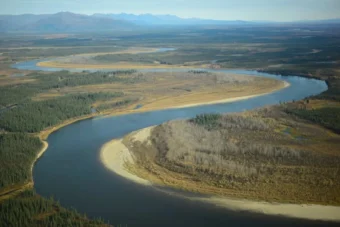
The Kobuk River runs through the Ambler Mining District, where a new road would be built to connect the Northwest Arctic with the Dalton Highway to Fairbanks. (Berett Wilber/Alaska Public Media)

Last June, the Biden administration rejected the Ambler Road Project, a proposed 211-mile road that would branch west from the Dalton Highway to a mining district. But the Pentagon did not give the Army Corps of Engineers a directive to revoke the road’s permitting until five days before President Donald Trump’s inauguration. Now it appears that the permits – and the project – may not be dead, but in limbo.
Major development projects need dozens of environmental permits from multiple agencies to move forward. It’s federal law. And for nearly a decade, permitting for the Ambler Road project has been a back-and-forth between presidential administrations.

Several tribes and conservation organizations say the road would cause irreparable harm to the land and subsistence resources. Mining companies and development supporters, including Gov. Mike Dunleavy and Alaska’s congressional delegation, say the road is necessary to access a region that mining companies say could contain valuable deposits of copper, zinc, lead, silver and gold.

Delayed Action?

The first Trump administration greenlit the project. Then multiple lawsuits challenged it. After a lengthy review process, the Biden administration rejected part of the project in June 2024, which canceled the entire thing.

But it wasn’t until Jan. 15 that then-President Joe Biden’s Pentagon ordered the Army Corps of Engineers to kill one set of permits that are critical to the road megaproject — the 404 permits. 404 permitting is part of the Clean Water Act. When developers need to dredge or fill wetlands, they require 404 permits from the Army Corps of Engineers.

The Ambler Road project has these permits to cover the entire length of the road corridor — which includes around 1,431 acres of wetlands, including a half-acre of open water. Corps spokesperson John Budnik confirmed in an email the timeline and the directive to revoke the 404 permits. And he confirmed that the permits instead remain suspended — not quite dead.

Rob Rosenfeld, a consultant for several tribes that oppose the project, believes the Corps dragged its feet and should have killed the 404 permitting after the Biden administration rejected the project in June. Rosenfeld said the Corps’ inaction went against the wishes of 88 tribal governments that oppose the project.

“The intent for the tribes was to have that revoked,” he said. “Finally, in the 11th hour, on Jan. 15, the assistant secretary of the Army issued the order to revoke.”

Rosenfeld said it is uncommon for a commander or his staff to ignore orders issued by a superior officer.

“It was either done intentionally or accidentally,” said Rosenfeld. “The chain of command in the Department of Defense is something that is typically unbreakable. I don’t know if I’ve ever heard of it.”

An uncertain future

On his first day in office, Trump ordered that the Biden administration’s decision on the road be thrown out and replaced with Trump’s own pro-development decision. The 404 permitting remains in limbo.

Budnik shared an official statement from the Corps:

“With the change of administrations and the new Executive Order regarding this project, we are currently pending updated guidance and will have more information as soon as it is available,” it read.

Representatives of multiple pro-road interests, including the Alaska Industrial Development and Export Authority, the state-backed economic development corporation, and three mining companies with stakes in the region, could not be reached for comment.

But the project still faces major obstacles. Nana Regional Corporation, a landowner along the road’s route, has withdrawn from the project, for now. A representative from Doyon, Limited, noted that while it is a major stakeholder for the project, Doyon does not support or oppose the road. According to Rosenfeld, permitting that was revoked under the Biden administration, like the National Historic Preservation Act Programmatic Agreement, would have to be rewritten, which could take at least a year.

“Nothing will happen quickly,” said Rosenfeld. “I can say the collective we — the environmental organizations, the tribes and those Alaskans that don’t want that road — are going to fight it in the courts.”

Bridget Psarianos is the senior staff attorney for Trustees of Alaska, an environmental law firm based in Anchorage. She said the Army Corps could still revoke the 404 permits, reinstate them or modify them.

In the meantime, though, Psarianos said the permitting is “sort of paused.”

Correction: This article has been updated to reflect that Doyon, Limited, a stakeholder for the Ambler Road, has maintained a neutral stance on the project.

State Sen. Donny Olson hospitalized in Anchorage

Sen. Donny Olson, D-Golovin, speaks during a Senate floor session in Juneau on March 13, 2019.
Sen. Donny Olson, D-Golovin, speaks during a Senate floor session in Juneau on March 13, 2019. (Photo by Skip Gray/360 North)

State Sen. Donny Olson, D-Golovin, was flown to Anchorage last week after suffering a medical emergency. The 71-year-old lawmaker took to Facebook on Monday to acknowledge the news.

“First I’d like to thank those who have lifted me up in prayer over the years,” Olson said. “I suffered a medical event in Juneau and I put my guardian angels to the test. I received quick care and am well on the road to recovery.”

Olson was in Juneau participating in the opening week of this legislative session. He wasn’t able to provide an exact time for his return.

“I will need some time to heal but rest assured I will be back at 100% soon,” Olson said. “God is good, all of the time.”

His wife, Willow Olson, responded to a tweet by The Alaska Landmine to thank the public for the well wishes.

“We are really grateful for everybody that helped with a quick intervention. He will need to take some time to recuperate, but you know him, he’ll be back to work before we expect it,” Willow Olson said. “Really appreciate that (Gov. Mike Dunleavy) called to check on him. We would appreciate privacy right now.”

Site notifications
Update notification options
Subscribe to notifications