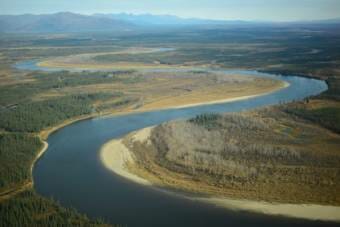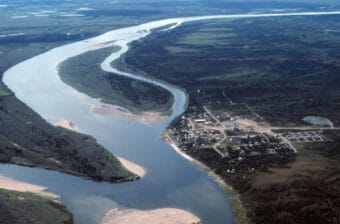
Aerial view of Ambler and the Kobuk River in the summer. (National Park Service)
U.S. Sen. Dan Sullivan said he’s added an amendment to an annual defense bill that would override the Biden administration’s rejection of the Ambler Road.
In a press release, Sullivan said the amendment requires the Interior Department to “select a viable path for the project across public land.”
The proposed Ambler Road would run more than 200 miles. It would start west of the Dalton Highway and terminate in a mineral-rich area called the Ambler mining district, surrounding the village of Kobuk. The road corridor would cross federal land, including part of Gates of the Arctic National Park.
A 200-mile road would connect the Ambler mining district to the Dalton Highway. (Alaska Division of Mining, Land and Water)
The project is controversial in the region. Several tribes say the road is a threat to caribou and the subsistence way of life.
The Biden administration in April rejected the project. NANA Regional Corp. withdrew in May, saying the state-owned entity that’s pursuing the road, the Alaska Industrial Development and Export Authority, hadn’t addressed its concerns about resource protection and community benefits.
But Sullivan and Sen. Lisa Murkowski railed against the federal decision to reject the road. They say the project would allow mining of minerals critical to national security and the economy. Alaska Congresswoman Mary Peltola also criticized the rejection. She called the decision premature, since regional stakeholders were still debating it.
Sullivan’s amendment to revive the road is in a bill called the National Defense Authorization Act, which has cleared the Senate Armed Services Committee. The next stop is the Senate floor.
There is little additional information available. The bill text hasn’t been made public yet and Sullivan did not grant an interview request.
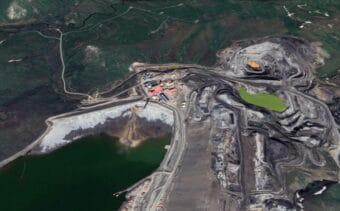
The Red Dog mine near Kotzebue is one of the largest zinc-lead mines in the world. (Google Earth)
The Red Dog mine has been a huge economic engine for the Kotzebue region for decades. But the zinc and lead deposits the mine relies on are running low and Red Dog may shut down operations as soon as 2031. KOTZ’s Desiree Hagen has been following this story.
Listen:
The following transcript has been lightly edited for clarity.
Ava White: If Red Dog closed how big of an economic hit would this be?
Desiree Hagen: So just a little background first. The Red Dog Mine produces about 4% of the global zinc supply. The land is owned by the NANA Regional Corporation, while the mine itself is owned and operated by Canadian mining company, Teck Resources. Red Dog is often held up as a success story for how an international mining company can work with an Alaska Native corporation.
And the economic impact would be enormous if the mine closes down. In 2023, about a thousand NANA shareholders were working for the mine, which equates to about $62 million in yearly wages to shareholder employees.
Here’s NANA’s Vice President of Lands Liz Cravalho.
“We cannot stress enough the impact of Red Dog’s planned closure on shareholders and the region as a whole,” said Cravalho.
As Cravalho said, it’s not just shareholders. Red Dog revenue touches everything in the Northwest Arctic.
The Northwest Arctic Borough receives about 80% of its revenue from what’s known as a payment in lieu of taxes agreement or PILT. So the Red Dog mine contributed around $26 million to the Borough last year. That money helps support the region’s schools, infrastructure projects and things like water and sewer in the villages, even public radio.
Red Dog revenue also supports other Alaska Native Corporations through 7(i) and 7(j) contributions which is a provision of the Alaska Native Claims Settlement Act. Since mine operations began in the late 1980s, NANA said the company has shared around $1.8 billion with other Alaska Native Corporations/ANCs.
Ava White: Do you have a sense of how likely it is that Red Dog will shut down?
Desiree Hagen: It’s kinda in limbo. There are two deposits close to the mine that Teck and NANA are looking at developing. If developed they could extend the mine life for decades. But before a decision is made, Teck needs to build a gravel road to access the deposits and do more exploratory work. Right now the company is waiting for a permit from the Army Corps of Engineers before they are able proceed.
Ava White: What can you say about these potential deposits?
Desiree Hagen: They are located about 8 miles from Red Dog’s main operating site, on state land, unlike Red Dog’s current location which is on NANA-owned land. This brings into question how those deposits would pan out economically both for NANA and the state if they are developed. As far as the deposits themselves – they are not easily accessible from the surface and would require underground mining – which is different from the open pit mining Red Dog currently uses. Teck said they aren’t really able to say much about the deposits until more exploration work is done.
Ava White: Do we know when Teck will make a decision?
Desiree Hagen: According to the company, once Teck receives the permits and the exploratory work begins it will take about six years before they can determine if the deposits are “economically and environmentally viable.”
That puts us really close to the planned 2031 closure of the mine. But keep in mind, if Teck moves forward with those deposits there’s still more work that would have to be done. Any major development would require environmental permitting, a haul road to transport ore, and a mine would need to be planned and constructed. It could be a lengthy process.
Here’s what Teck representative Wayne Hall said in a recent interview.
“I can’t really speculate on the timelines,” said Hall. “What I can tell you, it’s in all of our best interests to do whatever we can to shorten these timelines so that there is not a gap in production.”
Ava White: Does the borough have a plan B if the mine doesn’t continue producing ore?
Desiree Hagen: Both NANA and the Northwest Arctic Borough have begun preparing. Last fall NANA shareholders voted to establish a fund modeled after the Alaska Permanent Fund that puts Red Dog revenues aside to invest. This would ensure that NANA shareholders will continue to have sizable dividends once the mine ultimately closes – whether that’s in eight years or decades from now.
The Borough who – remember – receives the majority of its revenue from the mine has begun making budget cuts and is looking more seriously at the programs and services that it funds. But, the question of what will happen if or when the mine closes is a discussion at every recent Borough meeting. Several Assembly members have called it a “difficult and ongoing” conversation.
The NANA Regional Corp. office in downtown Anchorage is seen on Wednesday. The Native corporation, citing dissatisfaction with management by the Alaska Industrial Development and Export Authority, is ending its involvement with the Ambler Access Project. (Photo by Yereth Rosen/Alaska Beacon)
The regional corporation owned by the Iñupiat people of Northwest Alaska said Wednesday it is severing its ties to the Ambler Access Project, the controversial road that a state agency proposes to build through the Brooks Range foothills to allow commercial mining in an isolated Arctic area.
NANA Regional Corp., based in Kotzebue, said it will not renew a land-use permit for the project that it granted to the Alaska Industrial Development and Export Authority. AIDEA is the state-owned corporation that is seeking to build the 211-mile road through to the Ambler Mining District, the site of deposits of copper and other valuable metals. The land-use permit, which has a three-year duration, will expire this year, NANA said in its statement.
AIDEA’s management of the project led NANA to break away from it, the corporation said.
“This decision reflects unmet criteria, insufficient consultation, and a lack of confidence in the project’s alignment with our values and community interests. NANA upholds a rich legacy of responsible resource development in our region, guided by a commitment to protect and advance our Iñupiat way of life. NANA established specific criteria required to consider supporting AAP, including controlled access, protection of caribou migration routes and subsistence resources, job creation and community benefits. These criteria remain insufficiently addressed by AIDEA,” the company’s statement said.
The NANA decision is the latest in a series of setbacks for the Ambler Access Project.
It has been criticized by environmental and some regional tribal organizations as threatening the region’s environment and the natural resources upon which residents of Indigenous communities depend. Most prominently, the road project is portrayed as a dire threat to the Western Arctic Caribou Herd, one of North America’s largest caribou herds. The project is opposed by numerous tribal governments and organizations representing people who live along the proposed corridor, including the Tanana Chiefs Conference, an Interior tribal consortium. Opponents have cited the disruptions to caribou that roads are known to cause, among other concerns.
Citing those and other concerns, the Biden administration last month announced that it planned to deny a right-of-way permit for construction of the Ambler Access Project. The decision against proceeding with the project was contained in a final supplemental environmental impact statement released on April 19 by the U.S. Bureau of Land Management.
But the road and the mining it would enable are supported by Alaska political leaders and some other Native organizations.
The Alatna River, seen on Aug. 26, 2014, winds its way through a long valley in Gates of the Arctic National Park and Preserve. The proposed Ambler Access Project would put a road crossing over the Alatna River just downstream from Gates of the Arctic. (Photo by Sean Tevebaugh/National Park Service)
Supporters tout the potential economic benefits, not just in the Ambler region but along the entire corridor, where there are other mining claims and potential development sites. And they have made a pro-environment pitch for the project, arguing that it would provide supplies of copper and other minerals needed for the transformation away from fossil fuels.
NANA, which owns mineral-rich land in the region, still wants the option of developing mines there, the corporation said in its statement. Despite its break with AIDEA, the corporation said it disagrees with the Biden administration decision on the road.
“Our Elders fought to retain our ancestral lands in the Upper Kobuk, emphasizing both their subsistence value and mineral resource potential. It is our responsibility to steward these lands for future generations,” Gia Hanna, chair of the NANA board of directors, said in the statement. “All decisions about development on our lands need to be made by and with our people at the table. We intend to vigorously defend our right to pursue resource and infrastructure development in alignment with our values.”
“For more than 40 years NANA has successfully developed our resources alongside trusted industry partners in ways that respect our way of life and advance our region as a whole,” said John Lincoln, NANA president and CEO. “While NANA is disengaging from the AAP, we maintain our interest in future mineral development in the region that aligns with the expectations of our shareholders.”
NANA, one of the for-profit corporations created by the 1971 Alaska Native Claims Settlement Act, has been heavily involved in mining. The Red Dog mine, one of the world’s largest zinc producers, has for decades been an economic pillar for the corporation and for the Northwest Arctic region. The mine is located on NANA land and operated by Teck Resources Ltd.’s Alaska unit.
NANA owns some of the lands in the Ambler district and has a partnership with Ambler Metals LLC., the joint venture that is exploring mineral deposits there. Ambler Metals would be the prime beneficiary of the road. The joint venture was formed by Trilogy Metals Inc. of Canada and South32 of Australia.
The partnership with Ambler Metals remains intact, said Kaylee Devine, NANA’s director of communications.
“NANA will work with Ambler Metals to reassess the future of Upper Kobuk Mineral Projects,” Devine said by email. “NANA recognizes the significant value and economic potential the Upper Kobuk Mineral Projects has for the region and to provide critical minerals for the energy transition. However, any resource development project and its associated transportation methods must align with necessary criteria to ensure protection of subsistence and our traditional way of life. The Ambler Access Project, as proposed, does not meet NANA’s criteria.”
NANA’s statement said the BLM decision appears to be illegal, violating a provision of the 1980 Alaska National Interest Lands Conservation Act that guarantees future mining-road access through Gates of the Arctic National Park and Preserve. The road plan advanced by AIDEA includes 26 miles through Gates of the Arctic.
Devine said NANA takes issue with other aspects of the BLM decision. The supplemental environmental impacts statement was inaccurate in the way it portrayed the performance of the Red Dog mine, and those inaccuracies might affect future development decisions, she said. Additionally, the BLM document “appears to overreach in its authority,” possibly limiting activities on NANA’s land, she said.
The Biden administration decision against the road reversed a 2020 decision by the Trump administration to grant a right-of-way allowing construction of the Ambler Access Project. In response to lawsuits filed by numerous Native and environmental organizations, the Biden administration suspended the previous administration’s right-of-way and launched the supplemental environmental impact statement. That new analysis found that the Trump administration had vastly understated the road’s expected impacts to caribou, fish and other resources important to Indigenous culture, as well as to permafrost.
Randy Ruaro, AIDEA’s chief executive, said NANA’s decision effectively removes an exploration mine site on NANA land from the project. That mine site covers 500,000 to 750,000 acres, Ruaro told the Senate Finance Committee on Wednesday.
“But that still leaves nearly 600,000 acres in state mining claims that will benefit from the road and several other large mines. So we’ll respect NANA’s decision and we’ll bend the road to the north and we’ll stay on state land and avoid NANA land,” he told the committee.
He called the decision “unfortunate” but that AIDEA will continue to push for the road.
Also still pushing for the road is Sen. Lisa Murkowski, R-Alaska. At a U.S. Senate Interior Appropriations subcommittee hearing on Wednesday, she said she is considering cutting the Deportment of the Interior’s budget in response.
She told Interior Secretary Deb Haaland at the hearing that the Ambler decision was part of a Biden administration pattern of unfairly blocking resource development in Alaska. Other decisions in that pattern concerned blocking oil development in the Arctic National Wildlife Refuge and new rules limiting oil development in the sprawling National Petroleum Reserve in Alaska, Murkowski said.
“Why are we treated like one big national park and wildlife refuge, instead of a state that has balanced the need for development and the desire for conservation?” Murkowski asked Haaland.
“Right now, I’m in a position, I’m in a place, where it’s really hard for me to discuss the budget requests,” Murkowski said. “All I can think about is: If Interior is going to use its funding to make these kinds of decisions that penalize my state in this way, then I feel like what we need to be doing here is looking for ways to cut the department’s budget until the department gets the point, and returns to following the law and the balance that is reflected within it.”
The Kobuk River runs through the Ambler Mining district, where a new road would be built to connect the Northwest Arctic with the Dalton Highway to Fairbanks. (Berett Wilber/Alaska Public Media)
The U.S. Interior Department on Friday essentially rejected the Alaska Industrial Development and Export Authority’s proposal to build the Ambler Road, a 211-mile industrial road that would have cut through Gates of the Arctic National Park and Preserve to access copper and zinc deposits in Northwest Alaska.
The Interior’s Bureau of Land Management chose a “no action” option in its environmental analysis, effectively ensuring AIDEA would not receive a right-of-way to build the road across federal lands. The Biden administration said the road, also known as the Ambler Access Project, would cause irreparable damage to wildlife including caribou, which many local people rely on for food.

The administration also announced stronger protections for 13 million acres inside the National Petroleum Reserve-Alaska, a vast swath of oil-rich — but environmentally sensitive — federal land in the Arctic.
Both of Alaska’s U.S. senators, Republicans Dan Sullivan and Lisa Murkowski, expressed outrage even before the decisions were formally announced. They said the decisions hamper the state’s economy and domestic resource development.
“It’s more than a one-two punch to Alaska. When you take off access to our resources, when you say you cannot drill, you cannot produce, you cannot explore,” said Murkowski in a press conference on Thursday. “This is the energy insecurity that we’re talking about.”
Voice of the Arctic Iñupiat, a pro-development advocacy group comprised of Indigenous leaders and funded in part by the Arctic Slope Regional Corporation and North Slope Borough, called the NPR-A decision “insulting.”
“We deserve the same right to economic prosperity and essential services as the rest of this country and are being denied the opportunity to take care of our residents and community with this decision,” North Slope Borough Mayor Josiah Patkotak said in a statement.
But other Indigenous people applauded the decisions, as did environmental groups.
“That caribou were heard over cash is a really big deal,” said China Kantner, an activist from an anti-road group called Protect the Kobuk.
Evansville Chief Frank Thompson said his tribe has been fighting the Ambler Road proposal for a decade. He thanked the Bureau of Land Management and the Interior Department for listening to them and protecting traditional hunting and fishing.
“Today is a great day,” he said. “Our future looks bright without the threat of 168 trucks driving by per day. Without increased pressures on our subsistence resources.”
Bret Hanson puts Canadian bacon on a pizza in the kitchen at Peace on Earth, the restaurant in Unalakleet he owns with his wife, Davida. The couple was busy baking pizzas for mushers in the Iditarod Trail Sled Dog Race on Sunday, March 10, 2024. (Casey Grove/Alaska Public Media)
UNALAKLEET – They’re selling love by the slice at the local pizzeria.
Encouraging messages from all over the globe come with each pizza that the Peace on Earth restaurant delivers to this Iditarod Trail Sled Dog Race checkpoint, about three-quarters of the way into the 1,000-mile race. The mushers have been arriving here at the edge of Alaska, cold and tired after long stretches with only sled dogs to keep them company.
Their family, friends and fans began placing pizza orders by phone weeks ago. The calls kept coming as the front-running sled dog teams came in Sunday.
Left to right: Davida, Bret and Joann Hanson in the family’s restaurant, Peace on Earth, as they took pizza orders for mushers. (Casey Grove/Alaska Public Media)
The messages say things like “Good luck” and “Keep on mushing.” Some are inside jokes or written in a language other than English that Peace on Earth owners Davida and Bret Hanson, who cook the pizzas and write the messages in marker atop each box, don’t even understand.
“You get moms and dads, you know, ordering their kids pizzas,” Davida said. “And so you get, ‘Love, from Mom and Dad. Oh, and can you put a heart on there?’”
And, yes, they will draw a heart on the box, she said.
Davida Hanson holds her grandson, Christopher, while looking over pizza orders with her daughter-in-law, Joann, at Peace on Earth, the family’s restaurant. (Casey Grove/Alaska Public Media)
“Some of them get pretty personal,” Davida said. “Some of them are long, you know, so you’re sitting there, and you don’t want to mess up on the message, and it might be a couple sentences, and you’re actually writing a whole note to this person.”
A few make you want to cry.
That’s what happened last year when Australian musher Christian Turner’s wife called in an order from their home in Queensland, over 6,500 miles away. She included a message from their baby daughter.
“The message on there says, ‘Love you, Daddy, from your bubby girl,’” Davida said, holding up her phone to show a picture of Turner eating the pizza. “And when he read that, he just teared up, and it got the whole Iditarod checkpoint emotional.”
Even a year later, standing in her kitchen at home, Davida’s eyes were welling up.
“It was the most gut-wrenching happiness I’ve ever seen, because it was just, when he saw that, you know, there was that connection,” she said. “Maybe they haven’t seen their family in a long time, and when you get a message like that on one of these pizza boxes, it gives you that extra push to say, ‘OK, I’m almost there. I can do this.’ Or, you know, it kind of just lights that spirit back up in them, I think.”
A note to go with a pizza order for Iditarod musher Travis Beals Sunday. (Casey Grove/Alaska Public Media)
The Hansons have recognized that connection for years. They’ve operated Peace on Earth since they fired up the pizza oven the day after Christmas in 1996. Their house is right next door, and when the Iditarod racers are coming through, they’re often going back and forth between home and the restaurant, taking orders and making the pizzas: rolling out dough, spreading the dark red tomato sauce, sprinkling toppings like pepperoni and sausage and firing the pies in the oven.
Bret is constantly checking the Iditarod’s GPS tracker to make sure he’s ready to cook the right pizza for the right musher at the right time, to get it to them still hot when they get here.
“It’s just important,” Bret said. “It’s important to the people that made the orders, and it’s important to the mushers, because I’ve seen it in their eyes, to have something special and a little message from whoever is sending it.”
Bret Hanson puts a prepped pizza in a rack in the kitchen at Peace on Earth. (Casey Grove/Alaska Public Media)
Bret remembers the first time he saw a musher’s eyes light up when they got a pizza and a message from afar.
Swiss musher Sven Haltmann, by way of Fairbanks, had mushed in after more than 700 miles on the Iditarod Trail and was trudging along with buckets of water to mix with food for his dogs. Bret told Haltmann he had a pizza for him, from an order someone called in from the Lower 48.
“He turns around and says, ‘Wow, really?’” Bret recalled. “His face changed, and his eyes lit up and everything lit up all at the same time … and the change in his whole posture and emotion is just so memorable in my mind that I just think of him as the first one.”
Iditarod musher Matt Hall arrived here in fourth place Sunday, the musher and dogs all wearing red jackets that were only a slightly brighter hue than the pizza sauce. It had gotten down to 45 below zero the night before on the trail. After bedding down and feeding his dogs, Hall ambled into the checkpoint building to get something to eat for himself.
Musher Matt Hall hits a frozen bag of meat with the back of his axe to break it apart at the Unalakleet checkpoint. (Casey Grove/Alaska Public Media)
Hall spotted a stack of three pizza boxes with the name “Matt” on it, but thought at first it was for his competitor Matt Failor. Hall was going to take a piece anyway, then he realized the box had his bib number, 16, on it.
“I would’ve still stolen a piece,” Hall said.
Hall took a big bite of the cheese pizza. It was much better than the freeze-dried meals he’d been eating on the trail, he said.
“Yeah, this is super cool,” Hall said. “This is really hitting the spot. Mm hmm. This is delicious.”
Musher Matt Hall enjoys a slice of cheese pizza from Peace on Earth, a restaurant. (Casey Grove/Alaska Public Media)
Scrawled atop the box were the words “Good luck at the race. Have fun.” It was from a 4th grade class in West Newbury, Mass.
The pizza messaging really took off, the Hansons said, with a group of fans known as the Ugly Dogs, cultivated online by Wisconsin writers and dog mushers Blair Braverman and Quince Mountain, a married couple who’ve both run the Iditarod. (Ugly Dogs is a reference to a message Braverman got on the social media platform then called Twitter, in response to something she’d written about Taylor Swift, when a Swift fan told her to, “Go back to you ugly dogs, Karen.” Braverman and Mountain thought that was hilarious, and the name stuck).
The Ugly Dogs comprise a wide and active network online, and when they learned they could buy pizzas for mushers about five years ago, the orders started pouring in from all over, the Hansons said.
At first, the Ugly Dogs would order pizzas for specific mushers, Bret said. But some mushers would have a stack of them at the checkpoint, and others wouldn’t have any, he said.
“They decided that nobody should go without a pizza, and they made sure everybody down to the Red Lantern had a pizza,” Bret said. “And that was all the Ugly Dogs.”
Nowadays, the mushers come in anticipating the pizza and heartfelt messages. They walk into the checkpoint building, a part of the post office a short walk from the dog yard, asking if there’s a pie waiting for them, Davida said.
A former Iditarod musher had recently explained how good it felt to get a hot pizza with a warm note, Davida said.
“I was like, ‘OK, that’s why that’s why we do it,” she said. “So somebody knows they’re being thought of.”
A winter 2015 scene in Point Hope (Ellen Chenoweth/University of Alaska Fairbanks)
A 16-year-old boy has been charged with killing two adults and wounding two others during a shooting Sunday night in Point Hope.
Court records show two first-degree counts each of murder and attempted murder in Sunday’s shooting.
According to a charging document filed Monday, borough police responded just after 11:30 p.m. Sunday to the shooting at an Agvik Street residence. Officers found four gunshot victims: a dead man and woman, along with two severely wounded men.
The charging document says one witness told police she saw the suspect go into a house with a handgun and start shooting. Other witnesses described watching the suspect leave the house with a handgun and drive away on a four-wheeler.
The document did not mention what relationship the suspect had with the victims, if any, or any motive for the shooting.
Prosecutors said the suspect’s father brought him to the Point Hope police station soon after the shooting, saying he had confessed. The charging document says that officers read the suspect his Miranda rights before an interview with his parents present where he allegedly told police he had shot all four adults.
Close
Update notification options
Subscribe to notifications
Subscribe
Get notifications about news related to the topics you care about. You can unsubscribe anytime.