Northwest

Ongoing internet outage hamstrings 911, other vital services in Northwest Alaska

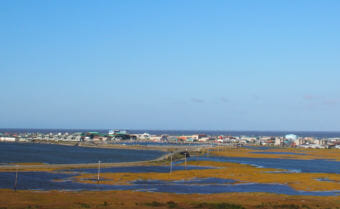
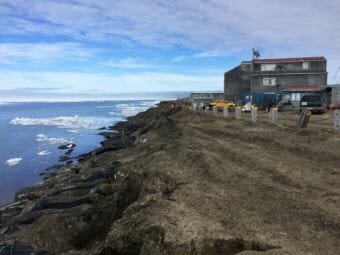
The Utqiagvik coastline, in a residential area near downtown. (Ravenna Koenig/ Alaska’s Energy Desk)

It’s been a week since ice severed a fiber optic cable in the Arctic Ocean, cutting communications to at least half a dozen communities in Northern Alaska. Many are still without internet or cellular service, and the company that owns the cable says it will be two months until the line is repaired. 

The break is disrupting normal life for many communities above the Arctic circle — including vital emergency services.

The cable connected most of Northwest Alaska. Quintillion, the Alaska-based company that owns the line, says the break primarily affected Nome, Kotzebue, Point Hope, Wainwright and Utqiagvik, as well as the villages of Atqasuk and Nuiqsut. 

Last Wednesday, the North Slope Borough issued an emergency declaration stating that the fiber break would “severely impact” the ability to provide essential services such as search and rescue, police, fire and utilities.

Atqasuk is feeling the break’s repercussions. Doug Whiteman is mayor of the community of about 300 people, which is 60 miles southwest of Utqiagvik. He says emergency communications aren’t working like they should between communities.

“We had a circumstance with 911 calls. The village police officer could call Barrow and they could hear, but their replies didn’t come back,” he said. “It’s a one way conversation.”

Whiteman says the borough is advising the community to stay off what limited internet is available. He says right now, public safety, the health clinic and fire are all sharing one satellite phone.

Further south, Wainwright — a community of nearly 700 people — is encountering similar challenges.

Mayor Chester Ekak says Wainwright is having problems with their 911 services, too. They also experienced one way communication with emergency services in Utqiagvik, which forced them to find a work-around.

“We had to set up a temporary dispatch facility and utilize VHF for police, fire and ambulance call out,” he said.

He says it’s not just emergency response that’s ground to a halt. It’s also daily life.

“It’s affecting businesses. Day-to-day operations. Stores turned into cash-only stores — they all were affected by the cable break,” he said.

Ekak says the ATMs require an internet connection, so now customers can’t withdraw money for the cash-only businesses. And Ekak says it’s also affecting people who receive assistance like EBT because they can’t use their cards.

Businesses in Kotzebue are also feeling the effects. Lewis Pagel is the owner and lead physician at Arctic Chiropractic. He says his office is without internet, which means he can’t process insurance billing, and his patients can’t schedule appointments.

“Also, my credit card machine won’t work either. So I can’t collect payments at the office. So from a financial standpoint, it’s pretty detrimental,” he said.

Pagel’s office isn’t alone. Kotzebue City Manager Tessa Baldwin says the fiber break is disrupting government operations — and that the city is unable to connect to their server, internet and phone.

The city is without internet, and  I went over there yesterday morning to pay my business taxes. But they can’t process anything,” she said. “We’re very lucky that our emergency services are still in operational mode.”

This week, Baldwin says the city was scrambling with payroll. They were able to resolve the issue, and now over 100 people employed by the city will be receiving their checks — a few days late.

“It’s been extremely difficult to manage a city with no internet or phone service,” she said.

Baldwin says there have been other issues including meeting the city’s grant deadlines and communicating with city partners outside of Kotzebue.

Internet outage closes government offices, businesses and university campus in Kotzebue

Kotzebue as seen from the road east of town (Photo by Zachariah Hughes/Alaska Public Media)

On Sunday morning, many Kotzebue residents woke to find their internet down and cell phones without service. Several days later, there’s little-to-no communications in or out, and it might be two months until services are restored to normal.
That’s according to a press release from telecommunications company Quintillion. On Monday, Quintillion reported a fiber optic cable in the Arctic Ocean had been cut, essentially severing the main artery of communications for most of rural Alaska west of Prudhoe Bay.

According to the press release, ice was the culprit. The severed cable is about 30 miles from Oliktok Point in Prudhoe Bay — and 90 feet beneath the ice.

In Kotzebue, the outage is affecting the local government operations. The City of Kotzebue is experiencing a “complete outage” to all departments. And the Northwest Arctic Borough says their telephone and internet services are down.

Kelly Williams is the CEO of OTZ telephone, a Kotzebue-based communications cooperative that provides internet, phone and cellular service to the region.

“A lot of people don’t know, this fiber optic cable is made of glass — it’s a tiny little glass tube,” he said. “Impact that ice can have, which we’ve all seen when you live in our area, especially sea ice, that there’s an inherent risk there,” he said.

The cable break is primarily affecting the hub cities of Bethel, Nome, Kotzebue and Utqiagvik. Williams says many remote communities in the Northwest Arctic are unaffected by the break. Villages in the region are mostly serviced by satellite.

“All the 10 village communities we serve are still up and running fine. We have them connected through a mixture of technologies of low, Earth-orbiting satellites and geosynchronous satellites,” he said.

For OTZ customers in Kotzebue, Williams says the communications outage only knocked out broadband.

“We had a backup system in place by which all of our emergency services, calling, texting, immediately switched when that cable was severed over and kept all of our, what we would call our vital services, up and working,” he said.

Heather Handyside is the Chief Communications officer for GCI. She says you can imagine that the fiber optic cable is a highway. But the highway’s been blocked. Now, GCI customers have to take a detour — they can get back online with satellite and microwave technology.

“It’s critical, especially in places like rural Alaska with unpredictable conditions, unpredictable weather, typhoons, earthquakes, wildfires, that there are backup systems,” sh said. “We will at least be able to deliver a basic level for phone calls, emails, text messages.”

But the backup internet service is still spotty and slow. As of Tuesday afternoon, many businesses in Kotzebue were unable to process credit card payments. Some even closed. The University of Fairbanks Chukchi Campus and library remain closed until further notice following the outage.

Nome brothers take home $500k for winning ‘Race to Survive: Alaska’

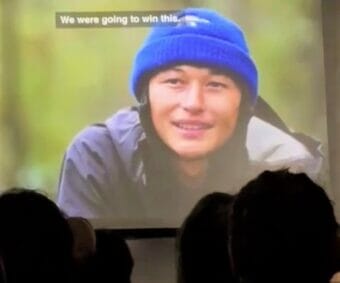
The first-season finale of “Race to Survive: Alaska” was broadcast Monday, June 5 at the Katirvik Cultural Center in Nome. (Ava White/KNOM)

Nome residents and brothers Oliver and Wilson Hoogendorn, competing as the AK Boys on USA Network’s “Race to Survive: Alaska” TV series, took home the championship on Monday during a watch party in front of a packed hometown audience.

The series finale was viewed by more than 100 attendees at the Katirvik Cultural Center.

After showcasing their win, which includes a $500,000 cash prize, in front of the standing-room-only crowd, they said this is what was most challenging.

“Probably starving for like 50 days,” the pair said. “One hundred percent.”

The first season of Race to Survive: Alaska aired starting in March of this year and showcased eight teams embarking on a competition to survive the Alaskan wilderness. The brothers competed over the summer across the 50-day survival course, becoming the first winners of the show.

The eight teams of two competed in six races over 100 miles of wilderness in rough and rural Alaska.

The brothers faced treacherous terrain and weather, but persevered and brought the win home to Nome. They said they needed each other more than anything else during the competition.

“I think with any other partner, wouldn’t have gone as well, so I’m glad we had each other,” Oliver said.

“If I didn’t have my brother as a partner, we probably wouldn’t have won,” Wilson said.

The teams were only allowed to use what they could carry on their backs and used their wildland skills to make it through each race.

With their winnings, the pair say they plan to give back to the Nome community, and they thanked numerous family members, friends and supporters after the airing of the episode.

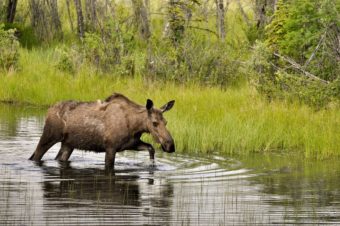
An aggressive moose in Teller had rabies. It’s the state’s first confirmed case in moose

moose
(Photo by Heather Bryant/KTOO)

A moose has tested positive for rabies in Western Alaska.

The Norton Sound Health Corporation’s Office of Environmental Health is encouraging residents of the region to make sure that their pets are vaccinated against the rabies virus after a moose tested positive for the virus in Teller.

According to a release from NSHC, on June 2, residents in Teller — a community of about 250 people, roughly 70 miles northwest of Nome — reported that a moose was acting aggressively toward people and showing other signs of the virus.

The Alaska Department of Fish and Game responded, and the moose later tested positive for rabies.

The rabies-positive moose is the first confirmed case in Alaska. The virus detected is the same variant of the rabies virus that has been found in red foxes, which according to Fish and Game, suggests the moose was most likely infected by a fox.

Fish and Game encourages anyone who finds a dead mammal or sees a mammal exhibiting signs of rabies, to report their sighting immediately to Fish and Game.

Signs of rabies include sudden behavioral changes, such as staggering, aggression, fatigue, excessive drooling, uncoordinated movements, biting at themselves, chasing vehicles, or acting unaware of their surroundings. Photos and videos can be helpful to evaluate the animal, but it is most important to keep your distance to avoid exposure.

All dogs and cats should be vaccinated against rabies at three months old, again one year later, and every three years after that.

To contact Fish and Game to report anything wildlife-related, call 907-443-2271. To reach out to NSHC regarding pet exposure or vaccinations, call 907-434-1659 or 907-434-0543.

A large fish that fills freezers in Northwest Alaska could be in danger

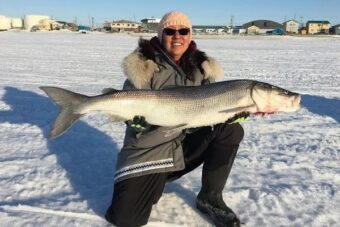
Siikauraq Martha Whiting ice fishing for sheefish. (Katrina Liebich/U.S. Fish and Wildlife Service)

Lance Kramer describes himself as an avid outdoorsman. The 52-year old loves traditional methods of hunting, fishing and trapping. His home is right next to the ice where many Kotzebue residents fish for sheefish. It gives him a bird’s-eye view to gauge when the fish are coming in.

“I get to watch every day, you know, out my window,” Kramer said. “My barometer is binoculars. If they’re pulling them up, then it’s time to go. If they’re not, stay in and drink coffee.”

Kramer is among many people living in Alaska’s Northwest Arctic who depend on sheefish as a staple in their diets. The fish, right now, are abundant. Residents’ freezers are filled with them after another successful season. But scientists warn that it may not always be this way. They say warming waters and permafrost thaw could lead to population declines. It’d be a double-whammy for a region already dealing with recent population declines in another key food source: caribou.
“When you don’t have any caribou in your freezer all year long, you know, sheefish is a huge reprieve,” said Kramer.

‘Sheefishing is a science’

Sheefish, or simply sii, are a whitefish found only in certain waterways in the Northern Hemisphere. In Alaska, they’re found in the Yukon and Kuskokwim drainage areas. In the Northwest Arctic, their spawning grounds are along the upper Kobuk and Selawik rivers. Here, individual sheefish are significantly larger than their counterparts elsewhere in the state. A single fish can measure 3.5 feet and weigh 60 pounds.

One fish is enough to provide several meals to a large family. They’re valued for their taste. The flakey white meat is oily and slightly sweet which makes it versatile in many dishes.

“There’s so many ways to eat them,” Kramer said. “It’s like Forrest Gump. Remember how he talked about the shrimp?”

Kramer, like many people in the region, fishes using a combination of traditional methods with modern equipment. He travels by snowmachine to the ice and, using an auger, drills a 10-inch hole. He looks for a “wedge” in the brackish water, where the fresh and salt waters meet. During winter, the sheefish tend to stay in the relatively warmer freshwater, occasionally venturing into the colder marine water to hunt for their next meal.

“Sheefishing is a science,” he said.

To catch the fish, Kramer uses a jig — a bent handle about a foot long with a line and hook attached. Sheefishing is typically done with a jig or net, not the rod and reel commonly used by many sports fishermen. Kramer uses the Iñupiaq words for his jig. His aulasuan, or handle, is made from wood or walrus ivory. For the ipiataq or fishing line, he uses a more heavy-duty 80-pound test line which attaches to the niksik, or hook. Kramer said he’s addicted to what he calls “the tug” — that initial feeling of hooking a sheefish on the line.

“It’s a direct connection between the energy of that huge incredible sheefish and your hand,” he said. “It’s the energy.”

A threat from thawing permafrost

Although sheefish are abundant now, they could be threatened by warming Arctic temperatures, according to Bill Carter, a fish biologist for the Selawik National Wildlife Refuge, based in Kotzebue. His focus is on the refuge’s aquatic habitat. For eight years, he and a group of Fish and Wildlife colleagues studied a potential threat to sheefish: the permafrost thaw slump.

“It’s basically a big mudslide where a south-facing slope has started to thaw into water, turning what used to be firm ground into mud and concrete — basically wet concrete,” Carter said.

Following a slump, the water becomes cloudy and full of sediment potentially suffocating the eggs of spawning sheefish. Sheefish are long-lived fish. It takes 10 years for the sheefish in the Northwest Arctic to reach sexual maturity which means that the threats to spawning could have longer lasting repercussions.

According to Carter, there have been several slumps in the region. One of the most concerning on Selawik River — about 10 miles upriver from sheefish spawning grounds — was massive.

“[It was] over 500,000 cubic meters, which is basically a 25-story building with a footprint the size of a football field,” said Carter. “That’s what’s come out of it. So it’s really big, over a half a mile across.”

He said there are several more permafrost thaw slumps in the region.

Kramer said he has the same concerns as Carter. He believes that along with warming waters and harmful algal blooms, the permafrost thaw slump will pose a threat to sheefish in the future. Carter and a group of scientists are planning a two-year project this summer to study how the thaw slump has affected sheefish populations.

Ice jam floods continue to plague Alaska river communities

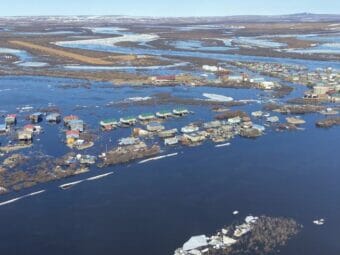
Flooding in Buckland, Alaska on May 18, 2023. (National Weather Service photo)

Ice jams caused major flooding in Buckland on Thursday, according to the National Weather Service.

The weather service said the Buckland River had flooded 80% of the Northwest Arctic Borough community, and residents were using boats to get around.

As of the 2020 census, 535 people lived in Buckland. An aerial photo shows the swollen river flowing across a bend and through the community.

A large ice jam on the Yukon

Meanwhile, a major ice jam was holding in place on a remote section of the middle Yukon River, upstream of the village of Ruby. National Weather Service hydrologist Ed Plumb flew over the ice jam on Thursday.

“We saw about 50 miles of packed-in ice behind the ice jam that wasn’t moving, and there was extensive overland flooding for several miles along the Yukon River — for several miles away from the bank,” he said.

Plumb says isolated cabins and fish camps were surrounded by flood water in the area where the Nowitna River flows into the Yukon.

“It’s creating a giant lake where it’s backing up the Yukon River water,” he said.

Plumb says water was rising at Tanana, about 40 miles upstream of the end of the jam, but it wasn’t clear if that was due to the jam or due to a broader slug of breakup water and ice flushing down the river.

In a flood advisory that’s in effect until 12:15 p.m. Saturday, the National Weather Service warned that people who live in the area should “stay alert and be prepared to take action.”

Floodwaters recede at Glenallen

In the Glenallen area, floodwaters caused by snow melt have significantly receded. Incident commander Jason Severs redits actions by the Alaska Department of Transportation.

“DOT has brought in a contractor with a couple of pumps. They are pumping the water out of Glennallen, downtown Glennallen,” he said. “They’re also installing two additional culverts to Moose Creek.”

Moose Creek and its tributaries are the source of the flooding, which started on May 12 when a rapid warm-up began melting a heavy snowpack. Severs says that at the flood’s peak, water was 6 to 8 feet deep in places.

“It has flooded the basement of the LIO office, the community library. Its flooded fire station completely out,” he said. “BLM has buildings that are underwater. I believe there are 6 homes that have damage. Several businesses and non-profits also have water damage.”

Severs says a community wastewater system damaged by the flood is back online but at reduced capacity. He says flood waters have largely drained from most of Glennallen proper, but the west end of town was still underwater on Thursday. 

Meanwhile, Severs says the community is getting help.

“There are some private contractors that have already come out to look at som of the private residences. The state has come out and they are doing some initial assessments. The American Red Cross is here. They’re offering water, food, cleaning supplies,” he said.

Severs says Glennallen is in line for state and federal assistance.  He anticipates the recovery process could take months.

Site notifications
Update notification options
Subscribe to notifications