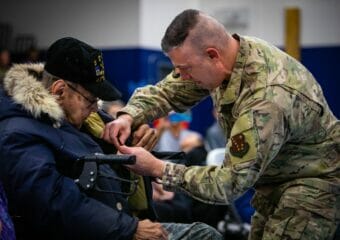
Maj. Gen. Torrence Saxe pins the Alaska Heroism Medal on Cpl. Bruce Boolowon in Gambell. (Photo courtesy Robert DeBerry, Alaska National Guard)
A Gambell man has been recognized by the top military officer in Alaska for his lifesaving effort in 1955.
In June 1955, Soviet fighter planes shot down a U.S. Navy P2V-5 Neptune flying on routine patrols over the Bering Sea. It crashed in flames on St. Lawrence Island, according to the Alaska National Guard.
Part of the Lockheed P2V-5 Neptune wreckage still remains in Gambell. (Photo courtesy of Gay Sheffield/UAF Northwest Campus and Alaska SeaGrant)
Boolowon is believed to be the last surviving member of the St. Lawrence Island rescue team. He attended a ceremony at the John Apangalook Memorial High School in Gambell on March 28. He was awarded the Alaska Heroism Medal from the Alaska National Guard and Alaska Office of Veterans Affairs.
Russians landed often in Gambell during the Cold War, but the visits were not usually nefarious, according to the Associated Press. Since St. Lawrence Island is so close to Russia, people routinely traveled back and forth to visit relatives.
Boolowon recounted when his unit first caught sight of the damaged U.S. Navy airplane.
“They came in and one engine was smoking, and then we knew, with the high-pitched motor, we knew there was something wrong with them,” Boolowon said.
Boolowon was happy to receive the medal for his squad’s action that day in 1955.
“I think it’s a good thing, really, to be awarded several years later,” Boolowon added.
JoAnn Kulukhon is a relative of men in the 1st Scout Battalion. She radiated praise for Boolowon at the ceremony.
“I’m so proud of him and happy,” Kulukhon said.
Alaska Adjutant General and Commissioner of the Department of Military and Veteran’s Affairs Major General Torrence Saxe presented Boolowon with the medal.
The Alaska Heroism Medal is the state’s highest award for valor during peacetime.
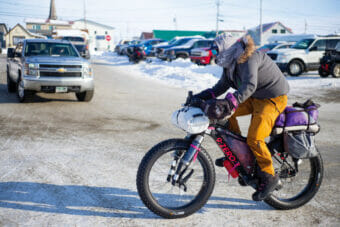
Miron Golfman approaches the finish line in Nome for the 2023 Iditarod Trail Invitational race. (Nils Hahn/Nome Nugget)
While the Iditarod Trail Sled Dog Race was making statewide, national and international news over the past week, another group of trail enthusiasts was blazing a path alongside the mushers.
Miron Golfman of Anchorage crossed the finish line of the Iditarod Trail Invitational in downtown Nome Wednesday at 12:51 p.m. The human-powered race follows the path of the famed dog race.
The Iditarod Trail Invitational, a bike, ski and foot race, travels from Knik Lake near Anchorage to the interior community of McGrath, continuing to the Bering Sea before reaching the trail’s conclusion in Nome.
The course travels along the Historic Iditarod Trail and, according to race organizers, requires self-sufficiency and resilience to make it through up to 30 days and nights of freezing temperatures and inclement weather.
Golfman left Knik Lake on Feb. 26 and finished in Nome with a moving time of 6 days, 21 hours, 5 minutes. He had a resting time of 10 days, 1 hour, 34 minutes. He averaged 5.9 mph while underway and covered an average of 57.1 mile a day.
Conditions were treacherous from the start, he said.
“We went right into first night, and it was negative 30 degrees out on the Yentna River, and a lot of folks got frostbite and got eliminated immediately … on day two we hit this big snowstorm and we all contended with that,” Golfman said. “We were able to get up and over the Alaska Range before the snowstorm hit us, but we were just like everyone else contending with that and 80 mph winds, and it was whiteout snowing.”
Conditions warmed up on Monday, and that brought a different kind of challenge to the trail, according to Golfman.
“I clocked 49 degrees on my thermometer at the peak in one day, and so everything turned to slush,” Golfman said. “I ended up spending almost two days pushing my bike, and my every bit of gear got wet because the second day it rained, and I was pushing my bike through about seven hours of rain. Everything got drenched.”
Riding on his 9ZERO7 Lynxbike, Golfman was racing to raise funds for the Ride to Endure project.
“This was my second annual ride for the Ride to Endure campaign, which is a charity that I started a couple years back,” Golfman said. “It is raising funds and awareness for ALS, Lou Gehrig’s disease.”
Golfman’s uncle is six years into his battle with that disease. Golfman has previously lived with him and was his primary caregiver. It was the experience of taking care of him that inspired Golfman to pursue his passion of becoming a bike racer.
A total of 98 competitors took part in this year’s invitational. Three more bikers finished together Thursday night, just before Iditarod musher Mike Williams, Jr. crossed under the burled arch in Nome.
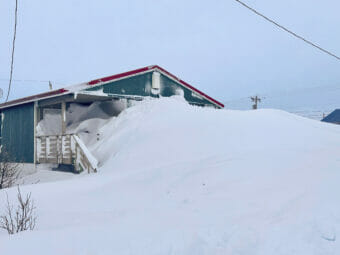
Drifting snow covers a house in Kotzebue on March 7, a day after the region’s most recent storm. (Desiree Hagen/KOTZ)
Kotzebue and the Northwest Arctic Borough have declared a disaster after a series of massive snow storms battered western Alaska. Kotzebue City Manager Tessa Baldwin said the city has a three-person crew working “around the clock,” but snow and high winds are disrupting some of the city’s key infrastructure, causing power outages and a city-wide boil water notice.
“We had a power outage which has caused a boil water notice and an extreme amount of snow,” Baldwin said. “It’s been extremely hard for our emergency responders to get to all places in the city.”
The first storm hit the region in late February and was followed by a second storm over the weekend, with gusts as high as 55 mph. Snow is piled more than 20 feet high in some areas.
Baldwin, a lifelong resident of Kotzebue, said the storms have been a “unique situation” and doesn’t believe the city has experienced this much snow in decades.
“We had five- or six-foot drifts on our main streets and then on the back streets,” she said. “We were looking at anywhere between 15- and 20-foot snow drifts. My house personally was just completely covered in snow. You can’t even tell that there was a house under the snow.”
In a letter to Borough Mayor Dickie Moto, Baldwin said 76 of the city’s fire hydrants were completely buried under snow. On Tuesday, Moto allocated $50,000 in disaster relief funding to hire local contractors to help with snow removal.
And as of Wednesday morning, the city was warning residents to keep boiling their drinking water. It was the second boil water notice issued in the last two weeks.
Baldwin said the city’s new water system, which began operating in November, was waiting for a part for its backup generator before the storm hit. According to Baldwin, Kotzebue’s intermittent power outages mean that the city’s water supply is losing pressure, which could cause sediments and other drainage to enter the city’s drinking water.
The city’s water reserves are currently below what Baldwin calls “a comfortable level.” The city is urging residents to conserve water and reduce their consumption.
The heavy snow build-up is also a concern for the city, and Baldwin said flooding when the snow melts could also pose a public health crisis. Kotzebue does not have a drainage system, and she said the spring runoff could overwhelm the city’s sewage system.
And more snow may be on the way. Baldwin says the Northwest Arctic is preparing for another storm to hit the region Thursday.
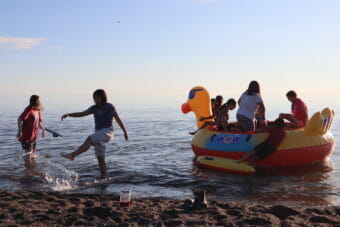
Kotzebue Sound, 30 miles north of the Arctic Circle, is separated from the open Chukchi Sea by 70 miles of shallow, protected water. On warm summer days, it’s a place to recreate, often young swimmers brave the cold and take to the water. Beyond the Sound, an increasing number of large industrial ships and other marine traffic are taking advantage of declining sea ice and increasingly navigable waters. (Emily Schwing)
This is the second part of a series. Read the first part here.
Concerns about national security are heating up in the rapidly changing Arctic. In 2021, the U.S. Coast Guard opened a seasonal airbase in Kotzebue. The community was once home to a permanent Air Force station, but that closed in 1983, as the Cold War wound down.
In recent years, more fighter jets have been based in Alaska, cold weather training for soldiers here has increased and an effort to provide the U.S. Coast Guard with a new, state-of-the-art icebreaker is underway. Russia lies about 250 miles west of Kotzebue and conflict with Ukraine has only fueled discussion about whether a more permanent military presence along Alaska’s west coast is both needed and warranted.
“This is our table,” said Vice President of Lands for NANA Qaulluq Cravalho. “We have to make sure that we’re there when it comes to policy making decisions because there is activity happening.”
NANA is one of the largest Alaska Native corporations in the state. Cravalho is also a member of the U.S. Arctic Research Commission. She said any military buildup in Northwest Alaska should include input from Alaska Natives.
“People can think of the Arctic as this pristine place where there’s no activity happening and that might be relatively true. On the U.S. side, there’s not as much activity, but on the Russian side, there is and all of our food resources go over there and come back,” she said. “So, it’s all one environment. There’s a lot of risk associated with it, and so how do we make sure we’re at the table to define what it looks like?”
Qaulluq Cravalho. (Emily Schwing)
In recent years, the Arctic has seen a drastic increase in industrial marine traffic in the region. According to the Arctic Council, marine traffic increased by 44% through the Northwest Passage between 2013 and 2019. As a self-described Coastal Iñupiaq, Cravalho has concerns about what more ships and a beefed-up military presence might mean for subsistence resources in the region. People here are heavily reliant on marine mammals and fish that provide a sustained food source.
“When you’re harvesting, when you’re participating in these activities, this is how you learn our culture and our language,” she said. “This is how it’s passed down generation to generation, because of the close relationship with the land in the water. It’s a primary means not only to provide sustenance for ourselves and our people in our communities. It’s also a primary means for our culture to continue.”
That culture has become a defining feature in Nate Kotch’s life, since he arrived here from Hawaii in his early 20s.
“So, it was certainly a culture shock to me to some degree,” he said.
The Air Force stationed him here in in the 1970s. He is one of the last remaining Kotzebue residents that remembers when there was an active military station here. Today, it functions as a long range radar site, with minimal full time civilian staff.
“It’s taken time for me to even learn what the culture really is in the community,” Kotch said. “I mean, the Native community, you know? What are their values, what are their needs? You know, what are they looking for?”
The U.S. Air Force stationed Nate Kotch in Kotzebue in 1975. (Emily Schwing)
After his time with the Air Force, he married into an Iñupiaq family and spent 27 years on Kotzebue’s City Council.
He said if the military ever decided to resurrect a base here, the community would need to be involved “because if that doesn’t happen that way, then there’s going to be a negative impact.”
Last October, the United States rolled out a new National Strategy for the Arctic Region. In a video posted to Twitter U.S. Secretary of State Antony Blinken included national security as one of four main pillars of a new National Security Strategy for the Arctic.
“We have no higher priority than defending our country and our people and securing the Arctic is key to that,” Blinken said.
Currently, a military buildup is just a discussion and no decisions have been made to move forward. There is talk of basing Coast Guard Personnel here permanently. There has also been talk of developing a naval base here, complete with a deep water port.
The U.S. Government built an Air Force Station in Kotzebue at the beginning of the Cold War. Construction was completed in 1958. Once a radar station, it was closed in 1983, as the conflict began to cool off. Today, it functions as part of the Alaska NORAD system. Minimal civilian staff are tasked with its upkeep. There are only a handful of people in Kotzebue today who were once full-time soldiers at the station when it was fully operational. (Emily Shcwing)
In early August, the Sound bustled with small boats. The fishermen inside lined up at a handful of docks, waiting to offload chum salmon. Overhead, small commuter planes shuttled cargo and passengers to nearby remote villages.
Qaulluq Cravalho said if the military does come this far north, the community will be ready.
“This community is not unfamiliar with it,” she said. “We’ve had a base here in the past. Certainly there’s always that risk of the community changing. So, it’s how we interact with that change that’s really important, right? You know, the tools and types of infrastructure needed to be present here have really changed over time.”
Kotzebue is set back from the open Chukchi sea by nearly 70 miles of shallow, protective water in Kotzebue Sound. So, even though marine traffic in the Arctic is increasing — it can feel far away here.
In late summer, the chum salmon arrive in Kotzebue Sound. It’s a fishery that’s not well understood. Alaska’s Department of Fish and Game doesn’t maintain long-term data on the fishery, but in recent years, those who fish commercially have seen booming harvests. (Emily Schwing)
What 85-year-old elder James McClellan is delighted to focus on is the successful chum fishery.
He’s spent many afternoons sitting on the beach, peering through binoculars as boats pulled in to offload their catch. He said 2022 is the first summer he didn’t fish commercially.
“I just like living from the country,” he said with a smile. It’s good. It keeps you healthy.”
The night before, he said, he’d had salmon for dinner. “Oh, it was good! Fried salmon, fried potatoes and onions and, boy, it was good.”
As McClellan scanned the horizon, what he couldn’t see is beyond Kotzebue Sound: a growing traffic jam of industrial ships, a potential for increased conflict with a foreign neighbor and the unknown impacts of a changing climate on food resources, including the chum salmon.
This ongoing series is made possible through a grant from the Climate Justice Resilience Fund.
All over the community of Kotzebue, the past seems to be part of the immediate present. The community of 3,100 people relies on subsistence hunting and fishing and has seen the military come and go. “We’ve had a base here in the past,” said Qaulluq Cravalho. “ Certainly there’s always that risk of the community changing. So it’s how we interact with that change that’s really important, right?” (Emily Schwing)
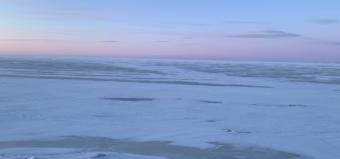
Sea ice on the Kotzebue Sound on Dec. 27, 2019. (Wesley Early/KOTZ)
The Northwest Arctic Borough Search and Rescue Team planned to set out at first light Monday morning to look for Thomas Brown, one of two missing teenagers who left Kotzebue a week ago on a snowmachine trip to Noorvik.
Brown was traveling with his companion, Josiah Ballot of Selawik. Both are 18.
A private plane spotted Ballot’s snowmachine on Friday afternoon about 28 miles south of Kotzebue, near some GCI towers.
Walter Sampson, a longtime member of the search and rescue team, said Ballot was found a short time later taking cover by a pressure ridge that had formed on the sea ice.
“The airplane landed close by and happened to be in the general area and looked under the chunks of ice and there, there he was,” Sampson said.
A map showing Kotzebue and Noorvik. (Google Maps)
Sampson said the ridge of ice, which protected Ballot from winds and 50-below wind chills, probably saved his life. He was medevaced to Anchorage for treatment of hypothermia and severe frostbite.
Sampson said the cold weather has also been hard on ground teams.
“People coming in with frostbites on their faces, with cold hands and other problems. When they come back, that doesn’t stop them.” Sampson said. “That’s how the community shows love to the people they’re looking for.”
The Northwest Arctic Borough Search and Rescue team has about 40 volunteers. Community members have brought in a steady supply of cooked dishes for the team, prepared pocket-sized packets of snacks for the trail and made breakfast every day. Some have shared warm clothing with crew members, while others have helped to maintain snowmachines.
“It’s a search that everybody comes together to work together,” Sampson said. “We also have search teams out in Noorvik, Buckland, Selawik that are also working out of those villages.”
Samson said crews will continue looking as long as possible — and will need help in the coming days with donations for fuel and other supplies.
Curtis Worland was an Alaska State Troopers court services officer. He was attacked and killed by a muskox near Nome on Tuesday. (Photo courtesy Alaska State Troopers)
A muskox attacked and killed a man near Nome on Tuesday, according to Alaska State Troopers.
Troopers spokesperson Austin McDaniel said Curtis Worland was trying to haze a group of muskox away from his dog kennel at home when one of the muskox attacked him. He was declared dead at the scene.
Worland had worked in Nome as a court services officer since 2009.
“Curtis Worland was a dedicated member of the Alaska Department of Public Safety,” McDaniel said. “He served the state well as a court services officer, and he will certainly be missed.”
McDaniel said a 911 dispatcher told troopers about the fatal attack. Alaska Wildlife Troopers and Alaska Department of Fish and Game will investigate. McDaniel said they may decide to kill the muskox if it’s deemed a public safety threat.