Northwest

Ishmael Hope recrafts a family tale in “Never Alone” follow-up

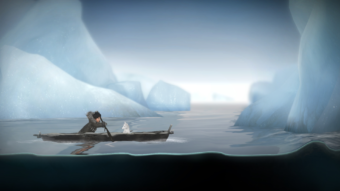
In "Never Alone: Foxtales," Nuna and Fox navigate on an umiak. They start in the Kotzebue area and eventually find themselves on the Noatak River. (Image courtesy Upper One Games)
In “Never Alone: Foxtales,” Nuna and Fox navigate on an umiak. They start in the Kotzebue area and eventually find themselves on the Noatak River. (Image courtesy Upper One Games)

With “Never Alone,” Cook Inlet Tribal Council and game developers combined indigenous storytelling with video gaming in a way that appealed to mass markets.

Its success has led to the follow up “Never Alone: Foxtales,” released on July 28. Juneau writer Ishmael Hope relied on his uncles, Alaska Native elders from Kotzebue, to write the game’s narrative.

Willie Goodwin Jr. narrates the videogame Foxtales. In Iñupiaq, he tells the story of two friends who emerge from their sod homes after a long winter.

“At springtime,” Goodwin says, “everything comes alive.”

Goodwin is an elder from Kotzebue. He’s also the uncle of Ishmael Hope, the game’s writer.

Hope says the two friends, Nuna and Fox, start chasing a little mouse.

“And then suddenly, in the middle of their chase, they’re stranded out in the ocean. They find themselves in an old umiak, a boat. They’re just out, and then they have to navigate their way all the way through,” Hope says.

In Nuna and Fox’s journey, “They get a little too exuberant, like young people will,” Hope says. “They’ll make little mistakes, but then they have to learn a lesson about how to respect all things, the values of being Inuit, Iñupiaq. It’s something that they had to learn.”

Ishmael Hope is the writer of "Never Alone: Foxtales." (Photo by Lisa Phu/KTOO)
Ishmael Hope wrote “Never Alone: Foxtales.” (Photo by Lisa Phu/KTOO)

Foxtales is based on a story told by Hope’s late grandfather, Willie Panik Goodwin. It’s a story about fighting a giant mouse. Goodwin told the story “The Two Coastal Brothers” during an archaeological trip with a team of scholars, including Wanni Anderson who transcribed it in a short story collection, “Dall Sheep Dinner Guest.”

Hope used a lot of his grandfather’s direct words when writing the game’s script. He also collaborated extensively with his uncles who live in Kotzebue, where Foxtales begins.

The game, like its predecessor “Never Alone,” is narrated in Iñupiaq with English subtitles.

“Even if people are absorbed in the game, there’s something really special about the elder’s voice, them speaking in the language. So even if you’re not following everything, you’re getting a sense of that world and that spirit,” Hope says.

Hope says it’s that spirit that gives identity. Hope is Iñupiaq and Tlingit. He says his uncles Elmer Goodwin, Willie Goodwin Jr. and John Goodwin taught him a lot about Iñupiaq culture. Hope says working with them was key to making Foxtales.

“They know how to hunt, they know how to fish, they know how to be in the land. They have so many stories of survival, of reading the landscape, observing the landscape, sensing the spirits and the life of everything around us. They have that knowledge and they were able to impart that a little bit with us,” Hope says.


Foxtales is a celebration of Iñupiaq culture, something Hope thinks young people playing the game need.

“It’s one instance where they get a positive image of themselves reflected back on them. And when you’re in pop culture and you have almost no images or it’s all horrible stereotype, it’s really nice to kind of break through just a little bit,” Hope says.

Videogames have been seen as separating the young generation from the old, but Hope wants Foxtales to do the opposite.

“For young people everywhere, it allows them to create the bridge to their mom and their dad and their uncles, their aunties and their grandparents who may tell them, ‘Oh you know I know a story just like that, so let’s sit down and let me tell it to you,'” Hope says.

Hope doesn’t know if Nuna and Fox will go on any more adventures, but he says with the title Foxtales, there’s a possibility for more.

“Never Alone: Foxtales” is available for the Xbox One, PS4 and PC and Mac. It requires the original “Never Alone” to play.

As subsistence foods become scarce, Kivalina celebrates a new store

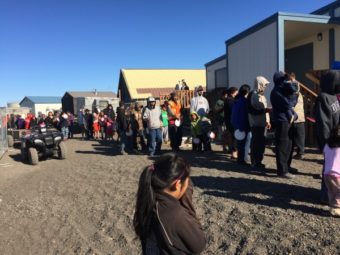
Kivalina’s new store, owned by Seattle-based Alaska Native Industries Cooperative Association, celebrated its grand opening with hot dogs and hamburgers for the community. (Photo by Janet Mitchell)

It’s been a festive day in the Northwest Arctic community of Kivalina as residents celebrate the grand opening of a new store. It’s an end to eight months of struggle with limited supplies after Kivalina’s store burned to the ground Dec. 5.

Janet Mitchell is Kivalina’s city administrator. She says the village doesn’t have firefighting equipment so men cut a hole in the ice of the local lagoon and pumped water on the fire, mainly to keep it from spreading to nearby teacher housing. Mitchell says a temporary store was established but it was a very small space.

“They ran out of things very quick and that posed a difficulty for young babies or young families, families that need formula,” Mitchell says.

She says eggs cost more than $8 per dozen and pilot bread $7 because of limited supplies. Mitchell says the temporary store was in a storage structure built in the early 1900s and mainly sold staples of eggs, flour and rice.

Seattle-based Alaska Native Industries Cooperative Association, or ANICA, owns the store. The new store is two or three times bigger than the old structure, she says, and on Tuesday company officials flew in for the grand opening.

Kivalina’s population of 468 includes a high percentage of young people. Mitchell says close to half are 18-years-old or younger and many of them don’t care for traditional foods. Subsistence resources are also harder to get in a changing climate. Mitchell says the ice went out in early June and with it went the subsistence mainstay, ugruk, also known as bearded seal.

“It’s our winter food (and) we didn’t have an opportunity to hunt the bearded seal. So it’s going to be a very, very lean year in terms of Native foods,” she says.

Mitchell says her large extended family normally harvests between 15 and 20 large adult seals. This year they got one small seal. She says fewer than 20 have been harvested by the entire community and they haven’t seen many caribou either. She says even older Kivalina residents who normally rely heavily on subsistence hunting will have to include more Western food in their diet.

“The store is going to be very important to have if we don’t have the capability of hunting the foods we normally do.”

Although she prefers Native food, Mitchell says she buys supplies at places like Costco when she can get to Anchorage.

“But we have families that (include) up to 20 (people) in one household, so that can be quite a challenge to keep them fed, especially when they don’t hunt,” she says.

Mitchell says her community continues to fight development to protect subsistence food, but that the store will be increasingly important in the future.

Site notifications
Update notification options
Subscribe to notifications