Family

Office of Children’s Services demographics show racial disparity between caseworkers, children in foster care

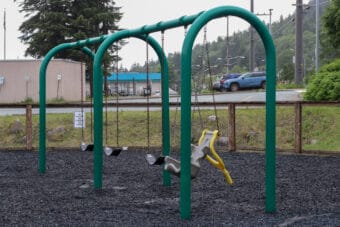
A green metal swingset with three regular black swings and a plastic child's seat.
A swing set at Harborview Elementary School on July 9, 2025. (Photo by Jamie Diep/KTOO)

Listen here:

The Alaska Office of Children’s Services has struggled with staffing for years, from high vacancies and turnover to high caseloads. And data shows caseworker demographics also don’t line up with the state’s, or the system’s children.

According to the 2023 progress report on the state’s child welfare system, 8.7% of caseworkers are Alaska Native or American Indian, and more than 71.9% are white. As for supervisors, all but 2 of the agency’s 13 supervisors are white. The agency is turning to training and partnering with tribes to address the gap.

Indigenous children have been overrepresented in Alaska’s child welfare system for years. State population estimates from last year show that 23.8% people under the age of 18 are Alaska Native or American Indian. But data from the Office of Children’s Services shows they consistently make up around two-thirds of the children who are in out-of-home care such as a foster home. It’s been as high as 69% in the past.

Mary Johnson is the senior director of family services at the Central Council of the Tlingit and Haida Indian Tribes of Alaska, and worked as a caseworker for a tribal organization earlier in her career. She said the racial disparity concerns her.

“How do we connect with this, these 69% of our families?” she said. “If they are from one population, it would make sense that we would want to identify people to work with the population who are like them.”

Kate Paskievitch is a public information officer with the Alaska Department of Family and Community Services, which runs OCS. In an email, she wrote that “OCS does not view this as a ‘concern’ in the sense of a problem to be fixed, but it does guide our efforts to provide culturally responsive care.”

She wrote that care includes partnering with local tribes in the state on cases, prioritizing hiring local staff in the communities they serve, and providing ongoing training on cultural responsiveness.

Tlingit and Haida is one of the tribes that partners with the state on cases that apply to the Indian Child Welfare Act, or ICWA. That federal law lays out minimum requirements when taking on a case involving Indigenous children. The state must try to place children with their family members or in their local communities first.

Johnson herself is Yup’ik. She said it’s important to have tribal representation when working on these child welfare cases.

“It makes sense that if you’re not able to recruit and hire Alaska Native people, at least partner with tribes, at least have tribal partners be a part of the decision making process when making decisions about how our children and families are being cared for and treated,” she said.

Johnson said the tribe largely employs Alaska Native people in its family services office. She said it’s important to have Alaska Native people working on cases, either as a caseworker or as a tribal partner.

“I do think in the field of child welfare, when it’s something so serious and so personal, that the people making the decisions for the group of people that are involved really should have knowledge on how this other group exists in this world, right, and how we parent,” she said.

Trevor Storrs is the president of Alaska Children’s Trust, a nonprofit that advocates and works toward ending child abuse and neglect in the state. He said hiring people whose racial demographics line up with the people they serve is important, but it’s hard to focus on that when the entire system is strained.

“They’re doing really important work, and their hearts are out to protect kids, but they’re also challenged,” he said. “There have been audits. They have high caseloads. They can’t keep staff. There’s just all these challenges.”

Storrs said training on cultural responsiveness is part of social work programs, which is why he said it’s important for the state to hire credentialed workers. That also isn’t always happening.

An audit performed this year on OCS shows many people hired do not have a degree in social work. The state even hired case workers with only a high school diploma.

Storrs said the state should be looking for ways to improve the system as a whole. He said he wants to see a focus on supporting children and families and preventing the problems that lead to OCS intervening.

“It’s less kids that are not going to school, less kids and families addicted to substances, and for us and for OCS, it would be less cases of child abuse and neglect,” he said.

Research from Casey Family Programs shows some children benefit from the system, but they often leave state custody with lasting negative effects on their education, mental health and employment.

A change to the system might be on the horizon. A federal class action lawsuit against the state aiming to reform the system is awaiting a judge’s decision.

Juneau businesses, community members rally behind family fundraising for child’s clinical trial

A crowd of people mingle in a white tent filled with string lights and star-shaped lights.
Families and community members gather at a fundraiser at Tracy’s Crab Shack in Juneau to raise money for Cade Jobsis’ medical treatment on Sept. 21, 2025. (Photo by Jamie Diep/KTOO)

Rain poured down in Juneau on Sunday, but that didn’t stop residents from going to Tracy’s Crab Shack for a night of music from the local band The High Costa Livin’. Under covered tents, attendees lined up for food and were surrounded by a silent auction, a raffle and a bake sale.

Tracy’s hosted one of more than 15 local fundraisers working to help a young Juneau resident go on a clinical trial for a rare genetic disease. Emma Jobsis is the mother of four-year-old Cade Jobsis.

“People that I haven’t even asked, I haven’t even talked to, are texting, calling, wanting to be a part of this,” she said. “And I’m just so grateful because there’s no way we could do this alone.”

She says fundraising efforts started a couple years ago, when Cade was diagnosed with SPG50, a rare disease where a child gradually loses their cognitive and motor function. There is no cure.

“When we got the diagnosis, the doctors told us to take him home, love him. There was nothing they could do,” Jobsis said.

But there is an experimental treatment that she says was developed by the father of a child with the same disease. Its creation had a hefty price tag. Jobsis said she and several other families raised the $3 million to create the treatment. For Jobsis, that was largely done through social media campaigns.

Cade Jobsis and his mom, Emma, at the Tracy’s Crab Shack fundraiser on Sept. 21, 2025. (Photo courtesy of Emma Jobsis)

Now, the Juneau family is fundraising again so Cade can use the new treatment. They need to raise $1.15 million for hospital and regulatory fees to do a clinical trial for Cade. Jobsis said fundraising largely falls on families, despite her efforts to raise funds through the government and pharmaceutical companies.

“It’s not lucrative, and they’re never even going to see their money again,” she said. “So the only people that care to get treatments are parents of children that have this childhood disease. And so as parents, we came together — four families — and we said, ‘We have to do this. We have to raise the money, because nobody else is going to. Nobody else cares like we do.’”

The Juneau community has been responding in a big way. Jobsis said as of Sunday evening, they had raised $357,000. She said Cade can begin treatment in November if they have 80% of the funds in escrow by Oct. 20. 

Juneau resident Kelsey Riker was at the event, eating dinner in the crowded tent. She’s the manager at Kindred Post, a local gift shop and post office. Riker said it’s great to see the community act in a huge way.

“While this community support has been such a bright light, I also think this should not be necessary for anyone, especially a little kid born with a thing that we don’t know much about,” Riker said.

But Riker said she wants to continue to be part of the effort to raise money.

“If there are ways to be fighting a very broken system by rallying around our community, then that is something that I want to be a part of,” she said.

Tom Ainsworth made his way into the tent with the festivities. He is a retired weather forecaster and said he’s glad to see everybody supporting the cause. He got emotional when he talked about why he came to support the family.

“Well, we have a grandson about the same age, and I can’t imagine going through what they’re going through,” Ainsworth said.

Jobsis estimated on Monday they raised another $50,000 from the weekend’s fundraisers. They have to raise about $738,000 more to reach their goal. The family will continue raising money for Cade’s treatment with fundraisers in and beyond Juneau.

Juneau child care provider faces obstacles in opening new location, leaving monthslong gap in service

A large teddy bear rests on the ground next to a shelf full of toys at Floyd Dryden Middle School.
A large teddy bear rests on the ground next to a shelf full of toys at Glacier Valley Kids while it operated in Floyd Dryden Middle School in Juneau on May 9, 2025. (Photo by Jamie Diep/KTOO)

Listen here:

A Juneau child care center is set to open in a new location nearly a year after being displaced by flooding. But challenges in finding and preparing the site have left families with few options to fill a monthslong gap in child care. 

Glacier Valley Kids, one of about 20 licensed child care providers in Juneau, went through many changes in the past year.

They started when the center – which Carolina Sekona runs out of a house in the Mendenhall Valley – was damaged by last year’s glacial outburst flood. The City and Borough of Juneau then placed the center temporarily in the recently vacated Floyd Dryden Middle School to maintain child care coverage for about a dozen families.

“They wanted me to avoid closure because child care, it’s in crisis right now in Juneau,” she said. “So the idea was to continue to provide care while my home was being renovated.”

But Sekona had to move again this spring, and she couldn’t find a place to go. She gave families 30 days notice that Glacier Valley would close.

Kimmy Lamb was a parent with a child at Glacier Valley. She said 30 days didn’t feel like enough time to figure things out for her youngest son, Liam.

“It was definitely a shock, because we were just getting used to – or Liam was just getting used to – being around other kids, and he really likes Carolina and the other gals, and so it was very stressful,” she said.

Lamb said her parents came back to Juneau from the Philippines in time to step in and provide child care for her son. And Lamb was able to help Sekona find a new, permanent location for Glacier Valley in the Twin Lakes neighborhood. It’s a former private school run by Juneau’s Seventh-day Adventist Church.

Sekona was able to renovate the space with additional help from the church, the city and Southeast Alaska Association for the Education of Young Children, a local nonprofit that supports child care. And she expanded the center’s capacity from 12 children at a time to 30 when it reopens.

A woman in a white sweatshirt and blue glasses sits in a classroom.
Carolina Sekona sits in an empty classroom at Glacier Valley Kids while it operated in Floyd Dryden Middle School in Juneau on May 9, 2025. (Photo by Jamie Diep/KTOO)

Lamb said she’s glad she was able to help Sekona find a new space. But she’s waiting until the end of the year to bring her son back to Glacier Valley Kids in order to save money. 

“We’re excited for that,” Lamb said. “I know he’ll probably miss out on the socialization with the kids, but I feel confident that it’ll be still a good time with his grandparents.”

Ashley Anderson, another former Glacier Valley parent, has already been forced to find alternative child care several times. Still, she said this most recent experience was hard on her family.

“We went into panic mode,” she said. “We were kind of freaking out, and, you know, starting to think like,’ oh my gosh, we have bad luck with child care, like, what’s going on?’”

Anderson was able to find another provider, but she said it was hard for her and her child. She said she hopes it’s the last transition for him before he goes to school.

There are some bright spots to the moves. Sekona had to leave the temporary space at Floyd Dryden so a bigger child care venture – with money to renovate the space – could move in. The Central Council of the Tlingit and Haida Tribes of Alaska plans to house four of the tribe’s early education programs there, including the Lingít language immersion program Haa Yoo X̲’atángi Kúdi and Head Start. That will eventually expand child care options in Juneau when they open Aug. 26.

Tlingit and Haida also worked with tribal citizens receiving subsidized care at Glacier Valley Kids to find child care alternatives and added them to enrollment lists for the Floyd Dryden programs.

Red, blue and green chairs around small off-white tables in an empty classroom.
Empty chairs and tables at Glacier Valley Kids while it operated in Floyd Dryden Middle School in Juneau on May 9, 2025. (Photo by Jamie Diep/KTOO)

Meanwhile, Sekona and Glacier Valley have moved back to her old place in the Valley. She can provide child care to four children this month while waiting on a license to operate at the permanent location near Twin lakes. But that state license has become an obstacle – and Sekona is on a deadline. She needs to leave the house before the next outburst flood that’s expected in August. 

She said it’s been difficult getting her application processed.

A state task force established by Gov. Mike Dunleavy recommended the state take steps to ease the application process including developing an online application that can track paperwork. But Sekona said she had issues uploading paperwork, and had to email documents directly to a caseworker. And she faced another set of challenges with that.

“I turn all my paperwork to one caseworker, and then days later, I hear that caseworker is no longer there, so I’m transferred to another person,” Sekona said. “And this other person does not know what’s going on, and then I have to resubmit everything that I just submitted to the other worker, and it’s been a nightmare.”

A spokesperson for the Department of Health, which oversees child care licensing, wrote that the department is still improving its system as they receive feedback from providers.

Sekona said the state won’t be able to inspect the permanent space until the first week of August, and she won’t get licensed until September at the earliest. That means families who use child care vouchers that require them to go to licensed providers will have to wait at least another month before they can enroll in Glacier Valley Kids.

But Sekona said she’s ready to fully open again, which is a big deal as child care centers across the state struggle to hire and retain qualified staff.

“Lucky me. I do have all my staff,” she said. “Everybody has their certifications, and everybody’s been through the process and the trainings, and, yeah, we’re all ready.”

In the meantime, Sekona plans to provide care without a license in her new location starting next month. That means she and a coworker can care for only eight children, instead of the 30 she will be able to care for when she gets state approval.

Juneau families rally to support child care funding as Legislature teeters on fiscal cliff

Rally attendees carry signs and babies on the steps of the Alaska State Capitol in Juneau on April 29, 2025. (Photo by Jamie Diep/KTOO)

Listen here:

More than 100 parents, children, lawmakers and advocates carried signs and babies outside the Alaska State Capitol on Tuesday. They were asking the Legislature to prioritize child care funding.

The rally comes after the Alaska Senate cut more than $13.8 million in child care funding from the budget.

Hannah Weed is raising two children and runs Tumbleweeds, a licensed child care facility in Juneau. She said the only way she could afford taking care of her younger child was to start a business providing child care to others at the same time.

“I can’t actually afford to stay home with him, but I don’t have anywhere to send him,” Weed said. “So thankfully, I have experience working with children, and that route worked for me. But it doesn’t work for everybody.”

Child care is part of a long list of cuts as the Senate works on drafting their version of a budget that balances a nearly $2 billion deficit. Advocates also pushed for supporting several bills to bolster several early childhood education and development programs.

Blue Shibler is the executive director for the Southeast Alaska Association for the Education of Young Children. She’s advocated for child care support for years. She said it’s legislators’ job to look for ways to make money to fund child care, like through taxes.

“Parents are tired of having to, like, sing for their supper,” Shibler said. “We shouldn’t have to beg and plead for these things. They’re just basic things that every family needs to thrive in a state.”

At a Senate Majority press conference after the rally, Fairbanks Republican Sen. Cathy Giessel said she agrees with rally-goers on the importance of child care, but the state can’t afford to fund it.

“The problem is we don’t have any money. We’ve had to make serious cuts. And child care funding is one of them,” she said.

Giessel added that advocates shouldn’t give up as the Senate finds other ways to drum up revenue for the state.

“We’re not at a fiscal cliff anymore. We’re actually falling over the cliff,” she said. “And so what we’re trying to do is be creative, to find new ways and yet not place burdensome taxes on Alaskans that are struggling and businesses that are struggling.”

The Legislature is required to pass a balanced budget by the end of the session or face a state government shutdown. The last day of session this year is May 21.

Anchorage lawmaker seeks to boost Alaska early education funding

Gold Creek Child Development Center in Juneau in January, 2023. (Photo by Clarise Larson/KTOO)
Alaska school districts that offer early childhood learning programs for children ages 4 and 5, such as programs to help children be ready for kindergarten, could see a state funding boost under new legislation currently being considered by the Alaska Senate. 

Senate Bill 93 would boost funding for school districts that are currently enrolled in early education programs under the Alaska Reads Act. The bill would increase per-student funding from half funding to the full amount for other students within the state’s public education funding formula.

The Alaska Reads Act program supports early literacy for pre-K through grade 3 with the aim of improving reading.

“The concept isn’t new,” said Sen. Löki Tobin, D-Anchorage, the bill’s sponsor, citing a body of research supporting improved lifelong learning outcomes following pre-K programs. “For every dollar we invest in high quality early learning, we see a $32 return on investment in increased earning potential, higher graduation rates, higher engagement and post-secondary opportunities.”

She explained with the outmigration of families and children from Alaska, funding early learning programs would encourage young student enrollment. “Last year, the Legislative Finance Division indicated about 3,700 kids left our public education system in total,” she said. “So what our hope is, is not only to provide districts with full funding to maintain their pre-elementary programs, but also to help balance out that outmigration with incoming students.”

School districts can choose to offer prekindergarten in Alaska, and districts’ enrollment in early learning programs under the Alaska Reads Act is also voluntary. Currently the participating districts are Anchorage, Skagway and Valdez.

The Department of Education estimates the funding increase would cost roughly $7.6 million, already requested in Gov. Mike Dunleavy’s budget proposal for next year, going towards funding the Alaska Reads Act, according to a fiscal note to the bill. 

State Education Commissioner Deena Bishop said that the governor’s budget includes roughly $4.7 million to sustain funding for existing early education programs and $3 million to expand the number of districts with these programs. The Alaska Reads Act planned for annual increases in funding and programs, Bishop said in a text statement through a spokesperson.

“We look forward to all Alaska school districts who desire to serve their communities with pre-schools, can do so,” she said. “The Alaska Reads Act was a transformational piece of legislation. The present bill builds on its success.”

Tobin said the increased funding could also help alleviate child care costs for families. “We know those pre-K kids are in their communities, their parents might be struggling to braid together support for child care, or for babysitting,” she said. “And by not only providing stability for districts to offer these programs, we also are helping them in stabilizing their school population, and also helping families that are looking for child care options that are high quality and available.”

The bill now is set to be heard in the Senate Finance Committee, where Tobin hopes lawmakers support the education investment. “We know it’s not going to have an impact on our budget. And we do know the fiscal notes of the Alaska Reads Act were adopted when the bill was passed in 2022, so it’s not going to have a discernible impact on our current budget projections.”

Correction: The ages affected by the legislation were incorrect in the headline and first paragraph in the initial version of this article. The legislation would affect 4- and 5-year-olds, but not 3-year-olds.

Like all of Alaska, Juneau has a broken child care system. A state task force is trying to fix it.

Gold Creek Child Development Center in Juneau in January, 2023. (Photo by Clarise Larson/KTOO)

The closures of child care centers and a worker shortage have left Juneau parents with few options for affordable and reliable care for their kids. 

But, a new report by a state child care task force proposes dozens of recommendations aimed at expanding child care options statewide. 

City and Borough of Juneau Deputy City Manager Robert Barr is a member of the task force. He sat down with KTOO on Friday to discuss the task force’s findings and what role the city can play in making them a reality. 

Listen:

This interview has been edited for length and clarity.

Clarise Larson: How would you describe the state of child care in Juneau and across Alaska right now?

Robert Barr: I would say that it’s relatively tenuous, to use a word to describe child care.

I think Juneau, we’re in a better place than most of the state because we’ve been subsidizing and participating in the child care sector, using local dollars in a real, meaningful way for a handful of years now.  That same trend hasn’t been happening across the state. 

Clarise Larson: What kind of impact does this have on Juneau’s economy? When people can’t find reliable care for their kids? 

Robert Barr: Yeah, I mean it’s huge, right? There’s a lot of studies out there, there’s a lot of research that shows that when a parent of a child doesn’t have a place — a safe, high quality, good place for their child to be when they’re at work — then they’re not going to work. 

Solving that problem is a priority of many, many political bodies and many, many business interests because it’s really become evident — and there’s a lot of consensus right now across the spectrum, whatever spectrum you care, right, the political spectrum, the business spectrum, — that this is a problem that is really worth solving. For a variety of reasons, economic being primary among them. 

Clarise Larson: What would you say are the biggest barriers for child care providers right now?

Robert Barr: There are many, but the single biggest barrier is money. We as a society, don’t fund in a public way, child care from zero to five, very well at all. When you look at statistics of how much money public dollars in the United States go to child care, and compare that to other developed nations, we’re generally at the bottom of those lists. And, the business model of child care just bluntly, doesn’t work without significant public subsidy. You know, we heavily subsidized K-12 education, but expect parents to bear the burden for all of zero to five care, and that just doesn’t work from a business plan perspective.

Clarise Larson: As part of this task force, you were trying to find solutions. Highlight some of the recommendations that you guys came up with and, from your perspective, which ones really stood out to you.

Robert Barr: There are many — there’s over 50, I think total — recommendations that we made. And all of them matter. All of them can make a difference. But the biggest one that I highlight is the necessity of creating sustainable, publicly funded wage subsidies for licensed child care, both in-home care and center-based care that support a living wage. 

People who work in child care, those are super important jobs, and our our child care workforce really isn’t going to get where it needs to be until our centers and our providers can afford to pay people enough money to live on.

Clarise Larson: What role does the City and Borough of Juneau and the Juneau Assembly play in helping to solve the child care shortage locally?

Robert Barr: We subsidize child care in a couple of different ways. We have a couple of stipend-based programs, and we provide a monthly stipend directly to child care providers to help address that living wage issue and the recruitment and retention issues that child care centers have.

Clarise Larson: All these recommendations have a lot of big ambitions, but walk me through what next steps need to happen to get these recommendations to become a reality. 

Robert Barr: A lot of the recommendations are things that the state can do right now and that the state already has started working on in a lot of instances. Really, the big one is the money piece, right? That’s really the key missing ingredient to really solving this problem, both at a local and statewide and, frankly, a national level. Until we can get enough funding in the system to enable good, decent pay, that’s really the big element that we need.

Clarise Larson: Do these recommendations give you hope for the future of Juneau and solving this problem hopefully in the coming years? 

Robert Barr: They totally do. There really is sort of a bipartisan consensus and a consensus in both the child care sector and the business community that this is a problem worth solving for a wide variety of reasons. And so I think now is a good time to be talking about solving this problem because we’re largely coming from the same perspective.

Clarise Larson: Perfect. Well, thank you so much for coming in today and chatting with me.

Robert Barr: Thanks for having me.

Site notifications
Update notification options
Subscribe to notifications