Arctic

Report details threats from a warming Arctic: ‘These changes cascade directly into people’s lives’

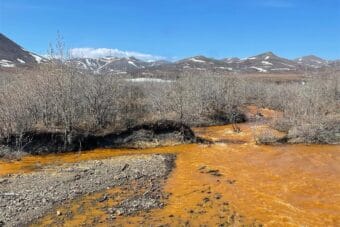
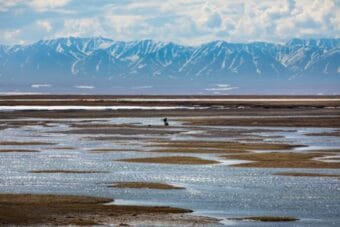
A tributary of the Kugororuk River in northwest Alaska runs orange.
A tributary of the Kugororuk River in northwest Alaska runs orange. (Josh Koch/U.S. Geological Survey)

The Arctic continues to warm faster than other parts of the planet and is seeing record high temperatures and record low sea ice levels. That’s according to the 2025 Arctic Report Card, which the National Oceanic and Atmospheric Administration released today.

For the past 20 years, the report has documented changes in snow and sea ice cover as well as air and ocean temperatures in the northern part of the globe. In that time, it’s shown that the Arctic’s annual temperature has increased at more than double the global rate of temperature changes.

The warming is affecting the environment and food security for those who call the region home, said Hannah-Marie Ladd, one of the report’s authors.

“These changes cascade directly into people’s lives, affecting fisheries, coastal safety and subsistence harvests,” Ladd said. “We are no longer just documenting warming. We are witnessing an entire marine ecosystem, which is tied to our economies and culture, transform within a single generation.”

Ladd is the director of Indigenous Sentinels Network, a program established by the Aleut Community of St. Paul Island to help Alaska Native communities monitor their environment. She was one the speakers from various research agencies who detailed this year’s Arctic Report Card at a press conference at the American Geophysical Union conference in New Orleans.

The report, which is the work of more than 100 authors from 13 countries, showed that the Arctic region experienced some of the highest temperatures since the turn of the century.

“October 2024 through September 2025, the Arctic experienced the highest temperatures on record since at least 1900,” said Matthew Druckenmiller,  a senior scientist at the National Snow and Ice Data Center in Colorado and lead editor of the report. “This included the warmest autumn, the second warmest winter and the third warmest summer ever observed.”

Warming linked to the ferocity of ex-Typhoon Halong 

The rapid warming of the Arctic is amplified by the loss of reflective sea ice and snow, Druckenmiller said. The report showed that last March, Arctic winter sea ice reached its lowest annual maximum extent in nearly 50 years of satellite records.

Druckenmiller said that the oldest, thickest sea ice has also declined by over 95% since the ’80s, primarily remaining in areas north of Greenland and the Canadian Archipelago.

“Thinner ice is then much more mobile with wind and current, and much less resilient against warming waters,” he said. “This means much more unpredictable ice conditions for those both living and working in the Arctic.”

Druckenmiller said that the report underscored the interconnectedness of Arctic changes. He said one example is the remnants of Typhoon Halong, which battered Western Alaska in October

“Prior to this storm, temperatures in the Bering Sea were well above normal, which contributed to the strength. The storm brought hurricane force winds, storm surge and catastrophic flooding, which displaced nearly 1,500 residents from across the region,” he said. “Still today, these communities are assessing the damage and trying to figure out how to resume their lives.”

Druckenmiller said that because of the amplified warming in the Arctic, scientists expect further disruptive changes and events like that storm.

Fewer fish in rusting rivers

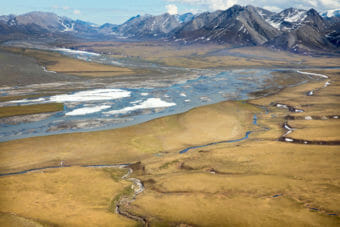
Arctic rivers are changing, too. The report highlighted an emerging phenomenon called rusting rivers. That’s likely caused when permafrost thaw allows groundwater to seep deeper and interact with mineral deposits, turning some streams and rivers a rusty orange color.

In Alaska, over 200 streams turned orange in recent years. That affected aquatic biodiversity and water quality, said Abigail Pruitt, a postdoctoral researcher at the University of California Davis who studies rusting rivers.

“Within Kobuk Valley National Park, we observed the complete loss of juvenile Dolly Varden and Slimy Sculpin in a tributary to the Akillik river when it turned orange,” Pruitt said. “Beyond the effects on fish, rusting rivers may impact drinking water supplies to rural communities as well.”

Partnerships between Indigenous communities and scientists

The report also highlights how Indigenous communities have been observing the changes in their environments and collaborating with scientists to better understand those changes.

Ladd, with the Indigenous Sentinels Network, described one example of such work – the BRAIDED Food Security Project. She said that St. Paul residents collect samples of harvested traditional foods, like seabirds, marine mammals and halibut. Harvesters donate those samples to a recently established and tribally owned laboratory at the Bering Sea Research Center. Then local employees, with the help from the University of Alaska Fairbanks, analyze the samples for contaminants like mercury.

“What’s happening on St Paul Island offers a model for resilience and collaborative research everywhere,” Ladd said.

She went on to say that Indigenous leadership and participation would be essential to future efforts toward understanding and adapting to the changing Arctic.

As the Arctic heats up, the U.S. Coast Guard’s icebreaker fleet is preparing for boom times

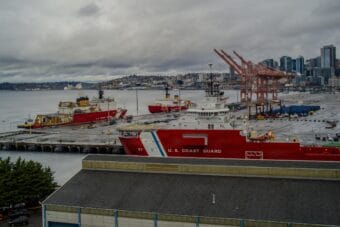
The U.S. Coast Guard icebreakers Polar Star (at background), Healy (at left) and Storis (at foreground) are seen together at Coast Guard Base Seattle on Oct. 26, 2025, marking the first time since 2006 that the Coast Guard had three active polar icebreakers in the same place at the same time.
The U.S. Coast Guard icebreakers Polar Star (at background), Healy (at left) and Storis (at foreground) are seen together at Coast Guard Base Seattle on Oct. 26, 2025, marking the first time since 2006 that the Coast Guard had three active polar icebreakers in the same place at the same time. (Lt. Christopher Butters/U.S. Coast Guard)

On a dreary November day in Seattle, the U.S. Coast Guard put its past and future on display.

Within sight of the Space Needle, three eye-catching red icebreakers towered over Pier 36. It was the first time since 2006 that the Coast Guard has had three active icebreakers in the same place at the same time.

In the coming years, that scene will become more common, and not just in Seattle. After years of underfunding, the Coast Guard’s icebreaker fleet is undergoing a massive expansion, with almost $9 billion for new ships.

On Tuesday, the U.S. government signed the Icebreaker Collaboration Effort — or ICE Pact — a three-nation agreement with Finland and Canada that will see some of those ships built in Finland, whose shipyards will train Americans to build more.

“It’s an exciting time to be a polar icebreaker sailor,” said Capt. Jeff Rasnake, commanding officer of the Polar Star, America’s only heavy icebreaker.

So many ships are about to join the Coast Guard’s fleet that the agency isn’t yet sure where it will put them all. The Coast Guard has earmarked millions for a port expansion in Seattle to accommodate three heavy icebreakers, plus another $300 million for Juneau to serve as a port for a medium icebreaker.

More space will be needed on top of that, and Sen. Dan Sullivan, R-Alaska, said his intent is to have as many of the new ships based in Alaska as possible.

“We want home port decisions on these icebreakers sometime in early 2026,” he said. “That is my goal.”

Eric Boget, a research engineer aboard the U.S. Coast Guard Cutter Healy (WAGB 20), prepares to throw a grappling hook to recover an Arctic Mobile Observing System (AMOS) mooring while Healy operating in the Arctic Ocean, July 21, 2025. Boget is a member of the scientific research team recovering data from the AMOS moorings. (Petty Officer 3rd Class Chris Sappey/U.S. Coast Guard Pacific Area)

The need for new icebreakers is clear: As the Earth warms amid climate change, no place is warming faster than the Arctic. Melting ice is opening new routes for shipping, places to mine and drill, and seas to fish or view from the deck of a cruise ship.

In many cases, control of those new routes is being disputed among nations.

“Right now, things are heating up in the Arctic, and not just on the ice,” said Capt. Kristen Serumgard of the icebreaker Healy.

Russia is expanding its military presence in the Arctic, including with icebreakers, and as NATO confronts Russian aggression in Europe, there’s been international concern that the United States and NATO should be prepared to match Russia in the Arctic as well.

China is operating significant numbers of icebreakers in the Arctic, as are European nations, each interested in maintaining their right to access the area.

“It’s a geopolitical hotbed up there,” Serumgard said.

Rasnake, who typically works in the comparatively calm Antarctic, said that “with lines being drawn and a lot of different contested (seafloor) land claims, it’s — I wouldn’t say the wild, wild West, but maybe the wild, wild North.”

Shipping traffic through the Arctic Ocean is on the rise, with more ships traveling Russia’s Northern Sea Route and the Canadian-American Northwest Passage each summer.

As yet, the Northwest Passage isn’t regularly used by commercial shipping, said Steve White, executive director of the Marine Exchange of Alaska, which monitors the area for safety risks.

While that’s the case, “we are seeing a trend of more and more traffic, though, going through the Bering Straits, both on the US side and on the Russian side,” he said.

With more ships comes more risk. On Sept. 6, the Dutch cargo ship Thamesborg ran aground in Franklin Strait, part of the Northwest Passage. The accident didn’t release any pollution and no one was injured, but it took 33 days for the ship to be freed and sent on its way.

The Northwest Passage and the Northern Sea Route each funnel through the Bering Strait, which is split between American and Russian control.

“The reason this is so important for people to understand is that the Bering Strait — you’ve only got about (51) miles between the US and Russia, and you have the biodiversity, the wildlife that’s there,” White said. “This comes at a time where we’re getting more storms, the communities are struggling up there with food security and the top priority, the salmon returns … the fabric of our Alaskan communities up there is under threat, and it’s under threat from what’s going on with the weather changing and increased traffic.”

The U.S. Coast Guard is the federal government’s nautical Swiss Army knife — it performs rescue operations, enforces fishing laws, stops drug smugglers, runs border patrols, performs safety inspections, anti-pollution patrols, counter-piracy patrols, and enforces America’s maritime laws.

The U.S. Navy runs submarines under the Arctic ice, but it doesn’t operate icebreakers. It leaves the Coast Guard to do that — on the Great Lakes, on American rivers, and in the Arctic and Antarctic.

But for years, the national icebreaker fleet has been underfunded.

When Nome, home to the endpoint of the Iditarod Trail Sled Dog Race, ran short of fuel in 2012, the U.S. Coast Guard struggled to muster a single icebreaker, the Healy, to escort a Russian icebreaking tanker to the town.

At the time, the Healy was the Coast Guard’s lone operating icebreaker. Soon afterward, it reactivated the Polar Star, which had been mothballed because it was old and needed maintenance.

While both ships continue to operate, they’re less capable than modern ships and have suffered mechanical breakdowns, some significant.

Last year, the Healy caught fire and had to abbreviate its summer patrol. While it returned to service in the fall and went on to discover a volcano-like mountain on the Arctic seafloor, it’s now due for an extended period of maintenance.

“She’s 25 years old and been breaking ice for 25 years, right? That is hard on a ship,” Serumgard said.

The U.S. Coast Guard Cutter Storis uses dynamic positioning to maintain its position near the Johns Hopkins Glacier in Glacier Bay National Park and Preserve, Alaska, Aug. 5, 2025. The Storis is equipped with Dynamic Positioning Class 2 capabilities which provide redundancy and ensure station-keeping even with the failure of a critical component, such as a generator or thruster. (Petty Officer 3rd Class Ashly Murphy/U.S. Coast Guard Arctic)

Two American icebreakers in the Arctic Ocean in 2025

If America’s icebreaking fleet is near a low ebb, this summer saw the first steps toward the planned resurgence.

As a stopgap until new ships arrive, Congress last year ordered the purchase of the Aiviq, an oilfield services ship designed to work in the Arctic Ocean.

Eight years ago, following a disaster that saw the Aiviq lose control of a drilling rig during a storm, the Coast Guard deemed the ship “not suitable for military service without substantial refit.”

Since then, the ship has been overhauled and the Coast Guard’s opinion has changed.

After Congress appropriated the money, the Coast Guard purchased the Aiviq, quickly converted it, and in August this year, commissioned it as the icebreaker Storis.

At the time of that commissioning, commanding officer Capt. Corey Kerns said the ship and its crew would “need to learn to crawl” before they could get fully up and running.

In addition, there were unanswered questions about how well the Storis would handle the kinds of storms that troubled the Aiviq.

In October, Kerns sat down for another interview after returning from the Arctic.

“One of the things that kind of surprised me was that it went smoother than maybe I would have expected,” he said.

“She was able to perform, get through the whole thing without any major issues,” Kerns said of the ship’s first patrol.

As a result, Kerns felt confident enough to guide the Storis into the Arctic Ocean, where it worked with the icebreaker Healy to shadow two Chinese research ships in parts of the ocean that the United States claims.

The presence of those Chinese ships and others that have operated in conjunction with Russian shipshas alarmed some American officials.

If China and Russia are present in the region, it behooves the United States to be there too, Kerns said in August.

“The ability to be present guarantees your ability to to maintain sovereignty. And that’s what we’re trying to get at here in the Arctic. We need more icebreakers to be present in our waters and be clear what is our waters,” he said.

The Coast Guard cutter Waesche, a “thin-hulled” ship, also monitored the Chinese ships. Both it and the Storis participated in Arctic Edge 2025, a military training operation near the Russian border that also included Canadian forces.

There’s still work to be done with the Storis, Kerns said. It hasn’t been certified to host Coast Guard helicopters yet, and it hasn’t done a full icebreaking test.

“We got into the ice and we showed that she could break flat ice to some extent, at certain speeds, but … probably not a fully worthy test of capability in the ice, so we’re discussing that now,” he said.

Coast Guard Chief Petty Officer Kevin Rambo gives a demo of a machine gun aboard the Coast Guard icebreaker Storis on Nov. 12, 2025, in Seattle. Four were mounted on the new Coast Guard icebreaker after its acquisition from a private offshore oilfield services company. (Tom Banse for the Alaska Beacon)

Thirteen years ago, the Aiviq lost control of the drilling rig Kulluk, causing it to run aground on Kodiak Island. That disaster took place after rough seas flooded the Aiviq’s fuel tanks and caused it to lose power.

This summer, as the Storis sailed across the Gulf of Alaska, it again encountered rough seas.

“There were a few nights where you didn’t sleep as well, but it was perfectly safe,” Kerns said.

He said his crew are already overhauling equipment and preparing for next summer in the Arctic, working in conjunction with the Healy.

That ship spent 129 days at sea this summer, primarily focusing on science, according to an official Coast Guard description of the patrol.

“We know more about the surface of the moon than we know about the seafloors, so it’s kind of a really amazing area of exploration,” Serumgard said.

En route back to Seattle, the Healy was diverted to help search and rescue efforts in Southwest Alaska following Typhoon Halong, which devastated the region and left hundreds of people homeless.

In Seattle, the Polar Star was preparing to leave on a five-month roundtrip to Antarctica, where it will help supply research outposts across that continent.

Rasnake said he believes the Polar Star is in the best shape it’s been since being reactivated in 2013, and he looks forward to it possibly breaking the record of the most Antarctic missions by any Coast Guard icebreaker. That would come — if all goes well — in December 2026 or January 2027.

The U.S. Coast Guard icebreaker Polar Star is seen in Seattle on Nov. 12, 2025. (Tom Banse for the Alaska Beacon)

A huge expansion of the fleet is on the horizon

If the Polar Star does break that record, it may not have many opportunities to expand on it. The Coast Guard’s first new heavy icebreaker since the Polar Star is now under construction in Mississippi.

Named the Polar Sentinel, it’s expected to be complete by 2030. The Republican-backed budget plan that President Donald Trump nicknamed the “Big Beautiful Bill” includes funding for two other heavy icebreakers after the Sentinel.

Thirteen other icebreakers were funded in that bill, said Sullivan, the Alaska senator.

“There’s funding for three to four Arctic Security mediums. Those are the target ones for our state. And then there’s 10 light icebreakers. Those are smaller. Those do work in the Great Lakes and other things like that,” he said.

The medium icebreakers, known as “Arctic Security Cutters,” are among 11 planned ships being built by two separate industry groups. Canada’s Davie Shipbuilding is planning to build five ships — two in Finland, and then three at a to-be-expanded Texas shipyard.

The second group, which includes American, Canadian and Finnish firms, will build two ships in Finland and a third simultaneously in the United States, then build three others in the United States.

The first five ships are expected to be delivered to the Coast Guard within 36 months of a contract being signed, meaning they could be patrolling the Arctic Ocean before the end of the decade.

The newly commissioned Storis will also need upgrades to complete its conversion from a civilian ship. First on the docket may be additional military communications gear, but Kerns said the Coast Guard is also considering how to fit more crew aboard.

In the longer term, Kerns — who has a nautical engineering background — is working with his crew on plans for a deeper refit that could allow the Storis to serve as a kind of “logistics ship.”

As currently built, it carries several large holds originally intended for drilling mud and other materials needed for oil wells at sea. Those could be repurposed, he said this month, and his crew is coming up with ideas for the ship’s first major refit, expected sometime after summer 2026.

The new ships and the changes to the Storis are only part of the Coast Guard’s plan in the coming years. Each ship will also need people and equipment ashore for maintenance and support. The Coast Guard is involved in an ongoing struggle to acquire acreage to expand its Seattle base, which the port authority is reluctant to cede.

Pier space at the Coast Guard’s Alameda base, in California, is also constrained.

“We’re looking for space in all possible areas,” said Capt. Brian Krautler, chief of operations for the Coast Guard’s Pacific Area.

The Big Beautiful Bill included $300 million to build a base in Juneau to host the Storis. Other places in Alaska — Seward, Kodiak, Nome, or Dutch Harbor — might also accommodate one or more of the new Arctic Security Cutters. Kodiak is home to the largest Coast Guard base in the country.

Speaking this week at the signing of the so-called ICE Pact, Secretary of Homeland Security Kristi Noem said that the Trump administration sees the expansion of the icebreaker fleet as a top priority.

“Today is a major milestone in the race to secure the Arctic for all of our countries,” she said. “The Arctic is the world’s last, most wild frontier, and our adversaries are racing to claim its strategic position and its rich natural resources for their own. If we give up that high ground, then we will condemn future generations to permanent insecurity, and we’re not going to let that happen on our watch.”

Kotzebue issues mandatory evacuation order ahead of flooding from coastal storm

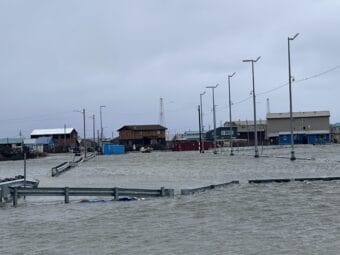
Flooded roads near Kotzebue's dock on Wednesday afternoon.
Roads near Kotzebue’s dock were flooded Wednesday afternoon. (Desiree Hagen/KOTZ)

The city of Kotzebue is under mandatory evacuation orders. That’s as the community prepares for flooding the National Weather Service warns could be worse than last year’s flood, which led to dozens of evacuations and two families losing their homes.

Flooding had already begun by Wednesday afternoon, and the Weather Service forecast said water could rise as high as 10 feet above the high tide line. Flood waters are expected to peak around 8 p.m. Wednesday night.

Forecast from National Weather Service, issued at 2:20 p.m. on Wednesday. (Courtesy of National Weather Service)

The city said Wednesday afternoon that the mandatory evacuation was issued to assist elders and to prepare residents to evacuate before dark. On Tuesday night, 28 residents stayed at Kotzebue Middle High School, which is the local evacuation point.

Kotzebue mayor Derek Haviland-Lie said first responders might not be able to reach people’s homes during the worst of the flooding.

“There may be a point, sometimes within the next 24 to 48 hours, that emergency services might not be able to make it to your home,” he said. “If that is the case, if you don’t go to the shelter, you’re going to have to shelter in place.”

As of this afternoon, barricades had been set up on the road past the airport and in other vulnerable areas of town. Haviland-Lie says the community should be prepared for power outages to several areas around town – including the airport area. Flights in and out of Kotzebue are also canceled.

“They’re worried about the water getting into their transformers that are out in the airport area. So there is going to be at some point where at least the airport is going to be without power. They have no choice,” he said.

The Kotzebue Electric Association is asking residents to report all outages and says that crews will respond when conditions are safe.

Flooding has already been reported in multiple sections of town including Front Street and the areas near Kotzebue’s airport and hospital. School is canceled Thursday. Both the city and borough closed early on Wednesday for non-essential workers.

Kotzebue’s Front Street around 4 p.m. on Wednesday, October 8. (Desiree Hagen/KOTZ)

The state also issued a notice Wednesday afternoon that it had activated its emergency operations center in preparation for a series of storms that are set to hit Western Alaska through the weekend. Kotzebue and other communities, including Kivalina, Shishmaref, Golovin, and Nunam Iqua, are expected to be among the hardest hit.

Residents in other Northwest Arctic communities have also reported that they’ve begun evacuating in preparation for the flooding. Kivalina residents are evacuating to higher ground at the school, located seven miles from the community.

This is a developing story. Check back for updates.

Alaska loses lawsuit that challenged the western boundary of the Arctic National Wildlife Refuge

A field of tall grass with cottony seedheads in front of a stark, treeless mountain range
Cottongrass wafts over the tundra in the Arctic National Wildlife Refuge on Sept. 2, 2006. (Steve Hillebrand/U.S. Fish and Wildlife Service)

A U.S. District Court judge in Anchorage has ruled against the state of Alaska in an 11-year-old legal dispute that has significant implications for the Arctic National Wildlife Refuge and state finances.

On Wednesday, Judge Sharon Gleason ruled that laws and regulations setting the western border of the Arctic National Wildlife Refuge are “ambiguous,” but federal regulators made a reasonable decision when they declared the border to be the western bank of the North Slope’s Staines River, rather than on the western bank of the Canning River.

There are 20,000 acres of potentially oil-rich land between the two waterways, and the state of Alaska had sought ownership of the area — sited just to the east of the Prudhoe Bay oil field — for oil and gas drilling.

This map, published by the Alaska Department of Law as part of its summary judgment motion, shows the area contested between the state of Alaska and the federal government. (Screenshot from Alaska Department of Law)

While the federal government is now advancing plans for oil and gas leasing in the disputed area, the decision to keep it under federal control means that if oil and gas are discovered there, the state of Alaska would receive far less revenue than it would if it were state-owned land.

“The state of Alaska is disappointed that the court failed to recognize the state’s ownership of this disputed area on the border of the Arctic National Wildlife Refuge,” said Patty Sullivan, communications director for the Alaska Department of Law, which brought the case against the federal government.

“This land may hold significant resource potential for the future of energy for Alaska and the United States and would likely be thoroughly explored and developed under state management. We will evaluate our options and are glad to, at least, have a federal administration currently in place that recognizes the importance of responsible resource development in this area,” she said.

Attorneys for the U.S. Department of the Interior and the U.S. Department of Justice did not return messages seeking comment.

The state’s dispute with the federal government revolves around whether federal mapmakers viewed the Staines River as a separate river from the Canning, or simply a “distributary,” a different channel of the same river, in 1957.

The Bureau of Land Management used the boundary drawn that year to create the Arctic National Wildlife Range in 1960, and it became the refuge in 1980. Maps published at that time show the border running along the Staines River.

As Gleason explained in her 74-page order, “If the Staines River was considered to be part of the Canning, then the extreme west bank would follow the west bank of the Staines distributary of the Canning River. But if the Staines and the Canning were considered to be two separate rivers, then the boundary would follow the west bank of western-most channel of the main Canning River.”

The dispute also included a marker designating the northwest, seaward boundary of the refuge, but the main issue was about the river-defined border.

In 2014, the Alaska Department of Natural Resources requested ownership “of certain lands west of” the Arctic National Wildlife Refuge.

The Alaska Statehood Act, which remains partially unfulfilled more than 65 years after statehood, allows the state to select more than 100 million acres of federal land for state ownership.

In 2016, the U.S. Bureau of Land Management responded to the state’s request, saying the state had already selected all available land in the area. The state protested, saying that federal officials were drawing ANWR’s border west of where it should have been because they were relying on the Staines River, not the Canning.

The state appealed to the U.S. Interior Board of Land Appeals, which ruled in favor of the BLM. The state sued over the issue in 2022 and won an early victory when Judge Gleason ruled the following year that the land appeals board failed to consider a 1951 map that showed the Staines as a separate river from the Canning.

But in 2024, the land appeals board again ruled against the state, which promptly renewed its case in the U.S. District Court and requested summary judgment, a request that was answered Wednesday.

Explaining her order, Gleason noted a 1906 U.S. Geological Survey dictionary that labeled the Staines and the Canning as the same river, but “on the other hand, some contemporaneous maps label the two rivers separately, indicating that the Staines and the Canning may have been considered to be two separate rivers. And yet other contemporaneous maps do not label the Staines or do not separately label the Canning River at the mouth,” she wrote.

While that might have favored the state’s position, Gleason concluded that the land appeals board’s interpretation of the border was reasonable, not arbitrary, was supported by substantial evidence and wasn’t contrary to law, meaning that the state doesn’t have grounds to overturn it.

Gleason concluded, “the court upholds the IBLA’s finding that the northwest boundary of the refuge follows the Staines River, a distributary of the Canning River.”

If the state chooses to appeal Gleason’s decision, it will have 30 days after final judgment.

An Alaska whale expert’s message in a bottle washed up in Scotland, years after his death

Sandsend Beach in Shapinsay, Scotland.
Sandsend Beach in Shapinsay, Scotland. (Photo by Paul Hollinrake)

In April, Julie and Dug Watkins were walking their dogs on Sandsend Beach, near their home in northern Scotland. As Julie was taking a short swim in the cold water, her husband found something unusual lying on the pebbles: an amber-colored wine bottle.

The bottle was sandy and partly covered with seaweed. Inside, they found a note saying it had been released on sea ice near Utqiagvik, on Alaska’s North Slope, six years earlier. The author had drawn a picture of a whale on the back and signed it: Craig George.

“When we read the message in the bottle and realized how significant a thing it was, we were really very excited,” Julie Watkins said.

Craig George (right) and Kate Stafford work during whale census outside of Utqiagvik in spring, 2019. (Photo provided by Cyd Hanns)

John Craighead George was a prominent whale expert who lived in Utqiagvik for decades. He died in 2023 — three years after setting the bottle adrift — leaving behind an extensive body of research. He published studies on things like how long bowheads can live and how they can survive in cold waters.

“I suppose Craig lives on in that message,” Watkins said. “He probably lives on in so many ways, but that was just one more thing.”

Release

Originally from New York, George was instrumental in starting a bowhead whale census back in the 1970s that incorporated knowledge of Iñupiaq hunters and supported their subsistence.

Kate Stafford, a researcher at the Marine Mammal Institute at Oregon State University, counted whales with George in the spring of 2019. For several months, they took hour-long snowmachine rides to an observation perch built on the ice north of Utqiagvik. At the end of the census, she said they followed George’s tradition and released several bottles with messages.

John Craighead George had drawn a whale on the back of the note that he released in a bottle in 2019. (Photo by Julie Watkins)

“Most of the time, we put them in the lead, and they probably got crushed when the ice moved around,” she said. “We thought this time, we would put them on the sea ice.”

Over the years, George collected sturdy wine bottles and emptied them with friends during music nights – which, to Stafford, is a lovely memory in itself. She said he would write his messages on waterproof paper, seal the bottles with wax and tape, and release them after the whale census.

The only known retrieval happened when one of those bottles washed up in Point Lay, about 180 miles to the southwest. That is, until now.

“Craig was the most curious person you’d ever meet,” Stafford said. “I think it just tickled him to think about putting a message – often with a little drawing that he’d done, and the weather, and the date – putting it in a bottle and seeing where it ended up, or if it ever got recovered. He would have been so thrilled that that bottle was recovered in such an interesting spot, like the Atlantic.”

Bottles with messages float in an open water lead outside of Utqiagvik after John Craighead George and Kate Stafford released them in spring 2016. (Photo by Kate Stafford)

The journey

When George released the bottle near Point Barrow, the northernmost tip of the United States, he was facing a strong northeastward stream. Seth Danielson, a physical oceanographer at the University of Alaska Fairbanks who was also George’s colleague and friend, said the bottle most likely got caught in the Beaufort Gyre, a clockwise ocean circulation that sent it toward the East Siberian Sea.

Then, the Transpolar Current likely picked it up. That’s the same stream that helped the explorer Fridtjof Nansen’s Fram drift from the Russian coast to Norway in the late 1800s. In the 1990s, it contributed to the global spread of rubber duckies after a spill in the North Pacific.

“There’s sort of this large ocean superhighway of ice that moves from the East Siberian Sea towards Fram Strait on the east side of Greenland,” Danielson said.

Danielson said that somewhere south of Iceland, the bottle probably drifted east and was caught by the North Atlantic Current, which carried it to its final destination: Shapinsay, one of the Orkney Islands, off the north coast of Scotland.

Discovery

There are no bowheads in Orkney, but the area is a popular whale watching spot for orcas. Julie and Dug Watkins – the couple who found George’s bottle – shared their discovery in a local Facebook group for whale enthusiasts. They learned that another Orkney resident knew George from helping with the whale census in Alaska, back in the 1980s.

“It’s just absolutely incredible that it should travel that far and not get broken or nothing else happened to it, but also end up on this beach, on this island, where people knew about him and respected his work and things,” Julie Watkins said. “It’s unbelievable almost, but it happened.”

Julie and Dug Watkins. (Photo by Julie Watkins)

The note in the bottle included George’s email address. The couple reached out, to no avail. Then they contacted the City of Utqagvik, which connected them with George’s widow, Cyd Hanns.

Hanns said she was glad the couple kept trying to reach out. She wrote to them about George’s life and research, as well as Alaska whaling traditions.

“I was happy-sad because he wasn’t here,” Hanns said. “He has so many friends around the world, and still making them.”

Julie Watkins’s husband Dug died unexpectedly a month after finding the bottle. The family sent his ashes out in a small burning boat from the same beach where the bottle washed up. Losing a loved one was a point of connection between Hanns and Watkins, who have stayed in touch over email.

And Hanns said the discovery brought her family closer together, three years after her husband’s death.

“It’s a story on the ocean currents and the way loved ones can surprise us even after they’re gone,” she said.

Nonprofit coordinating Arctic research will shut down as federal funding dries up

a polar bear
A polar bear walks along the shore in Alaska on Sept. 6, 2019. (U.S. Fish and Wildlife Service)

A nonprofit coordinating academic research on the Arctic plans to shut down as its federal funding dries up. The Arctic Research Consortium of the United States says it plans to wind down operations at the end of this month.

The group announced the decision in an email to members late last month, saying the National Science Foundation’s decision to scrap plans for a grant that provides the bulk of its funding left it no choice but to close its doors.

The Arctic Research Consortium brings together scientists working with universities, government agencies and nonprofits to collaborate and share their findings. Researcher Michael Walsh, a nonresident senior fellow at the Foreign Policy Research Institute who has worked with the organization, said the shutdown comes at a critical time as the federal government seeks input on a new five-year plan for government-funded Arctic research

“That new National Plan for Arctic Research is going to have to answer some of these big questions,” he said. “What are the policy drivers? What are the priority areas? What should, you know, the US government focus on supporting in the context of Arctic research?”

The group also connects thousands of Arctic researchers and provides grants that allow early-career academics to travel to other institutions or conferences Walsh said. Eliminating those opportunities will leave scientists isolated from one another and stunt young researchers’ professional development, he said.

A spokesperson for the National Science Foundation confirmed the grant funding much of the consortium’s activities would end in 2026 but declined to say why the agency scrapped plans to reissue it. The spokesperson said NSF would remain engaged with the Interagency Arctic Policy Research Committee, a federal working group that prepares the five-year Arctic research plan.

“NSF remains committed to supporting national interests in the Arctic through our continued leadership of IARPC and through collaborations with partners, including the research community, to support innovative scientific research about the Earth’s polar regions,” the NSF spokesperson said via email.

President Donald Trump has repeatedly said he would like to expand the U.S.’s presence in the Arctic by acquiring the self-governing island of Greenland from Denmark. But Walsh said the administration has not matched that apparent interest with investment.

“One would expect that what would follow from that would be a proliferation of Arctic studies centers to be able to develop the capacities and the resources and the knowledge the United States needs in order to be able to advance our national interests in those areas,” Walsh said. “We haven’t seen that yet.”

Site notifications
Update notification options
Subscribe to notifications