Arctic

Leaders focus on security and partnerships at Anchorage conference on the Arctic

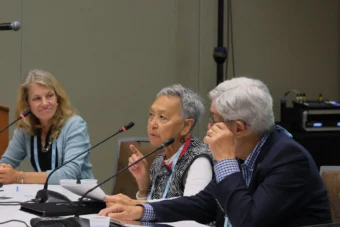
Vera Kingeekuk Metcalf (center) and Margaret Williams (left) speak during the Arctic Encounter Summit in Anchorage on July 31, 2025. Metcalf is the executive director of the Eskimo Walrus Commission. Williams is a senior fellow with the Arctic Initiative of the Harvard Kennedy School. (Photo by Alena Naiden/KNBA)

Growing political tensions, a need for partnerships and the importance of including Indigenous leaders in policy decisions were some of the themes at the Arctic Encounter Summit in Anchorage last week.

More than 700 participants, including leaders from around the circumpolar North, gathered at the Dena’ina Civic and Convention Center for the conference.

Mike Sfraga is a former U.S. ambassador to the Arctic who recently stepped into the interim chancellor role at University of Alaska Fairbanks. He spoke about how national, personal and environmental security are interconnected, especially for people who live in the Arctic.

“We’re talking about water security, food security, community security, health security. So it’s all nested in there,” Sfraga said. “But it’s highlighted by, obviously, our homeland and national security.”

Ties and tensions with Russia

The geopolitical climate in the Arctic has undergone a major shift since Russia invaded Ukraine in 2022. Margaret Williams, a senior fellow with the Arctic Initiative of the Harvard Kennedy School, said that it put an end to partnerships between Russia and the U.S. on wildlife research and planning for potential oil spills.

“Since that time, all of this important collaboration and communication has stopped,” Williams said.

Russia has also been strengthening its relationship with China while growing its shipping, fishing and military activities in the Arctic, Williams said — all of which have increased tensions with the U.S..

Vera Kingeekuk Metcalf is the executive director of the Eskimo Walrus Commission. She was born in Savoonga, a small village on St. Lawrence Island in the Bering Sea, which is closer to eastern Russia than it is to the rest of the U.S. Metcalf said Savoonga residents have a lot in common with their Russian neighbors.

“We have neighbors across the waters in Chukotka sharing the same concerns with Alaskans,” Metcalf said. “We know that we have the same issues that we’re dealing with, especially with marine mammal migration patterns changing because of climate change. Our coastlines are eroding, cliffs are crumbling, really challenging our community harvesters, affecting our food systems.”

Metcalf said she hopes that with time, Russian and American scientists and locals will collaborate again to protect marine subsistence resources and exchange cultural knowledge.

“As long as we focus on people-to-people, community-to-community ways — communicating with our neighbors,” Metcalf said.

Need for cooperation

The Arctic Encounter brought representatives from 27 nations to Anchorage. Some came from the European Union, Japan, Canada and Greenland.

During the final day of the conference, Sen. Lisa Murkowski acknowledged there is also friction between the U.S. and Western Arctic countries. Murkowski said the White House’s focus on tariffs and rhetoric around expansion hasn’t helped to build trust and diplomatic partnerships — President Donald Trump has talked about annexing Greenland and about Canada becoming the 51st state.

Murkowski said what can be helpful is having other officials who articulate the country’s priorities differently.

“It’s important to have elected representatives who can talk about the important relationships that we want to have with Canada, with Greenland, without suggesting that it has to be adversarial, confrontational or exploitative,” Murkowski said. “We cannot maintain a zone of peace if we erode the circle of trust and treat even our closest allies and friends like a common enemy.”

Murkowski said she sees examples of international collaboration in the Arctic in wildfire management. She said other examples are strengthening defense through military training and the inclusion of Sweden and Finland into the North Atlantic Treaty Organization.

“We have now a new task on the U.S. side, and that is to work to rebuild trust and relations, not with Russia, which has shown that it deserves neither, but with our fellow Western Arctic nations, our closest allies and our long standing partners,” she said. “My commitment is to ensure that America is a reliable partner, will be a reliable partner, so that in the Arctic, we can all advance together.”

Listening to Indigenous people of the North

Several Arctic Encounter panels focused on sovereignty. Speakers agreed that policy decisions about the Arctic should go hand-in-hand with listening to local communities.

Sara Cohen is a deputy head of mission at the Canadian Embassy in the U.S., where she focuses on foreign policy and national security.

“You can’t have safe people without having a safe environment. You can’t have safe people without them having a safe and secure access to a future that is characterized by dignity in Canada,” Cohen said. “That’s very much also part of our reconciliation with Indigenous peoples.”

Doreen Leavitt is the director of natural resources at the Iñupiat Community of the Arctic Slope, a tribal entity representing several communities on the North Slope. Leavitt said people living in the Arctic can represent themselves best.

“When decisions are made about us, we are diminished, and when we the tribes are ignored, it directly erodes our self determination and our sovereignty,” Leavitt said. “At the end of the day, no one else is going to know what is best for our people and our lands than we do.”

After the three-day conference in Anchorage, Arctic Encounter participants visited Fairbanks. The event repeats annually.

Copyright 2025 KNBA

U.S. House panel quietly advances Arctic drilling and other Alaska oil developments

Rep. Jared Huffman, D-Calif., employed puns and posters denounce the GOP reconciliation bill when the U.S. House Natural Resources Committee marked up the bill on May 6, 2025.
Rep. Jared Huffman, D-Calif., employed puns and posters denounce the GOP reconciliation bill when the U.S. House Natural Resources Committee marked up the bill on May 6, 2025. (Screenshot/U.S. House Video)

WASHINGTON — In an unusually quiet session, the U.S. House Natural Resources Committee passed a bill to mandate new oil lease sales in the Arctic National Wildlife Refuge and allow construction of the Ambler Road, crossing protected federal land in Northwest Alaska.

Lawmakers approved those items early Wednesday, as part of a budget reconciliation bill, with barely a peep from the Republican side of the room.

Democrats taunted. They fired off passionate assertions that usually get a rise out of the other side. They cajoled. They pleaded. Nothing they did could get Republicans on the committee to debate them.

Alaska Congressman Nick Begich III, like other Republicans, sat calmly scrolling on his phone or leafing through papers.

Republicans had a strategy, and they stuck with it.

Democrats tried to defeat portions of the bill with more than a hundred amendments. The first one would’ve removed the requirement to hold oil lease sales in the Arctic Refuge and killed any chance of ever drilling there.

“The Trump administration’s reckless and thoughtless push to sell off the refuge isn’t about lowering energy costs. It’s about sacrificing your public lands for his billionaire buddies, and that’s why I urge support for this amendment,” said Rep. Jared Huffman, D-Calif. “We should be voting to permanently protect this special place rather than auctioning it off to the highest bidder.”

In response, Republicans said nothing. Although, as soon as Huffman yielded the mic, Committee Chairman Bruce Westerman, R-Ark., made an announcement: Sandwiches were enroute.

“Soon we’ll have lunch in the back,” Westerman said. “We’re not going to recess for lunch, but if you want to go have lunch, you can go in the back room and have lunch.”

That’s how it went, through more than a hundred amendments, for hours at a time.

Democrats said Republicans wanted to avoid debating policy so that the bill wouldn’t get derailed in the Senate. A reconciliation bill is special because Senators can’t filibuster it, but to qualify, all the components have to be about revenue and spending.

The silent treatment had another benefit: The proceedings moved along faster. Still, it was after midnight when the committee passed the bill, by a vote of 26-17. One Democrat voted for it.

Alaska Congressman Nick Begich did not respond to an interview request but he claimed the win.

“This is a major victory for Alaska and for American energy independence,” he said in a statement emailed from his office.

At the U.S. Capitol, opponents of drilling in the refuge often cite the Gwich’in people, whose traditional culture depends on the caribou that give birth in the refuge. But oil development is more popular on the North Slope, in and near the refuge.

The bill “will advance Iñupiaq self-determination on our homelands and support economic development opportunities in our region that are crucial to sustaining our Indigenous culture,” said Nagruk Harcharek, president of a well-funded advocacy group called Voice of Arctic Iñupiat, by email.

Athan Manuel, the Sierra Club’s director of public land protection, has watched the House Resources Committee hold countless Arctic Refuge debates, many of them fiery, since 1998.

“This one feels weirder and worse,” he said.

Years ago, there were Republicans and Democrats on both sides of the debate. The Arctic Refuge fight didn’t entirely align with party labels.

Now, Manuel said, there’s less independent thought in Congress and more partisan dictates.

It was clear from the start, Manuel said, that all the Democratic amendments would fail. And they did.

In addition to the Arctic Refuge provisions, the bill mandates lease sales in the National Petroleum Reserve and Cook Inlet.

The reconciliation bill is controversial for other reasons, and GOP unity might not hold in Congress. Some Republicans say they’ll vote no because the bill adds trillions to the deficit.

Arctic sea ice has been hitting record lows. Scientists just lost a critical tool for studying it.

Wintertime shore ice near the village of Shaktoolik.
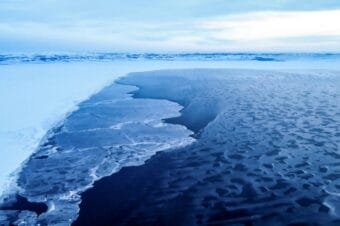
Wintertime shore ice near the village of Shaktoolik. (Laura Kraegel/KNOM)

The National Oceanic and Atmospheric Administration announced on Tuesday that it will defund a program that catalogs decades sea ice data in Alaska. Scientists say the program’s termination could create a gap in climate research at a time when polar ice is dwindling to historic lows.

Rick Thoman, a climate specialist at the Alaska Center for Climate Assessment and Policy in Fairbanks, is among them. On Tuesday, just a couple hours after he got the news about the program cuts, he was taking a tour group past an art installation about sea ice at the International Arctic Research Center.

The installation is in a long hallway at the University of Alaska Fairbanks, covered with vertical stripes in shades of blue and red. Thoman explained that bluer stripes mean the temperature was cooler than the 100-plus year average, while red stripes were warmer than average.

At the end of the hallway, the stripes stop. The years from about 2000 until the present day blend together, forming a solid block of scarlet.

Climate specialist Rick Thoman stands in front of the International Arctic Research Center’s Climate Stripes art installation on May 6, 2025. (Shelby Herbert/KUAC)

A guest asked Thoman what changed, and his answer was simple: less ice means higher temperatures.

“A lot of what’s driving this is the collapse of sea ice,” he said. “Both decreased extent and the thinning of sea ice — and, of course, increasing greenhouse gasses.

That long-term Arctic temperature data is safe, but the United States’ premier catalog of sea ice data — NOAA’s sea ice index — isn’t. The organization announced earlier this week that it will decommission the program, and the index stopped updating on May 6.

That development came as a shock to climate specialist Rick Thoman, but it comes after many other NOAA cuts this year. According to an internal budget document, the Trump administration is seeking to end nearly all of the agency’s climate research.

The termination of the index is one chapter in a long series of cuts the White House has made — or proposed — in recent months. February saw hundreds of probationary jobs slashed. And April saw a request for sweeping cuts to research funding.

It also follows an Alaska Climate Research Center report that said Arctic sea ice has been at or near record low levels since December, with 58,000 square miles fewer than the previous record low, which was set in 2017.

Scientists and barges left without a map

Hajo Eicken, director of the International Arctic Research Center at UAF, said the loss of the ice index could greatly impact the lives and livelihoods of coastal Alaskans. For example, it could make it harder for people to know the best time to schedule the barges that resupply communities off the road system.

“All of that type of activity relies on the sea ice information that gives you a sense of what’s normal,” Eicken said. “Like, what can we expect for a particular year?”

And Thoman said the scientific community will mourn the loss of the sea ice index, which he uses for his own research all the time. He said he used fresh ice data from the Bering, Chukchi, and Beaufort seas every day, which allowed him to track how things are changing relative to previous years.

Thoman said other global sea ice monitoring programs, like those in Europe and Japan, could pick up the slack. But the loss of the NOAA-funded sea ice index, which he calls “the gold standard,” will sting.

“When people ask me, ‘What does the sea ice concentration look like in the Bering Sea? What’s the ice extent now compared to last year in the short term?’ The answer is going to be: ‘We don’t know,'” he said.

NOAA officials did not respond to a request for comment by press time Wednesday.

As Trump eyes Greenland and Arctic resources, America’s ambassadorship for the region goes unfilled

Offshore oilfield service vessels sit docked in the city of Bergen in Norway, an Arctic nation that collaborates with the U.S. on military and other matters. (Photo by Nathaniel Herz/Northern Journal)

Five weeks before Election Day, at an evening ceremony at the office of the U.S. Department of State, America’s first-ever Arctic ambassador was sworn into his new job.

Barely 100 days later, on Jan. 20, Mike Sfraga resigned — departing his post, like other ambassadors, as Donald Trump took power.

Now, Sfraga’s position remains unfilled. And Alaskans and others tracking America’s stance toward the Arctic are waiting to see when, or if, the new administration will offer a clear vision or plans for the region that the U.S., its allies and rivals are increasingly eying as a zone for commerce and military activity.

“It’s feeling very quiet,” said Diane Hirshberg, who leads a research institute at University of Alaska Anchorage and is academic vice president at an international network of schools called University of the Arctic. “We’re just in this weird land of uncertainty.”

At a recent working group meeting of an international commission called the Arctic Council, Hirshberg said, the American government representative shared nothing, “other than that the U.S. reserves the right to comment at a later date.”

Experts say that Trump’s outspoken desire to annex Greenland makes clear that he’s aware of the Arctic’s growing strategic value. But they also say that his distrust of traditional European alliances and his targeting of research institutions risk undermining the nation’s interests in the region.

Mike Sfraga discusses Arctic issues during a Juneau World Affairs Council presentation at KTOO in Juneau on Feb. 6, 2020.
Mike Sfraga discusses Arctic issues during a Juneau World Affairs Council presentation at KTOO in Juneau on Feb. 6, 2020. Sfraga directs the Wilson Center’s Polar Institute. (Photo by Jeremy Hsieh/KTOO)

“There are other nations questioning us,” Sfraga said at an Alaska legislative hearing this month. “Every one of our allies in the North and elsewhere, they’re questioning how committed we are.”

Republican U.S. Sen. Lisa Murkowski, who’s long prodded the federal government to develop its Arctic policy, said she thinks the new administration appreciates the significance of the region for its natural resources and importance to American national security.

But she said she’s pushing for that awareness to be backed up with qualified personnel — new appointees to Arctic-focused positions like the ambassador job.

“At some of these Arctic conferences, I’m there,” she said in an interview. “But the U.S. delegation has to be more than just Lisa Murkowski.”

Former President Joe Biden created the Arctic ambassador position through an executive action, and it’s not set out in law — a fact that Murkowski, via legislation she introduced earlier this year, hopes to change.

U.S. Sen. Lisa Murkowski dances at a cultural festival in the northern Alaska community of Utqiagvik, above the Arctic Circle. (Photo by Nathaniel Herz/Northern Journal)

She said she’s also submitted names to the Trump administration to consider for the post and is concerned that if the decision is delayed, the new ambassador nominee could end up being a campaign donor chosen “as, kind of, a political favor.”

Murkowski said she’d love to see Sfraga reappointed to the position.

Biden originally nominated Sfraga, an Alaskan geographer who’d worked at a think tank and in Alaska’s university system, to the ambassadorship in early 2023.

Murkowski recommended Sfraga for the post and lobbied for his confirmation.

But it took more than 18 months for the U.S. Senate to take an up or down vote. Some Republican senators, led by Idaho Republican James Risch, criticized Sfraga’s relationships with officials and institutions from China and Russia.

Sfraga said in an email that filling his old post is in America’s best interest.

“The United States requires a Senate-confirmed ambassador so we can inform, influence and appropriately lead Arctic-related issues and policies throughout the region, clearly articulate U.S. Arctic goals and objectives, and ensure our policies and efforts are coordinated and advanced at home,” he said.

Asked whether he’d take the job back if chosen by Trump — as suggested by Murkowski — Sfraga thanked the senator for her “unwavering support.”

“It is now time to consider other opportunities to advance U.S. and allied partners’ interests in the Arctic, and Alaska’s unique role in the region’s future,” he said.

Alaska’s sole member of the U.S. House, Republican Nick Begich III, said in an emailed statement that an Arctic ambassador supports a strong presence in the region, “which is vital for national security.”

“I will continue to work with the executive branch and members of the Alaska delegation to advocate for an Arctic policy that includes leadership staffing as a component of our national security strategy,” Begich said.

The State Department, in an emailed statement to Northern Journal, did not directly answer a question about if and when the new administration plans to replace Sfraga. But it did say that the Office of the Ambassador-at-Large for Arctic Affairs “remains funded and operational.”

That’s in contrast to the Wilson Center — a 55-year-old think tank that once employed Sfraga when he was the founding director of the center’s Polar Institute.

The center, which focuses on foreign policy, has been almost entirely shut down by the new administration, with more than 100 employees placed on leave and just a handful of congressionally mandated positions remaining, according to the New York Times. The Polar Institute’s current director did not respond to a request for comment.

At the U.S. Department of Defense, meanwhile, the administration has filled one top Arctic-focused position. Last month, Steven Schleien, a longtime department official, was named deputy assistant secretary for Arctic and global resilience — with responsibilities that include Arctic security, ocean issues and critical minerals.

One other person that experts see as a potentially influential voice on the administration’s Arctic policy is Julia Nesheiwat.

Nesheiwat currently has no formal role in the administration. But she’s a former homeland security adviser to Trump and a former member of the U.S. Arctic Research Commission, and her husband, Mike Waltz, is Trump’s national security advisor.

Nesheiwat recently traveled with Waltz, Vice President J.D. Vance and other top administration officials to Greenland. She also held a meeting with Republican Alaska Gov. Mike Dunleavy at an energy conference in Texas last month.

Murkowski said she’s spoken about Arctic policy with Marco Rubio, the secretary of state and her former U.S. Senate colleague.

She also sent the president and other top administration officials a letter last month outlining her Arctic-related priorities — including the appointment of a special presidential assistant focused on the region, and the creation of a new deputy assistant secretary for Arctic affairs at the State Department.

Murkowski, who’s publicly clashed with Trump at times, acknowledged that some in the new administration “would love to deep-six anything that I might suggest.”

“But I know that you have people who are genuinely interested in advancing good policy,” she said. “I think they’re looking for suggestions.”

Nathaniel Herz welcomes tips at natherz@gmail.com or (907) 793-0312. This article was originally published in Northern Journal, a newsletter from Herz. Subscribe at this link.

Trump administration plans offshore oil leasing in Alaska’s ‘High Arctic’

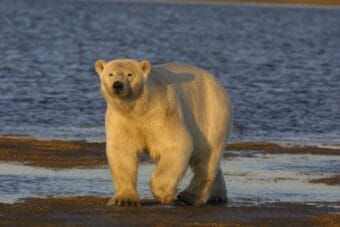
A polar bear is spotted on a multiyear ice floe in the Beaufort Sea on Aug. 13, 2023. The Trump administration is planning to designate a new “High Arctic” region off Alaska for offshore oil and gas leasing. (Photo by Petty Officer 1st Class Scott Bice/U.S. Coast Guard)

The Trump administration plans to create a new designated region for offshore oil leasing in Arctic waters off Alaska, an area where past exploration attempts have failed amid extremely high costs, logistical challenges and safety problems.

The Department of the Interior said it will soon release a new five-year national plan for offshore oil and gas leasing in federal water, and it will include a new High Arctic planning area. Details will be provided in an upcoming notice in the Federal Register and in information posted on the Bureau of Ocean Energy Management’s website, the department said in its statement.

“Launching the process to develop the 11th National Outer Continental Shelf Program marks a decisive step toward securing American Energy Dominance,” Interior Secretary Doug Burgum said in the statement. “Through a transparent and inclusive public engagement process, we are reinforcing our commitment to responsible offshore energy development—driving job creation, bolstering economic growth and strengthening American energy independence. Under President Donald J. Trump’s leadership, we are unlocking the full potential of our offshore resources to benefit the American people for generations to come.”

Further information was not provided by the department.

The Beaufort Sea coast is seen on Aug. 23, 2018, from East Dock at Prudhoe Bay on the North Slope. The Liberty oil discovery, which has languished without development, is located about 20 miles east of here. (Photo by Yereth Rosen/Alaska Beacon)

Most federal Arctic waters were previously put off-limits to oil leasing by former Presidents Barack Obama and Joe Biden.

President Trump attempted in his first term to open Arctic areas that Obama had withdrawn from the leasing program, but that attempt was struck down by a federal court.

A more recent Trump attempt to open withdrawn waters to oil leasing is now being challenged, as the first attempt was. A coalition of environmental groups sued the Trump administration in February over his efforts to overturn protections in the Northern Bering Sea and areas of the Atlantic and Pacific oceans.

Environmentalists on Friday criticized the newly announced plans for more offshore oil leasing, including in the Arctic.

“Drilling in the Arctic is a disaster waiting to happen. There’s no way to clean up an oil spill there and it will harm polar bears and bowhead whales. Oil companies should think twice about drilling in the Arctic, as it has been plagued with challenges,” Natalie Jones of the Center for Biological Diversity said by email.

The Center for Biological Diversity is one of the environmental groups that sued the Trump administration in February.

Despite some sporadic attempts to explore for oil in federal Arctic waters off Alaska, there has never been any commercial oil production there or in any federal waters off Alaska, except for a small portion of the Hilcorp-operated Northstar field, which lies mostly on state territory.

Royal Dutch Shell’s conical drilling unit Kulluk sits aground on the southeast shore of Sitkalidak Island, Alaska, 40 miles southwest of Kodiak City on Jan. 1, 2013. The Kulluk was grounded after efforts by U.S. Coast Guard and tug crews to tow the vessel to a safe harbor after it was beset by winter storm weather during a tow from Dutch Harbor, Alaska, to Everett, Wash. (U.S. Coast Guard photo by Petty Officer 1st Class Sara Francis/Released)

The field that was expected to become the first producing site located entirely in federal waters off Alaska, the Liberty project, has languished for decades without development. BP Exploration (Alaska) Inc. discovered it in the 1990s and drew up two separate development plans but wound up dropping those. Hilcorp acquired full ownership of Liberty in 2020, but its lack of progress on the project led to expiration of the leases earlier this year.

The last oil exploration attempt in federal Arctic waters was a Royal Dutch Shell campaign abandoned in 2015 after the company spent over $7 billion on it.

That campaign was beset with trouble — most notably, the wreck of a mobile drill rig that escaped its tow and grounded during a storm on Dec. 31, 2012. The rig, the Kulluk, had been used for Shell’s exploration in the Beaufort Sea, the portion of the Arctic Ocean east of Point Barrow. Shell used a separate drill ship in the Chukchi Sea, west of Point Barrow and north of the Bering Strait. That ship, the Noble Discoverer, also had numerous operational and environmental problems.

Shell wound up completing just one well, which was in the Chukchi, and the company concluded that it found too little oil there to justify further development.

Alaska wins lawsuit that could open Arctic refuge to oil exploration

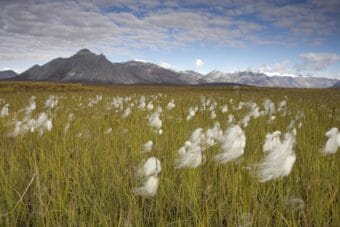
Research biologists pause among the wetlands of the coastal plain, with the Brooks Range in the background. (Lisa Hupp/USFWS)

A federal judge in Anchorage has ruled in favor of Alaska’s state-owned investment bank in a lawsuit that could clear the way for oil drilling in the Arctic National Wildlife Refuge.

In an order published Tuesday, Judge Sharon Gleason wrote that the U.S. Department of the Interior acted illegally when it canceled oil and gas leases held by the Alaska Industrial Development and Export Authority on land within the refuge.

“Having reviewed the parties’ arguments, the court concludes that DOI was required to obtain a court order before canceling AIDEA’s leases,” Gleason said in her 22-page decision.

AIDEA did not immediately respond to a request for comment, but Cori Mills, Alaska’s deputy attorney general, called the decision a victory.

“The state looks forward to working with the current federal administration on fully realizing the vast potential of ANWR to grow Alaska’s economy and help America’s energy independence,” she said by email. “It is unfortunate we have lost a significant amount of time litigating, instead of moving forward with field studies and development. We will continue to review the decision in more detail but it’s definitely a victory.”

Tuesday’s order was the result of a lawsuit filed by AIDEA against the federal government last year, when the Biden administration canceled oil and gas leases that AIDEA won in a January 2021 sale.

Two other companies also won leases during the sale but later surrendered them to the federal government, leaving AIDEA as the only company holding leases within the refuge’s coastal plain, which is believed to hold significant oil and gas reserves, just as nearby state land does.

The Biden administration claimed that the sale — conducted under the auspices of the first Trump administration — was flawed and thus illegal.

It first suspended, then canceled the leases, prompting AIDEA to sue in 2024.

Gleason had upheld the Biden administration’s suspension order, but when it came to the cancellation, she ruled in AIDEA’s favor, citing a provision of the 2017 Tax Cuts and Jobs Act that enabled the ANWR leases.

That act said in part that the Interior Department “shall manage the oil and gas program on the Coastal Plain in a manner similar to the administration of lease sales under the Naval Petroleum Reserves Production Act of 1976.”

Gleason wrote: “Among the NPRPA’s implementing regulations is a regulation that provides that ‘(p)roducing leases or leases known to contain valuable deposits of oil or gas may be canceled only by court order.’”

But the Interior Department didn’t obtain a court order, Gleason noted.

“Accordingly, federal defendants’ cancellation of AIDEA’s leases was not in accordance with law because it failed to seek a court order,” she wrote.

Several environmental and tribal groups sided with the federal government during the course of the lawsuit and had requested the ability to offer alternative solutions if Gleason ruled in favor of AIDEA.

She turned them down, writing, “DOI’s error is serious: DOI cancelled AIDEA’s leases without following the congressionally mandated procedure for doing so.”

In light of that finding, she vacated the department’s lease cancellation decision, saying the department — now back in the hands of the Trump administration — may decide what to do next.

In a statement released last week, Interior Secretary Doug Burgum said he intends to open the refuge’s entire 1.56 million-acre coastal plain to development, indicating that AIDEA will be given a free hand on its leases.

For its part, AIDEA has said in multiple court filings that if allowed to proceed, it will conduct seismic testing and other preliminary work necessary to determine how much oil and gas lies within its leases.

Among the various environmental and tribal groups that stood with the federal government in opposition to AIDEA was the Gwich’in Steering Committee, represented by attorneys from Trustees for Alaska.

“This disappointing ruling ignores the destruction oil drilling will do to our communities and only deepens our resolve in fiercely defending the coastal plain from oil and gas extraction,” said Kristen Moreland, executive director of the Gwich’in Steering Committee. “We will always protect the caribou, our way of life, and future generations.”

The Native Village of Venetie Tribal Government, Arctic Village Council, and Venetie Village Council, represented by the Native American Rights Fund, said in a statement that they will continue to oppose drilling in ANWR and that “multiple legal and administrative pathways remain to ensure proper environmental review before any ground-disturbing activities could occur.”

Site notifications
Update notification options
Subscribe to notifications