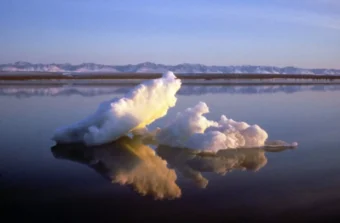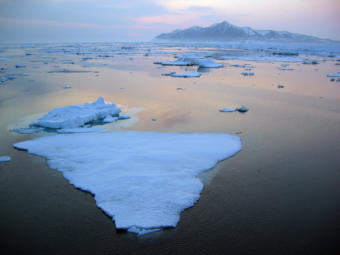
Sea ice floats in the Bering Strait off Cape Prince of Wales. (UAF photo by Gay Sheffield)
WASHINGTON, D.C. — President Biden announced Monday that he is banning offshore oil and gas drilling in large swaths of federal waters, including 44 million acres off Alaska, in the Northern Bering Sea.
“In Alaska, dozens of Tribes have fought to protect the Northern Bering Sea, a vital ocean ecosystem that supports their traditional ways of life. Vice President Harris and I have listened,” Biden said in his announcement.
President Obama created the Bering Sea Climate Resilience Area (shown in green) in 2016 and closed most of the northern portion to oil and gas drilling. President Biden announced Jan. 6, 2025 that he is closing the remainder. (Image courtesy of White House)
The ban doesn’t cancel any planned lease sales or shut down active development. It continues to allow drilling in the central and western Gulf of Mexico, where 97% of U.S. offshore production occurs.
In Alaska, Biden’s order builds on a 2016 offshore withdrawal then-President Obama made. He created the Northern Bering Sea Climate Resilience Area and closed about half of it to oil and gas drilling. Biden is closing the rest of the area, using a provision of the 1953 Outer Continental Shelf Lands Act.
It’s not clear that incoming President Donald Trump can reverse the ban without an act of Congress. The law doesn’t have a provision for reversing a presidential withdrawal. In 2019, a U.S. District Court judge in Anchorage struck down Trump’s attempt to reverse Obama’s Bering Sea withdrawal.
Alaska’s new congressman issued a quick denunciation of Biden’s order, and of the president personally. In a social media post, U.S. Rep. Nick Begich noted the importance of Cook Inlet gas to Alaskans. Biden’s closure doesn’t extend to Cook Inlet.
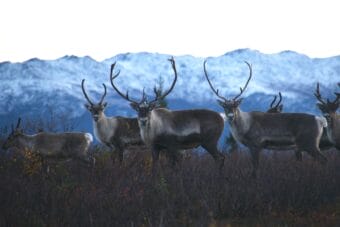
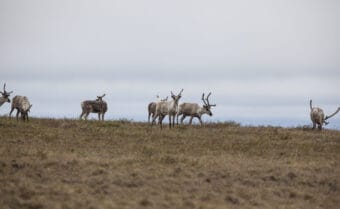
A group of Western Arctic Herd caribou pause in front of mountains in Kobuk Valley National Park during fall migration in 2016. The Western Arctic herd, one of the largest in the world, has been in decline for the past two decades. The 2023 census shows that the decline is continuing. The population is now only about a third of what it was in 2003. (Photo by Kyle Joly/National Park Service)
The Arctic tundra shifted this past year from capturing carbon to releasing it, which means it’s now contributing to rising global temperatures, according to the 2024 Arctic Report Card from the National Oceanic and Atmospheric Administration.
Rick Thoman, a climate researcher at University of Alaska Fairbanks, edited the report and said the NOAA report card also documents rapid declines in caribou herds.
“Particularly the large migratory herds, including the Western Arctic herd, have shown significant drops in population numbers, and they’re not recovering,” Thoman said. “Now it’s not all bad news. Some of the smaller coastal herds that don’t migrate as far have numbers [that] have rebounded in recent years from lows a decade or two ago.”
He said declining numbers are due to several factors connected to climate change. More precipitation in the winter can interfere with caribou feeding, and warmer summer temperatures mean bigger plants grow that crowd out the lichen that caribou eat.
Thoman said surface air temperatures are increasing across the Arctic, and precipitation is increasing, especially in winter, because even modest rising temperatures increase the amount of water the air can hold.
He also said the average extent of sea ice in the fall was the lowest on record, and that has led to increased ocean traffic.
“We had many, many transits of the Northwest Passage. And so the port of Nome [has been] very busy, as we’ve seen the last few years,” Thoman said. “A lot of traffic along the northern sea route.”
He said the uptick in vessel traffic means an elevated risk for a significant accident in Alaska coastal waters.
One big piece of good news from the report is that ice seals are still doing well, according to Thoman.
“Yes, we’ve had a decrease in sea ice, and we’ve had a couple of really low years there, 2018 and ‘19 in the Bering Sea.” Thoman said. “But overall, the health of ice seals is still pretty good. So I think that’s good news for Alaskans.”
The Arctic report card from NOAA incorporated research from October 2023 to September 2024. Next year will be the 20th year they’ve produced the report card consecutively.
Teshekpuk Caribou Herd animals graze in June of 2014 in the northeastern part of the National Petroleum Reserve in Alaska. The land around Teshekpuk Lake is considered key habitat for the herd, and a new right-of-way agreement gives Nuiqsut residents the authority to prevent development there. (Photo by Bob Wick/Bureau of Land Management)
As ConocoPhillips builds its huge Willow oil drilling project on the western side of Alaska’s North Slope, federal regulators and residents of the nearest Iñupiat village have struck a deal for a new type of environmental oversight to minimize impact of the development.
The U.S. Bureau of Land Management announced last week that it signed a right-of-way agreement with a partnership comprising the Nuiqsut city government, Nuiqsut’s tribal government and the Kuukpik Corp., the Inupiat village’s for-profit Native corporation.
The three entities, combined to form Nuiqsut Trilateral Inc., have authority over about 1 million acres of land encircling Teshekpuk Lake, the largest lake on the North Slope. The area is key habitat for the Teshekpuk Caribou Herd, among other wildlife populations.
The right-of-way agreement prohibits any new leasing, roads, any surface or subsurface exploration activities or oil-related gravel or sand mining on that parcel of land for the duration of Willow’s operations.
The purpose of the agreement, signed Dec. 17, is to “offset the impacts on the herd from the Willow Project by providing durable and long-term protection for the herd by prohibiting certain activities and facilities within the protected property for the benefit of the herd and the herd’s most important habitat,” according to the document.
A conservation right-of-way encircling Teshekpuk Lake, established through an agreement between the U.S. Bureau of Land Managment and Nuiqsut’s city government, tribal government and village for-profit Native corporation, is seen on this map. The map is from the signed right-of-way agreement. (Map provided by U.S. Bureau of Land Management)
Under the terms of the agreement, Nuiqsut Trilateral Inc. has the option to waive any or all of the restrictions.
Willow, which lies in the federally managed National Petroleum Reserve in Alaska, is set to become the westernmost producing oil field on Alaska’s North Slope.
Willow is expected to start producing oil in 2029, and output is expected to peak at 180,000 barrels per day. In comparison, total production of North Slope oil, which peaked in 1988 at over 2 million barrels per day, averaged 461,000 barrels a day for the 12 months that ended on June 30, according to the Alaska Department of Revenue.
The new right-of-way agreement does not establish an additional area of protection. The affected 1 million acres holds no active leases and is already part of the designated 3.65 million-acre Teshekpuk Lake Special Area, where development is limited, the BLM said. But it does establish a new type of protection that is led by the community.
Kuukpik said it was the entity that first suggested the right-of-way arrangement. Although the Native corporation opposes establishment of any new additional protected areas in the National Petroleum Reserve, the right-of-way concept puts conservation decisions in the hands of the local people and “is a completely community-led effort that BLM has adopted and supported from the ground up,” Kuukpik President George Sielak said in a letter sent to the BLM on Sept. 16.
Kuukpik has acknowledged that Willow development will “negatively impact” the Teshekpuk herd, and additional protections for the caribou were needed to gain the corporation’s support for the project, the letter said. Because of that, Kuupik proposed the arrangement as “an additive, forward-looking mitigation measure that was carefully designed specifically to offset Willow’s likely impacts to the herd by preventing oil and gas development during the life of the Willow Project in the core areas that were most vital to the herd’s continued survival and success,” the letter said.
ConocoPhillips’ North Slope acreage is seen in this map from a company fact sheet on Alaska operations. The map shows developments in the western part of the North Slope, including Willow and others in the National Petroleum Reserve in Alaska. (Map provided by ConocoPhillips)
The Biden administration approved Willow development in March of 2023, despite objections from environmentalists about potential climate-change impacts from the additional oil development. Nuiqsut’s tribal and city governments, now part of Nuiqsut Trilateral Inc., opposed Willow at the time, citing potential disruption of movement for the Teshekpuk herd and concerns that more industrialization would impede villagers’ traditional subsistence hunting and food-gathering practices. But the Nuiqsut governments have since changed their position on Willow.
While Willow is being built, ConocoPhillips has been developing several smaller production sites on the western side of the North Slope.
The newest is Nuna, which began producing on Dec. 17, a bit ahead of the expected early 2025 startup. It is a satellite in the Kuparuk River Unit, meaning its oil is processed at existing Kuparuk facilities. Nuna has 29 wells and is the 49th drill site to be developed in the Kuparuk unit, ConocoPhillips said.
Other new sites that started producing oil in recent years on the western side of the North Slope are ConocoPhillips’ Fiord West Kuparuk and Narwhal, both in the Colville River Unit on state land bordering the National Petroleum Reserve in Alaska. They started production in 2023 and 2022 respectively, a ConocoPhillips spokesperson said.
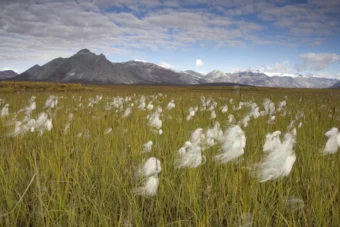
Green summer tundra and the rolling Mulgrave Hills in northwestern Alaska’s Cape Krusenstern National Monument are seen on July 11, 2011. The Mulgrave Hills are the farthest west extension of the Brooks Range. Arctic tundra, which for thousands of years was a net sink for atmospheric carbon, is now a net emitter, adding to the greenhouse gas load that is warming the earth, according to the 2024 Arctic Report Card released by the National Oceanic and Atmospheric Administration. (Photo provided by the National Park Service)
For millennia, the tundra regions of the Arctic drew in carbon from the atmosphere and locked it in permafrost.
That is the case no more, according to an annual report issued on Tuesday by the National Oceanic and Atmospheric Administration.
The tundra regions have become a net carbon source rather than a carbon sink, the result of permafrost warming, increased wildfires and other effects of climate change, said the 2024 Arctic Report Card, a NOAA project with nearly 100 collaborating scientists from different organizations in Alaska and elsewhere.
The sink-to-source switch means that carbon-based plant and animal matter that has been stored in permafrost for thousands of years now streams into the air because of warmth-induced decomposition, said Brendan Rogers, a scientist with the Woodwell Climate Research Center and one of the Arctic Report Card’s co-authors.
The fear is that the change will exacerbate the warming caused by carbon gases that envelop the planet and hold in warmth, creating what is called a greenhouse effect, Rogers said on Tuesday.
“There is a concern, of course, with the amount of carbon that’s stored, especially in permafrost. As climate warms, as those soils warm, that could be released. The scientific consensus is that some of that will be released. It could be the equivalent, for example, to a major greenhouse gas-emitting country,” Rogers said at a news conference, held by NOAA at the American Geophysical Union’s annual meeting in Washington, D.C.
The annual report card describes changes in a region of the world that has warmed up at nearly four times the global rate.
The tundra regions’ switchover from sink to source has occurred over at least the last two decades, according to the report card. While there have been some recent years when the tundra region functioned as a net carbon sink, on average it is a net carbon emitter, Rogers said at the news conference.
Permafrost, wildfires and the relationship between them have converted the tundra regions, according to the report.
In Alaska, average permafrost temperatures across an array of long-term monitoring stations were the second highest on record, the report card said. The temperatures were the highest ever recorded at about half of the Alaska sites, the report card said.
Smoke from the Noatak Grand Canyon Fire, burning in tundra in Alaska’s Noatak National Preserve, rises into the air on June 8, 2012. Wildfires, which are becoming more intense in Arctic regions, can expose permafrost and cause it to thaw. (Photo by Dan Stevenson/National Park Service)
Permafrost need not be thawed to emit carbon gases, Rogers said in an interview prior to the report’s release. As soil warms, even if temperatures remain below freezing, microbes become increasingly active and increase their expulsion of carbon dioxide, he said. Such carbon gas respiration is a byproduct when microbes break down organic matter.
Wildfire as a direct and indirect carbon emitter
Wildfires factor into the sink-to-source switchover because of their direct emissions and their effect on permafrost, the report card said.
Wildfires in circumpolar regions have emitted an average of 207 million metric tons of carbon annually since 2003, it said. Those fires are getting more intense, and this year’s fires north of the Arctic Circle emitted the second-highest amount of carbon yet recorded, the report card said.
Wildfires are normal in the boreal forest, which can regrow and absorb carbon from the air through photosynthesis, Rogers said at the news conference.
“What’s the challenge right now is, of course, in areas of permafrost, that those fires will remove the insulating soil organic matter. That permafrost can thaw and lead to longer-term emissions,” Rogers said. “And we’re just seeing this general intensification of wildfires since the mid-20th century, so that they’re emitting that carbon into the atmosphere.”
Concerns about fire unlocking permafrost carbon prompted a new policy in one area of Alaska, the Yukon Flats National Wildlife Refuge. Through consultation with the Woodwell Climate Research Center, a Massachusetts-based research organization, the refuge identified about 1.6 million permafrost-laden acres where fires, if they broke out, would draw responses to limit their burning. Past practice in those areas was to allow fires to burn naturally. The sites put into that classification were identified as holding a type of ice-rich permafrost called yedoma that is considered particularly vulnerable to thaw.
There was no fire suppression this year on any of those newly identified yedoma sites, but one fire that did draw a response burned over a separate area that does likely contain that type of ice-rich permafrost, said Jimmy Fox, the refuge’s superintendent. The Ed Berg Slough Fire flared up in June at a site that had not burned in recent years, and a quick response by firefighters limited it to about 4 acres.
The site would have qualified for the new classification had it not already been designated for what is considered a “modified” firefighting response, Fox said.
“Fortunately, although the fire did not start in a new yedoma protection area, researchers will likely be able to evaluate the event and what effect the suppression may have in protecting yedoma and at what cost,” Fox said by email.
Ted Schuur, a permafrost expert at Northern Arizona University and one of the report’s co-authors, emphasized the long-term nature of the switch.
“What we’re describing is a long-term, 20-year trend towards this increasing source from the tundra region,” he said at the news conference. That trend will be sustained even if there are occasional years when the tundra does soak up more atmospheric carbon than it emits, he said.
A few snow drifts remain on June 18, 2004, on the Arctic coastal plain of the National Petroleum Reserve in Alaska. The amount of atmospheric carbon absorbed by the Arctic’s tundra region in the summer is now outpaced by the amount of carbon dioxide emitted through permafrost warming and thaw, wildfires and winter carbon dioxide releases, according to the 2024 Arctic Report Card. (Photo by Craig McCaa/U.S. Bureau of Land Management)
Winter emissions, which occur when there is little or no sunlight to enable plant photosynthesis, are particularly high, said Schuur, who has documented the phenomenon in the Denali National Park area and elsewhere in Alaska.
This year’s emissions of carbon dioxide and methane, both of which are greenhouse gases, hit a new record, primarily because of wintertime, Schurr said. He noted that wintertime carbon emissions from tundra had not gotten much study in the past. “So in places that we’re hardly paying attention, we see records being set, and we think it’s very important,” he said.
Continued warming in the air and water
Beyond explaining how the tundra regions have shifted from being net carbon sinks to net carbon emitters, the report card described a continuing long-term trend toward a warmer and wetter Arctic.
Arctic annual surface air temperatures for the 12 months ending in September 2024 ranked second warmest since 1900. An August heatwave set new daily records in several sites in northern Alaska and Canada, the report card noted. The last nine years in the Arctic were the nine warmest on record, the report card said.
The past summer was also the wettest in the Arctic on record, it said. Despite above-average snow accumulation in the past year across the Arctic, the snow season was compressed in some places. In parts of Arctic Canada, the snow season was the shortest in 26 years, and overall, Arctic snowmelt is occurring one or two weeks earlier than it did historically, the report card said.
The sea ice minimum extent reached in September was the sixth lowest in the satellite record. All 18 lowest annual minimums have happened in the last 18 years.
Arctic greening, a satellite-based measurement of the northward expansion of woody shrubs and other plants as the environment warms, was the second highest on record, the report card said. The greening trend has been measured since 1990. Even though that new plant growth results in more intake of atmospheric carbon dioxide during the growing season, that amount of absorption is outweighed by the amount of carbon emitted from the ground and from the plants themselves during the dark non-growing season, the report card said.
There were regional variations and outliers.
One was the Chukchi Sea off northwestern Alaska. Most areas in the seas around the Arctic Ocean had August sea surface temperatures that were 2 degrees Celsius to 4 degrees Celsius, or 3.6 degrees to 7.2 degrees Fahrenheit, warmer than the 1991-2020 August average. However, the Chukchi was 1 degree to 4 degrees Celsius, roughly 1.82 degrees to 7.2 degrees Fahrenheit, cooler than that past average.
Melt on the Greenland Ice Sheet was a bit of an anomaly from the more long-term trend. This year’s loss of Greenland ice was the smallest since 2013, the result of more snowfall than usual, the report card said.
Muskox and geese roam vegetated beach ridges in front of the Igichuk Hills in Alaska’s Cape Krusenstern National Monument on Aug. 31, 2008. Tundra plants absorb atmospheric carbon in the summer, when they use sunlight to photosynthesize, but they emit carbon dioxide in the winter, when the daylight is gone. (Photo provided by the National Park Service)
Each year’s report card focuses on some specific Arctic species, and this year’s document described warming effects on tundra caribou and Alaska’s ice-dependent seals.
Uncertain future
NOAA has released the Arctic Report Card every year since 2006. Next year’s report is scheduled to be the 20th in the series. That means 2025 “will be a big event for the Arctic report card,” said Twila Moon, a lead editor of this year’s report and a scientist at the National Snow and Ice Data Center in Colorado.
That report is already in the works, she said at the news conference.
“The Arctic report card is a year-round effort, and we’ll be thinking about the next one as soon as we wrap up this one,” she said.
But the fate of the annual report card and NOAA itself are uncertain in the incoming Trump administration
NOAA, including its National Weather Service, is one of the federal agencies that may be slashed by the incoming administration. The conservative Heritage Foundation’s blueprint for remaking the federal government, called Project 2025, proposes deep cuts to NOAA and privatization of many of its functions, including those of the National Weather Service. There are fears among scientists that the incoming administration’s cost-cutting plan led by billionaire Elon Musk and former presidential candidate Vivek Ramaswamy will gut NOAA and its services.
President-elect Donald Trump has long opposed action to combat climate change, which in the past he called a hoax, and he has cast doubt on climate scientists’ reports.
NOAA Administrator Rick Spinrad, speaking at the news conference, expressed optimism nonetheless about the agency continuing its work to document climate change in the Arctic and elsewhere and to help people combat and adapt to it.
NOAA, he said, is a “mission agency” with science that responds to needs that continue to grow with intensifying events like wildfires, floods, drought and coastal inundation.
“In fact, the argument I would make is that now more than ever, the need, the requirement, the demand signal, if you will, is higher than ever before,” he said.
There can be changes to make the investments more efficient, but studies have shown that “the return on those investments is extraordinary, in many cases, 10-to-1 in terms of protection of lives and property,” he said.
The icebreaker Aiviq, seen sailing 116 miles southwest of Kodiak. (From U.S. Coast Guard)
The U.S. Coast Guard inked a deal last month to bring a third icebreaker, the civilian vessel Aiviq, into its fleet. The long-awaited move was announced at the Halifax International Security Forum held in Nova Scotia Nov. 22-24.
From July to September, the U.S. Coast Guard publicly documented at least five separate intercepts of Russian or Chinese vessels in the Bering and Chukchi seas. Press releases announcing the intercepts often noted that the Coast Guard “met presence with presence”.
But with the Coast Guard operating just two polar icebreakers, one each in the northern and southern hemispheres, what happens if one is not operational?
That happened this summer when the 28-year-old polar icebreaker Healy experienced an electrical fire while on patrol in the Chukchi Sea. Other Coast Guard vessels scrambled to fill the gap, although they lack the icebreaking capabilities the Healy and its sister icebreaker the Polar Star bring to the fleet.
Coast Guard Commandant Adm. Linda Fagan said at the forum that following months of negotiations, they’re getting closer to closing that gap.
“Just in the last three days, we have signed a contract to acquire a commercially available icebreaker,” Fagan said.
The Aiviq, which draws its name from the Inupiaq word for “walrus”, was launched in 2011 and has primarily served as a support vessel for oil exploration. Following some modifications, the 360-foot-long vessel will be designated a medium polar icebreaker, the same class as the Healy.
Seated next to Fagan was Canada’s minister of national defense, Bill Blair. He said as climate change transforms the Arctic, it is also remaking global trade routes.
“As the sea ice melts and the permafrost melts, we believe that the Arctic Ocean could very easily become the main point of transit between Europe and Asia, as a trade route, in the coming decades,” Blair said.
The Coast Guard has said it needs as many as nine icebreakers to protect the nation’s interests in the Arctic. According to Fagan, they can’t come soon enough.
“We are behind as a nation. This isn’t an Alaska issue, this is a United States sovereignty and defense issue as it pertains to the Arctic,” she said.
During a Nov. 14 hearing of the U.S. House Subcommittee on Coast Guard and Maritime Transportation, Coast Guard Vice Adm. Thomas Allan said efforts to get the new ship ready for operations are underway.
“We are making tremendous strides in that with the owner. They’ve already painted about a quarter of it Coast Guard icebreaker red,” Allan said.
He said the Aiviq is scheduled to sail to its new homeport of Juneau in the spring of 2026.
Mike Sfraga, then chair of the U.S. Arctic Research Commission, speaks on April 10, 2024, at the Arctic Encounter Symposium in Anchorage. He later became U.S. ambassador-at-large for Arctic Affairs. (Photo by Yereth Rosen/Alaska Beacon)
Earlier this month, a crowd gathered at a Fairbanks venue to celebrate the confirmation of U.S. Ambassador-at-Large for Arctic Affairs Mike Sfraga — an Alaskan and the first-ever person to hold the newly created position.
Sfraga’s confirmation was a priority of Republican U.S. Sen. Lisa Murkowski, who pushed for the creation of the Arctic ambassador post and was seen personally lobbying her colleagues on the Senate floor during the vote.
It took more than a year after Sfraga’s nomination for the U.S. Senate to confirm him, amid opposition from some Republicans. But now, not even three months in, he may soon be out of a job.
Sfraga was appointed by President Joe Biden, and it’s typical for politically appointed ambassadors to resign their posts during presidential transitions; others, like those serving as ambassadors to Kenya and South Africa, have already announced their departures.
Sfraga, a geographer who has also worked at a think tank and University of Alaska Fairbanks, has not publicly made such an announcement.
A spokesperson for Sfraga declined to comment, as did a spokesperson for Murkowski.
Republican U.S. Sen. Dan Sullivan said in a brief interview that Sfraga’s fate is likely up to Donald Trump.
“The tradition is, when a new administration comes in, most ambassadors, they just resign or step down,” said Sullivan, who missed Sfraga’s confirmation vote due to a trip to the United Nations. “But I have no idea. I truly don’t.”
Sfraga’s nomination faced close scrutiny from some Republicans, who criticized his links to Russia and China.
Republican U.S. Sen. James Risch of Idaho, the ranking member of the Senate Committee on Foreign Relations, said Sfraga had spoken at one Russian government-sponsored conference headlined by Vladimir Putin and also at a panel sponsored by a “sanctioned, state-owned Russian energy company.”
Sfraga, at a Senate hearing, called Russia “half of the Arctic” and said that because the region is a small community, “you must engage.”
“Indeed, at one of those conferences, President Putin did provide a keynote address,” he said. “But I had no interaction with President Putin at all.”
Among those voting against Sfraga’s confirmation was the man who would be his new boss, Republican U.S. Sen. Marco Rubio of Florida, whom Trump has chosen to be the new Secretary of State.
Many of Sfraga’s friends and allies are hoping to see him remain on the job. Fran Ulmer, a former Alaska lieutenant governor who served with Sfraga on the U.S. Arctic Research Commission, said Sfraga has spent many years working on Arctic issues and science, and establishing relationships with officials from other nations.
“He has a kind of credibility with them that would help the U.S. when it comes to pursuing a particular Arctic agenda,” she said. “Those relationships matter, and those relationships don’t happen overnight — they happen over years. So, it would be to the next administration’s advantage to have someone in there who has that kind of credibility but also those connections.”
Another friend of Sfraga’s, Mark Myers, a federal government veteran who is a former head of the U.S. Geological Survey, said that “if you were to bet, the bet would be against him.”
“But has some strong support,” added Myers.
Myers said the Fairbanks celebration of Sfraga’s confirmation drew dozens of people, including some from Alaska’s university system and the military and even Murkowski, who teleconferenced in.
“At his core, he is our neighbor, our friend — and he is just so important,” Murkowski told the audience, according to the Fairbanks Daily News-Miner.
Nathaniel Herz welcomes tips at natherz@gmail.com or (907) 793-0312. This article was originally published in Northern Journal, a newsletter from Herz. Subscribe at this link.
Close
Update notification options
Subscribe to notifications
Subscribe
Get notifications about news related to the topics you care about. You can unsubscribe anytime.