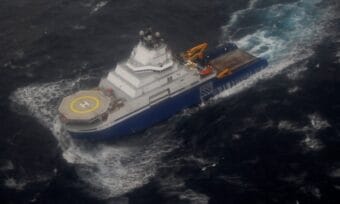
New data is used to map a volcano-like feature discovered this fall by science teams aboard the U.S. Coast Guard Cutter Healy, a polar-class icebreaker used for Arctic research. The scientists found the structure on the continental slope off northern Alaska. (Image provided by the National Oceanic and Atmospheric Administration)
Scientists aboard a U.S. Coast Guard icebreaker have discovered something unusual in the Arctic Ocean off northern Alaska: a volcano-like structure rising more than 500 meters from the seafloor and possibly emitting gas.
The discovery came as scientists from different organizations were aboard the Healy, one of two polar-class Coast Guard icebreaking cutters, were working on a mission to better understand uncharted waters in the Chukchi and Beaufort seas north of Alaska.
Although the structure rises well above the seabed, it tops out at about 1,600 meters below the water’s surface, so it is too deep to pose any risks to navigation, the Coast Guard said in a statement. However, there appears to be a plume of gas rising from the structure that nearly reaches the water’s surface, the Coast Guard said.
The discovery is part of a project called the Alaskan Arctic Coast Port Access Route Study. The project is surveying what have been uncharted waters and collecting depth data along a corridor that the Coast Guard has proposed to be a preferred vessel route between Utqiagvik, the nation’s northernmost community, and the U.S.-Canada border. The project is making use of equipment aboard the Healy to gather data and create detailed images of the seafloor and objects along the proposed Utqiagvik-to-Canada corridor.
Researchers from the National Oceanic and Atmospheric Administration Ship Fairweather and the University of New Hampshire analyze mapping data in the U.S. Coast Guard Cutter Healy’s computer lab while the cutter transits the Beaufort Sea on Oct. 16. (Photo by Lt. j.g. Haley Howard/U.S. Coast Guard)
Multiple organizations are collaborating on the project, which is in its first phase: the U.S. National Science Foundation, the National Oceanic and Atmospheric Administration, and the University of New Hampshire, along with the Coast Guard.
Capt. Meghan McGovern, the commanding officer of the NOAA Ship Fairweather, is part of the Healy mapping team and commented on the discovery.
“Although data analysis is ongoing, these findings are exciting and offer insight into what may exist beneath the ocean’s surface, much of which is unknown in this region,” McGovern said in a Coast Guard statement. “The coordination and partnerships during this mission fill critical gaps in the region for all waterway users and provide a foundation for safe navigation in the Arctic.”
The port access route study accomplishments came despite some difficulties endured earlier in the year by the Healy, its crew and its visiting scientists.
The Healy is the only Coast Guard icebreaker designed to support scientific research. This year, it hosted 20 early career scientists, along with their mentors, to help them gain Arctic research experience and skills.
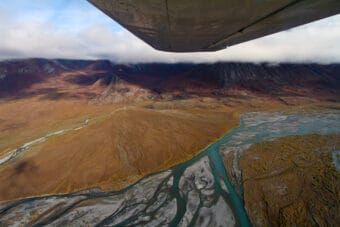
The Canning River, which flows on the western edge of the Arctic National Wildlife Refuge into the Beaufort Sea, is seen from the air on Aug. 23, 2015. The coastal plain of the refuge, through which the river flows, is the subject of new rules proposed by the Biden administration to minimize the environmental impact of legally mandated oil leasing there. (Photo by Katrina Liebich/U.S. Fish and Wildlife Service)
Oil companies could buy oil leases in the Arctic National Wildlife Refuge, but with new restrictions, under a plan released Wednesday.
At least 400,000 acres in the refuge’s coastal plain would be available for oil and gas leasing, but only in areas deemed to have high potential for holding hydrocarbons and only under some new environmental restrictions to protect wildlife and other resources, according to the preferred plan released by President Joe Biden’s administration.
The plan, detailed in a supplemental environmental impact statement led by the U.S. Bureau of Land Management, proposes much more limited oil development than what was authorized by the administration of former President and now President-elect Donald Trump.
The fate of the refuge’s coastal plain has been subject of hot debate for decades, pitting desires for oil development in a new part of Arctic Alaska against desires for environmental protection, including protection of the calving grounds of the huge Porcupine caribou herd.
With Trump set to return to the White House, the area is back in the spotlight. He has declared intentions to reopen the area to drilling. He has claimed, falsely, that it holds potential for more oil than what is in Saudi Arabia.
He referred to the refuge in a September town hall event in Michigan, though he confused it with Bagram air base in Afghanistan. “We have Bagram in Alaska, they say it might be bigger than all of Saudi Arabia,” he said at the time.
Environmentalists are expecting a tough fight over the refuge in the coming years.
“The coastal plain is clearly something in the crosshairs of the Trump administration,” said Cooper Freeman, Alaska director of the Center for Biological Diversity.
Freeman noted that the 2021 lease sale drew little industry interest. Nonetheless, “It’s going to be the fight of our lives to keep the Arctic Refuge protected from development,” he said.
The Biden administration’s new environmental study was launched in response to legal challenges against the Trump plan, and it is intended to correct what the Biden administration characterized as deficiencies in studies done by the Trump administration that led to a January 2021 auction that sold nine leases.
No major oil companies submitted bids, and no exploration work took place on the leases that were sold. The main bidder was the Alaska Industrial Development and Export Authority, a state development agency, which picked up seven leases. An Anchorage real-estate company bought another, and a small oil company bought one. The latter bidders relinquished their leases voluntarily, and the Biden administration canceled the AIDEA leases, citing the need for better environmental analysis.
Although Biden, Interior Secretary Deb Haaland and others in the administration oppose oil development in the refuge, a second lease sale is required by law.
The Tax Cut and Jobs Act of 2017, signed by Trump, mandates two lease sales offering at least 400,000 acres be held before the end of 2024.
The main differences between the Biden administration’s chosen alternative for leasing and that pursued by the Trump administration concern protections for caribou, polar bears, marine and freshwater areas and ice-rich permafrost.
One major difference is the limit on the areas within the coastal plain that may be leased. Under the new preferred plan, tracts offered for leasing would be concentrated in the northern and western part of the 1.5 million-acre coastal plain; much of the eastern and southern area is withheld from leasing because of use by the Porcupine Caribou Herd.
Another difference is a new limit of 995 acres for surface disturbance, down from the 2,000 acres allowed under the Trump plan.
Caribou graze on July 9, 2019, on tundra plants growing on the coastal plain of the Arctic National Wildlife Refuge. The animals are in the Porcupine Caribou Herd. A new environmental study released by the Biden administration recommends more protections for the Porcupine herd, which packs into the refuge coastal plain during calving season. (Photo by Andrea Medeiros/U.S. Fish and Wildlife Service)
A third notable difference is the preferred alternative’s restriction on seismic exploration, which employs heavy equipment on the surface to send soundwaves into the earth to help map out geologic structures. Under the new preferred alternative, seismic exploration would be limited to leased tracts; under the previous Trump administration plan, seismic exploration was to be allowed throughout the entirety of the coastal plain. Although seismic exploration was proposed, none was carried out.
The exact date of the lease sale to be held is yet to be determined. It would follow the next step in the administrative process, which is the issuance of a formal document called a “record of decision” that makes the choice final. The record of decision will come no earlier than 30 days after the notice of the supplemental environmental impact statement is published in the Federal Register. Publication is scheduled for Friday, the BLM said.
The Biden administration’s move toward new restrictions on refuge leasing drew sharp criticism from some ardent supporters of oil development there.
Voice of the Arctic Iñupiat, a regional group that has generally advocated for oil development across the North Slope, said in a statement that local leaders are unified in their opposition to the new plan, singling out the effect on the village of Kaktovik.
“It seems that once again the people of the North Slope are being told that our voices and lived experience are insufficient, and that federal laws passed by Congress mean little in the eyes of the Biden administration’s Department of the Interior (DOI),” North Slope Borough Mayor Josiah Patkotak said in the statement. “The federal government’s latest actions are shameful and will have serious consequences for Kaktovik and the North Slope. With this latest development, DOI has soundly rejected the opportunity to partner in our effort to aptly balance development and preservation in our region.”
Rex Rock Sr., president of the Arctic Slope Regional Corp., also criticized the new restrictions.
“There is a majority consensus of elected leadership across the North Slope, including Kaktovik, that responsible resource development is essential to maintaining our economic security and way of life,” he said in the Voice of the Arctic Iñupiat statement. “We remain united against any attack on our self-determination.”
Kaktovik, which has about 270 residents, is the easternmost Alaska North Slope community and close to much of the caribou-calving area that the new plan has designated for protection. It is also a center of ardent support for drilling in the refuge coastal plain, as its village for-profit corporation owns land that could be developed. Arctic Slope Regional Corp., the regional Native corporation for the North Slope, has the mineral rights on that Native-owned land, and it also generates much of its income from North Slope oil operations.
In Tuesday’s election, 78% of Kaktovik’s presidential vote went to Trump, according to preliminary results from the Alaska Division of Elections.
Alaska Natives who oppose oil development in the refuge said Wednesday they will continue their fight.
In a statement, the Neets’ąįį Gwich’in Tribal governments of Arctic Village and Venetie, Gwich’in Athabascan communities near the southern edge of the refuge, renewed their call to permanently ban oil development in the refuge.
“As people connected to the Arctic Refuge for our cultural, spiritual, and subsistence purposes, we will never accept any disruption of this land,” RaeAnn Garnett, first chief of Native Village of Venetie Tribal Government, said in the statement. “Though the FSEIS is an improvement on the previous EIS, we continue to urge Congress to create permanent protections for this land that our people have lived in concert with for countless generations.”
“It is inarguable that the Arctic Refuge EIS released by the Trump Administration was inadequate and completely disregarded the impact any oil and gas activities would have on our Tribal communities who rely on that land,” Galen Gilbert, first chief of Arctic Village Council, said in the statement. “The recently released FSEIS is an improvement on the initial assessment. However, this is only a step towards protecting our Sovereignty and right to continue our traditional way of life that depends on this sacred place.”
In Tuesday’s election, over 90% of Arctic Village voters supported the Democratic ticket of Kamala Harris and Tim Walz, and 72.5% of Venetie voters also supported the Harriz-Walz ticket, according to preliminary results from the Division of Elections.
Sen. Lisa Murkowski, R-Alaska, was the lead author of the legislative language that requires the lease sale. Speaking to reporters Wednesday, she said she fears that the plan “effectively crippled and made it not viable for anybody to bid on with the conditions that they have put in place.”
She also said potential bidders may look elsewhere as Trump opens up federal land where development is less costly. She wants oil companies to come to Alaska, she said “But I think we need to also recognize that perhaps we’re not the only game in town,” she said.
The Center for Biological Diversity’s Freeman said the Arctic National Wildlife Refuge coastal plain is likely to be only one area over which environmentalists will be battling with the incoming Trump administration.
“We are definitely going to be playing some serious defense to protect what’s left and all we love and cherish across Alaska,” he said.
Reporter James Brooks contributed to this article.
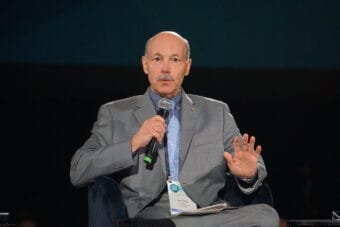
Mike Sfraga discusses Arctic issues during a Juneau World Affairs Council presentation at KTOO in Juneau on Feb. 6, 2020. (Photo by Jeremy Hsieh/KTOO)
The U.S. Senate has confirmed Michael Sfraga of Fairbanks to be the nation’s first ambassador-at-large for the Arctic.
The vote was 55-36, with nine Republicans joining Democrats to vote yes.
Sen. Lisa Murkowski was the chief advocate for creating the ambassador position and Sfraga’s biggest champion in the Senate.
“Mike is probably the most recognized go-to Arctic expert that we have, not just in Alaska, but around the country,” she said, outside the Senate chamber before the vote. “I go to a lot of Arctic convenings. Mike Sfraga is there at all of them.”
His expertise extends to Arctic research, policy and national security, she said. He’s in Helsinki now for a security conference and Murkowski said he’ll attend another in Warsaw next week.
Sfraga’s travel was at the root of why the top Republican on the Senate Foreign Relations Committee opposed him. Sen. James Risch of Idaho said Sfraga didn’t disclose to the committee all his travel to Russia. Risch also argued that Sfraga was too trusting of the foreign officials and scholars he met at conferences and through his work at the University of Alaska Fairbanks, especially those from Russia and China.
“I really think that he is naive at best, as far as dealing with Russia and China,” Risch said on the Senate floor. “And in his defense, the entire academic community, for that matter, shares this naivety when compared to our national security agencies.”
Murkowski disagrees with that assessment.
“He has been very clear about making sure that U.S. interests in the Arctic are protected and defended — against Russia, against China and anybody else that would would encroach on our sovereignty,” she said.
She also said he didn’t intentionally hold anything back from the committee but thought the panel expected just a list of international conferences where he gave a presentation. When the Senate committee asked for a fuller list, he complied. Then he searched his records and found more trips and conferences to tell the committee about.
President Biden created the Arctic ambassador-at-large position in 2022, elevating what had been called an Arctic co-ordinator. Ambassadors-at-large aren’t dispatched to a particular country and typically are assigned to a global issue, like the at-large ambassadors for religious freedom and global criminal justice.
Sen. Dan Sullivan did not vote on the Sfraga confirmation, but he praised the nomination last year. A staff member said Sullivan was part of a Senate delegation this week to the United Nations.
ASLC Animal Care Specialist Maddie Welch (left) and ASLC Veterinary Technician Jessica Davis (right) feeds the orphaned female Pacific walrus calf patient that arrived from Utqiagvik on July 22, 2024. (Courtesy ASLC)
The Alaska SeaLife Center in Seward admitted an orphaned Pacific walrus calf last week that was found alone on a beach in Utqiagvik. According to a press release from the center, the female calf was likely left on its own after a walrus herd passed through the area.
The calf weighs nearly 165 pounds and is believed to be no more than a few weeks old. She’s one of only eleven walruses that have been admitted to the SeaLife Center since it opened in 1998.
Center staff say the walrus was dehydrated and malnourished after it arrived in Seward. It also had minor scrapes and lacerations.
Carrie Goertz is the director of animal health at the SeaLife Center. She says the walrus calf has perked up and has started feeding from a bottle.
“She has improved slightly,” Goertz said. “Big milestone in terms of getting her to nurse from a bottle, it really makes it so much easier to care for her. It also gives us good feedback in terms of what her appetite is doing.”
According to the SeaLife Center, the care regimen for Pacific walruses is more demanding than other marine mammals. They’re highly social animals that seek comfort through physical contact with their mothers, meaning staff work around the clock to act as surrogates. In the wild, walruses are usually under the care of their mothers for more than two years. Because the calf was separated from its mother before learning to survive on its own, Goertz said the calf will not be released back into the wild.
Under the SeaLife Center’s care, Goertz says the young walrus’ bloodwork and eating habits are trending in the right direction.
“She has gained a little weight, which is great,” Goertz said. “Good sign that we’re meeting her needs, and a number of her bloodwork parameters have improved.”
If you find an injured or stranded marine animal in Alaska, you can call the 24/7 Stranded Marine Animal Hotline by dialing 1-888-774-SEAL. For more information about the Alaska SeaLife Center, visit its website.
Iñupiat whalers use a sealskin boat, or umiak, in 2019. Voice of the Arctic Iñupiat, an advocacy group, say oil revenues allow North Slope people to live longer, healthier lives. (Ravenna Koenig/Alaska’s Energy Desk)
A group of North Slope cities, tribes and Alaska Native corporations is challenging new federal restrictions on oil development in the National Petroleum Reserve-Alaska.
Voice of the Arctic Iñupiat filed a lawsuit in U.S. District Court in Anchorage last week that takes aim at a Biden administration rule completed in May. The rules tightens environmental restrictions on development in the NPR-A, an area of federal land the size of Indiana.
The lawsuit says that the Bureau of Land Management rule effectively confers wilderness status, the highest level of environmental protection, to 13.1 millions acres that were previously designated for protection, and bars leasing on another large swath.
The advocacy organization is largely funded by the Arctic Slope Regional Corporation and the North Slope Borough. It has been clamoring against the rule for months. Its campaign may have received a boost with a U.S. Supreme Court opinion last week called Loper Bright. It removed some of the latitude government agencies had to impose regulations on matters not specified in law.
Voice of the Arctic Iñupiat says the people of the North Slope benefit from oil development, primarily through local taxes on the industry.
“These tax receipts provide the vast majority of revenue for the North Slope Borough, which is then used to provide a wide range of essential public services,” the lawsuit says, “including sewer, water, heat, sanitation, schools, clinics, hospitals, wildlife and fisheries management and research, infrastructure, and social and cultural programs.”
The group says the Biden administration’s environmental restrictions threaten to reverse progress that has improved their lives.
Many environmental groups hailed the Biden administration rule for the Reserve. They said it would protect birds, wildlife and other resources important to subsistence. The protections in the rule helped lessen their anger at President Biden for allowing ConocoPhillips to proceed with Willow, a large oil development underway in the NPR-A.
The Center for Biological Diversity, on the other hand, says the rule doesn’t go far enough because it still allows oil and gas development on about half of the Reserve.
“This could potentially result in the additional extraction of hundreds of millions of barrels of oil and subsequent hundreds of millions of metric tons of greenhouse gas emissions,” said Cooper Freeman, Alaska director for the Center for Biological Diversity. “The planet, the Arctic, Arctic wildlife and communities across Alaska just can’t withstand that level of destruction from climate change.”
The U.S. Coast Guard Cutter Healy, a 420-foot icebreaker homeported in Seattle, breaks ice in support of scientific research in the Arctic Ocean during a 2006 cruise. The Healy is now on its way to Alaska and scheduled to complete three missions this year, including a sailing through the Northwest Passage to Greenland. (Photo by Petty Officer Second Class Prentice Danner/U.S. Coast Guard)
The U.S. Coast Guard cutter Healy, the largest U.S. icebreaker, is on its way to Alaska for the first of three Arctic scientific missions planned over the coming months.
The Healy departed on Wednesday from Seattle, its home port, the Coast Guard said. Its first mission will bring scientists to the Beaufort Sea to service underwater moorings, devices installed to collect information about oceanic conditions. Scientists on the mission will also survey the currents between the Bering Sea and the Canadian Beaufort Sea. Other work to be conducted includes monitoring of Arctic algal blooms, the Coast Guard said.
In its second mission, the Healy is scheduled to carry early career scientists on a cruise through the Northwest Passage to Greenland. That mission is intended to train scientists in Arctic research practices and is modeled after a similar mission conducted last year on the Sikuliaq, a research vessel owned by the National Science Foundation and operated by the University of Alaska Fairbanks.
The Healy’s third scheduled mission is to gather data for the Global Ocean Ship-Based Hydrographic Investigations Program, an international scientific program established in 2007. That work will collect high-resolution data across the Arctic basin, the Coast Guard said.
The research vessel Sikuliaq, owned by the National Science Foundation and operated by the University of Alaska Fairbanks, is docked in Seward on the evening of July 4, 2022. The Sikuliaq’s 2024 research cruises are already underway. (Photo by Yereth Rosen/Alaska Beacon)
“We are excited to support three significant missions in the northern high latitudes,” Coast Guard Capt. Michele Schallip, the Healy’s commanding officer, said in a statement. “Two of these missions are part of long-standing data collection projects, aimed at enhancing our understanding of a changing Arctic. The third mission is dedicated to inspiring future principal investigators who will continue this important work.”
At a time when scientific interest in the Arctic Ocean is intensifying, the Healy “substantially enhances” U.S. Arctic research capacity, she said. “Healy’s crew have been unwavering in their efforts during our in-port maintenance period, ensuring the cutter is ready to meet the demands of these missions,” she said.
The Healy, which is designed to break through ice up to 4.5 feet thick, is one of only two operating polar-class icebreakers owned by the Coast Guard. While the Healy generally works in the Arctic during the summer and fall supporting scientific research and other purposes, the Coast Guard’s other polar icebreaker, the Polar Star, is usually assigned to the Antarctic.
The Seward-based Sikuliaq, which completed some West Coast missions in the spring, has already been deployed in the Gulf of Alaska to continue long-term research there. The Sikuliaq has Alaska research cruises scheduled through September.
The Sikuliaq, which is named for the Inupiaq term meaning “young ice,” is designed to sail through relatively thin ice.
Other ships are also scheduled to conduct research cruises to collect information about fish stocks, whales, seabed features and sea ice, among other subjects, according to the Interagency Arctic Research Policy Committee.