
KDLL - Kenai

KDLL is our partner station in Kenai. KTOO collaborates with partners across the state to cover important news and to share stories with our audiences.

Feds charge Soldotna troopers with civil rights violations over violent Kenai arrest

From left, Jason Woodruff, Clint Campion, Joseph Miller and Matthew Widmer participate in an arraignment hearing on Thursday, Nov. 14, 2024 in Kenai, Alaska.
From left, Jason Woodruff, Clint Campion, Joseph Miller and Matthew Widmer participate in an arraignment hearing on Thursday, Nov. 14, 2024 in Kenai, Alaska. (Ashlyn O’Hara/KDLL)

A federal grand jury has indicted two Alaska State Troopers shown on body-camera video beating, tasing and pepper-spraying a Kenai man in a case of mistaken identity.

Former Trooper Sgt. Joseph Miller and Jason Woodruff are each charged with violating the man’s civil rights. Neither were arrested following the federal indictment.

In a news release, the U.S. Attorney’s office says 50-year-old Miller had no legal justification for the violent arrest. Prosecutors say 43-year-old Woodruff illegally used his police dog to bite the man when he did not pose a threat. The arrest was captured on body cameras. The state brought charges against Miller and Woodruff last summer after a routine use-of-force review.

State prosecutors say body camera footage shows Woodruff and Miller tasing, pepper-spraying, beating and having their police dog maul Kenai man Ben Tikka during an arrest at Kenai’s Daubenspeck Park. The state charging document says troopers did not ask for Tikka’s name during the arrest, and did not learn until later that the man they’d arrested was Ben, and not his cousin, Garrett.

Garrett had an outstanding warrant for failing to appear for a 10-day jail sentence for driving with a revoked license.

The lawyer representing Ben Tikka in the state case says he underwent more than $40,000 worth of medical procedures as a result of the arrest, which left him with a concussion and a broken clavicle.

Miller is no longer employed by the State of Alaska. Jason Woodruff remains employed by the department but has been on leave since the botched arrest. The union contract that covers public safety employees says employees charged with a crime over professional conduct will be put on unpaid leave. The police dog involved in the arrest was also released from the department.

If convicted in the federal case, Miller and Woodruff each face up to 10 years in prison.

James Cockrell is the commissioner of the Alaska Department of Public Safety. He was quick to condemn Miller and Woodruff’s conduct after reviewing the body-worn camera footage last year. In a statement to KDLL, Cockrell called the alleged civil rights violations deeply concerning and contrary to the department’s values.

“While this is an unfortunate day for the Alaska State Troopers, the alleged actions of these two individuals do not reflect the professionalism of the hundreds of State Troopers and DPS employees who serve Alaskans with integrity every day, often in the most challenging conditions in the United States,” he said.

Cockrell said the department continues to cooperate with state and federal prosecutors. A spokesperson for the Alaska U.S. Attorney’s office said she was not aware of any prior instances in which an Alaska State Trooper faced federal charges as a result of their conduct on duty.

Woodruff’s attorney declined to discuss the case. Miller’s did not respond to a request for comment.

Tuesday’s announcement comes as Woodruff and Miller await trial in their respective state criminal cases. They are each facing first-degree assault charges. In September, a judge declined a request from Miller to dismiss the state’s case against him. Miller and Woodruff are scheduled to go to trial next year.

Kenai Aviation suspends service, citing financial woes

Cars park outside the Kenai Aviation office on Monday, Nov. 3, 2025 in Kenai, Alaska.
Cars park outside the Kenai Aviation office on Monday, Nov. 3, 2025 in Kenai, Alaska. (Ashlyn O’Hara/KDLL)

Kenai Aviation announced Monday that it was ceasing all flight operations. The company said in a Facebook post it was “financially insolvent” after accruing debt during the pandemic, and would stop flying by the end of the day.
Since 2022, the airline has offered more than a dozen daily flights between Anchorage and the Kenai Peninsula, including to Kenai, Homer and Seward. Before Monday, it was one of three airlines serving the Kenai Municipal Airport, alongside Grant Aviation and Aleutian Airways, after Ravn pulled out of the region.

Joel Caldwell and his brother, Jacob Caldwell, purchased Kenai Aviation in 2018. Neither immediately responded to requests for comment Monday.

On Facebook, Joel Caldwell said he was “devastated,” writing: “We need capital, we need partners, we need a lifeline. That investor is out there, we just need to find them.”

Kenai Aviation serviced eight communities across Alaska with its mixed fleet of Beechcraft Super King Air and Tecnam Traveller P2012 aircraft.

Earlier this year, the federal Department of Transportation picked Kenai Aviation to run its essential air service route to Seward. That contract was expected to run through 2027. Around the same time, it also picked up the federal route between Anchorage and Unalakleet, near Nome. It was the only regularly-scheduled passenger airline serving the route. But in August, Kenai suspended flights after its only King Air plane was down for maintenance.

The company’s Facebook post said the grounded King Air compounded its financial troubles.

Interim Airport Manager Mary Bondurant said the the City of Kenai will collaborate with its remaining airlines to meet passenger demand and explore other airlines that may be interested in offering passenger flights to Kenai.

Alaska LNG Project nets preliminary agreement with Tokyo utility

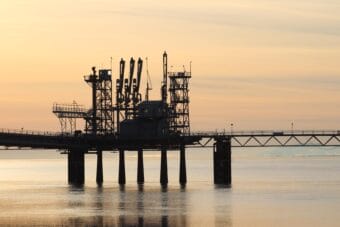
The sun sets behind Marathon Petroleum Corportation's Kenai LNG Terminal on Thursday, Feb. 6, 2025 in Nikiski, Alaska.
The sun sets behind Marathon Petroleum Corportation’s Kenai LNG Terminal on Thursday, Feb. 6, 2025 in Nikiski, Alaska. (Ashlyn O’Hara/KDLL)

The proposed Alaska natural gas pipeline project picked up another nonbinding agreement last week. This time, the letter of support comes from Tokyo Gas Company, one of Japan’s largest energy utilities. It’s the fifth acquired for the project since Glenfarne, a private energy asset developer, took over majority project ownership earlier this year.

If it’s built, the Alaska LNG Project will move natural gas from the North Slope through a roughly 800-mile pipeline to Nikiski to be liquefied and shipped overseas.

Adam Prestidge is the project president with Glenfarne. He told KDLL last month that preliminary agreements, though nonbinding, are a necessary first step toward agreements that are binding. But he says that can take a while.

“Typically, an LNG contract like this, can take, you know, 12, 18, 24 months to go from initial concept to being a binding agreement,” he said.

Glenfarne celebrated the preliminary Tokyo Gas agreement in a press release for pushing the project over the halfway mark of its LNG export capacity.

Glenfarne Communications Director Tim Fitzpatrick said the project’s annual capacity boils down to two separate numbers.

The first is the natural gas capacity of the pipeline, measured as a volume in billion cubic feet. The second is the liquid volume of natural gas for export, measured as a weight in million tons.

Fitzpatrick says the pipeline has an estimated capacity of 3.3 billion cubic feet of natural gas per day. Of that, 15.2%, or 500 million cubic feet, is earmarked for in-state use by Alaska residents as natural gas. According to a report commissioned by the Alaska Gasline Development Corporation, that’s roughly double what Alaskans in the Anchorage, Matanuska-Susitna and Kenai Peninsula regions actually use each year – between 180 and 200 million cubic feet.

The remaining project output will be converted to 20 million tons of liquefied natural gas for export, Fitzpatrick said. Of that, 11 million tons already have tentative customers through the handful of preliminary agreements reached this year.

Glenfarne estimates it needs binding commitments for five million more tons of liquified natural gas to fund the full $44 billion project.

The Tokyo Gas announcement comes on the heels of a town hall Glenfarne held in Nikiski earlier this month to promote the project.

This week, the head of the International Energy Agency predicted a forthcoming increase in liquefied natural gas supply could change global markets. Reuters reports the shift is creating a buyer’s market, pushing prices down for importers in places like Asia.

Glenfarne is eyeing the end of this year to decide whether to move forward with project development or not.

Correction: A previous version of this story incorrectly stated the annual natural gas capacity of the pipeline.

AK LNG nets two new agreements as development decision looms

Gov. Mike Dunleavy (left) listens to Glenfarne CEO Brendan Duval (right) talk about the Alaska LNG Project during a panel on Thursday, June 5, 2025 in Anchorage, Alaska.
Gov. Mike Dunleavy (left) listens to Glenfarne CEO Brendan Duval (right) talk about the Alaska LNG Project during a panel on Thursday, June 5, 2025 in Anchorage, Alaska. (Ashlyn O’Hara/KDLL)

The Alaska LNG Project netted two more agreements earlier this month during an energy conference in Italy. Both agreements are nonbinding, but proponents say it’s proof of ongoing positive momentum. The developments come as the company behind the project aims to decide whether to move forward with development, or not, by the end of the year.

Adam Prestidge remains optimistic about the Alaskan LNG Project’s commercial viability. He’s the project president under Glenfarne Group, which assumed majority ownership earlier this year.

“We think it is a fantastic project from an infrastructure fundamental standpoint,” he said. “Its commercial attributes, we think, make it a really attractive project, and put it in a really advanced state.”

The idea of a natural gas pipeline between the North Slope and Southcentral has been tossed around for decades.

If it’s built, the three phase project would extract and treat natural gas on the North Slope, move it through an 800-mile long pipeline to Southcentral and then liquefy it in Nikiski for export overseas. The project already has the necessary land and permits. What it needs now are customers – and, of course, to be built.

Since taking over, Glenfarne’s secured five nonbinding agreements with potential project customers. Two of those were signed at the Gastech Conference earlier this month in Italy.

One agreement is with JERA Co. – Japan’s largest power generation company – to purchase a set amount of liquefied natural gas from the project over two decades.

The other agreement outlines a “strategic partnership” with POSCO International. The company is the sales representative of POSCO Group, Korea’s largest steel producer, and also imports liquefied natural gas.

Prestidge says he’s aware of the skepticism around nonbinding contracts. But he says the scale and scope often require a drawn out negotiation process – sometimes up to one or two years.

“They’re enormous contracts, and they don’t just turn into binding agreements overnight,” he said.

Glenfarne Communications Director Tim Fitzpatrick says four of the agreements are at the first in a three-step process to get to a binding agreement.

The agreements come as project owners prepare to make a final decision whether to move forward with development – a decision expected by the end of the year.

Glenfarne enlisted another firm to update the project’s current cost estimate. Prestidge says Glenfarne does not expect construction costs to be “significantly more expensive” than previous estimates, but they’re keeping the final construction price tag secret.

“You wouldn’t normally be publishing publishing costs for a project – for a private project, kind of on a recurring – rolling updates,” he said. “And so the ultimate cost to complete is going to be something that is most likely not going to be made public.”

Glenfarne says construction costs are only one part of the equation. Prestidge says steel tariffs and the cost of liquefied natural gas will ultimately dictate final project costs, and Glenfarne thinks its commercially viable.

Larry Persily is a former state revenue commissioner and Federal Coordinator of the Alaska Natural Gas Transportation Projects. He suspects Glenfarne’s decision won’t sit well with Alaskans.

“I think keeping it secret, which is another way to say private, will just increase the skepticism among Alaskans who think this thing has been a multi-million dollar wasted effort over the years,” he said.

And Persily is doubtful project costs will come in at previous estimates, around $44 billion, pointing to rising labor costs and project overruns in other parts of the country. In the mid-2010s, the total estimates were between $45 billion and $65 billion. In 2020, the estimate dropped $37.5 billion, but then came back up, in part, due to inflation.

“It’s really hard to believe that is going to come in at that [Alaska Gasline Development Corporation] estimate,” he said. “Mega-projects like this are notorious for going over budget.”

Prestidge says Glenfarne’s team is up to the challenge.

“We’re very appreciative of the reception that we’ve gotten from Alaskans,” he said. “We know, we know that we’re new in the state, and we’re going to continue working, working really hard to deliver this fantastic project for the state.”

Glenfarne and the Alaska Gasline Development Corporation will hold an open house Oct. 8 at the Nikiski Community Recreation Center from 5:30 to 7:30 p.m. to share project updates and meet with residents.

Kenai bear attack leaves one seriously injured

DSCN8958.JPG
(Riley Board/KDLL)

Alaska State Troopers are asking Kenai residents to be on high alert after a bear attack left a jogger seriously injured on Tuesday morning.

The attack occurred in a neighborhood near the intersection of Chinook Drive, just west of the Kenai Spur Highway. According to a trooper dispatch, a 36-year-old woman was attacked near her driveway at around 5:45 a.m. She was later found by a neighbor and flown to an Anchorage hospital.

Officials with the Kenai Police Department and the Alaska Department of Fish and Game assisted troopers in searching for the bear. Troopers say the bear has not yet been found, and will continue to search the area. It is unclear what type of bear caused the attack.

Troopers say residents should be cautious when going outdoors. They recommend supervising pets and children, and securing attractants like trash or food. If you see a bear, troopers say keep a safe distance and do not approach it.

Sullivan pitches LNG pipeline to Pentagon leadership

Sen. Dan Sullivan addresses the Alaska Legislature on Feb. 21, 2024 (Clarise Larson/KTOO)

Republican U.S. Sen. Dan Sullivan says he’s pitching the Alaska LNG Project to the U.S. Department of Defense for potential investment. Speaking to reporters on Tuesday, Sullivan said bringing the federal government on to the project could “dramatically lower the cost of capital.”

“One of the things that we are doing right now with Glenfarne and the Department of Defense is trying to see if there’s a way in which the Department of Defense can be a buyer of gas that would come down through the pipeline,” he said.

Glenfarne is the private company that assumed majority ownership of the project earlier this year. A company spokesperson declined to say whether the company is pitching the project to the Pentagon.

If it’s built, the Alaska LNG Project would move natural gas from the North Slope to Southcentral for export. The long-sought project is estimated to cost $44 billion. President Donald Trump has shown interest, boosting hopes that it might finally attract investors.

The proposed pipeline route passes near Alaska’s largest military bases – Fort Wainwright and Eielson Air Force Base in Fairbanks and Joint Base Elmendorf-Richardson in Anchorage.

A spokesperson for the Alaska Gasline Development Corporation, which owns the state’s 25% project stake, says the Fairbanks military bases could connect to the pipeline through a proposed project spur. JBER is already connected to the ENSTAR Natural Gas system, to which the project would be connected.

Sullivan says he’s already pitched the project to Secretary of Defense Pete Hegseth and to Hegseth’s deputy, Steve Feinberg.

“The senior leaders of the Pentagon are very aware of this opportunity and that Glenfarne is quite interested in that,” Sullivan said.

And he says the project could benefit from the budget reconciliation bill moving through Congress.

Among other things, the bill would replace an existing federal loan program with a new one – the Energy Dominance Financing program. Sullivan says the bill puts about $1 billion toward it.

“I was on a conference call with Secretary Wright, and, you know, that’s the capitalization in the program,” he said. “He is very interested in looking at the AK LNG Project as one of the projects by which they would use this new energy dominance financing mechanism.”

Glenfarne, the Alaska Gasline Development Corporation and Gov. Mike Dunleavy have previously said they’ll seek financing from the private sector.

“Because of the amount of private sector capital, you really don’t need to rely on government capital, and that’s been made clear countless times,” Dunleavy told KDLL last month.

The project has existing federal loan guarantees approved under former President Joe Biden. Sullivan says the program was never set up under Biden, but that he’s renewing that push under Trump.

Site notifications
Update notification options
Subscribe to notifications