KDLL is our partner station in Kenai. KTOO collaborates with partners across the state to cover important news and to share stories with our audiences.

A small plane was spotted Monday morning after it partially fell through the ice on Tustumena Lake. (Courtesy of Dale Eicher)
Three people were rescued Monday morning after their small plane fell through the ice on Sunday near the east side of Tustumena Lake, on the Kenai Peninsula.
The Alaska Army National Guard rescued an adult pilot and two passengers, both minors, from a Piper Super Cruiser at about 10:30 a.m., according to an online dispatch from the Alaska State Troopers.
All three passengers were taken to Central Peninsula Hospital for non-life-threatening injuries. The hospital did not disclose the current status of the patients.
The non-commercial flight originated from the Soldotna airport. The plane was reported missing on Sunday night, about 12 hours before it was found partially submerged under ice.
A U.S Coast Guard air crew searched the area early in the morning, but the plane was found later by a good Samaritan aircraft.
The three passengers of the plane waited on the wings until help arrived.
This is a developing story. Please check back for updates.
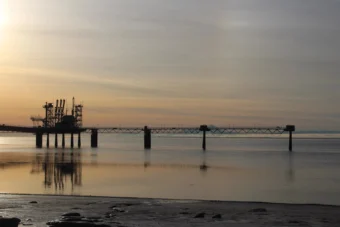
The sun sets behind Marathon Petroleum Corportation’s Kenai LNG Terminal on Thursday, Feb. 6, 2025 in Nikiski, Alaska. The former LNG export terminal is near one end of the proposed $44 billion Alaska LNG Project. (Ashlyn O’Hara/KDLL)
President Donald Trump voiced his support for a long-discussed – but unbuilt – Alaska energy project during his first address to Congress since taking office in January.
“My administration is working on a gigantic natural gas pipeline in Alaska, among the largest in the world, where Japan, South Korea and other nations want to be our partner with investments of trillions of dollars each,” he said during Tuesday night’s speech. “There’s never been anything like that one. It will be truly spectacular. It’s all set to go. The permitting is gotten.”
That pipeline is known as Alaska LNG, a massive proposed project that would send natural gas from Alaska’s North Slope 800 miles south to Nikiski, where it would get cooled to a liquid state and exported overseas — most likely to America’s Pacific allies like Japan.
Trump’s address to Congress on Tuesday wasn’t the first or even the second time Trump has touted the pipeline since taking office. And he supported the project during his first term, too. But different versions of the project have been discussed in Alaska for decades, and there are longstanding questions about how it would pencil out.
So how accurate were Trump’s statements about the project? And what else do we know about it?
Would it be ‘gigantic’? Would it be among the world’s largest?
Gigantic is a relative term.
The Alaska LNG Project pipeline would be far from the longest in the world. That title goes to Russia’s Druzhba Pipeline, which covers more than 3,100 miles in Europe. In North America, the Keystone Oil Pipeline runs more than 2,100 miles between Canada and the United states.
But at 42 inches, it would be large in diameter. A 2021 report from Global Energy Monitor puts the average pipeline diameter at 30 inches. The Keystone pipeline is 36 inches in diameter.
What about Japan and South Korea investing trillions each?
Foreign support for the Alaska LNG Project has ebbed and flowed over the last decade.
In 2023, the Wall Street Journal reported ambivalence about the project from prospective buyers in Japan and South Korea, who had concerns about the project’s costs, timeline and impact on climate change.
But last week, the New York Times described new interest from prospective partners in Asia as a way to placate Trump amid tariff threats.
Still, as of Wednesday, there aren’t any binding agreements with anyone to buy gas from the project, if it’s built. But the project does have what’s called a gas sales precedent agreement with Great Bear Pantheon, an Alaska-based oil exploration company, to buy up to 500 million cubic feet of gas per day. The Alaska Gasline Development Corporation says that’s “more than enough” to meet in-state gas needs.
And it’s still unclear who exactly might pay to build the project. Its hefty price tag has long stalled efforts to move work along. Current estimates put the project cost at $44 billion. A study commissioned by state lawmakers last year puts the price tag at about $11 billion for the pipeline alone.
Late last year, the state did get a $50 million pledge from state developers. That money’s meant to lower the risk for whatever company decides to take on the work of updating the project’s engineering and design cost estimates to 2025 numbers.
Tim Fitzpatrick, spokesperson for the Alaska Gasline Development Corporation, said Trump’s comment about trillions from Japan and Korea could refer to future purchases of liquefied natural gas from Alaska. But he confirmed there are no purchase agreements now.
Is the permitting really ‘gotten’?
The project received the bulk of its permits from federal regulators in 2020, which the corporation says it’s kept “up to speed.”
“If there’s any additional work efforts that are being asked of us by the agencies, we’re providing that,” Richards said. “When we take a final investment decision, we’re able to move forward.”
Some of the project’s existing federal permits have expiration dates. But Richards says the corporation can apply for extensions as long as it shows the project is being advanced.
Trump’s was the longest modern address to Congress – but how did Alaska LNG get in there?
Republican U.S. Sen. Dan Sullivan was quick to celebrate Trump’s comments Tuesday — he recorded a video from the Senate subway after the address. According to Sullivan’s office, he “personally pitched” the project to Trump in January.
“People have always been naysayers – ‘We’re not there yet,’” he said. “Gov. Dunleavy and I worked this really hard to encourage the president and his team to put it in the State of the Union. They did. That was a huge win for us.”
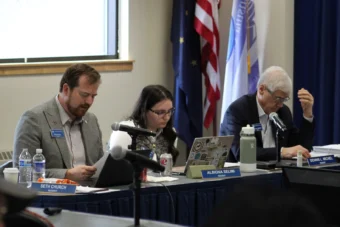
From left, University of Alaska regents Seth Church, Albiona Selimi and Dennis Michel participate in a board meeting on Friday, Feb. 21, 2025 in Soldotna, Alaska. (Ashlyn O’Hara/KDLL)
The University of Alaska System will no longer use or refer to “diversity,” “equity,” “inclusion,” or other similar words on its websites, print or electronic communications, programs and positions. That’s after a vote by the system’s board of regents, who say they’re still committed to offering an inclusive educational environment.
It was toward the end of two days of meetings at Soldotna’s Kenai Peninsula College that Board of Regents Chair Ralph Seekins appeared to veer off script.
“Are we ready for this?” he asked. “Here is a motion that we will make that, if I’m correct, we need to make the motion to approve this. And it is hopefully very clarifying in the minds of a lot of people that are watching to see as the board goes forward.”
“I move the Board of Regents direct the President to take all necessary actions to comply with recent federal executive orders and applicable agency guidance,” Church reads.
Those recent federal orders come from President Donald Trump, who’s put diversity, equity and inclusion policies squarely in his crosshairs. And according to the Board of Regents, those “necessary actions” include scrubbing university websites, employee position titles, programs and communications of the words “diversity,” “equity,” “inclusion” and “other associated terms.”
A preamble to the motion says the board reaffirms its “dedication to being an inclusive, nondiscriminatory institution,” and to continue honoring Alaska Native communities. Seekins underscored that before the vote.
“In a nutshell, we’re asking this university be a welcoming, open access university, discrimination toward none and opportunity for all,” he said.
The only vote against came from student member Albiona Selimi. Selimi declined an interview after Friday’s meeting, but said in an email statement the move isn’t in the best interest of students, staff or faculty. She said she also stands to be directly impacted by the board’s decision.
“I am a part of the wonderful McNair Program at UAA, a federally funded program that supports first-generation and historically underrepresented students pursuing graduate education. I am also proudly pursuing a minor in Women’s Studies, a program that is commonly scrutinized by anti-DEI practices,” the statement reads.
The University of Alaska Board of Regents meets at Kenai Peninsula College on Friday, Feb. 21, 2025 in Soldotna, Alaska. (Ashlyn O’Hara/KDLL)
The Board of Regents is putting enforcement of the new policies in the hands of university chancellors – some of whom sought clarification on how they should be responding to the federal orders. One of those chancellors is Sean Parnell, who oversees the University of Alaska Anchorage.
“I asked for clarifications, because I felt like our employees deserve more certainty about direction, and I could only provide so much as chancellor of one university who answers to the President and the Board of Regents,” Parnell said.
He says part of the confusion stems from the University System’s historic embrace of diversity initiatives. Diversity, equity and inclusion is a cornerstone of UAA’s latest strategic plan, which acknowledges the campus sits on the ancestral homelands of Alaska Natives. It articulates plans to boost diversity among the university community, eliminate systemic racism from university policies and create a sense of belonging for marginalized groups.
“There have been strong policies in the past from Board of Regents, which utilize some of the terms, the DEI terms that are now, you know, not supposed to be used according to the president, President Trump’s orders, executive orders,” he said.
University system President Pat Pitney says the motion was really about ensuring none of their existing policies or programs appear discriminatory. And she says that work started before this week’s board meetings.
“It’s an emotional subject, and, and people want a very clear answer, and right now, there’s not any clear answers, and so the best we can do is focus on our welcoming environment for all,” she said.
Pitney says the board is trying to reaffirm the university system’s openness to all, rather than perceived restrictions to some.
But not everyone thought Friday’s motion was the right move.
Monique Musick, who’s part of the university’s staff alliance, cast doubt on whether the motion actually provides clarity.
“I think I’m probably going to be spending a lot of the next few months trying to define that as we try to meet this and finding every way of removing diversity, equity and inclusion and other associated terms, from our jobs, from our research, from our clubs, from our activities,” she said. “I mean, where does this end?”
Kate Quick was in the audience when the board voted. As the votes came down in favor, she shook her head. Quick is an organizing manager for United Academics. That’s the union representing the university system’s non-adjunct faculty and postdoctoral fellows. She’s worried about how the board’s decision is going to impact existing employees and programs.
“I know they’re in a tight spot because of the federal mandates, but they’re still being reviewed,” she said. “They’re being fought. And I think this was premature. They probably could have come out with a different statement saying we’re going to continue business as usual until the courts resolve this. But that’s not what they did.”
After the meeting adjourned, the university system’s director of public affairs said he hadn’t yet read about the ruling, but that the language passed Friday is meant to give general clarity to university staff. He said board members will take new developments into account.
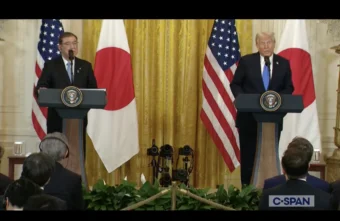
Japanese Prime Minister Shigeru Ishiba (left) and U.S. President Donald Trump participate in a joint news conference on Friday, Feb. 7 in Washington. (C-SPAN screenshot)
President Donald Trump on Friday announced a joint venture with Japan for the Alaska LNG Project. If it’s built, the $44 billion project would move gas from the North Slope through an 800-mile pipeline to a liquefaction facility in Nikiski for shipment overseas.
In a joint news conference with Japanese Prime Minister Shigeru Ishiba, Trump said the two spoke “at length” about the project, which he called exciting.
“Japan will soon begin importing historic new shipments of clean American liquefied natural gas in record numbers,” he said. “It’ll be record numbers.”
The announcement followed talks during Ishiba’s first summit with the president. Speaking through a translator, Ishiba said his country isn’t just interested in LNG.
“As the country of Japan, we are interested in importing not just LNG but also bioethanol, ammonia,and other resources at a stable price, a reasonable price from the United States,” Ishiba said. “And we also want to improve the trade deficit that the U.S. has towards Japan.”
It isn’t the first time the U.S. has announced project progress through an agreement with another country. Former Gov. Bill Walker signed an agreement in Beijing in 2017. And before that, former Gov. Sean Parnell traveled to Japan to promote the project.

Republican U.S. Sen. Dan Sullivan celebrated the joint venture and thanked Trump for his work on the issue in a social media post shared Friday.
“With his leadership, we will get the Alaska LNG Project built, which will create thousands of good-paying jobs, reinvigorate our American steel industry, significantly reduce our trade deficit in Asia, and deliver clean-burning Alaska gas for Americans, our military, and our allies in the Asia-Pacific, like Japan,” he wrote.
But as recently as last week, Alaska lawmakers continued to express concerns about where the money to build the expensive project will come from. The project scope includes a treatment facility on the slope, the pipeline and a liquefaction plant in Nikiski. A recent study commissioned by the legislature estimated the pipeline alone would cost roughly $11 billion.
A report commissioned by state lawmakers estimates that, if the Alaska LNG Project is built, the first exports wouldn’t happen until 2031.
Tim Fitzpatrick is the spokesperson for the Alaska Gasline Development Corporation. That’s the state agency heading the project. He said the joint venture revives the two countries’ decades-long LNG partnership.
“Alaska LNG’s competitive cost, abundant supply, and close proximity to Japan make this project a vital trade and energy security enhancement for our two nations,” he wrote in an email. “We welcome further Japanese support and engagement and look forward to continuing our discussions following today’s important advancements.”
Fitzpatrick also said the federal government has committed loan guarantees that are currently valued at $30 billion. He says those guarantees reduce the project’s debt cost, make it more attractive to investors and lower the project’s energy costs.
Friday’s announcement came a day after a trio of companies announced their plans to revive and redevelop Marathon Petroleum’s LNG facility in Nikiski to an import terminal. That facility was previously used to send LNG almost exclusively to Japan.
President Donald Trump signs an executive order at the White House supporting natural resource development in Alaska on Monday, Jan. 21, 2025 in Washington. (C-Span screenshot)
Within hours of returning to the country’s highest office Monday, President Donald Trump formalized his support for the $44 billion Alaska LNG Project.
Support for natural resource development in Alaska as the official policy of the United States was tucked into the flurry of executive orders Trump signed on his first day. According to Trump, that means prioritizing development of LNG for sale and transport to other parts of the country and its Pacific allies – including via the Alaska LNG Project.
If it’s built, the Alaska LNG Project would move natural gas from the North Slope to Southcentral through an 800-mile pipeline. The gas would be liquefied at a facility in Nikiski and then shipped overseas.
The Alaska Gasline Development Corporation is the state agency overseeing the project. In a statement Monday, corporation president Frank Richards said he looks forward to working with the president on the project.
But environmental groups and some state lawmakers expressed skepticism about Trump’s energy agenda and the project’s future as the legislative session kicked off Tuesday in Juneau.
Anchorage Republican state Sen. Cathy Giessel criticized a $50 million backstop Alaska Industrial Development and Export Authority, or AIDEA, OK’d for a company to update the project’s 10-year-old engineering and design work. The money was included in the governor’s proposed budget for the upcoming fiscal year.
“We’re offering now a completely risk-free $50 million to a company,” she said. “We don’t know what the product is going to be and if it’s a nothing product, we are still paying $50 million. I question whether it was AIDEA’s authority to take the $50 million they actually owed us as a dividend and appropriate it for this.”
Bethel Democrat Sen. Lyman Hoffman co-chairs the Senate Finance Committee. He says energy is a priority this session, but called AIDEA’s backstop a “bad precedent.”
“The question has to be asked, ‘Will the federal government come up and pony up to assist – and to what level – in the construction of this gasline?” he said. “The President wants to develop Alaska resources, and to what level and to what extent will that be, for a gasline?”
Giessel says lawmakers are scheduled to take up a variety of energy issues during the first meeting of the Senate Resources Committee on Wednesday. According to the committee’s agenda, lawmakers will hear from representatives of Hilcorp Alaska and HEX/Furie.
Correction: A previous version of this story misspelled Sen. Cathy Giessel’s last name.
Alaska Gasline Development Corporation President Frank Richards (left) announces an exclusive framework agreement for the Alaska LNG Project during an energy press conference with Gov. Mike Dunleavy (right) on Monday, Jan. 6, 2025 in Anchorage, Alaska. (Courtesy photo/Office of Gov. Mike Dunleavy)
The Alaska Gasline Development Corporation on Thursday named Glenfarne Group LLC as the company it’s in talks with to take over the $44 billion Alaska LNG Project. The announcement came three days after the corporation announced a framework agreement with a company not to be named until an agreement was finalized.
Corporation spokesperson Tim Fitzpatrick said Thursday they released the company name “in the interest of transparency.” He said the company will announce further developments and public updates at future board meetings and legislative presentations.
Glenfarne Energy Transition confirmed an exclusive agreement with AGDC to KDLL on Thursday. In a statement, the company said the agreement covers the 800-mile pipeline between the North Slope and Southcentral, an LNG export facility in Nikiski and carbon capture infrastructure on the slope.
AGDC President Frank Richards teased the then-unnamed company’s qualifications during a news conference on Monday, when it was initially announced that an agreement was in the works.
“The company involved brings extensive U.S. and international natural gas and LNG experience to bear to this project,” he said.
Glenfarne’s spokesperson declined to comment on whether the company has any experience with natural gas projects in Alaska. The company also owns and manages the Texas LNG Project, a natural gas export facility in south Texas.
Glenfarne said it has a second exclusive agreement with ENSTAR Natural Gas Company. That agreement is to advance a natural gas import infrastructure in the same facility as the proposed export infrastructure in Nikiski.
Enstar spokesperson Lindsay Hobson said the company’s import agreement with Glenfarne is separate from AGDC’s Alaska LNG Project agreement. The company doesn’t have a cost estimate for the import project covered by the agreement.
Hobson said Enstar’s import project envisions a land-based design for regasification facilities, meaning it wouldn’t include floating gas storage units. She said the project includes a terminal to receive liquefied natural gas tankers and facilities to regas it for ENSTAR’s systems.
In a statement provided to KDLL, ENSTAR President John Sims called their Glenfarne agreement an “important step” in bringing new gas to Southcentral Alaska.
“While we are optimistic about this progress, we are still in the early stages with a long road ahead of us before we are able to discuss project details,” Sims said.
Glenfarne’s website says the company was founded in 2011 and develops, owns and operates energy infrastructure. The company has primary offices in Houston and New York, but has eight offices around the world, including in Panama and South Korea.
Close
Update notification options
Subscribe to notifications
Subscribe
Get notifications about news related to the topics you care about. You can unsubscribe anytime.