KDLL - Kenai

KDLL is our partner station in Kenai. KTOO collaborates with partners across the state to cover important news and to share stories with our audiences.
Dunleavy signs bill expanding Alaska Performance Scholarship program

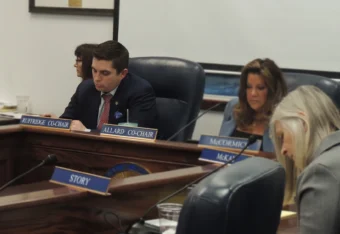
Rep. Justin Ruffridge co-chairs the House Education Committee on April 13. (Riley Board/KDLL)

Last week, Gov. Mike Dunleavy signed a bill expanding a state scholarship program. Advocates say it will help more Alaska students qualify for and use the Alaska Performance Scholarship program, which gives money to Alaska’s high performing students to use at in-state universities.

The bill expanding the program was sponsored by the House Education Committee and carried by the office of Soldotna Republican Rep. Justin Ruffridge’s office during the 33rd Alaska Legislature. Speaking to the Kenai City Council on Wednesday, Ruffridge celebrated the bill becoming law.

“For those of you with connections to our area high schools, certainly something you might want as information for students going into their senior year, especially this year,” he said.

Since the program was established in 2011, it’s paid out over $100 million to more than 11,000 students. Use of the scholarship has declined in recent years. In 2022, just 17% of Alaska high school seniors were eligible for the program. The same year, that rate was just 15% for the Kenai Peninsula Borough School District.

The bill increases scholarship award amounts, requires school districts to notify students earlier of scholarship opportunities and removes standardized testing as a prerequisite for eligibility.

The lowest level scholarship award amount would increase from $2,378 per year to $3,500 per year. Awards for the middle level would go from $3,566 to $5,250. For the highest scholarship level, the amount would increase from $4,755 to $7,000 per year.

Additionally, the bill creates a new “step-up” provision that allows students to increase their scholarship amount if their grade point average improves in college. Students can also now use career and technical education courses toward eligibility.

Kenai Peninsula residents joined Alaskans from around the state in voicing their support for the bill when it was introduced.

Virginia Morgan lives in Cooper Landing and also serves on the Kenai Peninsula Borough School District’s Board of Education. She was one of multiple people who spoke in favor of removing standardized testing as one of the scholarship’s eligibility criteria. Addressing the House Education Committee last year, she said not all Alaska students have equal access to testing. That can make it harder for them to qualify for the program.

“The testing opportunities are limited on the Kenai Peninsula and our family lives 50 miles away from the nearest testing center,” she said. “There was one test available for my daughter to take as a senior and it was in the City of Seward. Luckily, we do live on the road system and we were able to leave home around 5 a.m. to drive through a snowstorm for her to take the test.”

Megan Murphy, a counselor at Soldotna High School, shared similar thoughts with the committee.

“It’s just not fair for students that live in Nanwalek and Tebughna to have to come over and they can’t access testing sites,” she said. “And this year, we had students that had to go drive to Anchorage or go to Homer in order to access those tests. So for this reason, many of our students are choosing not to do these tests because they don’t have accessibility — by cost or the ability to get to those testing sites. Which is unfortunate, because otherwise they would qualify.”

State data show that standardized testing requirements do impact how many students receive Alaska Performance Scholarships. The program’s testing requirements were waived for two years during the COVID-19 pandemic, and the number of students eligible for the scholarship went up. That trend was also observed on the Kenai Peninsula.

On Wednesday, Kenai City Council member James Baisden said he’s hopeful the changes will encourage more Alaskans to stick around.

“My son’s been a direct benefit of that at the University of Fairbanks and it’s played out well for us keeping him in state,” he said. “I think it’ll play a big part maybe with some of these other kids doing the same thing.”

Changes to the Alaska Performance Scholarship became effective at the end of last month. That means they’ll be in place for students for the upcoming school year. More information about the Alaska Performance Scholarship can be found on the Alaska Commission on Postsecondary Education’s website at aps.alaska.gov.

Seward’s Lydia Jacoby won’t swim 100-meter breaststroke event at Paris Olympics

Seward swimmer Lydia Jacoby greets fans at the Anchorage airport after returning home from the 2021 Olympic trials. (Valerie Lake/Alaska Public Media)

Seward swimming phenom Lydia Jacoby fell short of an Olympic sequel Monday after failing to clinch a fast enough time in the 100-meter women’s breaststroke final event.

Jacoby, 20, placed third in the 100-meter breaststroke finals in Indianapolis. She swam a time of 1:06:37, in the same event she took home Olympic gold in 2021 with a time of 1:04:95. Jacoby qualified for Monday’s finals after placing fifth overall in qualifying heats held Sunday.

She could still go to the Olympics this year, as she’s also set to compete in the 200-meter breaststroke event.
According to Team USA, more than 1,000 American swimmers competed for a spot in the U.S. Olympic team trials.

Alaskans rallied around Jacoby when she swam in the 2020 Tokyo Summer Olympics, held 2021. At 17 and still a junior at Seward High School, Jacoby took home a silver medal for the women’s four by 100 meter medley relay in addition to her gold for the 100 meter breaststroke.

Jacoby is the first Alaskan to qualify for an Olympic games in swimming. She swims collegiately at the University of Texas at Austin, where she is majoring in textiles.

Two other athletes with Kenai Peninsula roots have Olympic ambitions this year.

Allie Ostrander, a graduate of Kenai Central High School, will compete for a spot on Team USA’s track and field team June 21-30 in Eugene, Oregon. As reported by the Peninsula Clarion, Ostrander qualified for the Olympic trials in the 3,000-meter steeplechase in April.

USA Cycling announced last week that Kristen Faulkner, of Homer, will compete on the 2024 track cycling team. Faulkner, 32, also races with EF Pro Cycling. As reported by NBC, Faulkner went to Harvard University and quit her job as a venture capitalist in 2021 to do cycling full-time.

The 2024 Olympics kick off in Paris in July.

Pipeline proposed to power Donlin mine could have impacts from Y-K Delta to Cook Inlet

The proposed Donlin Gold mine site on Aug. 19, 2017. (Katie Basile/KYUK)

If it’s built, the Donlin Gold mine project on the Yukon-Kuskokwim Delta would be one of the largest open-pit gold mines in the world, powered by a gas pipeline that would stretch hundreds of miles across the state to Cook Inlet.

KYUK’s Sage Smiley and KDLL’s Riley Board teamed up from both ends of that potential pipeline to tell this story.

Mile 315 – Crooked Creek

There’s gold in the hills outside of the middle-Kuskokwim River village of Crooked Creek – an estimated 34 million ounces of gold, the weight of five large blue whales.

It’ll take a lot of work to get it out of the ground.

Kristina Woolston is the vice president of external affairs for Donlin Gold, which is trying to develop the mine. She explained the mining process during an Alaska State Senate Resources Committee meeting in early April.

“Donlin Gold is a refractory ore, meaning that microscopic particles are held within arsenopyrite and some pyrite. And so it requires a very energy-intensive process to extract the gold,” Woolston explained. “We will be milling roughly 59,000 tons per day; (that) requires an awful lot of power.”

The Donlin Gold project site sits on land owned by Alaska Native corporations formed under the 1971 Alaska Native Claims Settlement Act. The surface rights are held by the Kuskokwim Corporation, and the subsurface rights are held by the regional Calista Corporation.

Thom Leonard is the vice president of corporate affairs for Calista. He said that the project has gone through a few different ideas of how to power such a hard-to-access site.

“One of the early ideas for the project being so remote, obviously Donlin would have to ship everything in barges. Not just materials for buildings, but also fuel, diesel fuel for all the equipment, and power, and heat,” Leonard said.

But concerns over that potential increase in barge traffic caused pushback from communities on the Kuskokwim.

“We heard from shareholders and residents up and down the Kusko(kwim), ‘Hey, that’s a lot of barges. We’re concerned about that.’ So we reminded Donlin of those comments,” Leonard said. “They went back to the drawing board and said, ‘Hey, we can look at building a natural gas pipeline. And that’ll cut the number of barges on the river by half.’ So we’ve taken in, we’ve learned from the comments of people who have concerns or are opposed to the project.”

The proposed path of the natural gas pipeline that would power Donlin Gold mine, as submitted to the State of Alaska in late 2013. (From Alaska Division Of Oil And Gas)

The project is backed by many in the village of Crooked Creek, less than a dozen miles from the proposed mine site, as well as Calista Corporation.

But plenty of other people on the Y-K Delta are still not entirely happy with the plan, even with the proposed barge traffic reduced. Over recent years, many traditional Native councils and organizations have rescinded support for the project over a variety of environmental concerns.

“It’s skewing our traditional values to fit a mold of corporate infrastructure,” said Sophie Swope, the executive director for Mother Kuskokwim, a nonprofit tribal consortium formed in 2022 in opposition to the Donlin project.

“The fact that there’s going to be a (315)-mile pipeline from Cook Inlet all the way to Crooked Creek, it’s going to be passing so many streams. And of those many streams, we don’t know how many actually are bearing fish,” Swope said. “And I think that is heavily lacking.”

Mile 0 – Cook Inlet

In the Cook Inlet region, more of the conversation revolves around the price of natural gas. Specifically, what happens to residential utility costs if Donlin starts buying up the gas.

Donlin says its pipeline will use about 20 billion cubic feet of natural gas every year. To put that number into perspective, it’s about equal to the amount of gas consumed by every single residential user in the state combined in a year.

Energy consultant Mark Foster is worried about that demand. Foster wrote a report for the Homer-based environmental nonprofit Cook Inletkeeper about Donlin’s potential impact on utility rates.

His conclusion? Donlin’s proposed energy use could increase rates for Southcentral customers by $265 a year.

That’s because Donlin would be buying gas from Cook Inlet, already a hot topic as utilities warn of their gas contracts ending and lawmakers scramble to propose policy solutions.

“The Donlin Mine has a large natural gas demand, based on the documentation it’s provided to prospective investors, and that demand, if it came from local Cook Inlet gas, would be a significant block of demand,” Foster said. “Given the limited reserves we see on the horizon, you can see where their demand would push the price up significantly.”

Not everyone agrees with Foster’s report. Alaska Department of Natural Resources Commissioner John Boyle said that it’s premature to worry about Donlin’s demand when utilities can’t fill contracts in the short term.

“The fact that the existing demand is forecasted to not be met by future supply — absent new investment, new drilling, and new production — it’s fanciful, or I guess illogical, to think that somehow Donlin Mine is going to be able to come in, contract out for somewhere north of 20 billion cubic feet worth of gas, and just exacerbate the overall energy supply imbalance.”

Boyle agrees that Donlin would use a lotof gas, but he actually thinks it would drive prices downHe said that industrial customers like mines tend to provide stability for local utilities.

“The more demand they have from industrial, as well as residential consumers, it enables them to defray those costs out, to spread the cost out,” Boyle said. “So the more cost these industrial consumers bear, the lower the cost, then, for each individual consumer.”

DNR said in Fairbanks, Golden Valley Electric Association members saw a 7% reduction in bills after the Fort Knox Mine came online. And it said that ratepayers in Juneau have saved $70 million since 2009 thanks to Hecla Greens Creek Mine’s investment in hydropower. Those numbers come from the Alaska Miners Association.

During the April Senate Resources Committee, Woolston with Donlin said that she thinks the mine would have a positive impact on the gas market, but said that Donlin has the same worries about Cook Inlet gas as utilities and the state.

“So we’re anxiously watching everybody else, like everyone else, the supply in Cook Inlet and what the solution will be,” Woolston said.

The lawsuit

The pipeline is not a done deal. Its permit is challenged in a civil lawsuit that’s currently before the Alaska Supreme Court.

The state approved a right-of-way permit for the pipeline in 2021, which crosses around 200 miles of state lands.

But four tribes from the Yukon-Kuskokwim Delta region: Orutsararmiut Native Council, Chevak Native Village, Native Village of Eek, Native Village of Kwigillingok, and conservation group Cook Inletkeeper are legally pushing back.

“Unless you look at the whole project, you’re not actually going to understand the impacts on the public interest,” said Olivia Glasscock, an attorney for Earthjustice, which represents the four tribes and environmental nonprofit.

The basic argument of the suit is that the state only considered the pipeline itself, not the impact of the whole project when it permitted the pipeline. Glasscock said that the two are inextricably linked.

“What they missed is the fact that the pipeline, the use of state lands, is for this big project at the end,” Glasscock said. “The pipeline doesn’t have any other planned uses. It’s only planned to be maintained for the life of the mine. It would not be built unless the mine was happening. There’s no other planned projects related to that pipeline, even though it does have additional capacity.”

Oral argument for the case before the Alaska Supreme Court is scheduled for the end of July.

Bill will allow higher insurance reimbursements for injured commercial fishermen

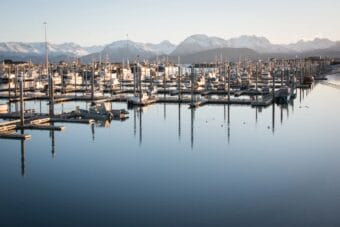
Vessels at the Homer Harbor. (Sean McDermott/KBBI)

Injured commercial fishermen and boat owners in Alaska will now be able to access higher insurance reimbursements, thanks to Senate Bill 93, which was signed into law last month.

The bill was sponsored by the Senate Labor and Commerce Committee, which Nikiski Republican Sen. Jesse Bjorkman chairs. It concerns the fishermen’s fund, which was established pre-statehood as a service to commercial fishermen who are injured while fishing. It’s funded by fees from commercial fishing licenses.

“The Alaska fishermen’s fund reimburses licensed fishermen and boat owners for their out-of-pocket medical costs if they have been injured or have a qualified illness while fishing off-shore, or doing fishing-related work on-shore,” Bjorkman explained in a hearing.

In 2023, the council that oversees the fund requested the maximum payout be raised from $5,000 to $10,000 to better match the insurance deductibles of many vessel owners. Fishermen requested raising that number to $15,000, which Senate Labor & Commerce adopted.

“Even with the $15,000 maximum, the projected disbursements from the fund leave the balance still very stable,” Bjorkman’s staffer Laura Achee explained at a March 2023 hearing. “And so it becomes a philosophical question in a situation in which a fund is created to serve a population, finding that balance between keeping the fund itself healthy, but not allowing disbursements from the fund to serve the balance of the fund more than they serve the population the fund was intended to serve.”

The bill was also designed to incentivise boat owners to get Protection and Indemnity, or P&I, insurance policies.

Representatives from the state’s division of workers compensation, which oversees the fishermen’s fund, testified that the rate of reimbursements over the past several years shows it would be sustainable to increase the maximum payout.

During public testimony, Tracy Welch with trade group United Fishermen of Alaska expressed support for the bill.

“As you’ve heard from staff, the fund is very healthy. It’s paid for by fishermen, for fishermen. And this is a great chance for us to be able to help those fishermen who are seeing a high increase in their deductibles,” Welch said. “Some of us loaners are seeing 10, 15 thousand for deductibles. So this is a way to help them, and provide a little bit of incentive for them to hold P&I insurance for them and their crew.”

In addition to raising the reimbursement ceiling, the bill also adds viral illnesses to the list of issues eligible for payouts.

The bill had another hearing in Labor and Commerce, and in the corresponding house committee. It passed the Senate unanimously in May 2023, then reached the House floor this session, where it passed 39-1. Gov. Mike Dunleavy signed the bill April 23, and it took effect immediately.

In a press release last month, Bjorkman said he was grateful the bill had been signed into law.

“As policies have risen in price, operating costs have appreciated, and labor shortages have impacted bottom lines, many owners have purchased policies with a higher deductible to control costs,” the release reads. “This bill provides support to vessel owners by establishing equity for crew across the industry, potential cost savings, and protection of loss that enables owners to provide for injury or illness without risking their entire operation.”

He reiterated it should have no financial impact on the state.

Juneau Empire, Peninsula Clarion parent company sold to Mississippi newspaper group

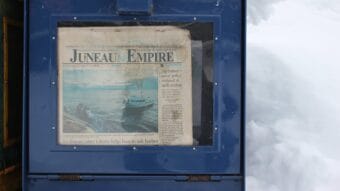
A Juneau Empire newspaper box, photographed on Wednesday, Jan. 17, 2024. (Katie Anastas/KTOO)

The parent company behind three Alaska newspapers has officially been sold to a group of investors, after filing for creditor protection to avoid bankruptcy in January.

Black Press Media is the parent company of Sound Publishing, which owns the Peninsula Clarion, Homer News and Juneau Empire. In addition to those three Alaska papers, Black Press publishes 94 newspapers in Canada, 35 publications in Washington state and six newspapers in Hawaii.

Carpenter Media Group purchased Black Press Media alongside two Canadian investment firms, Canso Investment Counsel and Deans Knight. The sale officially went through Monday.

Carpenter is a Mississippi-based media company that manages 27 publications across eight states: two in Georgia, seven in Kentucky, five in Louisiana, three in Mississippi, four in North Carolina, one in Tennessee, two in Texas and three in Virginia.

In a story uploaded to the Alaskan publications’ websites earlier this week, Black Press CEO Glenn Rogers said the company is dedicated to hyperlocal news.

“With our strong financial position and the support of our new ownership group, our readers and advertisers can count on us to continue delivering the quality journalism and advertising solutions that we are known for,” Rogers said.

In an email Tuesday, Rogers said he could not comment about how the sale will affect the Alaska newspapers because he is no longer CEO.

lengthy affidavit filed in January by Black Press’s corporate finance director, Christopher Hargreaves, says the company will wind down unprofitable businesses, sell properties and lay off employees at its U.S holdings in a plan to mend the company’s finances by the end of the year.

The editors of Black Press’s Alaska publications declined requests for comment. According to court documents, the company’s earnings had “steadily fallen” over the last decade, as print readership declined and advertising revenue dropped. Last spring, Sound Publishing reduced the Clarion and Empire from daily printing to twice-weekly publication, and moved printing off-site.

Legislators get update on fixes for $5B transportation plan rejected by federal government

Senate Finance Committee Co-Chair Sen. Bert Stedman, R-Sitka, listens to testimony from Alaska Department of Transportation and Public Facilities Commissioner Ryan Anderson on Feb. 28, 2024. (Riley Board/KDLL)

After federal authorities rejected Alaska’s four-year statewide highway project funding plan earlier this month, the state Department of Transportation is racing to submit revisions by Friday. State officials say they’ve removed or changed high-expense projects in the process, although the exact changes are not yet public.

On Feb. 9, federal agencies responsible for approving the Statewide Transportation Improvement Program or STIP rejected the proposal, which includes more than $5 billion in highway projects across Alaska. The department now has until March 1 to fix the five most serious issues with the plan before resubmitting, and a longer timeline to revise secondary issues.

In a Senate Finance Committee meeting Wednesday morning, Transportation Commissioner Ryan Anderson updated lawmakers on the revision.

Some senators expressed worry about what will happen to the state’s construction industry and anticipated highway projects if the STIP is not approved, or only conditionally approved. Sen. Lyman Hoffman, a Bethel Democrat, pointed out Alaska’s unique position.

“It’s my understanding that we’re the only state that’s been asked for a resubmittal, and I think that’s a drastic step by the federal government,” Hoffman said.

Anderson said some projects were removed from the plan. He wasn’t able to answer questions in committee about what exactly has been removed from the STIP for the revision, and said those changes were still ongoing as of Wednesday morning.

But the Cooper Landing Bypass on the Central Kenai Peninsula, one of the department’s most expensive capital projects, did come up. Although a critical aspect of that project, the Juneau Creek Bridge, has already been funded and is underway, Anderson told Sitka Republican Sen. Bert Stedman in an exchange that future segments of that project will no longer be in the STIP.

Work on the Cooper Landing Bypass, west of Juneau Creek, in September 2023. (Riley Board/KDLL)

“At this point in the STIP, you won’t see any planned expenditures — obligations, I should say — for Cooper Landing between 2024 and 2027,” Anderson said.

He said other projects that will be pulled from the plan include work on the Parks, Richardson, Sterling and Seward Highways, although in most cases, they’ll just be broken up into different segments, not removed entirely.

“So you will see where the projects are still in there, but there’s one phase of it, versus the whole thing,” he said.

A DOT spokesperson said the department will publicly release the full list of removed projects once the revised STIP is finalized, within a few days.

After the March 1 deadline, Anderson said, the department will focus on second-tier issues over the next six months, including more coordination with local transportation groups in Anchorage, Fairbanks and the Mat-Su.

“I mean yeah, we’re gonna get there,” he said. “It’s gonna take some resources.”

Anderson described difficulties with moving to a digital public comment system for the STIP, the challenges of high inflation and new rules about what should and shouldn’t be listed in the plan. He said the state is committed to not ending up in this situation again, and is looking at a “rolling STIP” model employed by other states, which would allow the department to perpetually update its STIP rather than create a new one every four year.

Anderson described the department’s progress on the revision as being at 90%, in advance of the Friday deadline for resubmission.

After DOT submits its revised STIP, federal transportation officials have 30 days to approve or respond to it.

Site notifications
Update notification options
Subscribe to notifications