KDLL - Kenai

KDLL is our partner station in Kenai. KTOO collaborates with partners across the state to cover important news and to share stories with our audiences.
Alaska nears agreement with private company to lead state LNG project

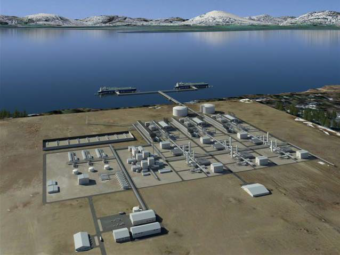
This illustration shows a rendition of what the liquefaction plant in Nikiski could look like if the Alaska LNG project is completed as planned. (Image courtesyAlaska LNG project.)

The state corporation spearheading an effort to build a $44 billion natural gas pipeline between the North Slope and Nikiski says it is finalizing an agreement with a private company to lead the project.

Alaska Gasline Development Corp. President Frank Richards shared the development during an energy press conference with Gov. Mike Dunleavy on Monday in Anchorage.

“Today, after 10 years of planning, engineering and permitting, I’m announcing that AGDC has reached an exclusive framework agreement with a qualified energy company to privately lead and fund the development of the Alaska LNG project,” he said.

Richards says AGDC won’t release the name of the company until a final agreement is reached. But he says the company has “extensive U.S. and international natural gas and LNG experience.”
“The terms of the framework agreement have been negotiated,” he said. “The next step is for both parties to create legally binding development agreements that will move the project forward.”

Tim Fitzpatrick, the corporation’s spokesperson, said Monday’s announcement came after roughly eight months of discussions between AGDC and the unnamed company. AGDC is now exclusively working with the developer until contracts are final.

It’s been roughly a month since the Alaska Industrial Development and Export Authority approved a $50 million line of credit to update the project’s engineering and design work. Richards said Monday that move was “critical” to the framework agreement, which officials hope to finish soon.

“The sooner that this project is underway, the sooner Alaskans benefit from our North Slope natural gas for the long term benefits,” he said.

Construction of the 800-mile pipeline has been floated for decades. But high costs and questionable demand have stymied progress.

The project got new life after Russia’s invasion of Ukraine sent some countries in Europe looking to diversify their energy sources. And Dunleavy has celebrated what he anticipates will be a more accommodating federal government once President-elect Donald Trump is sworn in later this month.

Fitpatrick said the agreement will cover the full project cost, but that the state will have the option to chip in up to 25% of costs once a final investment decision is made. He says it would be up to Dunleavy and state lawmakers to decide whether the state wants equity in the final project.

On Monday, Dunleavy said he thinks there’s a “real opportunity” for the project.

“I’ve questioned it for years, to be perfectly honest with you,” he said. “And as I mentioned earlier, I’ve been hesitant to talk about it until there’s some real concrete, I think, steps going forward. But I think we’re entering a phase of reality for this pipeline.”

Richards says he expects to announce a final agreement within the next few months. Then, he says, work could start on front-end engineering and design — the last step before any construction could start.

Fat Bear Week returns to Katmai National Park

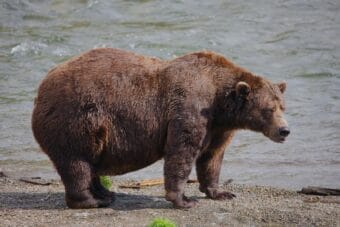
Chunk, a contender in this year’s Fat Bear Week celebration at Katmai National Park and Preserve. (From National Park Service)

Over the last several months, brown bears have been putting on pounds at Katmai National Park and Preserve. The culmination of their efforts is celebrated during Fat Bear Week, where 12 bears are pitted against each other in a bracket-style competition for the adoration of online voters.

The annual observance of Katmai’s bears has exploded in popularity since it started almost a decade ago. Last year, Fat Bear Week saw its highest voter turnout to date, with over 1.3 million participants from over 100 countries.

“It’s an opportunity to share their stories with people around the world, and also to celebrate Katmai’s robust ecosystem,” said Mike Fitz, resident naturalist with Explore.org, a website that livestreams the bears at Katmai’s Brooks River Falls.

Contenders for this year’s Fat Bear Week were announced Tuesday after an incident earlier this week where a large bear killed a rival bear near Brooks River Falls.

In the running are several fan favorites. One of them is Grazer, last year’s Fat Bear Week winner. She grew in popularity because of her dominant nature and hefty stature, often displacing male bears in the park.

This year, though, Fitz says Grazer’s focused more of her energy on raising a new litter of cubs.

“She’s probably not as fat this year, but there’s a lot of stories associated with her that we can admire,” Fitz said. “Her fearlessness, her dedication to her cubs, her work ethic. Bears are single moms, they don’t get any help from the male bears in raising cubs.”

There’s also Chunk, the most dominant bear on the river this year. He packs a punch at about 1,200 pounds. Yet, he’s never won Fat Bear Week.

A number of newcomers are also on this year’s docket. Bucky isn’t the oldest bear, but he’s certainly one of the smartest. He’s discovered a fishing spot all his own – under the cascade of Brooks River Falls. No bear has consistently fished there before.

And Fitz says Bear number 519, a teenager who just split from her mother, is also competing.

“It’s one of those young bears that’s on its own and trying to figure out the world for the first time, and that could be a real challenge for some of these younger bears,” he said.

For the first time, longtime favorite and four-time Fat Bear Week champion, Otis, is not in the running. He’s one of the oldest bears in the park, but has not returned to Brooks River Falls this summer. Fitz suspects he may have passed away.

Although the annual celebration is dubbed Fat Bear Week, the fat bears shouldn’t get all the credit. Fitz says Katmai’s sockeye salmon runs are the healthiest and largest in the world. Without them, there’d be no Fat Bear Week.

“Brooks River is part of the Bristol Bay salmon run, which is one of the last, probably the last great salmon run left on earth,” Fitz said. “To be able to share that story of the sustainable fishery, of Bristol Bay, and what salmon can bring to ecosystems, whatever they happen to be, is a powerful message to bring to the world.”

Fitz says the much-anticipated event isn’t all about who wins, but rather, showcasing the diverse stories of the bears in the running. He says organizers are always looking for new and unique brown bear stories to tell that will resonate with online fans.

“This is an event, an election where all of the bears are worthy of the vote,” Fitz said, “Despite what you see in local and national politics, and you may be apathetic or maybe not like the candidates at your disposal, I think every Fat Bear Week bear is certainly worthy of the vote.”

Online voting for Fat Bear Week opened Wednesday and runs through Tuesday. You can vote for your favorite fat bear and follow bracket results at Explore.org.

Alaska’s public libraries sound alarm over abrupt loss of state grant funds

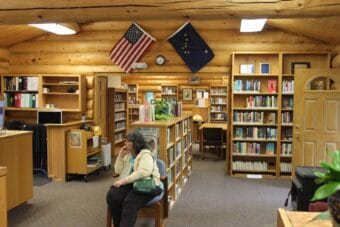
Janet Bentley sits in the Cooper Landing Community Library on Saturday, Aug. 31, 2024. (Ashlyn O’Hara/KDLL)

Libraries across Alaska are scrambling after learning a key state grant was being slashed six weeks into the fiscal year. Small libraries stand to be hit the hardest and, in some cases, may be forced to close their doors entirely.

There’s no running water at the community library in Cooper Landing. The log cabin was built in the early 1980s and is next to the Kenai River, which rushes by on an early fall morning.

Inside, logs crackle in a wood stove while Virginia Morgan shows a patron how to use the library’s website. Morgan is the library’s volunteer director. In that role, she’s responsible for overseeing library operations and keeping the building running.

Cooper Landing sits on the bank of Kenai Lake and boasts about 220 year-round residents. Despite the town’s size, the library circulated 2,300 pieces of media last fiscal year, including 1,215 books, 515 videos and 206 ebooks. More than 150 people participated in library programs that year, from book clubs to author visits.

Over the last two weeks, though, Morgan’s job has also included advocacy.

Flowers bloom outside the library. (Ashlyn O’Hara/KDLL)

That’s after the state announced it will reduce funding for library operating grants by nearly 75% this fiscal year from more than half a million dollars to $150,000.

Multiple librarians have criticized how the state broke the news — in an email that began with well wishes and season’s greetings. Morgan says she almost missed it.

“If we knew there was only $150,000 even going into this program, I mean, we should have known that before the informal notification on the 16th of August,” Morgan said.

State lawmakers created the Public Library Assistance grant program in 1981. The program used to award grants up to $10,000 and required a local match for any award over $5,000. In 1998, that maximum amount was reduced to $7,000.

In recent years, libraries around the state have received $7,000 a year from the program. Awardees are required to match that amount. For smaller libraries, that match usually comes in the form of volunteer hours and community fundraisers.

Near the Cooper Landing library’s front desk, Craig Mullett scans a wall of DVDs. He’s a part-time resident of the unincorporated town, and says the library is as much about community as it is checking out media.

“To me, a library is a lot more than a place with bookshelves,” Mullett said. “It’s a place where people meet each other, it’s a place where you can get on the computer if you’re having trouble with your Wi Fi, you can maybe get involved in local community stuff — in, like, volunteer activities.”

Mullett is one of many people who’s worried about the library’s future. Some smaller libraries say the loss of grant funds could mean the difference between staying open and closing their doors.

Cooper Landing Community Library Director Virginia Morgan helps a library patron. (Ashlyn O’Hara/KDLL)

Cindy Mom chairs the Seldovia Public Library Board. Seldovia is located south of Homer and can only be accessed by boat or plane.

“We could continue to operate the way we have been on the PLA for two or three years, but then we have nothing in reserve,” Mom said.

Mom says the loss will impact the 90-year-old library’s ability to buy materials and offer services. Many residents and visitors use the library’s internet and telephones because Verizon is the only carrier that works in town.

“I’m the one right now who gets to decide what we buy, and I have a long wish list that I was excited about, and now I can’t buy anything, and I also can’t buy the things that people suggest,” she said. “So we take recommendations from folks of things they want to see in the collection and can’t do it. So that’s very frustrating.”

In Ninilchik, it’s a similar story.

Director Heather Smith says their 72-year-old library’s annual operating budget is between $30,000 and $40,000. That means the state grant combined with the library’s match requirement makes up roughly half of its annual operating budget. As in Cooper Landing, Smith says the community library is about more than checking out materials.

“We also have members of the community that might not have a warm place at home during the winter, and they come here, and they come in here to sit, have a cup of coffee, use the internet, and, you know, just feel like they are a part of the community, and that would be lost,” Smith said.

The library already reduced its hours this month. Without the grant funding, Smith says they’ll have to shut their doors this winter.

The dramatic decrease in library grant funding isn’t due to a gubernatorial veto or legislative vote.

Instead, it has to do with internal budgeting. In emails to librarians and state lawmakers, the Department of Education and Early Development, or DEED, says annual grant amounts depend on the amount of money available for the program and the number of libraries that apply.

This year, the division says it only had $150,000 to give out to 82 libraries and library branches, down from more than half a million dollars in recent fiscal years.

Visitors are encouraged to put late fees and donations in a piggy bank at the Cooper Landing library. (Ashlyn O’Hara/KDLL)

It’s not clear why the funding was cut.

Multiple department and division employees did not respond to specific questions about the reduction and where the money is being spent instead. A public information request for the division’s budget for the current fiscal year has also not been filled.

The state doesn’t have designated funding for the library assistance grants. Although the grant’s been steadily awarded at the max amount of $7,000 per library branch in recent years, there’s no designated fund for the program.

Still, librarians said they’ve come to rely on the funding each year. This year’s reduction wasn’t announced until mid-August — six weeks into the fiscal year.

“The $7,000 was usually a guarantee, and that was how we paid our actual bills and made sure that we would have electricity and all of that throughout the year,” Smith said. “The other money comes up from just donations. That is something that we, on a regular basis, have to fight for monthly.”

Last fiscal year, the state program gave money to 79 libraries, roughly half of which had annual budgets less than $50,000. Another dozen libraries had budgets less than $14,000.

Librarians aren’t the only ones looking for solutions.

Kenai Peninsula Borough Mayor Peter Micciche echoed the library’s concerns at Tuesday’s borough Assembly meeting.

“What they don’t understand is libraries all over the state run with volunteers that give their time every day to keep them running, and that $7,000 evaporating is the end of the world for most of our rural libraries,” he said.

Sen. Jesse Bjorkman, a Republican from Nikiski, went to the meeting as well. He said the Legislature fully funded the library division and the decision to cut grant funding was internal.

“We have not been able to identify why that money left that program or where it went to only that the money was not given initially to that grant program,” Bjorkman said.

Some librarians say they won’t need to shut down tomorrow. But they are making other arrangements.

In Cooper Landing, volunteers are preparing to draw from savings and up their ask through the Kenai Peninsula Borough’s Community Assistance Program. They’ve also sent out a letter to the community, explaining the situation and issuing a call to action.

Morgan, the library director, is optimistic.

“In reality, yes, we will find a way, I guarantee you, because … we have dedicated volunteers,” she said. “We have a dedicated community who knows the value of our library.”

In a Tuesday letter to state lawmakers, DEED Commissioner Deena Bishop said the library division is looking at where they can make up the grant funding within the budget.

Landslide triggers 55-foot tsunami wave at Kenai Fjords National Park

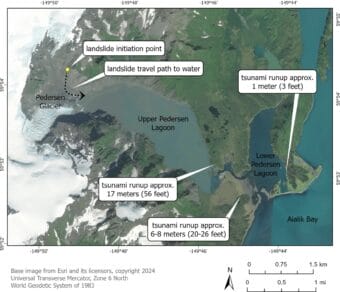
A satellite map showing the Pedersen Lagoon tsunami site. (From National Park Service)

A remote landslide produced a tsunami last month at Kenai Fjords National Park near Seward.

No injuries or fatalities were reported, but the wave caused minor damage to a privately-owned boardwalk. It also moved a Park Service campground food storage box about 20 feet.

According to the National Park Service, the Aug. 7 landslide splashed down into the upper part of Pedersen Lagoon about 20 miles southwest of Seward, producing a wave about 55 feet high. Then it crossed over a ridge and flowed into the lower part of the lagoon, hitting the shore at a height of about 3 feet.

Chad Hults, the Park Service’s regional geologist for Alaska, said the slope above the water is unstable. As a result, the landslide and tsunami didn’t come as a surprise.

“The landslide gave way during a very significant rain event that happened that week, I believe it was around 15 inches of rain that fell that week,” Hults said.

Hults said the region has seen several landslides within the last few years, and that heavy rains and thinning glaciers are making them more common.

“People should be careful about travel and understand when there’s heavy rain events, those are times when landslides can be triggered, and they can hit the water and generate tsunamis,” he said.

The Park Service recommends visitors to Pedersen Lagoon take precautions for the possibility of other landslides or tsunamis.

2 Soldotna troopers charged with assault over May arrest in Kenai

Alaska State Trooper Joseph Miller (left) tases Ben Tikka while Trooper Jason Woodruff (right) deploys a police dog against him on May 24, 2024 in Kenai, Alaska. (From Alaska Department of Law)

Two Alaska State Troopers are being charged with misdemeanor assault for using unreasonable force while arresting a person in Kenai who they thought was someone else, according to criminal charges filed Wednesday.

Joseph Miller Jr. and Jason Woodruff, both state troopers based in Soldotna, are facing one count each of fourth-degree assault. Both have served as troopers for more than a decade.

During a news conference on Thursday, Alaska Department of Public Safety Commissioner James Cockrell said he was “totally sickened” by the incident. He said it’s rare for troopers to face criminal charges for use of excessive force in the field.

“I’ve been with this department 33 years and I’ve never seen any action like this before by an Alaska State Trooper,” Cockrell said. “Let me be clear, the action of these two individuals is not acceptable to me, not in the line of our training and our policy and I know it’s not acceptable to the Alaskans that we serve.”

A 20-page charging document against the troopers, signed by Assistant Attorney General Daniel Shorey, lays out what prosecutors say happened.

According to the charges, Soldotna’s 911 dispatch center received a call on May 24 from someone asking about public camping. Dispatchers believed the call was placed by Garrett Tikka, who had an outstanding arrest warrant, and reported it to local law enforcement. The warrant was for not showing up to serve 10 days in jail for driving with a revoked license.

Charging documents say dispatchers gave law enforcement a description of a vehicle “associated with” Tikka. The Kenai Police Department later located the vehicle near Daubenspeck Park in Kenai. The charges say Miller, who was on duty at the time, waited to contact the man in the vehicle until additional law enforcement arrived and called Woodruff, who had a police dog with him.

Charges say Miller told Woodruff he’d like to have the dog nearby in case Tikka tried to flee.

According to charging documents, video footage from a Kenai police officer’s body-worn camera shows troopers ordering a person inside the vehicle to come out. Then, they break one of the vehicle’s windows and pepper spray inside. The person inside exits the vehicle and gets on the ground.

Law enforcement didn’t ask the person for their name, the charges say, and didn’t learn until much later that the person was not the man they were looking for, but instead his cousin, Ben Tikka.

The incident was recorded on Miller’s camera and the Kenai officer’s camera. Cockrell said Thursday that Woodruff’s camera was not activated during the incident because it had run out of battery power.

The charging documents say the camera footage shows Miller kicking Ben Tikka in the shin, punching him in the back of thr head and pushing him to the ground. Miller then steps on his head, tases Tikka from less than a foot away and puts the end of the Taser directly against his body, according to the charges. While tasing Tikka for a second time, the charges say, Miller incidentally hits one of the other troopers on the scene.

The charges say the dog starts to bite Tikka while he’s on the ground and being tased while trying to get away from the dog. Woodruff gives the dog a bite command and Tikka is bitten multiple times while Miller tases him.

The documents say body camera footage also shows Miller raising his foot and bringing it down quickly near Tikka’s head, Tikka “bleeding profusely” from the face and head while rolling on the ground and Tikka telling troopers he can’t breathe.

A still image from the Kenai officer’s body camera footage shows Tikka on his back and bleeding from the face. To the left, Miller stands over Tikka, tasing him. To the right, Woodruff holds the K9 unit’s leash while the dog bites Tikka.

Charging documents say troopers requested emergency medical services after Tikka said he needed to go to the hospital. Another trooper who arrived on scene after the altercation rode with Tikka to the hospital and learned en route that the victim was Ben Tikka and not Garrett Tikka.

At the hospital, Ben Tikka was interviewed by troopers about his dog bites. Investigators later learned that Tikka underwent surgery after the incident and that he suffered a bite on his arm, a fractured scapula and lacerations on his arm and head.

Troopers later opened a criminal case against Tikka, in which he was charged with three counts of fourth-degree assault, disorderly conduct and resisting or interfering with arrest. That case was later dismissed by the Kenai District Attorney’s office.

While looking into the troopers’ use of force, the Alaska Bureau of Investigation found discrepancies between what Woodruff and Miller wrote in their reports of the incident and what was shown on body camera footage.

The report concludes that Miller and Woodruff’s use of force in the incident was “objectively unreasonable” and that “aspects of their reports are inaccurate and contain omissions.”

Miller is a 14-year veteran of the department and most recently served as a night shift supervisor. Woodruff has been with the department for 16 years and most recently worked as a K-9 officer. Cockrell said both officers are on administrative leave, but said he could not say whether that leave is paid. The police dog is not currently in service.

Deputy Attorney General John Skidmore said in his 25 years of working at the Department of Law, he’s seen charges associated with excessive use of force brought one time, against a police officer in Bethel.

Alaska Department of Public Safety Commissioner James Cockrell speaks to reporters about assault charges brought against two state troopers during a press conference on Thursday, Aug. 15, 2024 in Anchorage. (Wesley Early/Alaska Public Media)

Cockrell said the department is reviewing some of Miller and Woodruff’s previous cases as a result of their conduct in the May 24 incident.

He said it was an “unfortunate day” for the agency and that he hopes Alaskans will continue to put their trust in troopers.

“It’s hard for me to equate how this has affected me and other troopers that wear this uniform,” he said.

Woodruff and Miller are scheduled to be arraigned at the Kenai Courthouse on Sept. 10.

Young walrus rescued in Utqiagvik admitted to Alaska SeaLife Center

ASLC Animal Care Specialist Maddie Welch (left) and ASLC Veterinary Technician Jessica Davis (right) feeds the orphaned female Pacific walrus calf patient that arrived from Utqiagvik on July 22, 2024. (Courtesy ASLC)

The Alaska SeaLife Center in Seward admitted an orphaned Pacific walrus calf last week that was found alone on a beach in Utqiagvik. According to a press release from the center, the female calf was likely left on its own after a walrus herd passed through the area.

The calf weighs nearly 165 pounds and is believed to be no more than a few weeks old. She’s one of only eleven walruses that have been admitted to the SeaLife Center since it opened in 1998.

Center staff say the walrus was dehydrated and malnourished after it arrived in Seward. It also had minor scrapes and lacerations.

Carrie Goertz is the director of animal health at the SeaLife Center. She says the walrus calf has perked up and has started feeding from a bottle.

“She has improved slightly,” Goertz said. “Big milestone in terms of getting her to nurse from a bottle, it really makes it so much easier to care for her. It also gives us good feedback in terms of what her appetite is doing.”

According to the SeaLife Center, the care regimen for Pacific walruses is more demanding than other marine mammals. They’re highly social animals that seek comfort through physical contact with their mothers, meaning staff work around the clock to act as surrogates. In the wild, walruses are usually under the care of their mothers for more than two years. Because the calf was separated from its mother before learning to survive on its own, Goertz said the calf will not be released back into the wild.

Under the SeaLife Center’s care, Goertz says the young walrus’ bloodwork and eating habits are trending in the right direction.

“She has gained a little weight, which is great,” Goertz said. “Good sign that we’re meeting her needs, and a number of her bloodwork parameters have improved.”

If you find an injured or stranded marine animal in Alaska, you can call the 24/7 Stranded Marine Animal Hotline by dialing 1-888-774-SEAL. For more information about the Alaska SeaLife Center, visit its website.

Site notifications
Update notification options
Subscribe to notifications