
KDLL is our partner station in Kenai. KTOO collaborates with partners across the state to cover important news and to share stories with our audiences.
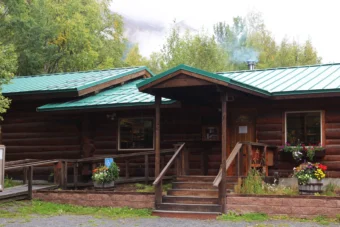
Flowers bloom outside of the Cooper Landing Community Library on Saturday, Aug. 31, 2024 in Cooper Landing, Alaska. (Photo by Ashlyn O’Hara/KDLL)
Alaska’s interlibrary loan program, an 800 number that was slated to end next week, will continue for at least another year.
The 800# Interlibrary Loan & Reference Backup Service allows rural residents to access books and DVDs that smaller libraries may not have the budget or space for. The program is funded annually by the Institute of Museum and Library Services, an independent agency of the federal government. President Donald Trump targeted the agency for cuts through an executive order in March. The move sent libraries around the state scrambling to preserve the program that serves about 70 rural Alaska libraries each year.
In May, a federal judge temporarily stopped the Trump administration from dismantling the agency. Alaska libraries were notified on June 17 that IMLS funding was approved through next year.
“This is a benefit for everybody in the state,” said Sandy Knipmeyer, who runs the 800 hotline out of the Anchorage Public Library. She says more than 4,000 materials were requested through the program last year.
“You want these small towns to be inquisitive, interesting, smart people, and the 800 number helps to provide that because of the access to materials that they have,” Knipmeyer said.
The Cooper Landing Community Library is one of a handful on the Kenai Peninsula that uses the hotline. When it stopped taking requests earlier this year, library director Virginia Morgan says patrons drove to other libraries to find what they were looking for.
“This is just the perfect way for us to put those items in the hands of people when we don’t have the space for everything, nor do we have the funds to purchase everything,” Morgan said.
Morgan says since the program started taking requests again, she’s called in about once a day. Alaska’s interlibrary loan program is currently funded through fall 2026.
Flowers bloom outside of the Cooper Landing Community Library on Saturday, Aug. 31, 2024 in Cooper Landing, Alaska. (Photo by Ashlyn O’Hara)
At the Moose Pass Public Library, kids were playing in a room lined with bookshelves. Children’s toys lay scattered across the floor. This is a typical day for the library, which has become a hub for the Kenai Peninsula community of about 80 people.
It’s one of the roughly 70 libraries in Alaska that participate in a lending program, called the 800# Interlibrary Loan & Reference Backup Service, that primarily serves rural communities. The service stopped taking requests on May 7.
“A lot of people are like, well, that’s, you know — it’s a big inconvenience,” said Moose Pass Public Library Director Dani Koschak.
Nearly 100 interlibrary loan requests have been filed at the library since last summer. They included children’s science fiction novels like “The Wild Robot,” vehicle repair manuals and an Alaska climbing guide.
“Not everyone can just buy what they want, either, so that’s why they rely on libraries,” Koschak said.
The program gave rural residents access to books that smaller, far-flung libraries don’t have the budget or space for. If a request couldn’t be satisfied in-state, the title would get pulled from a library in the Lower 48.
But the service could be eliminated entirely if funding for the Institute of Museum and Library Services isn’t approved by the end of June. The institute is an independent federal agency that was targeted for cuts through a Trump administration executive order in March entitled “Continuing the Reduction of the Federal Bureaucracy.”
The Institute of Museum and Library Services could not be reached for comment via email.
The Moose Pass Public Library, on the Kenai Peninsula, is a hub for the community of about 80 people. It’s one of the roughly 70 libraries in Alaska that participate in the state’s 800# Interlibrary Loan & Reference Backup Service. (Photo by Hunter Morrison/KDLL)
Sandy Knipmeyer, who runs the rural interlibrary loan service at the Anchorage Public Library, says losing it will be worst for people who live in villages with few library options.
“There is nothing in the state that will step in to provide that,” Knipmeyer said.
Virginia Morgan is library director of the Cooper Landing Community Library, a Kenai Peninsula library housed in a small log cabin without running water. Her library serves about 200 people.
“I don’t think we’ve even started to comprehend how we’re going to adapt,” Morgan said. “We are still sort of, like, a little bit shell-shocked at what’s happening.”
Janette Cadieux, a patron of the Cooper Landing library, has used the interlibrary loan service several times. She once requested a style manual for a research paper she wrote. She says the title wasn’t available in Cooper Landing.
“If I lived in a large town, I would just go to that big library and get the book, and I would take my laptop in, and day after day, I’d just go in and use that manual and get it done,” Cadieux said. “But that’s not really feasible in a little community like Cooper Landing.”
The Cooper Landing Community Library, on the Kenai Peninsula, is housed in a small log cabin with no running water. The library serves about 200 people. (Photo by Hunter Morrison/KDLL)
Cadieux says her research paper wouldn’t have been published in an academic journal without the style manual being sent to Cooper Landing through the loan program.
Trump’s executive order could also end the Alaska Library Extension, a service that mails books and DVDs to Alaskans who don’t have a library in their community. It also provides virtual reference services.
The program is funded entirely by the Institute of Museum and Library Services. If federal funding isn’t approved, it will end after June, too.
“Right now, in the absence of funding, there is no alternative,” said Catherine Melville, director of the Juneau Public Libraries. That’s where the program operates.
“There are a lot of areas in Alaska that are off the beaten track and isolated, and this program really provided a connection to the outside world,” Melville said.
Last year, nearly 90 communities without libraries used the Alaska Library Extension. Melville says it’s sad to even consider living without the program.
Koschak, the Moose Pass library director, said she hopes the cuts won’t stop people from using rural libraries’ remaining services.
“We do the best that we can,” she said. “But ultimately there will just be more disappointment.”
Deborah Standefer, a member of Soldotna’s Thursday quilting group, shows off a mariner star she’s working on. (Hunter Morrison/KDLL)
It’s a Thursday morning in the multipurpose room of Soldotna’s Christ Lutheran Church, where a handful of quilters gather weekly to work on projects. Deborah Standefer fires up her sewing machine and stitches a blue, circular quilt.
But despite Standefer’s enthusiasm, there’s a palpable feeling of loss among the group. Just two traffic lights north on the Kenai Spur Highway, the Joann Fabric and Crafts store is hosting a going-out-of-business sale. The Soldotna location is set to close April 29.
Standefer says she mostly shops at Joann for its selection of quilt batting – or insulated material between the quilt top and backing fabric.
“You never truly miss them until they’re really gone,” Standefer said. “We all shop at Joann’s at some time or another, so I think it’s going to have a big impact.”
The Ohio-based nationwide retailer filed for bankruptcy last year amid financial troubles. It originally planned to close about two-thirds of its stores – like those in Anchorage and Juneau. But the company wasn’t able to find a buyer willing to keep any stores open.
For quilters on the Kenai Peninsula, there aren’t many other local options to turn to. One of them is North Beach Quilting in Kenai, which sells higher-end fabrics. It’s a lot smaller than Joann, but shop owner Shonda Powell says many established quilters in the area already shop there.

“I get my fabrics from like, they’re made in Bali or Indonesia,” Powell said. “So the stuff that I have is not something that you’re going to find at Joann Fabrics.”
Since the Soldotna Joann store announced its closure, Powell says she sees new customers every day. Some are looking for items her store doesn’t carry. Powell is hoping to expand the small shop’s inventory as much as possible.
Shonda Powell, owner of North Beach Quilting in Kenai, works on a blue hooded kuskpuk. Her store is one on the Peninsula hoping to fill the gap. (Hunter Morrison/KDLL)
But Powell says she’s sad that crafters will soon have fewer options on the Kenai Peninsula to choose from. She’s concerned that Joann’s closure will impact quilters on a budget and those new to the craft.
“I think that if somebody’s learning how to sew, this is not the place that they’d pick first,” Powell said.
Crafters say they shop at Joann’s because of the store’s breadth of inventory. Barbara Steckel is a long time member of Soldotna’s Thursday quilting group. She says she’s used to being able to find a wide range of items at Joann, like every shape and size of velcro.
“Well, it’s definitely going to have an impact, because when I’m working on something, I’m used to running in there and being able to find most of the supplies,” Steckel said.
Steckel is also involved with Stitches of Love, a local group that makes and donates quilts to those in need. Even though much of the group’s quilting material is donated, they buy a lot. And Steckel fears the store’s closing could make it hard to stay within their budget.
”We’ve been looking at other sources and looking at the prices,” Steckel said. “We’re not quite sure what the impact is going to be.”
For quilters on the Kenai Peninsula, Joann’s closure will affect more than just their quilting projects. Many also knit, paint or scrapbook, and are not sure where to go for their crafting supplies. Some say they’ll resort to Walmart or online retailers.
Standefer, with the Thursday Soldotna quilting group, says Joann is a landmark for Kenai Peninsula crafters. She says the store’s closure is a blow to the community.
“You go into Joann Fabric, and everybody in town’s there,” Standefer said. “It’s kind of a melting pot, you always see somebody that you know, and it’s just been there for a long time, so it’s kind of a highlight to the community.”
Standefer says crafters from across the Kenai Peninsula would visit the Soldotna store, and often make purchases at other local businesses. She’s concerned about how the chain’s closure will affect local employees and those who craft to make money.
Alaska State Troopers Sgt. Joseph Miller (left) and Jason Woodruff (right) pleaded not guilty to assault in Kenai District Court on Tuesday. (Ashlyn O’Hara/KDLL)
Two Alaska State Troopers facing assault charges over alleged conduct during their arrest of the wrong man in Kenai last year won’t go to trial until next February, after a judge pushed the trial date back Wednesday.
Former trooper Sgt. Joseph Miller Jr., 50, and Jason Woodruff, 43, each face a felony assault charge in Kenai Superior Court. The state charged the officers last summer after body-worn camera footage appeared to show them beating and Tasing as well as siccing a police dog on Benjamin Tikka near Kenai’s Daubenspeck Park last spring. Troopers later said they’d been attempting to arrest Tikka’s cousin, who shares the same last name, for failing to appear for a 10-day jail sentence.
Miller and Woodruff were initially charged with, and pleaded not guilty to, a misdemeanor assault. Then a Kenai grand jury upped those charges to felony assault, to which they also pleaded not guilty.
The troopers’ trial was originally scheduled for this June. But on Thursday, their lawyers asked for more time. Superior Court Judge Thomas Matthews scheduled a pretrial check-in hearing for later this year, and a new tentative trial date of February 2026.
If the case goes to trial next February, it will be almost two years after the assault is alleged to have occurred.
“As you’re all aware, there’s certainly emphasis on trying to get all cases to trial,” Matthews said. “This one is not certainly the oldest one in the court system, but I’m sensitive to the right of the victim, to the desire to get these cases moving forward.”
Thursday’s hearing comes amid a statewide backlog of trial cases and lengthy pretrial delays. An investigation published earlier this year by the Anchorage Daily News and ProPublica found some cases delayed as long as a decade.
Shortly after, the Alaska Supreme Court put new limits on how long a criminal case can be postponed. The order takes effect May 12 and limits delays to 270 days for cases filed in or after 2022.
Darryl Thompson, who’s representing Tikka in the case, said during the hearing he’s not surprised the delay was requested.
“Well, we’ve been sad for the victim that he has to be out there even longer to get their day in court, to be heard and to have that justice be met,” Thompson said. “But as a defense attorney, I do understand that lots of things can happen.”
Clint Campion, Woodruff’s attorney, said in response to Thompson that he and his client spent three full days reviewing case material.
“This is not a matter where we haven’t been diligently working through discovery, but there’s a lot of material to discover,” Campion said. “It’s a relatively novel case for the state.”
Matthews says he hopes to set a firm trial date at the August hearing. Matthews is based in Anchorage. He was assigned the case after all of Kenai’s three superior court judges recused themselves from the case.
A trooper spokesperson said Wednesday via email that Miller is no longer employed by the state of Alaska. Woodruff is still employed by the state, but was taken out of service when the department learned about the Tikka arrest. The police dog deployed in the arrest is no longer with the department.
Miller and Woodruff’s lawyers each said Thursday they’re preparing motions to dismiss their clients’ respective indictments.
Alaska Gasline Development Corp. President Frank Richards addresses board members during a special meeting on Thursday, Mar. 27, 2025 from Tokyo, Japan. (Screenshot from Alaska Gasline Development Corporation Zoom)
The Alaska LNG Project took a step forward Thursday. That’s when the board of the state-run Alaska Gasline Development Corp. authorized an agreement with Houston- and New York-based pipeline developer Glenfarne Group to shepherd the project to a final investment decision.
“We’ve been burning the midnight oil to move forward and work on these definitive agreements with Glenfarne,” said AGDC President Frank Richards.
He called into Thursday’s special board meeting from Tokyo – the latest stop on his East Asian tour he’s on with Gov. Mike Dunleavy to promote the project.
Under the agreement, Glenfarne will own three-quarters of the $44 billion project. The state of Alaska will own the other quarter. That’s the same equity share the state had when the project was being led by ExxonMobil, BP and ConocoPhillips. A corporation spokesperson said AGDC is staying a part-owner to uphold its statutory obligations.
If it’s built, the Alaska LNG Project would move natural gas between the North Slope and Southcentral. The full project includes a gas treatment plant on the Slope, an 800-mile pipeline and a liquefaction and export facility in Nikiski.
As the new owner, Glenfarne’s first task will be to update the project’s existing cost estimate to 2025 dollars. AGDC estimates that work will cost around $150 million. A small piece – $4 million – is covered by an existing federal grant secured by U.S. Sen. Lisa Murkowski in 2023.
If the project ultimately doesn’t move forward, Glenfarne will be able to recoup as much as $50 million from a backstop OK’d by Alaska’s state-run development agency, the Alaska Industrial Development and Export Authority.
The agreement also says Glenfarne will prioritize the pipeline piece of the project before moving to later phases. That would let Alaska customers access gas before it’s available for export.
The Arctic treatment plant would likely be necessary to allow gas to start flowing from established fields like Prudhoe Bay and Point Thompson. But state officials say they’re optimistic gas from a forthcoming field developed by Great Bear Pantheon won’t require treatment before it’s sent south. The developer signed an agreement with the state last year, but the field has not yet started production.
“This really is a tremendous opportunity for the state, for the United States, for our allies, and we couldn’t be more thrilled to see the board vote in favor of this transaction,” Glenfarne CEO Brendan Duval told the AGDC board.
On a Thursday evening call with reporters, Dunleavy said Alaska is closer than ever to getting the pipeline project off the ground. But he says he understands if people still have doubts about its prospects.
“I was very skeptical for years on this project, and I’m not going to have a final celebration,” he said. “I’ll get excited when these guys go to (final investment decision). I’ll get excited when pipe is ordered. I’ll get excited when it’s welded. I’ll get excited when gas is going through it. I’ll really get excited when we flick on the switch and we’re guaranteed that Alaska gas. So I would just say, stay tuned.”
While in Asia, Richards and Dunleavy picked up a nonbinding letter of support for the project from Taiwan’s state-owned CPC Corporation. And though the letter is nonbinding, Richards says it’s a big step towards making the project a reality.
“Six million tons represents one train of the Alaska LNG,” he said. “So it’s significant for us, and that has then drawn significant interest in review by the other countries that we’re talking to.”
Richards said he and Dunleavy had also met with officials and energy companies in South Korea, Japan and Thailand.
But some have questioned the extent to which foreign interest is the result of tariff threats from the White House. Dunleavy says there are concerns about international trade. But he says there’s also demand for natural gas.
“Asian countries are needing gas,” he said. “The question is, where are they’re going to get it from? And Alaska, in many cases, is closer to them, and we believe it could be delivered at a price that works better than other locales.”
Though Thursday’s decision is a step forward, it’s still unclear whether enough investors will sign on for the project to be built.
Gov. Mike Dunleavy (second from left) and Alaska Gasline Development Corporation President Frank Richards (third from left) celebrate a letter of intent from Taiwanese CPC Corporation for the Alaska LNG Project. (Courtesy photo/Alaska Gasline Development Corporation)
The $44 billion Alaska LNG Project picked up a letter of intent last Thursday from Taiwan’s state-owned CPC Corporation. The letter is non-binding. But project officials say it’s a first step toward a binding agreement to buy gas from the project if it’s built.
In a joint press conference with Gov. Mike Dunleavy, Taiwanese President Lai Ching-te said Alaska gas is conveniently located and a source of high-quality natural gas. In a press release, CPC Corporation said Alaska would become Taiwan’s closest source of natural gas if the project is built.
“We are very interested in buying Alaska natural gas because it can meet our needs and ensure our energy security,” Ching-te said.
Gov. Mike Dunleavy called Alaska LNG the state’s flagship project. And he said it’s more than just an energy initiative.
“It is a bridge connecting the future prosperity of both Alaska and Taiwan,” he said.
If it’s built, the Alaska LNG Project would move natural gas from the North Slope to Southcentral for shipment overseas. The project includes a treatment plant on the Slope, an 800-mile pipeline and a liquefaction facility in Nikiski.
Last month, Trump announced a joint venture with Japan for the project, although that did not include a letter of intent. And after Dunleavy visited the Philippines last month, the country’s ambassador to the U.S. said they plan to procure natural gas from Alaska.
To date, nocompany has signed firm agreements to buy gas from the project. And the state corporation that owns the project declined to provide details about existing letters of intent, including who has signed them and how many there are.
Dunleavy is still in Asia to promote the project and seek investors. His office was not able to provide the trip itinerary. But Reuters reports Dunleavy met with government officials and companies in South Korea on Tuesday. He’s traveling with officials from Glenfarne. That’s the company in talks to take over the project from the Alaska Gasline Development Corporation.
Close
Update notification options
Subscribe to notifications
Subscribe
Get notifications about news related to the topics you care about. You can unsubscribe anytime.