Lingít Word of the Week

Lingít Word of the Week: Yaakw — Canoe

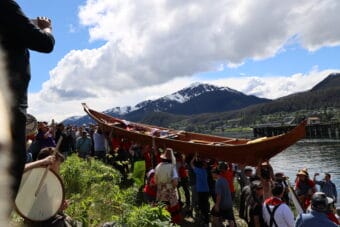
People carry a yaakw from shore in downtown Juneau on June, 4, 2024. (Clarise Larson/KTOO)

This is Lingít Word of the Week. Each week, we feature a Lingít word voiced by master speakers. Lingít has been spoken throughout present-day Southeast Alaska and parts of Canada for over 10,000 years.

Gunalchéesh to X̱’unei Lance Twitchell, Goldbelt Heritage Foundation and the University of Alaska Southeast for sharing the recorded audio for this series.

This week’s word is yaakw, or canoe. Listen to the audio below to learn how to say yaakw.

The following transcript is meant to help illustrate the words and sentences. 

Kooshdáakʼu Bill Fawcett: Yaakw. 

That means canoe.

Here are some sentences:

Kooshdáakʼu Bill Fawcett: Goodé sáwé yaa naḵúx̱ wé yaakw?

Where is that canoe going? 

Keiyishí Bessie Cooley: Haa x̱ooní Yanshkoowas.á amsikóo yaakw layeix̱í.

Our friend Yanshkoowas.á Jimmy Smarch knows how to build a canoe. 

Keihéenák’w John Martin: Ya aan, ldakát yá Lingít aaní yá átx̱ has alyéx̱ nooch, dutʼéek wé yaakw.

The village, all the Lingít villages, they all use it all the time, people paddle canoes.

Ḵaakal.áat Florence Marks Sheakley: Yá “blue canoe” áyá haa yaagúx̱ sitee.

This blue canoe here is our boat.

Kaxwaan Éesh George Davis: Du yaagú yíkt aawatʼík.

They are paddling in their canoe by themselves.

You can hear each installment of Lingít Word of the Week on the radio throughout the week. 

Additional language resources:

Find biographies for the master speakers included in this lesson here.

Learn more about why we use Lingít instead of Tlingit here.

Watch a video introducing Lingít sounds here.

Lingít Word of the Week: Taan — Sea lion

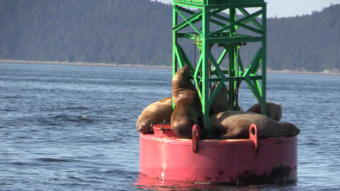
Sea lions sunning on a buoy near Juneau on August 29, 2019. (Photo by David Purdy/KTOO)

This is Lingít Word of the Week. Each week, we feature a Lingít word voiced by master speakers. Lingít has been spoken throughout present-day Southeast Alaska and parts of Canada for over 10,000 years.

Gunalchéesh to X̱’unei Lance Twitchell, Goldbelt Heritage Foundation and the University of Alaska Southeast for sharing the recorded audio for this series.

This week’s word is taan, or sea lion. Listen to the audio below to learn how to say taan.

The following transcript is meant to help illustrate the words and sentences. 

Kaxwaan Éesh George Davis: Taan. 

That means sea lion.

Here are some sentences:

Kaxwaan Éesh George Davis: Taan eech kut.áa.

The sea lion sits on the submerged boulder.

Keihéenák’w John Martin: Haa tuwaaxʼ kalitéesʼshán taan.

We think sea lions are interesting to look at.

Keiyishí Bessie Cooley: Taan dax̱dligéixʼ.

Sea lions are big.

Kooshdáakʼu Bill Fawcett: Taan xʼáatʼi áyá.

This is a sea lion island.

Ḵaakal.áat Florence Marks Sheakley: Yá taan yá has du x̱ʼadaadzaayí áyú yá shakee.át daa yéi too.úx̱xʼun. 

We always used to put sea lion whiskers on our shakee.át.

You can hear each installment of Lingít Word of the Week on the radio throughout the week. 

Additional language resources:

Find biographies for the master speakers included in this lesson here.

Learn more about why we use Lingít instead of Tlingit here.

Watch a video introducing Lingít sounds here.


Lingít Word of the Week: Saak — Hooligan

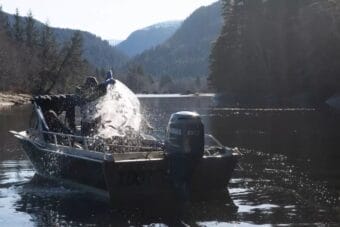
Louie Wagner empties a net of hooligan into his boat on the Unuk River. (Jack Darrell/KRBD)

This is Lingít Word of the Week. Each week, we feature a Lingít word voiced by master speakers. Lingít has been spoken throughout present-day Southeast Alaska and parts of Canada for over 10,000 years.

Gunalchéesh to X̱’unei Lance Twitchell, Goldbelt Heritage Foundation and the University of Alaska Southeast for sharing the recorded audio for this series.

This week’s word is saak, or hooligan. Listen to the audio below to learn how to say saak.

The following transcript is meant to help illustrate the words and sentences. 

Keiyishí Bessie Cooley: Saak. 

That means hooligan.

Here are some sentences:

Keiyishí Bessie Cooley: Saak eex̱í aag̱áa yatee át akamdulgaaní.

People light hooligan grease.

Keihéenák’w John Martin: Táakw.eetíxʼ áyá yaa yaga.eich saak.

The hooligan always run in the spring.

Kooshdáakʼu Bill Fawcett: Ḵúnáx̱ áwé yaawa.aa wé saak.

The hooligan were really running.

Ḵaakal.áat Florence Marks Sheakley: Taakw eetíxʼ yéi daaduné saak.

People work on ooligan in the spring.

Kaxwaan Éesh George Davis: Saak eix̱í ax̱ x̱ʼéix̱ aawatée.

They gave me hooligan grease to eat. 

You can hear each installment of Lingít Word of the Week on the radio throughout the week. 

Additional language resources:

Find biographies for the master speakers included in this lesson here.

Learn more about why we use Lingít instead of Tlingit here.

Watch a video introducing Lingít sounds here.

Lingít Word of the Week: Shaa — Mountain

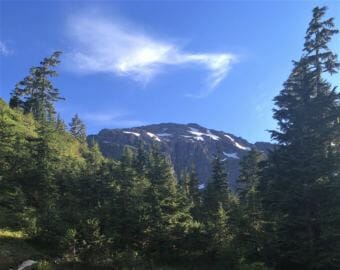
Mount Jumbo, also known as Mount Bradley, from the trail. (Photo by Adelyn Baxter/KTOO)

This is Lingít Word of the Week. Each week, we feature a Lingít word voiced by master speakers. Lingít has been spoken throughout present-day Southeast Alaska and parts of Canada for over 10,000 years.

Gunalchéesh to X̱’unei Lance Twitchell, Goldbelt Heritage Foundation and the University of Alaska Southeast for sharing the recorded audio for this series.

This week’s word is shaa, or mountain. Listen to the audio below to learn how to say shaa.

The following transcript is meant to help illustrate the words and sentences. 

Keihéenák’w John Martin: Shaa. 

That means mountain.

Here are some sentences:

Keihéenák’w John Martin: Ḵúnáx̱ átx̱ sitee yá Lingít yá óoxjaa noowx̱ sitee yá shaa.

Itʼs really something, for the Lingít, the mountains are a wind fortress.

Keiyishí Bessie Cooley: Shaa kaadé na.átch dzískw, tlákw táakw.

The moose always walk up the mountains every winter.

Kooshdáakʼu Bill Fawcett: Shaayadaadé gax̱too.aat.

Letʼs go up around the upper part of the mountain.

Ḵaakal.áat Florence Marks Sheakley: Lingít aaní shayadihéin shaa.

There are many mountains on Lingít land.

Kaxwaan Éesh George Davis: Dleit a shakée daak wusitán wé shaa.

It snowed on top of the mountain.

You can hear each installment of Lingít Word of the Week on the radio throughout the week. 

Additional language resources:

Find biographies for the master speakers included in this lesson here.

Learn more about why we use Lingít instead of Tlingit here.

Watch a video introducing Lingít sounds here.

Lingít Word of the Week: Geesh — Bull Kelp

Photo courtesy of Matt Kern and Lia Heifetz
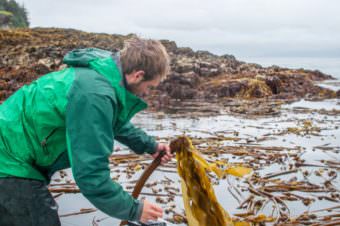
Matt Kern harvests wild bull kelp for salsa that he and his partner, Lisa Heifetz, sell. (Photo courtesy of Matt Kern and Lia Heifetz)

This is Lingít Word of the Week. Each week, we feature a Lingít word voiced by master speakers. Lingít has been spoken throughout present-day Southeast Alaska and parts of Canada for over 10,000 years.

Gunalchéesh to X̱’unei Lance Twitchell, Goldbelt Heritage Foundation and the University of Alaska Southeast for sharing the recorded audio for this series.

This week’s word is geesh, or bull kelp. Listen to the audio below to learn how to say geesh.

The following transcript is meant to help illustrate the words and sentences. 

Ḵaakal.áat Florence Marks Sheakley: Geesh. 

That means bull kelp.

Here are some sentences:

Ḵaakal.áat Florence Marks Sheakley: Yakʼéi áyá geesh wán daak adustʼéix̱i.

It is good to go out fishing at the edge of the bull kelp.

Keihéenák’w John Martin: Yá yéil sh kalneegí áyá geesh daax̱ woogoodí yéil.

There is a Raven story where Raven went around the bull kelp. 

Keiyishí Bessie Cooley: Éilʼ héen yíkx̱ yaa kana.éin wé geesh.

Kelp is growing in the ocean.

Kooshdáakʼu Bill Fawcett: Dliwkát latín wé geesh líl a káx̱ eeḵooxúḵ!

Watch that bull kelp; donʼt go over it! 

Kaxwaan Éesh George Davis: Héen x̱ʼakee yoo liháshk geesh.

The bull kelp floats on the water.

You can hear each installment of Lingít Word of the Week on the radio throughout the week. 

Additional language resources:

Find biographies for the master speakers included in this lesson here.

Learn more about why we use Lingít instead of Tlingit here.

Watch a video introducing Lingít sounds here.

Lingít Word of the Week: Xóots — Brown Bear

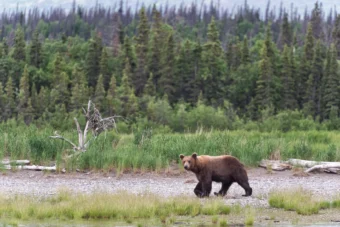
A young adult brown bear walks in front of a forested area in Katmai National Park and Preserve on June 16, 2018. (R. Taylor/National Park Service)

This is Lingít Word of the Week. Each week, we feature a Lingít word voiced by master speakers. Lingít has been spoken throughout present-day Southeast Alaska and parts of Canada for over 10,000 years.

Gunalchéesh to X̱’unei Lance Twitchell, Goldbelt Heritage Foundation and the University of Alaska Southeast for sharing the recorded audio for this series.

This week’s word is xóots, or brown bear. Listen to the audio below to learn how to say xóots.

The following transcript is meant to help illustrate the words and sentences. 

Kooshdáakʼu Bill Fawcett: Xóots. 

That means brown bear.

Here are some sentences: 

Kooshdáakʼu Bill Fawcett: De sá wé yaa nagút wé xóots?

Where is the brown bear walking to?

Keihéenák’w John Martin: Teiḵweidí shagóon áyá xóots.

The Teiḵweidí are the brown bear clan.

Keiyishí Bessie Cooley: Xóots, máayatee yéixʼ yatseeneit yóo dax̱ duwasáakw.

Brown bears are sometimes called “Yatseeneit” (the living thing).

Ḵaakal.áat Florence Marks Sheakley: Yá xóots ḵa yá hintaak xóodzi woosh tin has yatee.

Brown bears and polar bears are coming together.

Kaxwaan Éesh George Davis: Xóots aas daax̱ kei wdlitl’ét’.

The brown bear climbed a tree.

You can hear each installment of Lingít Word of the Week on the radio throughout the week. 

Additional language resources:

Find biographies for the master speakers included in this lesson here.

Learn more about why we use Lingít instead of Tlingit here.

Watch a video introducing Lingít sounds here.

Site notifications
Update notification options
Subscribe to notifications