Lingít Word of the Week

Lingít Word of the Week: Neech — Beach

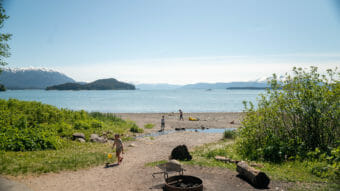
Families play on the beach at Auke Rec, June 1 2022, Juneau AK (Photo by Paige Sparks KTOO)

This is Lingít Word of the Week. Each week, we feature a Lingít word voiced by master speakers. Lingít has been spoken throughout present-day Southeast Alaska and parts of Canada for over 10,000 years.

Gunalchéesh to X̱’unei Lance Twitchell, Goldbelt Heritage Foundation and the University of Alaska Southeast for sharing the recorded audio for this series.

This week’s word is neech, which means beach or shoreline. Listen to the audio below to learn how to say neech.

The following transcript is meant to help illustrate the words and sentences. 

Here are some sentences:

Ḵaakal.áat Florence Marks Sheakley: Neechdéi nagú!

Go to the beach! 

Keiyishí Bessie Cooley: Neech káx̱ yaa nagút wé sʼeek tlein.

That big black bear is walking on the beach.

Keihéenák’w John Martin: Yakʼéi haa atx̱aayí yá neech dáx̱.

We get our good food from the beach.

You can hear each installment of Lingít Word of the Week on the radio throughout the week. 

Find biographies for the master speakers included in this lesson here.

Learn more about why we use Lingít instead of Tlingit here.

Lingít Word of the Week: L’ook — coho

Coho — or silver salmon — are identifiable by their white gum line. (USDA image)

This is Lingít Word of the Week. Each week, we feature a Lingít word voiced by master speakers. Lingít has been spoken throughout present-day Southeast Alaska and parts of Canada for over 10,000 years.

Gunalchéesh to X̱’unei Lance Twitchell, Goldbelt Heritage Foundation and the University of Alaska Southeast for sharing the recorded audio for this series.

This week’s word is l’ook, or coho salmon. Listen to the audio below to learn how to say l’ook.

The following transcript is meant to help illustrate the words and sentences. 

Keihéenák’w John Martin: L’ook. 

That means coho or silver salmon.

Here are some sentences:

Keihéenák’w John Martin: Yaakwdáat dáx̱ áyá l’ook ḵoowdzitee.

It was from Yakutat that the coho were born.

Keiyishí Bessie Cooley: Lʼook ḵu.aa téil Deisleenx̱ dax̱ uxʼaak.

The coho, however, none of them swim to Teslin. 

Kooshdáakʼu Bill Fawcett: Héen yík yawa.aa yu l’ook.

The coho flowed in the river.

Ḵaakal.áat Florence Marks Sheakley: Lʼuknax̱.adí at.óowux̱ sitee yá lʼook.

The coho is the Lʼuknax̱.adíʼs at.óow (sacred clan-owned item).

Kaxwaan Éesh George Davis: L’ook náayadi aas aawax̱áa.

He ate half smoked coho for dinner.

You can hear each installment of Lingít Word of the Week on the radio throughout the week. 

Find biographies for the master speakers included in this lesson here.

Learn more about why we use Lingít instead of Tlingit here.

Lingít Word of the Week: S’eek — black bear

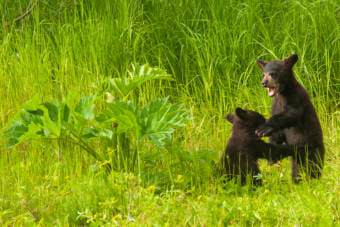
Two black bear cubs wrestle at the Mendenhall Wetlands State Game Refuge on June 19, 2021, in Juneau, Alaska. (Photo by Rashah McChesney/KTOO)

This is Lingít Word of the Week. Each week, we feature a Lingít word voiced by master speakers. Lingít has been spoken throughout present-day Southeast Alaska and parts of Canada for over ten thousand years. 

Gunalchéesh to X̱’unei Lance Twitchell, Goldbelt Heritage Foundation and the University of Alaska Southeast for sharing the recorded audio for this series.

This week’s word is s’eek, or black bear. Listen to the audio below to learn how to say s’eek, or black bear.

The following transcript is meant to help illustrate the words and sentences.

Kaxwaan Éesh George Davis: s’eek.

That means black bear. 

And here are some sentences.

Kaxwaan Éesh George Davis: S’eek du yátx’i ḵoowdzitee.

The black bear had cubs.

Ḵaakal.áat Florence Marks Sheakley: Yagéi tlein wé sʼeek.

That black bear is really big. 

Keiyishí Bessie Cooley: Lax̱ʼ loowú aatlein sʼeek has du tuwáa sigóo

Black Bears want lots of swamp blueberries.

Keihéenák’w John Martin: X̱áat has du x̱ʼéi yak’éi yá s’eek

Salmon taste good to the black bears.

You can hear each installment of Lingít Word of the Week on the radio throughout the week. 

Find biographies for the master speakers included in this lesson here. 

Learn more about why we use Lingít instead of Tlingit here. 

Lingít Word of the Week: T’á — king salmon

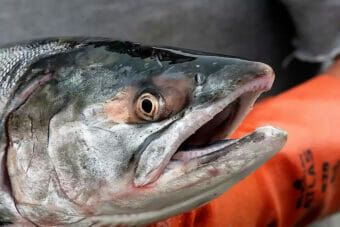
This week’s Lingít Word of the Week is T’á, or king salmon. (Photo by MaryCait Dolan/KYUK)

This is Lingít Word of the Week. Each week, we feature a Lingít word voiced by master speakers. Lingít has been spoken throughout present-day Southeast Alaska and parts of Canada for over 10,000 years. 

Gunalchéesh to X̱’unei Lance Twitchell, Goldbelt Heritage Foundation and the University of Alaska Southeast for sharing the recorded audio for this series. 

This week’s word is t’á, or king salmon. Listen to the audio below to learn how to say t’á.

The following transcript is meant to help illustrate the words and sentences. 

Keiyishí Bessie Cooley: T’á. 

That means king salmon. 

And here are some sentences.

Keiyishí Bessie Cooley: Tʼá Deisleent uxʼaakch, August yaa ḵuna.éini.

The king salmon swim to Teslin when August is first arriving.

Kooshdáakʼu Bill Fawcett: Ḵúnáx̱ áwé ya’kéi wé t’á.

King salmon is very good.

Ḵaakal.áat Florence Marks Sheakley: Ḵúnáx̱ dusteix̱ yá t’á.

People are really steaming king salmon.

Kaxwaan Éesh George Davis: T’áaw ax̱á.

He ate king salmon.

You can hear each installment of Lingít Word of the Week on the radio throughout the week. 

Find biographies for the master speakers included in this lesson here. 

Learn more about why we use Lingít instead of Tlingit here. 

The language speakers behind KTOO’s Lingít Word of the Week

KTOO’s Lingít Word of the Week series owes a debt of gratitude to X̱ʼunei Lance Twitchell, professor of Alaska Native Languages at the University of Alaska Southeast, and to the elders and language scholars who recorded the words and sentences used.

Here is more information about the people involved:

Keiyishí Bessie Cooley

Keiyishí Bessie Coolie is Kooḵhíttaan and a child of a Yanyeidí man. She’s from Deisleen (Teslin) and grew up spending time in Teslin, and around Teslin lake. She earned a Master’s degree in Indigenous languages and linguistics from Simon Fraser University. She’s currently translating projects for the Children of the Taku Society. 

Kooshdáakʼu Bill Fawcett

Kooshdáakʼu Bill Fawcett was Lukaax̱.ádi and the child of a Southern Tutchone man who passed away before Bill was born. His mother later married Tseexwáa Bill Fawcett, who helped raise Bill. He lived on Áakʼw Ḵwáan Aaní and enjoyed working with advanced language learners, helping them answer difficult questions about the language.

Ḵaakal.áat Florence Marks Sheakley

Ḵaakal.áat Florence Marks Sheakley is Lukaax̱.ádi and the child of a Chookaneidí man. She grew up on Mark’s trail in a family that used Lingít as the primary language and were involved in documenting, teaching and publishing in Lingít. She has taught the language at all levels, and has served as the teacher of teachers in the Juneau area for decades now. 

Kaxwaan Éesh George Davis

Kaxwaan Éesh George Davis was Tʼaḵdeintaan and the child of a Tsaagweidí man. He grew up in Ḵéex̱ʼ (Kake) and learned to speak well because he would always bring traditional foods to the elders there. As someone who fished a lot and spent time on the land, he knew lots of Lingít place names all over the area, and he learned many stories and advanced ways of speaking.

Keihéenák’w John Martin

Keihéenák’w John Martin was T’aḵdeintaan and a child of a Kaagwaantaan man. He is from the Xunaa Ḵaawu, the people of Hoonah, and was a contributing elder and speaker at many language immersion gatherings in Glacier Bay, Yakutat and Juneau. He attended boarding school in Shg̱agwei (Skagway) and attended Gonzaga University.

Site notifications
Update notification options
Subscribe to notifications