Glacial Outburst Flooding

Juneau Assembly asks View Drive residents to help pay for their own buyout after years of outburst flooding

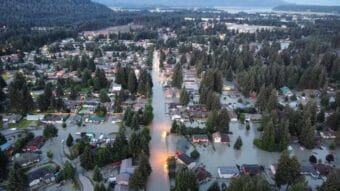
The Mendenhall River surrounds homes on View Drive in the Mendenhall Valley on Tuesday, July 22, 2026. (Photo by Clarise Larson/KTOO)

The City & Borough of Juneau tip-toed toward a federal buyout program for homeowners on View Drive this week, a street that’s been hit the hardest by annual glacial outburst flooding. The city’s asking those residents if they’ll help pay for it.

Eighteen homes line the forested cul-de-sac on View Drive, which extends into the Mendenhall River like a peninsula. They’re located beyond the temporary levee the city built last year, which protected hundreds of homes during the record flood in August. 

The buyout program, through the Natural Resources Conservation Service, or NRCS, would cost roughly $25 million if every household participates. The federal government has offered to cover three-quarters of the cost. The local portion could be around $6 million. 

City Manager Katie Koester spoke about it at a Juneau Assembly finance committee meeting on Jan. 7.

“The project would be a buyout of up to 18 homes on View Drive, and those homes would need to be demoed and turned into parkland in perpetuity,” she said. 

The city sent an informal ballot and letter to View Drive residents on Wednesday, asking if they’d be willing to give up hundreds of thousands of dollars from their home payout to shoulder that local portion. But it’s still unclear how this would work. In exchanges with KTOO, staff from the federal agency and the city explained it differently. 

Tracy Robillard, a spokesperson for NRCS Alaska, said in an email that state governments typically sponsor the 25% cost-share — including in New Jersey and Connecticut, and upcoming projects in New Mexico and South Carolina — where state environmental protection agencies have programs to purchase floodplains. In other cases, city governments have paid the local portion, Robillard said. 

Brett Nelson, Alaska’s watershed program manager at NRCS, said at the committee meeting there is another option.

“The more likely route would be some sort of third party coming up with the 25% local cost share,” he said. 

That third party could be a nonprofit. City staff spoke with the Southeast Alaska Land Trust back in July, but leaders there said they can’t commit millions of dollars in such a short time frame. 

NRCS hopes to offer the buyout before the next flood, expected this summer, Nelson said.

The U.S. Army Corps of Engineers is working on an engineered solution that would protect the whole Valley, but it’s still years away. In the meantime, homes on View Drive are expected to flood again and again. Some residents have said that leaving feels like their only option. 

“That’s an individual decision for those property owners, whether or not to, you know, take their chances and wait for an enduring solution,” Koester said at the meeting. 

If the buyout program moves forward, homes would be appraised at their 2024 value, prior to the flood that year. 

The city is asking residents to submit their informal ballots by Feb. 16, and plans to discuss the results at a Juneau Assembly committee meeting on Feb. 23. 

Army Corps will pursue a ‘lake tap’ solution to stop glacial outburst floods in the Mendenhall Valley

Sean Smack pulls people on a raft through floodwaters on Meander Way on Wednesday, Aug. 13, 2025. (Photo by Clarise Larson/KTOO)

The U.S. Army Corps of Engineers has landed on a solution to put an end to glacial outburst floods that have grown more destructive in Juneau’s Mendenhall Valley neighborhoods over the past few summers. 

The agency will pursue something called a ‘lake tap.’ It’s essentially a tunnel through Bullard Mountain on the east side of the glacier that’s meant to steadily drain Suicide Basin so it can’t fill to the point of bursting and send some 16 billion gallons of water through the Valley. 

Denise Koch, the director of engineering & public works at the City and Borough of Juneau, explained it with a metaphor on Friday. 

“I just think about Suicide Basin as a proverbial bathtub,” she said. “What the lake tap is, is just leaving the drain open.” 

She said the drain will empty the water from Suicide Basin into Mendenhall Lake through a conduit somewhere between the face of Mendenhall Glacier and Nugget Falls.

The decision comes after a three-day, closed-door meeting the Army Corps held with federal agencies, local officials and researchers in Juneau this week. Their main task was to discuss five options to prevent homes from flooding in the future. The Army Corps initially planned to host press briefings each day, but cancelled them on Tuesday. 

The city announced today that city leaders, along with the U.S. Forest Service and the Central Council of the Tlingit & Haida Indian Tribes of Alaska, support the lake tap option, aligning with many of the public comments the Army Corps received last month.

Besides a lake tap, the options discussed at the meeting were a dam at the outlet of Mendenhall Lake, a permanent levee, a bypass channel through the Mendenhall River floodplain and relocating impacted residents from the Valley. 

Koch said the group weighed the options based on risk to downstream residents, how quickly they could be built and the overall cost. 

“Ultimately, a lake tap was seen to reduce risk the most while being able to be constructed the most quickly, for the lowest amount of cost, with the least complex and least costly operation and maintenance,” Koch said. 

Koch said the tunnel could take as long as six years to excavate — the most conservative estimate. She said it could cost somewhere between $613 million and $1 billion, but that all estimates are very rough at this stage.

The Army Corps aims to finish its technical report for the lake tap in May. That will include a preliminary design, a more detailed cost estimate and a draft environmental review. There will be another public comment period once it’s complete.

To implement the solution, the Army Corps will need authorization and funding from Congress. 

Correction: This article has been updated to clarify that a full draft environmental impact statement is unlikely to be drafted in the technical report.

U.S. Army Corps to hold closed-door glacial outburst flood solution meeting in Juneau next week

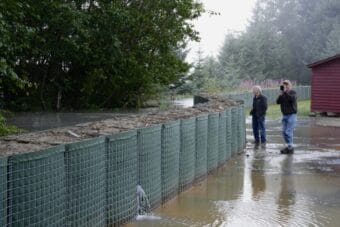
Floodwater seeps through HESCO barriers on Meander way during the glacial outburst flood on Wednesday, Aug. 13, 2025. (Photo by Clarise Larson/KTOO)
Floodwater seeps through HESCO barriers on Meander Way during the glacial outburst flood on Wednesday, Aug. 13, 2025. (Photo by Clarise Larson/KTOO)

Next week, the U.S. Army Corps of Engineers will hold a closed-door, three-day meeting in Juneau to discuss long-term solution options for glacial outburst floods in the Mendenhall Valley. Federal agencies, local officials and researchers will participate. 

During the meeting, the group will discuss the pros and cons of five options to prevent homes from flooding in the coming years. Those options are:

  • a dam at the outlet of Mendenhall Lake 
  • a permanent levee 
  • a lake tap or tunnel through the mountains to drain Suicide Basin 
  • a bypass channel through the Mendenhall River floodplain
  • relocating impacted residents from the Valley

The Army Corps will host the multi-day meeting, called a ‘charette’, at The Huddle in the Mendenhall Mall Dec. 9 through 11. 

Army Corps Spokesperson John Budnik wrote in an email to KTOO that the meeting will be closed to the public to “ensure open dialogue, idea and information sharing is achieved and uninhibited amongst the experts and stakeholders that will be there.”

Press briefings will be held at The Huddle after each day, and the Army Corps plans to publish a report summarizing the meeting for the public in January. 

Brig. Gen. Joseph Goetz at a press briefing in Juneau during the glacial outburst flood on Wednesday, Aug. 13, 2025. (Photo by Clarise Larson/KTOO)

The Army Corps solicited public input on potential solutions during a month-long public comment period that closed last week and received 34 comments. 

Two options received more attention in those comments than the others. The first is a lake tap or tunnel meant to drain Suicide Basin before it can fill to the point of bursting. The second is a dam or levee at the outlet of Mendenhall Lake. A few commenters favored a bypass channel through the floodplain. 

Some commented on the benefits and drawbacks of each solution, without necessarily favoring one. Others said they didn’t have enough information from the Army Corps about what each option would entail to weigh in. 

Many said that finding a solution is urgent for the hundreds of Valley residents who face annual flooding. The current levee, made of HESCO barriers, is temporary and protected homes from catastrophe by a slim margin during the most recent flood in August. 

The agency aims to recommend a long-term flood solution and design it by the end of May 2026. Budnik anticipates the public will have another opportunity to provide comments on the prospective solution in June 2026. 

Juneau Assembly weighs cost of buyout for View Drive residents in flood zone

Don Habeger and Wayne Coogan walk on the top of a privately made berm that failed to protect Habeger’s home from flooding on View Drive in August 2025. (Photo by Clarise Larson/KTOO)

Listen to this story:

View Drive is the street hardest-hit by Juneau’s annual glacial outburst flood, and remains unprotected by the city’s temporary levee. The Juneau Assembly is hoping to avoid paying a portion of the cost for a federal program that would offer buyouts to those residents.

A federal buyout for View Drive would pay residents to leave, demolish their homes and transform the land into a park. But first, the city has to decide whether to sponsor it. At this point, it’s not clear if the Assembly will vote to do so. 

Mayor Beth Weldon was cautious at Thursday’s special Assembly meeting, where experts presented the city’s options.  

“I don’t think anybody’s ready to commit to anything tonight,” she said.

Brett Nelson is Alaska’s conservation engineer at the Natural Resources Conservation Service, or NRCS. The federal agency oversees a recovery buyout program. At the meeting, he explained that the City and Borough of Juneau would be responsible for 25% of the cost. 

If all 18 eligible properties participated, it would cost an estimated $25 million. That means the city would be on the hook for up to around $6 million. But he says it’s unlikely every household would take the deal.

The Assembly voted unanimously to request a waiver to pay. Nelson said it’s worth making the request, but he’s not sure it’s realistic that NRCS headquarters would approve it. 

“I’ll say this: it is not very often used,” Nelson said.

If the cost is not waived, the city could seek funding from other sources besides Juneau taxpayers, such as nonprofits. But there is one restriction on the city’s portion:

“The 25% cannot be from another federal source unless that other federal source comes with congressional language specifically indicating that it can be used as a match for federal dollars,” Nelson said.

He said it would take around a year to complete the process and that the agency would prefer to offer the buyout option to residents before the next flood, which is expected next summer. 

“This is an emergency program and we’d like to move as expeditiously as possible,” he said.

If the city does take on the project, NRCS will appraise the 18 homes on View Drive and then residents will choose whether to take the deal or stay. Nelson says there are two appraisal options: they can be done based on the value now, or as of the day before the 2024 flood — and the agency is leaning toward the latter.

That appraisal decision will apply to every eligible property and affect the overall price tag of the project, since homes are worth more before they’ve been damaged by repeated flooding. 

Engineers say that while a couple of properties on View Drive might benefit from a barrier, the whole street can’t be protected by the HESCO barriers that make up the temporary levee protecting most other Valley neighborhoods.

Mike Records is a hydraulic engineer at the Army Corps. He compared the hazard of putting HESCO barriers on View Drive to the danger of a mariner taking a dinghy across Lynn Canal during a storm. 

“View Drive basically sits on a moraine from the retreat of the Mendenhall Glacier, so that moraine is extremely porous,” Records said.

He said that means water would seep under a temporary levee and form a pool. That’s what happened to a property at the end of the street where residents decided to erect their own berm ahead of the flood this August.

“You’re building a reservoir — potential reservoir  — with homes in the middle and no way out,” Records said, referring to how View Drive is a dead-end street with a single entry and exit point.

He said he recognizes that it’s unfair not to protect View Drive residents who’ve faced flooding over and over, and that they’re in a “horrible situation.” But from an engineering perspective, he said the only way to protect households that decide to stay is to implement a long-term flood solution

Nelson says parcels that get bought out become restricted from development forever, so households that participate in the program couldn’t return to their former properties — even after a long-term solution is built. He says NRCS has already determined View Drive is eligible for a buyout and that federal funding would likely be available soon after the government shutdown ends, if the city decides to sponsor it.

Army Corps agrees to pay for HESCO barrier expansion, expedites long-term outburst flood solution

Mayor Beth Weldon and Daryl Downing, a program manager at the U.S. Army Corps of Engineers, sign the assistance agreement to enhance the temporary levee on Oct. 30, 2025. (Alix Soliman/KTOO)

Listen to this story:

The U.S. Army Corps of Engineers announced Thursday that it will pay the full cost to extend and repair Juneau’s temporary river levee meant to protect almost all Mendenhall Valley neighborhoods from glacial outburst floods in the near-term. And it will expedite its process to choose a long-term solution that will protect the entire Valley. 

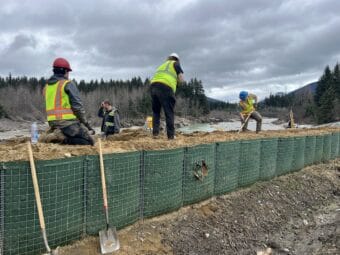
The existing temporary levee is made of HESCO barriers — steel and mesh baskets filled with sand. It protected hundreds of homes from flooding by a slim margin during the record-breaking glacial outburst flood in August. At a special Juneau Assembly meeting Thursday, members signed an agreement accepting assistance from the Army Corps to enhance the temporary levee. 

After signing the agreement, Mayor Beth Weldon referenced a quip Assembly member Ella Adkison made moments before. 

“The Army Corps is going to do phase two and pay for it. So we truly appreciate the assistance, and as Miss Atkison says, there’s no take-backs,” Weldon said.

The agreement expands the levee both upstream and downstream, protecting many more homes and businesses along Mendenhall River. Phase 2 will go from Back Loop Bridge to just before Juneau International Airport. The city estimates the expansion will cost around $19 million to build. The agreement means the city will no longer have to debate controversial ways to pay for construction.

Daryl Downing, program manager at the Seattle District of the Army Corps, says the agency will cover HESCO design and installation, as well as armoring the banks. 

“What is not covered is going to be any sort of outreach the City and Borough of Juneau will need to do to secure rights of entry or any permitting requirements for these efforts,” Downing said. “Once the Corps installs these measures, they get turned over to the City and Borough of Juneau for operations and maintenance, and then removal as well.”

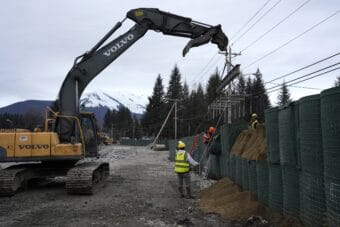
The Army Corps will also help repair the existing stretch of the flood barrier, which leaked and slumped during the flood this summer — sustaining about a million dollars in damage — and build it higher for the next flood. 

The agency aims to complete that work by July 15, 2026. For reference, the glacial outburst flood has struck during the first two weeks of August in each of the past three years. 

None of this funding will retroactively cover the cost to build Phase 1 of the levee — which is estimated at around $6 million. The Assembly passed a controversial funding scheme called a local improvement district, or LID, earlier this year to split 40% of the cost among more than 400 homeowners in the flood zone. 

At Thursday’s meeting, the Assembly voted not to close out the Phase 1 LID. The only Assembly member who objected was Nano Brooks. He asked if it would be possible to use some funds from the recently reappropriated $5 million that was pulled from the Capital Civic Center to reduce the residents’ portion. 

City Manager Katie Koester said that money could be used to care for future repairs and maintenance of the HESCO barriers. 

“In the end, it’s really your decision how much you want to use taxpayer dollars versus property owner dollars,” Koester said. 

Long-term solution in sight

The Army Corps made another major announcement Thursday.  It aims to finish its technical report, recommend a long-term flood solution, and design it by the end of May 2026. That’s several years faster than the process agency staff outlined at a public meeting in July.

John Rajek is the chief of the geotechnical and engineering services branch at the Alaska District of the Army Corps. 

“We plan on developing a preliminary design of the preferred flood control alternative, we’re going to prepare a planning-level cost estimate that’s going to help everybody understand the financial implications and basically help make informed decisions on the path forward,” Rajek said. “And then the third element is, we’re going to complete a draft environmental assessment of that alternative.”

Those options are a dam, a permanent levee, a bypass channel along the river, a tunnel to drain Suicide Basin or relocating buildings from the flood zone. 

Rajek says that in December, the Army Corps will hold a charette — a major planning meeting with federal and local agencies — to discuss the options and pick one.

Anonymous sources engaged in the agency’s process told KTOO that a tunnel through Bullard Mountain to drain Suicide Basin looks like the preferred option at this point, but Army Corps staff refused to comment. 

The Army Corps is seeking public comment on the long-term solution, which closes at the end of next month. The public affairs office requests comments to be submitted to public.affairs3@usace.army.mil.

Juneau will pay for part of temporary levee expansion using funds meant for Capital Civic Center

HESCO flood barriers line the Mendenhall River on Tuesday, July 22, 2025. The barriers end before reaching an apartment building that dangled over the river due to erosion during a flood in 2023 (Photo by Clarise Larson, Mikko Wilson/KTOO)

Juneau plans to expand its temporary levee along the Mendenhall River, in part by using money originally intended for a new arts and culture center. 

An ordinance passed unanimously at Monday’s Assembly meeting will allow the city to help protect more homes and businesses from annual glacial outburst flooding by pulling $5 million from the proposed Capital Civic Center. 

The current levee is made of HESCO barriers — steel and mesh baskets filled with sand. It protected hundreds of homes from flooding by a slim margin during the record-breaking glacial outburst flood in August. 

Deputy City Manager Robert Barr said at the meeting that $4 million of the reallocation will go toward Phase 2 of the levee project. 

“These funds would contribute toward ongoing overall protection costs like site preparation, armoring, environmental installation and legal for HESCO barrier installation along (parts of) the Mendenhall River that do not currently have barriers,” Barr said. 

Water seeps between HESCO barriers installed along the Mendenhall River on Wednesday morning, Aug. 13, 2025. (Photo by Clarise Larson/KTOO)

Phase 2 would expand the levee both upstream and downstream, so it would stretch from Back Loop Bridge to just before Juneau International Airport. The city estimates the expansion would cost around $19 million to build. 

The other $1 million pulled from the Capital Civic Center will be used to repair and maintain the existing stretch of HESCO barriers, which leaked, slumped and lost sand during the flood. 

The Capital Civic Center is a proposed project that would replace the current Juneau Arts & Culture Center. Juneau voters rejected a ballot proposition to fund the new civic center in 2019, but the city appropriated funds to a slightly altered version of the project anyway. 

Barr said those funds were meant to be a match for a federal or state grant, which hasn’t materialized. He said that money was originally allocated from the hotel bed tax fund and the general fund.

The Assembly will discuss how to fund the rest of the HESCO barrier expansion at a special assembly meeting on Thursday.

Site notifications
Update notification options
Subscribe to notifications