Alix Soliman

Climate & Environment Reporter, KTOO

“I write stories that shine a light on environmental problems and solutions. In the words of Rachel Carson, ‘The public must decide whether it wishes to continue on the present road, and it can do so only when in full possession of the facts.’”

When Alix isn’t asking questions, you can find her hiking, climbing or buried in a good book.
Forest Service opens public comment for Tongass National Forest plan revision

The forest on Douglas Island dusted with snow on Nov. 25, 2025. (Photo by Clarise Larson/KTOO)

The U.S. Forest Service officially kicked off its public process for the Tongass National Forest Plan Revision on Wednesday, with an initial 30-day public comment period intended to guide a draft plan and environmental review. 

The Tongass National Forest is the largest national forest in the U.S., with more than 16 million acres covering 80% of Southeast Alaska, including more than a thousand islands.

Forest-wide decisions made at the federal level shape the environment and the lives of Southeast residents — from industrial uses like mining and timber, to tourism and recreation, to the health of ecosystems and quality of subsistence harvests.

The last forest management plan was completed in 2016. That plan phased down the amount of old-growth available for logging over several years. The revised plan will set the stage for how the agency intends to manage the forest over the next 10 to 15 years. 

In its public notice released Tuesday, the agency outlined six proposed goals for the updated plan that address land use designations; economic uses of the forest; the rise in cruise ship visitors, collaboration between different groups; subsistence hunting, fishing and gathering needs; and Indigenous knowledge.

The public notice said the agency will ensure the plan is consistent with two of President Trump’s executive orders aimed at maximizing mineral extraction and logging in the Tongass. 

The agency also noted that a long-term timber demand analysis underway at the Pacific Northwest Research Station will inform projected timber sale quantities. The last analysis, published in 2016, estimated demand for Tongass forest products would range from roughly 41 to 76 million board feet per year between 2015 and 2030.

The public comment period for the scoping phase ends March 19 at 11:59 p.m. The agency expects to publish a draft revised plan and draft environmental impact statement this fall, followed by a 90-day public comment period. The final plan is expected next May.

Mariculture workshop in Juneau highlights growth potential for Alaska oyster farms

Thousands of young Pacific oysters grow in bins within the floating upweller system, or FLUPSY. (Photo by Alix Soliman/KTOO)

Listen to this story:

At the end of a dock in Auke Bay, an oyster farmer lifted a creaky hatch door on an unassuming floating platform. Inside were bins holding thousands of young oysters, called spat.

The platform is called a floating upweller system, or FLUPSY, and it’s one way oyster farms can keep more stock.  

“This is just a cheaper way to buy spat in a smaller size, much bigger quantity,” said Maranda Hamme, owner of Shinaku Shellfish Company, a small, family-run Pacific oyster farm in Klawock. Hamme was part of a small group that visited Juneau for a day-long mariculture workshop organized by Alaska Sea Grant and the Central Council of the Tlingit & Haida Indian Tribes of Alaska last week.

Nutrient-rich water flushes through the FLUPSY, so the tiny oysters can quickly grow big enough to fit into mesh bags out on a farm. The oysters in the FLUPSY are around the size of a penny — they’ve been growing here for roughly 9 months.

An oyster farmer opens a hatch on the FLUPSY in Auke Bay, where thousands of small oysters are growing. (Photo by Alix Soliman/KTOO)

The FLUPSY in Auke Bay belongs to Salty Lady Seafood Company, the only oyster farm in Juneau. Hamme said she’s planning to stock her own FLUPSY in Klawock because it can help her scale up, even when there are bottlenecks in the supply chain. 

“Currently, there’s only so many FLUPSYs in the state, and as a farmer, we’ve already not had seed needs met,” she said.

Most oyster farmers in Alaska, including Hamme, have to ship in spat from out-of-state hatcheries in Hawaii, Washington, Oregon or California. Sometimes there are shortages at those hatcheries. 

Spencer Lunda manages the University of Alaska Fairbanks’ mariculture research hatchery at Lena Point. He said developing in-state hatcheries can help solve that problem. 

The facility pumps in seawater that gets heated and flows into troughs filled with oysters, where Lunda and his team are studying ways to produce spat locally for farms across Alaska. 

“It would be nice to have spat production in the state, and be able to produce oysters that perform better in the conditions of Alaska, because the water is very cold here compared to where oysters are typically grown,” he said. 

Lunda said the ultimate goal is to breed oysters that grow relatively quickly in cold water and form a deep cup with a lot of meat — traits desirable for both farmers trying to turn a profit and consumers slurping them from the half-shell. 

Spencer Lunda holds a scallop shell covered in dozens of tiny oysters, called spat, in the oyster research hatchery at Lena Point. (Photo by Alix Soliman/KTOO)

Back on the dock, Hamme said the lease process to enter the industry is another issue that could be improved.

“I’m here sharing about being a farmer and the struggles and challenges that we face firsthand so other Indigenous farmers can get into the industry,” said Hamme.

She said it took two years to get an aquatic farm lease through the state. She also said the process doesn’t include tribal consultation to see whether proposed farm sites would overlap with subsistence seafood harvest sites.  

“I think it’s crucial that the state of Alaska incorporates tribal consultation, rather than just city government,” Hamme said. 

But developing mariculture operations could become a boon for Native communities, too. 

Frank Nix, the cultural foods manager for the Organized Village of Kasaan, attended the workshop to see how mariculture could bolster economic development and food security in his small village. 

Parent oysters, or broodstock, sit in a trough in the oyster research hatchery. (Photo by Alix Soliman/KTOO)

“Most of us are already working three or four jobs, and all of our facilities are running three or four programs,” Nix said after touring the small Auke Bay oyster hatchery. “So when it comes to looking at opportunities like, well, maybe we don’t have the manpower to run a farm — but, you know, it seemed like one or two people could manage a space of the size that we were just in.” 

He said he’s grateful to attend the workshop on a travel scholarship, and the recent availability of funding and training in Alaska mariculture makes the industry attractive. 

“I think one of the most valuable things that I’ve seen so far is that this seems perfectly doable,” he said.

New Amalga mining road proposal opens for public comment

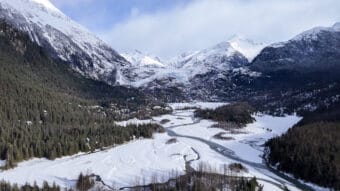
Snow covers Herbert Glacier and Herbert River on Monday, Feb. 16, 2026. (Photo by Clarise Larson/KTOO)

A Canadian company with plans to mine for gold near the face of Herbert Glacier applied to punch an access road through state land in December. The state opened a public comment period for the road last week. 

Grande Portage Resources wants to build a 15 foot-wide and 1.3 mile-long unpaved road with helicopter pads connected to Glacier Highway around mile 27. The road between Herbert River and Eagle River would allow the company to stage drilling supplies for transportation to the proposed New Amalga mine site. 

This would be the first segment of road that will eventually reach the mine site if the U.S. Forest Service approves the operation, according to the company’s application to the state. 

The Forest Service approved exploratory drilling at New Amalga last spring. Grande Portage has been flying in prospecting supplies from Mendenhall Valley and wrote in its application that building a new staging site and access road will shorten the helicopter flights.

The road would cut through forest and wetlands in a popular recreation area near the Eagle Glacier Cabin trail, Herbert Glacier Trail and Windfall Lake Cabin Trail. 

The proposed mining road segment would end at the boundary between Alaska state land and the Tongass National Forest. (Image courtesy of Grande Portage Resources)

If approved, the company anticipates road construction will begin this spring. 

The deadline to submit public comments is March 13 at 5 p.m. and comments can be emailed to john.driscoll@alaska.gov

Alaska Marine Lines, ferry system staff discuss options for safely transporting electric vehicles to Southeast Alaska

A barge departs from the Alaska Marine Lines dock in downtown Juneau.
A barge departs from the Alaska Marine Lines dock in downtown Juneau. (Heather Bryant/KTOO)

Staff from Alaska Marine Lines and the Alaska Marine Highway System discussed EV shipping safety during a panel held by Renewable Juneau, an advocacy nonprofit, on Wednesday. 

Electric vehicles have grown in popularity in Juneau over the years, but shipping safety concerns have now made it more difficult for people to bring them to Alaska or send them out for maintenance.

AML stopped shipping electric vehicles to Alaska last year due to the fire risk posed by lithium ion batteries. The decision came after another company’s cargo ship carrying hundreds of hybrid and electric vehicles caught fire in the open ocean off the coast of Adak, burned for days and sank. An AML spokesperson said at the time the company would reassess its policy as industry standards improve. 

During the panel, AML President Don Reid said he wished there were reliable safety ratings for the various lithium ion batteries on the market. 

“Every manufacturer you talk to wants to tell you that their product is perfectly safe,” Reid said. “And, you know, who are you supposed to believe?”

Reid said he wants AML to be able to ship all vehicles, but he’s spent a lot of time researching the issue and speaking with consultants, and said that shipping EVs that plug-in would be too risky for the company at this point. 

“What I need is the confidence that the thing’s not going to catch on fire on the barge. That’s really what it comes down to,” Reid said.

AML was the last barge company to pull EVs off its Alaska shipping routes after Matson and Tote Maritime. Now, EVs can be shipped two ways: on the road system, which doesn’t extend to much of Southeast, or two-at-a-time on the ferry — creating a bottleneck for consumers.

Craig Tornga, marine director for the Alaska Marine Highway System, said people who want to ship an EV on the ferry from Bellingham might wait around three months. 

To improve safety procedures, the agency hired a vessel firefighter with expertise in EV battery fires. The procedures include recommending EV drivers not charge the battery too much before boarding, placing EVs in areas of the ship easy for firefighters to access and repeatedly inspecting the vehicles while in transit.

“We have thermal infrared handheld cameras,” Tornga said. “We go around and we — every hour, on the hour — we shoot the battery to see what the temperature is and make sure we don’t see any changes.”

In addition to the handheld cameras, the ferry system plans to install other thermal cameras and purchased high-powered sprayers called Turtle Fire Systems that can flood a battery box to cool it down. 

Disclaimer: The panel was hosted at KTOO, with staff outside the news department contracted to produce the event.

US Forest Service cancels plan to build Herbert Glacier cabin in Juneau

Herbert Glacier on Nov. 27, 2025. (Photo by Alix Soliman/KTOO)

After proposing to build a new cabin near Juneau’s Herbert Glacier, the U.S. Forest Service released a draft decision last month abandoning it. 

The cabin site was initially selected due to public interest. It would have been built within a mining claim block across the river from the proposed New Amalga gold mine owned by Grande Portage Resources, Ltd. The Forest Service approved exploratory drilling at New Amalga in April. 

But Paul Robbins, a public affairs officer for Tongass National Forest, said the agency’s decision to cancel the cabin is unrelated to mining interests and is instead due to the challenging location and limited staff capacity. This comes after the agency lost a third of its staff in Alaska last year. 

“The proposed cabin site’s elevation, distance from the trail, design requirements and the need to move materials through difficult terrain all add to the complexity of that cabin project,” Robbins said.

He said the agency’s landscape architects and engineers could be overwhelmed with work if they moved forward with building the cabin.  

But some residents in Juneau submitted public comments saying they don’t believe those reasons are genuine. 

“Cancelling the project seems to be influenced by mining interest across the river which would inherently be hard to make compatible,” wrote Riley Moser, a Juneau resident. “It appears that the Forest Service is bending to corporate interests instead of listening to the needs and concerns of the public.”

Staff from the Alaska Miners Association and Grande Portage submitted comments to the agency before the draft decision, saying that building a cabin near the proposed mine could lead to disputes over how the land is used.

“Selection of a site to be used for recreational lodging, which can be easily placed anywhere, within an area of active mineral exploration could unnecessarily invite land use conflicts that do not and should not exist, and could incite litigation and appeals for years,” wrote Deantha Skibinksi, executive director of the Alaska Miners Association.

Kyle Mehalek, a technical specialist at Grande Portage, wrote that “it would be incredibly challenging, likely impossible, to protect the proposed cabin from potential visual and noise impacts with the same effectiveness as the existing trail.”

The cabin would have been part of the Alaska Cabins Project, the Forest Service’s biggest public-use cabin expansion plan in 50 years, which plans to bring around 25 new cabins to the Chugach and Tongass National Forests, including four in Juneau at Mendenhall Campground, Montana Meadows, Treadwell Ditch Trail and Dupont Beach.

Robbins said cancelling this cabin won’t affect the other proposed cabins. He said the Forest Service plans to reroute part of Herbert Glacier Trail and build a scenic overlook there instead. 

Although there is a lot of public support for building a cabin near Herbert Glacier, Robbins said the agency is unlikely to change course.

“Only because our decision was based on the complexity and capacity, not on whether or not the site was popular,” he said. “We know the site is popular, that’s why we wanted to initially build a cabin there.”

A public comment period to object to the cancellation closes March 9.

ADF&G euthanizes mountain goat kid with contagious skin infection found on Perseverance Trail

A healthy mountain goat kid and adult pictured in the Haines area. (Photo courtesy of Alaska Department of Fish & Game)

A Juneau resident took home a sick mountain goat kid with crusty skin lesions after hiking Perseverance Trail last weekend and contacted the Alaska Department of Fish & Game. Officials say the goat had a highly contagious viral skin infection that can transfer to humans and pets.

“It’s very important that people — if they see a sick or a dead wild animal — that they call Fish and Game, and not try to take it home themselves,” said Kimberlee Beckmen, the wildlife health veterinarian at ADF&G. “It’s also illegal to pick up wildlife and take it home.”

Beckmen said the goat had contagious ecthyma. It’s not always fatal in sheep and goats, but it’s usually more severe and deadly in lambs and kids. It causes skin lesions to develop around openings in the body. 

“When it covers their face, their eyes, their mouth, they can’t eat,” she said. “This recent case — the poor animal was starving to death and was completely dehydrated. It could not see out of its eyes.”

She said the goat probably would have died from the infection within a couple of days, and ADF&G euthanized the animal over the weekend.

In people, the infection is called orf and it’s typically mild. A lesion usually appears within a week of exposure. Beckmen said it’s not fatal to humans or dogs, and the lesions typically go away on their own after several weeks. The virus can transfer when the scabs make contact with openings in the skin. 

A mountain goat with contagious ecthyma that wandered into a Juneau neighborhood and later died. (Photo courtesy of Alaska Department of Fish & Game)

But Beckmen said hunters can still eat the meat of an infected animal if it’s handled properly. 

“We recommend that people wear gloves when they’re harvesting their animal and butchering it, and if they see any lesions on the skin or anything unusual, they want to make sure that they clean their knives off before they cut into the meat,” she said. 

ADF&G officials said they get calls about the infection popping up every once in a while. Carl Koch, the department’s area biologist in Juneau, said his team collected a dead goat kid with ecthyma near the Flume Trail in December. He said the department received a call in October about twin goats with the early stages of an infection, and thinks the two that died recently could be them. 

Beckmen said this is not an outbreak or an unusual occurrence. Sporadic cases have appeared in Dall sheep and mountain goats across Alaska since the 1980s, and she said the state is not currently concerned about it affecting those populations.

ADF&G requests that people report ecthyma cases to the wildlife disease surveillance hotline at 907-328-8354, by emailing dfg.dwc.vet@alaska.gov or calling the local ADF&G office. People can also report sick or injured wild animals through the department’s web form.

Koch said the person who took the goat home last week had called the department and left a message while out on the trail, but didn’t get a response since it was Saturday. He said people can call the police non-emergency number at (907) 586-0600 if they don’t hear back from ADF&G about a time-sensitive wildlife issue over the weekend.

Site notifications
Update notification options
Subscribe to notifications