Alix Soliman

Climate & Environment Reporter, KTOO

“I write stories that shine a light on environmental problems and solutions. In the words of Rachel Carson, ‘The public must decide whether it wishes to continue on the present road, and it can do so only when in full possession of the facts.’”

When Alix isn’t asking questions, you can find her hiking, climbing or buried in a good book.
Southeast ferry riders call proposed Cascade Point terminal a ‘boondoggle’ in public comments

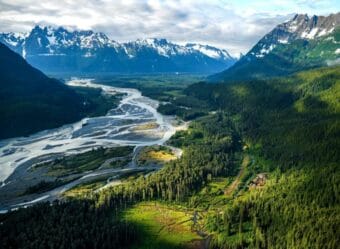
An aerial view of Berners Bay, where the state is proposing to build the Cascade Point Ferry Terminal. (Photo by Alix Soliman/KTOO)

More than 90% of the comments submitted to the state reject the Cascade Point ferry terminal proposed in Juneau. Many of the comments opposing the project suggest the purported benefits to ferry passengers are disingenuous, and the project looks instead like a fast-tracked subsidy for mining companies.

Dozens of commenters said that the public process to approve this project is lacking, with the comment period and a highly criticized economic analysis coming after the state already signed a $28 million contract for the first phase of construction, set to begin this summer.

The plan includes developing an access road from the end of Glacier Highway north to the site — roughly 30 miles north of the existing Auke Bay Ferry Terminal — and a staging area for future construction.

Leaders in Skagway and Haines oppose the project. Members of the Alaska Marine Highway Operations Board have also questioned the motives behind it and said it doesn’t fit into their long-range plan for the Alaska Marine Highway System.

Public funds for private industry

The Juneau Assembly hasn’t taken an official stance on the state’s plan, but Assembly Member Maureen Hall wrote a comment objecting to it. 

“I oppose the use of public funds to construct a remote State of Alaska ferry terminal when the facility’s apparent primary purpose is to function as an ore dock for private industry,” Hall wrote. “This represents a blatant misuse of public resources and raises serious concerns about the appropriateness and legality of such expenditures.”

Of the more than 500 comments opposing the project, a majority said the project would mainly benefit mining companies with holdings nearby and Goldbelt Native Corporation, which owns the land where the terminal would be built. Thirty-three commenters called the project a “boondoggle” outright, including Juneau resident Bjorn Wolter. 

“There is just no reason at all to build a new terminal,” Wolter wrote. “This project has all the potential to be another South Mitkof or Coffman Cove boondoggle.” 

Those ferry terminals on Mitkof Island and Prince of Wales Island cost millions of dollars. They were built far from the population centers they were meant to serve and close to logging sites 20 years ago. Two years after they were built, the Inter-Island Ferry Authority stopped running routes to them, and both have since sat unused

The Cascade Point ferry terminal stands to benefit the New Amalga gold mine proposed near the face of Herbert Glacier by Grande Portage Resources Ltd., a Canadian company. In December, Grande Portage announced that it is working with Goldbelt to design an ore barge dock alongside Cascade Point.

Ian Klassen, president and CEO of the company, was one of the 49 people who commented in favor of Cascade Point. He wrote that the plan will “create possibilities that currently do not exist north of Juneau for the reliable movement of cargo and commerce.”

Steve Ball, general manager of Coeur Alaska’s Kensington Mine, located across Berners Bay from the proposed site, also wrote in favor. 

“The twice-daily boat trips to the Kensington Mine would depart from the new Cascade Point Ferry Terminal, resulting in reduced risk for our workforce, contractors, and visitors by shortening the distance of the boat run and exposure to the Upper Lynn Canal,” Ball wrote. 

Coeur Alaska contracts with Goldbelt to transport miners to Kensington, mainly from Yankee Cove and from Echo Cove during inclement weather. 

Ferry users weigh-in

The state has been pushing for the new terminal for several years and has said it would benefit travelers in Southeast by reducing operating costs and travel time between Juneau, Haines and Skagway. 

But hundreds of commenters said building a second terminal in Juneau doesn’t solve the problems that the Alaska Marine Highway Service faces, including an aging fleet, crew shortages, reduced sailings and a lack of funding to address those issues. 

Robin Ross is treasurer for the Organized Village of Kake, the tribal government for the village, and secretary for the Kake City School District. She commented that the project fails to address ongoing transportation needs in Southeast. She said a ferry cancellation disrupted a mammogram van service that provides cancer screenings for women there, and while flights were arranged for some women, not all were able to travel. 

“The unfortunate reality is that a recent breast cancer diagnosis in October may have been

detected sooner had the ferry service not been canceled in May,” Ross wrote. “The ferry service serves as a critical lifeline.”

DOT’s FAQ page says, “terminal projects like Cascade Point are a critical step toward a stronger, more resilient system while new vessels are planned and funded through separate processes.”

But members of the Alaska Marine Highway Operations Board told the Anchorage Daily News that the project has been foisted upon AMHS and will create operational challenges they have to deal with. Last year, Gov. Dunleavy vetoed state legislators’ plan to divert funding from Cascade Point. 

Southeast residents said that while a ferry ride from Juneau to Haines might be shorter, the burden will be placed on drivers and walkers to get to and from the new terminal, which is much farther from the city center. The city bus system already does not extend to the Auke Bay ferry terminal — it’s about a two-mile walk along the highway shoulder from the last stop. 

Sean Powell, a current AMHS crew member, commented that commuting to Cascade Point would be much more difficult. “The increased distance, combined with weather conditions and other unforeseen disruptions, would add unnecessary challenges for crew members,” he wrote. “I believe funding would be better spent improving our existing infrastructure.”

Emily Mesch drives for rideshare services in Juneau during the summer and commented that it’s already difficult to make money driving people to the Auke Bay ferry terminal since it’s not centrally located. “I would never pick up a passenger there,” she wrote of the Cascade Point location, “unless the fares were about as high as a ferry ride, itself.” 

According to the Alaska Department of Transportation, Goldbelt has committed to running a shuttle service from Cascade Point to Auke Bay and the Mendenhall Valley, but hasn’t set a ticket price yet. 

DOT said that increasing snow plow service along Glacier Highway would cost about $30,000 if ferries operate out of Cascade Point in the winter. But after back-to-back snowstorms slammed Juneau this winter, some commenters said they’re not confident that plow service would be reliable. 

“DOT and the city are both overwhelmed when we get snow, let alone the storms that have hit at the end of December and into January,” wrote Morgan Ramseth. “Placing necessary services at the end of a poorly maintained road seems completely out of touch with reality.”

Others said increasing traffic farther out the road would stretch the city’s emergency services thin. 

The comment period for the first phase of the project ended on Jan. 9. The Alaska House Transportation Committee will hold a hearing with the Alaska Marine Highway Operations Board and DOT on Thursday, Feb. 5 at 1:30 p.m.

Some small businesses in Juneau speak out against ICE amid nationwide strike

Alaska Robotics Gallery closed Jan. 30, 2026 as part of the nationwide general strike. (Photo by Alix Soliman/KTOO)

Some storefront owners in Juneau spoke out against U.S. Immigration and Customs Enforcement or shuttered their doors Friday as part of the nationwide general strike following recent killings in Minneapolis. 

Downtown, small businesses including Drip Drop Wonder Shop, Liaise Studio and Alaska Robotics Gallery closed, joining businesses across the country protesting ICE. 

Aaron Suring is co-owner of Alaska Robotics Gallery, a game and book shop. He said he participated in the strike because he wants to see ICE defunded. 

“There’s limited things that we can do so far away from what’s happening in Minneapolis, and we wanted to show our support in what way we could,” he said. 

He said he thinks joining the nationwide response can raise awareness and lead to action. Across the country, people are refraining from attending school, going to work or spending money in solidarity with those impacted by ICE. 

Some Juneau stores that remained open took a stance against ICE in other ways. 

Kindred Post, a gift shop and post office downtown, posted on social media that 25% of its revenue between Friday and Sunday will be donated to the International Rescue Committee in support of immigrants and refugees. 

Travis Smith, co-owner of The Rookery Cafe and In Bocca al Lupo, said he decided to keep the restaurants open because he can’t afford to close. But he encouraged patrons to pay in cash. 

“We’re going to basically take what would have been the credit card processing fees that we’re not paying, since people are paying in cash, and then we’re going to match that amount as a donation,” he said. 

He said that will amount to 6% of their sales from the day, which they plan to donate to funds on Stand With Minnesota, a directory aimed at supporting people impacted by ICE in the state. 

“The reality is that our businesses both rely upon immigrants, our communities are built on them,” he said. 

Travis Smith owns The Rookery Cafe and decided to donate a portion of sales on Jan. 30, 2026 to support the community response to ICE in Minnesota. (Photo by Alix Soliman/KTOO)

Smith called the ICE raids “atrocious” and said the U.S. should not allow masked officers to kill people. 

Across the street, a chalkboard sign stands in front of Bustin’ Out Boutique.

“It says, ‘fight fascism, not your bra.’ We’re just a full-service bra-fitting store,” said Hollis Kitchin, owner of the boutique. She said she’s been using the sign to speak out against the current administration since President Donald Trump’s inauguration last year. 

A sign outside of Bustin’ Out Boutique on Jan. 30, 2026. (Photo by Alix Soliman/KTOO)

She said she couldn’t afford to close for the day, but set up a snack and tea station in her shop to create a welcoming space for protestors. 

Kitchin said she’s a descendant of people who immigrated to the U.S. to escape fascism before World War II and the issue is close to her heart. 

“I have friends in Minnesota that are afraid to leave their houses because they’re not white, they’re carrying their passports and stuff with them,” she said. “It’s just disturbing and horrifying.”

The response from local business owners comes after organizers hosted an anti-ICE rally Thursday and a recent vigil remembering Alex Pretti and Renee Good Sunday. Another anti-ICE is planned for Friday evening starting at 5 p.m. at the whale statue. 

Correction: This story has been updated to correct when Hollis Kitchin’s family migrated. 

Juneau Assembly asks View Drive residents to help pay for their own buyout after years of outburst flooding

The Mendenhall River surrounds homes on View Drive in the Mendenhall Valley on Tuesday, July 22, 2026. (Photo by Clarise Larson/KTOO)

The City & Borough of Juneau tip-toed toward a federal buyout program for homeowners on View Drive this week, a street that’s been hit the hardest by annual glacial outburst flooding. The city’s asking those residents if they’ll help pay for it.

Eighteen homes line the forested cul-de-sac on View Drive, which extends into the Mendenhall River like a peninsula. They’re located beyond the temporary levee the city built last year, which protected hundreds of homes during the record flood in August. 

The buyout program, through the Natural Resources Conservation Service, or NRCS, would cost roughly $25 million if every household participates. The federal government has offered to cover three-quarters of the cost. The local portion could be around $6 million. 

City Manager Katie Koester spoke about it at a Juneau Assembly finance committee meeting on Jan. 7.

“The project would be a buyout of up to 18 homes on View Drive, and those homes would need to be demoed and turned into parkland in perpetuity,” she said. 

The city sent an informal ballot and letter to View Drive residents on Wednesday, asking if they’d be willing to give up hundreds of thousands of dollars from their home payout to shoulder that local portion. But it’s still unclear how this would work. In exchanges with KTOO, staff from the federal agency and the city explained it differently. 

Tracy Robillard, a spokesperson for NRCS Alaska, said in an email that state governments typically sponsor the 25% cost-share — including in New Jersey and Connecticut, and upcoming projects in New Mexico and South Carolina — where state environmental protection agencies have programs to purchase floodplains. In other cases, city governments have paid the local portion, Robillard said. 

Brett Nelson, Alaska’s watershed program manager at NRCS, said at the committee meeting there is another option.

“The more likely route would be some sort of third party coming up with the 25% local cost share,” he said. 

That third party could be a nonprofit. City staff spoke with the Southeast Alaska Land Trust back in July, but leaders there said they can’t commit millions of dollars in such a short time frame. 

NRCS hopes to offer the buyout before the next flood, expected this summer, Nelson said.

The U.S. Army Corps of Engineers is working on an engineered solution that would protect the whole Valley, but it’s still years away. In the meantime, homes on View Drive are expected to flood again and again. Some residents have said that leaving feels like their only option. 

“That’s an individual decision for those property owners, whether or not to, you know, take their chances and wait for an enduring solution,” Koester said at the meeting. 

If the buyout program moves forward, homes would be appraised at their 2024 value, prior to the flood that year. 

The city is asking residents to submit their informal ballots by Feb. 16, and plans to discuss the results at a Juneau Assembly committee meeting on Feb. 23. 

Juneau residents call to defund ICE at rally downtown following killings in Minnesota

Ariel Hasse-Zamudio urges protestors to call their representatives. (Photo by Alix Soliman/KTOO)

More than 200 people gathered in the capital city Thursday to speak out against U.S. Immigration and Customs Enforcement, or ICE, following recent killings of two citizens in Minneapolis. 

Juneau resident Denali Marin organized the noon rally outside the courthouse, where protestors brought salt and chanted, “Melt ICE.” 

Marin listed some of the people who have lost their lives at the hands of ICE officers, including U.S. citizens Alex Pretti and Renee Good. Dozens of others have died while in custody in recent months. 

“I want to be very clear about what we’re asking for today, not vague statements, not calls to lower the temperature and not investigations that lead to nowhere,” she said into a microphone on the plaza steps. “Today, I’m calling on our national leaders to act.”

She and other speakers at the event called for leaders to defund ICE and impeach Homeland Security Secretary Kristi Noem. 

On Thursday, seven U.S. Senate Republicans joined Senate Democrats to block a funding bill that would have included $10 billion for ICE. Senators Dan Sullivan and Lisa Murkowski were not among those Republicans; instead they voted in favor of the funding bill. But Murkowski said this week that Noem should resign.

Protestors hold a large banner urging senators to stop funding ICE. (Photo by Alix Soliman/KTOO)

Local advocate Ariel Hasse-Zamudio encouraged attendees to call Alaska’s congressional delegation. 

“Dan Sullivan, Lisa Murkowski, Nick Begich, we need to call them and hold them accountable,” she said. 

Emma Sulczynski, a student at the University of Alaska Fairbanks, took the microphone to urge people to get involved in other ways. 

“There is a nationwide strike — strike on going to school, going to work, and on spending,” she said, referring to the national anti-ICE strike planned for Friday. “You don’t have to do all of these things, but whatever is accessible for you, please stand in solidarity with the brave people in Minneapolis and in the rest of our country who are resisting day and night.”

She also urged people to boycott corporations that support ICE.

Representative Sara Hannan and others sing along to a song written by an organizer. (Photo by Alix Soliman/KTOO)

Scientists confirm climate change is making destructive landslides more frequent across Alaska — especially in Southeast

A muddy landslide path crosses a road into the ocean
The deadly landslide that crashed through the outskirts of Wrangell on the night of Nov. 20, 2023, is seen from the air on the following day. The landslide killed six people and blocked a major road, the Zimovia Highway. (Photo provided by Alaska Department of Transportation and Public Facilities)

Listen to this story:

Landslides have killed at least a dozen people in Southeast in recent years. 

That prompted Aaron Jacobs, a hydrologist at the National Weather Service in Juneau, and his colleague to answer a major question people in the region have been asking: “Are we seeing more landslides across Southeast Alaska?”

A couple of years ago, scientists weren’t sure. Now, Jacobs says the answer is yes.

According to the study, published in the journal Landslides in November, news outlets reported 281 destructive landslides between 1883 and 2025 in Alaska. Jacobs said they decided to use news reports as the data source because if a landslide affected people or infrastructure, it probably made the news.

They found the number of reported landslides started to increase in the 1980s and has skyrocketed in recent decades. 

Fewer than 10 damaging landslides were reported per decade before 1980. From the 1980s to the 2010s, they found a 295% increase in impactful landslides across the state. In the 2010s, 84 damaging landslides were reported. In just the first half of the 2020s, 76 landslides have made the news.

“A big thing that stuck out was the precipitation-driven or triggering events that were increasing within the last 20 years,” Jacobs said. 

Images of the last four fatal landslides in Alaska, included in the paper: (a) Sitka; (b) Haines (c) Wrangell; and (d) Ketchikan. (Photos courtesy of (a) U.S. Coast Guard; (b) and (c) M. Darrow; and (d) NWS Juneau)

The four fatal landslides that hit Southeast in recent years — Sitka in 2015, Haines in 2020, Wrangell in 2023 and Ketchikan in 2024 — were all triggered by heavy rain or rapid snowmelt.

In the paper, the scientists drew a connection between rising average annual air temperatures — between 1.2 and 3.4 degrees Celsius — and a 3% to 27% increase in precipitation across Alaska over the past half-century. 

“It’s all connected,” Jacobs said. 

It’s a result of climate change. As the globe heats up, more intense atmospheric rivers are slamming Southeast because warmer air can hold more moisture. These downpours cause steep slopes to crumble. 

Climate change is also expected to raise the frequency and intensity of storms that dump rain on top of snow. When the rain melts the snow, it rapidly saturates hillsides and can make landslides more likely. Additional research published Wednesday by Jacobs and others found that this phenomenon triggered the 2023 Wrangell landslide.

Earlier this month, Jacobs and his colleagues posted a manuscript of a scientific paper addressing these rain-on-snow events that hasn’t been peer-reviewed yet. They used a high-precision weather forecasting model to assess atmospheric rivers in Southeast within the last handful of decades and project how they could change in the near future.

The researchers found that rain-on-snow events coincided with 8% of landslides assessed between 1981 and 2019, including some that were large and widespread. They predict that rain-on-snow events will happen more often and involve an increase in extreme rainfall and snowmelt between 2031 and 2060 as the atmosphere continues to heat up.

Landslide debris scars Mount Roberts near the Strasbaugh Apartments on Gastineau Avenue in Juneau on Thursday, Sept. 18, 2025. (Photo by Clarise Larson/KTOO)

How people use the land also plays a role in where landslides occur and how they affect people. On Prince of Wales Island, scientists have mapped nearly 800 landslides. The island is crisscrossed by hundreds of miles of logging roads. 

“The writing is on the mountain,” said Quinn Aboudara, natural resources manager for the Shaan Seet tribal corporation in Craig. 

He said he’s noticed that landslides are more prevalent in logged patches and where roads cut across steep slopes. When he was growing up in Port St. Nicholas Bay, he said landslides weren’t as frequent and more snow fell in the winter. In recent years, it mostly rains. 

“Now we treat the rainy seasons as landslide season,” he said. 

Shaan Seet is piecing together a road and culvert inventory to identify problematic areas. During a deluge, Aboudara said some old culverts meant to funnel water under roads clog or just aren’t big enough to handle the runoff. He said that causes water pressure to build up in the hillside and can lead to landslides. 

“We’re looking to replace those with actual bridge works instead of culverts,” he said. 

At the Sitka Sound Science Center, Luka Silva is working on other measures to reduce risk. He manages the Ḵutí Geohazards Project, which works with Southeast communities to address gaps in landslide science and public safety. 

“Because no one wants to lose their neighbor or their home or their friends or loved ones in a landslide, and we have steps that we can take to make that less of a possibility,” Silva said. 

The center developed an early warning system for Sitka that Silva said other communities are using as a model. Scientists are studying soil thresholds to someday forecast landslides. Many communities are working on or already have landslide hazard maps. 

But some municipalities have struggled to take action. After residents in Juneau pushed back against updated landslide hazard maps, the Juneau Assembly declined to adopt them and rolled back development restrictions in landslide paths. Nearly identical stories played out in Sitka and Haines. It’s because homeowners don’t want to see their property values tank and insurance premiums rise. 

Silva urges people to keep the bigger picture in sight.

“We know what we know about how our landscape is going to change even further, and how our landslides are going to be more and more impactful and frequent,” he said. “What are we going to do about that? And what are we going to do to make people safer?”

This story has been updated with information about an additional study published Wednesday. 

From taxes to policy, young commercial fishermen gather in Juneau to gain industry knowledge

Rowan Miller peeks out from behind a fishing net while seining in Prince William Sound. (Photo courtesy of Rowan Miller)

Listen to this story:

Seventeen-year-old Quinn Branch was among the young fishermen socializing at the Hangar on the Wharf ballroom in downtown Juneau on Tuesday evening as part of the Alaska Young Fishermen’s Summit.

Branch traveled to the summit from Kodiak because she said her dream is to spend the rest of her life setnetting on the Island. 

“So my grandpa, who I’ve been fishing for for three years now — we’re a setnet site out in Kodiak — he sent me here pretty much because I want to take over the family business one day,” she said. 

Branch said she’s got the fishing part down, but wants to understand the behind-the-scenes work, including filing taxes, applying for loans and hiring staff. 

She said she’s also connected with role models at the summit. 

“Just getting to see other women who are doing the same thing, you know, the same passion and the same desires as I is pretty cool,” she said.

One of those women is Rowan Miller, a 24-year-old from Valdez who’s starting her own fishing business. Miller said she’s spent half of her life fishing for salmon on her dad’s boat in Prince William Sound.

Now, she’s buying a 50-foot steel seiner from a family friend. She said people keep asking why she doesn’t just take over her dad’s boat when he retires. 

“I’m like, ‘No, I’m not going to wait that long,'” Miller said. “He’s, you know, he’s 58 now. I’ve got another 25 years to wait ‘til he retires, so why would I do that?”

She said some skippers she knows have fished well into their 70s and even into their 80s. 

Alaska’s fishing fleet is aging out, and that’s one reason why Alaska Sea Grant hosts the summit — to support the next generation of Alaskan fishermen. The organization started the summit in 2007 and hosts it every other year. 

The average age of a permit holder in 2014 was 50 years old. That’s a decade older than it was in 1980. Between 1980 and 2013, the number of young people holding permits dropped significantly. After the state limited entry into the fishing industry, hundreds of high-cost permits drained out of Alaska and were sold to out-of-state operators. That left many rural villages that relied on fishing without a fleet to support their local economies

Miller said seeing other young people at the summit is a good sign for the industry. But she said there are other obstacles outside of her control that make buying into the industry feel like a gamble.

“Between climate change and uncertain fish runs and uncertain markets with global things like tariffs and whatnot — there’s just a lot of uncertainty going on,” she said. “So it’s a big leap of faith.” 

Along with learning how to run a business, Miller said she’s also interested to learn more about what she could have a say in: fisheries policy. She said she wants to have a hand in shaping the future of the industry.

That’s another goal of the summit, said Gabe Dunham, fisheries specialist at Alaska Sea Grant and chair of the event: “How to engage with the public processes that influence their business, like the council process and the Board of Fish, and also how to interpret the science and the management around them.” 

Dunham said older, experienced fishermen volunteer to host sessions and pass on their knowledge. But he said fewer people attended the summit this year — around 20 — compared to the 30 to 60 people who typically go. 

Site notifications
Update notification options
Subscribe to notifications