“I write stories that shine a light on environmental problems and solutions. In the words of Rachel Carson, ‘The public must decide whether it wishes to continue on the present road, and it can do so only when in full possession of the facts.’”
When Alix isn’t asking questions, you can find her hiking, climbing or buried in a good book.
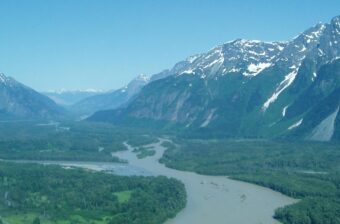
Herbert Glacier carves through the Tongass National Forest on Aug. 6, 2025 (Photo by Alix Soliman/KTOO).
Alaska lost about a third of its U.S. Forest Service employees in the past year due to federal staffing cuts led by the now-defunct Department of Government Efficiency, or DOGE. Before that, the agency had around 700 Alaska-based staff. This month, the agency told KTOO that 467 remain.
Leading this workforce in flux is Jerry Ingersoll, the U.S. Forest Service’s acting regional forester for Alaska, covering both the Chugach and the Tongass National Forests. Ingersoll has worked for the Forest Service for 40 years and took on the role in November 2025.
In this interview with KTOO’s Alix Soliman, Ingersoll talks about changes he’s leading Alaska Forest Service staff through, including the impending consolidation of the U.S. Department of Agriculture and the Tongass National Forest plan revision.
The following transcript has been edited for length and clarity.
Listen to this conversation:
Jerry Ingersoll, acting regional forester for Alaska (Photo courtesy of U.S. Forest Service)
Alix Soliman: What is your vision for this role?
Jerry Ingersoll: This is a period of change, and it is my job, I think, to keep the boat upright and the passengers in. There’s changes in national policy associated with changes in political leadership, and it’s my job as a professional civil servant, not only to implement those changes, but also to take care of the people in the communities involved.
Alix Soliman: Over the summer, USDA Secretary Rollins announced the consolidation and restructuring of the USDA, and the USDA made statements to the press that several Alaska forest offices will close. What is the timeline for that reorganization? Do you know what’s going to happen?
Jerry Ingersoll: I don’t, and that’s probably the largest piece of that answer is that I don’t know. The announcement of the Secretary’s decision and of moving forward with the reorganization has not yet come and I’ll hear about it when the rest of you do. And I’m in an Acting Regional Forester position because that’s part of this interim organization. I’m filling in until this larger reorganization takes place. Many employees left the agency over the last year, more in Alaska, even as a percentage of our organization, than in some other parts of the country. And so we’ve got people stepping up, covering for their departed colleagues.
Alix Soliman: Let’s talk about the Tongass Forest plan revision, which has been underway for a while now. Can you just go ahead and share where we are at now with the revision and what the next steps are?
Jerry Ingersoll: We expect within the next few months, maybe less than that, to publish a notice of intent to begin revision of the Tongass land management plan. As you say, that’s been anticipated for a while. So I would anticipate, after the notice of intent gets published, that we will host public meetings and engagement sessions around the Tongass — around Southeast Alaska — this spring. I’d expect that we will engage federally recognized tribal governments in government-to-government consultation. We’ve already begun that process, but we’ll do so even more as we officially launch the revision, and then we are hoping to complete the process and revise the forest plan over the next couple of years.
Alix Soliman: Some federal comment periods have been expedited. Do you expect a shorter public comment period than has happened in the past for this revision?
Jerry Ingersoll: You know, I think it’s too early to know for sure. We want to — we want to fully engage people in the development of their plan for their forest, and we don’t want to spend all of our lives on planning and not on doing.
Avalanche forecasters view drone footage avalanche paths at City Hall on Jan. 12, 2025. (Photo courtesy of Catherine Melville).
An avalanche evacuation advisory remains in effect for one neighborhood that sits beneath Mount Juneau in Alaska’s capital city. And now, for the first time, the city is using a radar detection system to track avalanches that rumble down the mountain, thanks to state money freed up by the city and tribe’s disaster declaration last week.
Severin Staehly works for an avalanche technology start-up called Gravimon in Zurich, Switzerland. On Sunday, he installed the Doppler radar system at the Alaska Electric Light & Power substation on Douglas Island. It’s called an Avymonster, and it points at Mount Juneau continuously to scan for avalanches.
“We can really see where it happens and where it starts, where it ends, measure the speed and give all this information to the forecasters,” he said in an interview at City Hall.
Staehly said the Avymonster is popular in other places with high avalanche risk like Norway, Canada and the European Alps. He said he installed one in Alaska last week near Portage Lake, south of Anchorage.
A slide coming off Mount Juneau down Chop Gully above the flume in the Basin Road area on Friday, Jan. 9, 2026. (Mikko Wilson/KTOO)
John Bressette, the city’s avalanche advisor, said it works just like boat radar, so it can scan through the night and in poor weather. Now, the team won’t have to wait for clear weather to see whether avalanches occurred. The radar system notifies staff instantaneously.
“It allows us to detect avalanches when we can’t visually see them, which in Juneau is often with the darkness and with the weather,” he said.
Using drone flights and binoculars when the clouds rose a bit on Sunday, Bressette said he was able to see where avalanches released some snow down the Behrends path to the end of Judy Lane. But he said the avalanche didn’t start from high up the mountain.
“There’s a lot of undisturbed snow at the top of the Behrends pass still that hasn’t been affected yet,” he said. “We feel that there’s still potential for — if that were to go — to potentially reach homes.”
An annotated photo of the Behrends avalanche path from the 1967 report. (Keith Hart, Report of the Preliminary Evaluation of the Behrends Avenue Avalanche Path)
That’s where the city is still advising residents to keep clear. An evacuation advisory was issued Friday for residents living in avalanche hazard zones for all slide paths in downtown Juneau, and for part of Thane Road south of downtown. The advisory was lifted Sunday for everywhere but Behrends.
North of downtown, Bressette said he confirmed a loud avalanche reported on Thunder Mountain this morning around 9:00 a.m., but that it didn’t threaten homes.
Bressette said his next step is to work with the Alaska Department of Transportation and Public Facilities to fly a helicopter-mounted LIDAR sensor over the mountain to measure the snow. He also wants to dig snow pits to look at layers in the snowpack. He said that will help forecasters better estimate the risk to those who live in the Behrends path.
Ryan O’Shaughnessy, the city’s emergency programs manager, estimates the radar system and installation costs about $200,000 or less. Since Gov. Mike Dunleavy approved the city and tribe’s disaster declaration, he said the state is likely to pay for it.
“We’re very confident that this will be part of our public assistance reimbursement,” he said.
At the top of the White avalanche path on Mount Juneau, weather sensors track air temperature and snow depth. But avalanche experts say adding other sensors that measure wind, solar radiation and snowpack temperatures could also help refine avalanche risk assessments for downtown Juneau neighborhoods.
Ezra Strong in front of the Behrends slide path on Friday, Jan. 9, 2025. (Photo by Alix Soliman/KTOO)
Two small avalanches released on a slide path of Mount Juneau, above the Behrends neighborhood, as Ezra Strong was on a walk this morning in the pouring rain.
The city issued an evacuation advisory about an hour earlier for Juneau residents in all known slide paths downtown and along Thane Road. Strong and his wife live on Gruening Avenue with their dog. He said he’s not heeding the advisory.
“I think in part because we’re a little bit protected by a rock wall and some other things behind us, in part because we have seen slides come down before on the main slide path that didn’t even get close to us,” he said.
During an online press conference Friday morning, the City & Borough of Juneau’s new Avalanche Advisor John Bressette said that many small slides reduce the hazard by decreasing the amount of snow that could be released in a larger slide.
“So it’s actually a good thing that we’re seeing smaller slides reducing the total snow load that is capable of producing an avalanche,” Bressette said.
Some avalanches released above the Flume Trail today. The Alaska Department of Transportation and Public Facilities confirmed numerous small avalanches along Thane Road Friday morning. The agency expects more avalanches this evening since the forecast shows continued heavy rainfall, strong winds and warming temperatures. The closure of Thane Road could be extended multiple days.
A slide coming off Mt. Juneau down Chop Gully above the flume in the Basin Road area on Friday, Jan. 9, 2026. (Photo by Mikko Wilson/KTOO)
Some residents of the Behrends neighborhood have evacuated to friends’ houses or Centennial Hall, the official shelter set up by the city and the American Red Cross.
Carlos Cadiente lives kitty-corner from Juneau-Douglas High School: Yadaa.at Kalé in the Behrends slide path. He evacuated at around 11:30 a.m. in one vehicle while his wife drove behind in another. At a stop sign, he told KTOO they were headed to a friend’s house just down the street.
“We already had a go-bag going and we already had the cars loaded up and ready to roll, and so we’re rolling,” Cadiente said.
He said this is the first time they’ve heeded an avalanche evacuation advisory in the decades they’ve lived here.
“It’s kind of an extreme measure, you know, extreme weather that we’ve had,” he said. “So we’re just kind of trying to be proactive and not be a problem,” he said.
Britt Tonnessen is the community disaster program manager for the Red Cross of Alaska in Southeast. In coordination with the city, the Red Cross set up an emergency shelter at Centennial Hall downtown for residents on Friday.
Blankets sit in a stack for avalanche evacuees at Centennial Hall on Friday, Jan. 9, 2025. (Photo by Clarise Larson/KTOO)
At the shelter on Friday morning, she said the Red Cross has been preparing for the last week in case of an evacuation.
“We’ve seen multiple fatal landslides and avalanches in the past decade,” she said. “Evacuating to a congregate shelter is not people’s dream idea. It’s a safe place to go. We do the best to meet the needs and we have incredible, loving, warm volunteers to meet people.”
Tonnessen said that anyone from avalanche zones, as well as those who feel the load on their roof is becoming too heavy, are welcome at the shelter.
She said they are prepared to take 150 people, and around 30 people signed in by the early afternoon.
Avalanche, weather and road conditions are expected to worsen Friday evening.
KTOO reporter Clarise Larson contributed to this report.
Part of the front eave on Tracey Muir’s house collapsed under the weight of heavy snow on Jan. 8, 2026. (Photo by Jamie Diep/KTOO)
A portion of a residential roof collapsed Thursday in Juneau under the weight of several feet of snow that fell over the past few weeks.
Tracey Muir was born and raised in Juneau and bought the house in Mendenhall Valley a little over a year ago. He was inside when the roof gave way.
“This morning, I heard crackling, came and took a peek, and it was down and, well, all the snow we’ve been getting is what took it,” he said.
An overhanging section of the roof collapsed on the front of the house, which was built in the 1970s.
The National Weather Service estimated the weight of snow on a flat roof could be around 41.6 pounds per square foot as of Wednesday, based on ground measurements made at their forecast office in Mendenhall Valley.
Emergency officials and engineers say most homes built in Juneau before 1991 were designed with a snow load capacity of 40 pounds per square foot.
Muir said that, thankfully, there’s been no damage to the inside of the house, and that he was already planning to have the roof replaced this spring. He plans to patch it until then.
“I’m definitely done with winter,” he said.
Muir hadn’t cleared snow from the roof, and said he was hoping warmer weather would melt it for him. Now, he suggests others don’t follow in his footsteps.
“Get your roofs cleaned,” he said.
Nate Geary is a civil engineer who specializes in structural design. During the record-breaking storm that dumped four feet of snow on Juneau just after Christmas, he measured the weight that accumulated on his roof using roughly the same method as NWS.
“Once I got close to 40 pounds a square foot, which is the snow load rating for my roof, I decided it was close enough to switch over from a science experiment to going ahead and cleaning it off,” Geary said.
That was on Dec. 30. His home in Mendenhall Valley was built in 1973.
He said a roof will show some warning signs before it gives out.
“It’ll start to deform, which can create some cracks in the sheetrock or make some popping sounds,” he said.
Geary said there are some steps homeowners can take to reduce the risk of roof collapse, even if they can’t clear the whole thing.
“I think the first layer of risk management would be like using a snow rake and clearing eaves and overhangs, since they’re the weakest part of the structure,” he said.
Then, he suggests clearing around vents to prevent moisture accumulation in the attic, and shoveling drainage paths on flat roofs.
Geary is from Juneau and said that when heavy snow has fallen on his roof in the past, it melted relatively quickly. That’s not the case this time.
“This snowstorm is just not like anything that I’ve seen since I’ve lived here,” he said.
More heavy snow and rain are on the way. Meteorologists said that could make the snowpack heavier, wetter and harder to move.
An aerial view of Berners Bay, where the state is proposing to build the Cascade Point Ferry Terminal. (Photo by Alix Soliman/KTOO)
The public comment period for phase 1 of the controversial Cascade Point Ferry Terminal in Juneau closes tomorrow, Jan. 9.
The state’s proposed ferry terminal would be located about 30 miles north of the Auke Bay ferry terminal, on land owned by Goldbelt Incorporated, an Alaska Native Corporation. The project is slated to cost tens of millions of dollars.
Phase 1 of the project involves site preparation. The Alaska Department of Transportation already approved a $28.5 million contract for phase 1 construction to begin this summer. In December, the state signed a $1.3 million contract with Juneau Hydropower for equipment to electrify the proposed dock.
The state has been pushing for the new terminal for several years, saying it would benefit travelers by reducing operating costs and travel time between Juneau, Haines and Skagway.
The project stands to benefit the proposed New Amalga gold mine in Juneau, which would be established near the face of Herbert Glacier. In a press release last month, the Canadian company that proposed the mine, Grande Portage Resources, announced that it is working with Goldbelt to design an ore barge dock alongside Cascade Point.
Leaders in Skagway and Haines oppose the project. Members of the Alaska Marine Highway Operations Board have questioned the motives behind it. Some organizations, like the Southeast Alaska Conservation Council, have called it a bad idea when the money could be spent on improving the ferry system for riders. The Juneau Assembly hasn’t taken a stance on it.
The state’s comment period was initially set to end on Nov. 28 but was extended through Jan. 9. Comments can be submitted via email to gjc@mlfaalaska.com or through DOT’s Cascade Point webpage form.
The state plans to open another comment period for phase 2 of the project, which will involve construction of the ferry terminal itself.
A city worker attempts to clear flooded drains in downtown Juneau on Friday, Jan. 9, 2025. (Photo by Clarise Larson/KTOO)
Update, 10:00 a.m.
The City and Borough of Juneau has lifted the remaining avalanche evacuation advisory for the neighborhood below the Behrends Path.
“Risk from avalanche hazard remains elevated and future evacuation advisories are possible. CBJ is actively monitoring and assessing avalanche risk for all other known slide paths and will provide updates as conditions continue to change,” the city wrote in an update.
The Alaska Department of Transportation has also reopened Thane Road.
Update, Wednesday 9:30 a.m.
After heavy rain and warm temperatures at elevation Tuesday, no avalanche activity has been reported as of Wednesday morning. To better assess current avalanche conditions, officials are waiting to conduct a visual inspection and assessment of the Behrends Path during daylight hours, according to the City and Borough of Juneau. The city will provide updates as they are available.
Update, 11:45 a.m.
The city has updated its avalanche advisory page: “Avalanche risk on the Behrends path is increasing significantly and will peak late today and into tomorrow morning due to heavy rain, high winds and warming temperatures at high elevation.”
An evacuation shelter remains open at Centennial Hall. The city urges people in the Behrends pathway who have not evacuated or have returned to their homes to evacuate now.
Update, Tuesday 10:00 a.m.
The Alaska Department of Transportation will close Thane Road at the avalanche gates today at noon due to elevated avalanche risk.
Update, Monday 7:00 p.m.
All schools in the Juneau School District, including Mendenhall River Community School, are expected to open for in-person classes on Tuesday. This is the first time all schools will be open since the district returned from winter break last Monday.
According to a district email, school buses will run on regular routes, but buses won’t be able to go to these locations:
5th Street in Douglas
Glacier Highway between Highland Drive and Bartlett Regional Hospital
Thane Road
Any trailer parks
Mendenhall Peninsula Road
The district said families with students who normally leave from trailer parks should call First Student at 907-789-7352 to coordinate pick up.
Parking continues to be unavailable along Glacier Avenue near Juneau-Douglas High School: Yadaa.at Kalé. The district encourages students to take the school bus to and from school. Students can also park at Thunder Mountain Middle School and take a school bus from there.
Update, 8:00 p.m.
Mendenhall River Community School will remain closed Monday as crews continue snow removal efforts. MRCS students will move to remote learning. All other schools in the Juneau School District will be open with regular schedules Monday.
More rain is expected early Tuesday, when another storm could come through Juneau. The National Weather Service has issued a high wind watch starting Tuesday evening.
City facilities, including libraries and pools, will reopen Monday after being closed since Friday.
Update, 7:15 p.m.
The city has rescinded the avalanche evacuation alert for all known slide paths except for Behrends Avenue. Centennial Hall remains open as an evacuation shelter.
Free parking in downtown city-owned parking garages will end Monday at 8 a.m. Anyone who took advantage of the free parking while the city allowed it should move their car before then if they don’t have a permit to park in the Marine or Downtown Transit Center parking garages, otherwise they may be ticketed.
Update, 1:00 p.m.
Fred Meyer grocery store is open after being closed for several days due to concerns about snow load on the roof.
Update, Sunday 11:30 a.m.
The Flood Advisory has ended and Thane Road has reopened, though closures are still possible.
Update, 7:00 p.m.
The National Weather Service has extended its flood advisory to 10 a.m. Sunday.
It was initially set to end at 9 p.m. on Saturday. NWS reports that water continues to pool on side streets and low-lying areas.
-Alix Soliman
Update, 6:45 p.m.
The emergency warming shelter is moving from the Glacier Valley Elementary School gym back to the warehouse off of Thane Road tonight. The shelter will reopen at 9 p.m.
The shelter moved to the school Friday night due to avalanche concerns. Deputy City Manager Robert Barr told KTOO that drone assessments made today by the Alaska Department of Transportation showed avalanche risk has decreased in that specific area.
“Our conclusion is that the amount of snow left in that path is extremely unlikely to cross Thane Road and impact that facility,” Barr said.
But he said avalanche risk remains high in all other known avalanche zones, including Thane Road south of the avalanche gates and the Behrends and White slide paths. An avalanche evacuation advisory remains in effect for those areas and Thane Road is still closed past the gates.
“We’ll continue to monitor, assess and communicate risk about all of those other slide paths,” Barr said.
The emergency shelter at Centennial Hall remains open for people evacuating their homes due to unsafe conditions.
– Alix Soliman
Update, Saturday 1:40 p.m.
The City and Borough of Juneau continues to monitor roof loads and the safety of its public buildings as some roofs increase in weight and others decrease.
The city has teams working at Mendenhall River Community School, as well as at Bartlett Regional Hospital, where roof loads are nearing capacity.
Sixty people are currently working to clear the hospital’s roof, said Bartlett CEO Joe Wanner during a press briefing Saturday morning.
“We’re predominantly focused on patient care areas that have the highest loads. You know, we’re kind of looking at buildings that are showing stress at this point, which will be our admin building,” Wanner said.
He asked people going to the hospital to not park near the buildings.
“We will be offloading the roofs onto the areas next to the buildings. We will try to put cones and barriers up to mark those areas, but I just ask everyone to stay out of those areas.”
Wanner added that many parking spots have been closed off due to the massive amounts of snow, and a lot of heavy machinery is moving around the area.
“At this point, everything is moving in the right direction, and so we don’t anticipate any changes to services as of today,” he said.
In other infrastructure updates, the city moved the location of its emergency warming shelter from its facility in Thane due to avalanche hazard. First, the shelter was moved to Marie Drake building midday Friday, then to Sít’ Eetí Shaanáx – Glacier Valley Elementary. The elementary school had previously been closed earlier this week due to roof snow removal. “That ended up being the only JSD/CBJ facility that was tenable for that space,” Deputy City Manager Robert Barr said during the Saturday press conference.
Barr said the city is actively figuring out another CBJ location for the warming shelter if avalanche risk continues and Thane continues to not be an option.
“There is no scenario where the warming shelter will continue to exist at a school once a school is in operation again, so it will be moving from Glacier Valley. We are working on whether or not that move can happen today or if that move must happen tomorrow. But one of those two things is our goal for that operation,” he said.
– Lisa Phu
Correction: Capital Transit is not running between Bartlett Regional Hospital and the Federal Building.
Update, 1:15 p.m.
Juneau continues to face flooding and avalanches, with more rain expected Saturday.
Aaron Jacobs, senior service hydrologist at the National Weather Service in Juneau, said the weather pattern the city has seen — with record-breaking early-season snowfall followed by warmer temperatures and rain — is uncommon for Juneau.
“These are unprecedented times,” Jacobs said at a press briefing Saturday morning. “The amount of snowpack that we are seeing on the ground at the airport, and then this massive warm-up that we’re seeing, really hasn’t been seen in the climate records.”
Jacobs said extreme weather events are expected to happen more often due to climate change, but he can’t tie a short-term weather pattern directly to long-term climate trends.
Jacobs said this atmospheric river brought about 4 to 8 inches of snow, followed by 1 to 2 inches of rain so far, and winds up to around 35 miles per hour at sea level and up to 60 miles per hour at Eaglecrest. More rain is expected today, and another storm could come through Juneau next week.
Deputy City Manager Robert Barr said that flooding due to clogged storm drains is already impacting buildings, but the city doesn’t yet have a grasp of the extent.
“Water is starting to move into buildings and structures and basements,” Barr said. “We know that water is very damaging to facilities. It’s important to document.”
Barr said residents who witness flooding on city-owned roads before 4 p.m. should call (907) 586-5256.
For urgent flooding on all roads, or after 4 p.m., residents can call the Juneau Police Department non-emergency line at (907) 586-0600.
For flooding on Alaska DOT&PF roads, leave a message at: (907) 465-4655
An avalanche evacuation advisory is still in effect for residents in all known slide paths downtown and along Thane Road. Centennial Hall remains open as an emergency shelter.
John Bressette, the city’s new avalanche advisor, said multiple avalanches happened on Mount Juneau on known slide paths including White Pass, Chop Gully near Flume Trail and above Behrends Avenue. He said he doesn’t know exactly how many occurred, but that it’s somewhere in the double-digits.
The Thane Road avalanche slide path, photographed from Douglas Island on Saturday, Jan. 10, 2026. (Photo by Kelly Aicardi/KTOO)
He said avalanche conditions stabilized a bit overnight when temperatures cooled and rain stopped. But the hazard is high again today.
“We are expecting things to ramp back up today as rain comes back in,” Bressette said.
Thane Road remains closed. Pat Dryer is an avalanche forecaster at the Alaska Department of Transportation. According to the agency’s infrasound detection system, he said eight to 10 avalanches came near Thane Road yesterday.
“The hazard remains elevated above Thane Road, and we’ll be conducting drone reconnaissance in partnership with CBJ this afternoon to further assess current conditions,” he said.
The city advises residents living in an avalanche zone to remain clear of those areas until the city advises otherwise.
Barr said that it’s still too early to know how much this disaster will cost in resources and damages. “All I can tell you right now is that it is going to be substantial. We’re talking in the millions of dollars,” he said.
– Alix Soliman
Update, Saturday 10:00 a.m.
The City and Borough of Juneau will hold another briefing at 10:30 a.m. today about avalanche risk and ongoing storm response. City, state and tribal staff will share information and the National Weather Service will provide an update. Tune in live on the radio 104.3 FM or 91.7 FM or watch here.
Thane Road currently remains closed at the avalanche gates.
The Juneau Arts and Culture Center will be closed today in order to serve as a supplemental emergency shelter if necessary. According to the city, 47 people stayed at Centennial Hall last night.
Update, 9:45 p.m.
Eaglecrest Ski Area has posted an uphill travel closure beginning at 6 a.m. Saturday while crews work on avalanche mitigation. More conditions and status updates can be found here.
Update, 8:30 p.m.
All City and Borough of Juneau facilities will be closed Saturday and Sunday. That includes all public libraries, the Juneau Douglas City Museum, pools and parks and recreation facilities and the recycling center and hazardous waste facility. The Shéiyi X̱aat Hit Youth Shelter will remain open.
Update, 7:45 p.m.
The avalanche evacuation advisory remains in effect. As a reminder, The American Red Cross of Alaska has opened an emergency shelter at Centennial Hall (101 Egan Drive) for those evacuating the avalanche hazard area. Mass care support, feeding services and pet sheltering are available at Centennial Hall.
Parking is available in the lot between Juneau Arts & Culture Center and Centennial Hall. Residents with questions, concerns, or that have been displaced from their home due to the winter storm can call 1-800-RED-CROS for information and follow-up. According to a City and Borough of Juneau public service announcement, residents that are unable to vacate their homes and need transportation assistance to access emergency sheltering should call 911 for assistance.
Blankets sit in a stack for avalanche evacuees at Centennial Hall on Friday, Jan. 9, 2025. (Photo by Clarise Larson/KTOO)
Update, 7 p.m.
Alaska DOT&PF will re-evaluate the emergency closure of Thane Road at 8 a.m. Saturday. DOT warns that Thane residents should be prepared for extended road closures.
Update, 6:30 p.m.:
According to a city release, the winter emergency warming shelter operated by St. Vincent De Paul is not moving to Marie Drake due to unsafe conditions. Instead, it’s moving from its previous location within the known avalanche hazard area at 1325 Eastaugh Way off of Thane Road to Glacier Valley Elementary School. The shelter will be open at 9:00 p.m.
“The roofs at both Centennial Hall and GVES have been surveyed by a structural engineer and deemed safe for occupancy,” the release says.
Update, 6:15 p.m.:
The Alaska Department of Transportation has detected several slides in the Thane Road area.
Update, 3:25 p.m.:
The emergency warming shelter located on Thane Road is relocating due to avalanche danger.
Update, 3:00 p.m.:
The city is warning residents that roads are beginning to flood, and the snow on roofs is getting heavier.
At the city briefing earlier, National Weather Service meteorologist Nicole Ferrin said the heaviest rain is expected to fall throughout the day Friday into the evening. The National Weather Service issued a flash flood watch across Southeast Alaska this morning that will last through the weekend.
“We do have a flood watch that remains in effect for localized flooding, ponding of water on roadways and other hazards that can come out of that, like hydroplaning and things like that,” she said.
The existing snowpack, with some berms over five feet tall in parts of town, is blocking drainage on roads. She said cars can get stuck in the high water, which residents are sharing videos of on social media.
“If you’re not sure how deep the water is across a roadway or otherwise, or if you don’t know if your vehicle can make it through, then find an alternate route,” Ferrin said. “If your tailpipe is reaching the level of the water, then you could easily get stuck and cause more issues there also.”
And as the rain falls, the existing snowpack absorbs it “like a sponge” making it heavier, Ferrin said that additional weight may increase the risk of roofs collapsing.
The city advises anyone who is not in an avalanche evacuation area to stay at home and off the roads while crews work to clear storm drains and make them safe for travel again.
-Yvonne Krumrey
Update, 12:30 p.m.:
Capital Transit has suspended service along Glacier Highway in areas in the avalanche zone.
“Our team at Capital Transit has suspended bus service along Glacier Highway in that avalanche area … that really looks like between the federal building and the hospital on Glacier Highway,” said Ryan O’Shaughnessy, the emergency programs manager for the City and Borough of Juneau, during the city’s briefing Friday. “Capital Transit routes are still running on Egan, but stops that are located along Glacier Highway are not being serviced at this time due to avalanche risk.”
Update, 11 a.m.:
An avalanche evacuation alert has been issued for all downtown Juneau residents in slide zones. An emergency shelter is being set up at Centennial Hall in downtown Juneau.
“This evacuation advisory is made with the safety of Juneau residents in mind,” the alert from the City and Borough of Juneau reads. “This decision is not made lightly and CBJ realizes that evacuating under extreme weather conditions may be difficult. Again, the safety of Juneau residents is our main factor in making this evacuation advisory.”
Update, Friday 10 a.m.:
The City and Borough of Juneau will hold a presentation at 11:30 a.m. about avalanche risk and ongoing storm response.
City, state and tribal staff will share information and the National Weather Service will provide an update. Tune in live on the radio 104.3 FM or 91.7 FM or watch here.
Update, Thursday 6:45 p.m.:
All Juneau schools are closed Friday in anticipation of heavy rain and snow.
The Juneau School District notified parents and staff of the closure Thursday night and said that no remote instruction will take place Friday.
“For the safety of our students, staff and families, all classes, meetings, and activities are canceled. The Juneau-Douglas High School: Yadaa.at Kalé Hockey games at Treadwell are also canceled.”
City engineers and maintenance staff will continue to monitor the roofs of school facilities.
The University of Alaska Southeast’s Juneau campus will also operate remotely Friday.
All City and Borough of Juneau facilities are closed Friday as well. That includes city hall, city offices, public libraries and parks and recreation facilities.
Residents are once again encouraged to stay off the roads. Capital Transit will continue running on winter routes.
Update, Thursday 6 p.m.:
The City & Borough of Juneau sent out an alert Thursday evening warning residents that the avalanche risk is “very likely to significantly increase” in the next 24 hours due to the atmospheric river making landfall. The alert is not an evacuation advisory.
The Alaska Department of Transportation will close Thane Road Friday at noon and will re-evaluate the closure at 8 a.m. on Saturday. But the city said in its alert that Thane residents should be prepared for extended road closures.
Original story:
As the state of Alaska responds to Juneau’s disaster declaration, the capital city is bracing for heavy rain and potential flooding from an atmospheric river expected to hit Southeast late Thursday night.
This comes after back-to-back snowstorms dumped more than four feet of snow on Juneau. The city and tribal governments issued a joint disaster declaration Tuesday, requesting help from the state as local resources have been stretched thin.
The National Weather Service issued a flood watch in Juneau for Friday morning through Saturday evening.
At a press conference held in coordination with city, state and tribal officials Wednesday evening, NWS Warning Coordination Meteorologist Nicole Ferrin said the agency expects the storm to bring both snow and rain to Juneau.
“The most likely scenario right now is for anywhere from four to five inches of snow out of that event,” Ferrin said. “But if the warm-up takes a little bit longer into the day on Friday, then we could see upwards of possibly seven inches of snow before we change to rain.”
She says the heaviest rain is expected to hit Juneau on Friday.
Streets have already been pooling with water due to warming temperatures and rain, and Ferrin said to expect road conditions to worsen with the deluge coming while snow and ice block drainage.
But she said the agency is not expecting snowmelt to cause much of the flooding at this point.
“The snow itself will absorb a lot of the water, because we had some dry layers in there initially,” she said.
“That verbal declaration carries the weight of law,” said Jeremy Zidek, a spokesperson for Alaska’s Division of Homeland Security and Emergency Management, during the press briefing. “He activated the state’s public assistance program, which is to fund repairs to damaged critical infrastructure and also to help with emergency response costs.”
In addition to helping clear roofs of public buildings like schools, water treatment facilities and Bartlett Regional Hospital, the state also plans to help dig out storm drains and fire hydrants.
But state and city officials said that the assistance from this declaration will not include helping local residents or businesses clear snow from their roofs.
“The declaration and assistance from the state is unfortunately not available to help clear snow from private residences or commercial properties,” said Deputy City Manager Robert Barr at a special Juneau Assembly meeting Wednesday evening, where the city adopted a resolution approving the disaster declaration.
Barr said the state’s individual assistance program is designed to help private residences, but only after property has been damaged. The program doesn’t prevent damage.
Barr said the city has been prioritizing shoveling the roofs of public buildings based on how close each building is to its designed snow load capacity, which he said staff have been measuring daily or sometimes more often.
“Some are quite close, very few — only one that I’m aware of right now — are over [weight capacity],” Barr said. “That’s the Auke Bay Fire Station. So we’ve limited occupancy to that, and we’ll be addressing it as quickly as we can.”
Pat Dryer, an avalanche forecaster at the Alaska Department of Transportation, said the agency is anticipating road closures due to the potential for large avalanches.
“Given the current weather outlook, we’re anticipating heavy snowfall, heavy rain and warming temperatures at higher elevations,” he said. “This will lead to rapid rises in avalanche hazard, specifically for Thane Road.”
City officials said that state assistance could include committing additional personnel to the avalanche hazard, flying helicopter-mounted LIDAR flights to monitor the risk and potentially ordering radar systems.
This is a developing story. Check back for updates.
Close
Update notification options
Subscribe to notifications
Subscribe
Get notifications about news related to the topics you care about. You can unsubscribe anytime.