KDLL - Kenai

KDLL is our partner station in Kenai. KTOO collaborates with partners across the state to cover important news and to share stories with our audiences.
Katmai’s Fat Bear Junior competition kicks off this week

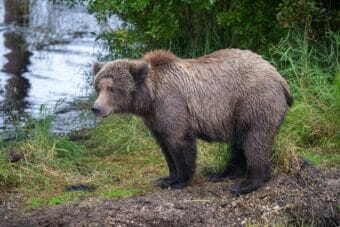
A brown bear in Katmai National Park (Courtesy explore.org)

Fat Bear Week, the annual celebration of brown bears gearing up for hibernation at Katmai National Park and Preserve, kicks off this week with its junior bear competition. Pitted against one another for the highest number of votes, four bear cubs will face off in a tournament-style bracket to take home the crown of Fat Bear Junior Champion. The winner has a chance to compete against their senior bear counterparts next week.
The junior competition began in 2021 as a way to get people excited about Fat Bear Week, the nine-year-old festival that brings attention to Katmai’s brown bears with the help of livestream cameras in the park. It focuses on first-year cubs and yearlings, or bears that are about 18 months old.

“Fat is the fuel that powers the survival of brown bears during hibernation, and a fat bear is a successful bear,” said Mike Fitz, a resident naturalist with Explore.org. “Fat Bear Week and Fat Bear Junior is a way for us to celebrate the success of brown bears as they prepare for hibernation. It also celebrates the ecosystem and the health of it that supports these bears, especially the sockeye salmon coming from Bristol Bay into the Naknek River Watershed.”

In addition to a pair of first-year cubs, this year’s junior bear competition will showcase a yearling cub and a singleton first-year cub. It will also feature a junior cub who was separated from her mother and raised by her aunt.

“Adoption is rare among brown bears, and the circumstances that lead to it are often mysterious or unknown,” Fitz said. “What I think led to the adoption this year was the sociability between those bear families and those mothers last year.”

Fitz and rangers at the national park have been keeping tabs on the bear cubs all summer. They can tune in via Explore.org’s livestream bear cams, which provide insight into the lives of the bears living near Katmai’s Brooks River Falls.

While this week’s focus is on the fattest bear cub, Fitz says that they shouldn’t get all of the credit. The junior winner will prove to be a hat tip to the mother who raised it. He spoke of the singleton spring cub who was brought up by a second-time mother.

“The cub itself wasn’t quite comfortable standing on the bank of Brooks River on its own, but the cub really wanted to be next to mom,” Fitz said. “Even when it was only a few months old and got out into the river, sometimes it would get swept downstream. We saw it fall over Brooks Falls several times this year. It’s grown a lot, its overall size shows that bear cubs single, they don’t have litter mates, have advantages because they have access to all of mom’s food.”

Located in the Bristol Bay region of Alaska, Katmai National Park and Preserve is home to the largest and healthiest runs of sockeye salmon left on Earth. The region also has more brown bear inhabitants than humans.

“Each bear in Fat Bear Junior is an individual with a unique story to tell about life and survival,” Fitz said. “This is a really unique wildlife watching opportunity to get to know animals as individuals rather than as populations.”

Fitz says that Fat Bear Week not only showcases the health of the bears, but is a way to raise awareness around the world about the health of the Bristol Bay region.

“Each one of them showcases a slightly different way of living, a slightly different way of surviving, and I think that’s a really special opportunity,” he said. “When we watch wildlife, generally, we don’t know anything about those individuals.”

Online voting for the Fat Bear Junior competition begins on Thursday at 8 a.m. You can vote at explore.org.

Unprecedented double glacial dam release brings flooding to the Kenai

Skilak Lake in the Kenai National Wildlife Refuge. Skilak Glacier Lake started releasing on Thursday, sending water into Skilak Lake and ultimately down the Kenai River. (Sabine Poux/KDLL)

A rare double glacial dam release into the Kenai River is causing high water levels and flood risks on the Kenai Peninsula.

Two glaciers — the Snow and Skilak — are releasing large amounts of water at once, which is flowing downstream into the Kenai. The phenomenon is a glacial dam release, which can happen after part of a glacier melts, leaving behind a seasonal lake where ice used to be.

“And that is dammed up by the main glacier. Every couple years, when that gets full, it releases. It’s enough of what we call hydrostatic pressure that it can force its way under the glacier, and then it will all flow out within a couple of days,” said Kyle Van Peursem, a forecaster at the Alaska Pacific River Forecast Center in Anchorage.

Usually, these two glacial lakes release every two or three years, but two at the same time is unprecedented.

“It’s pretty rare that those go in the same year, even more rare that they go within a few days of each other,” he said.

It’s also unexpected, because the Snow Glacier Lake also released last year. Van Peursem said there’s no good explanation for why that’s occurring.

He said the Snow Glacier lake began releasing water Wednesday into the Snow River and down to Kenai Lake. Skilak Glacier Lake started releasing on Thursday, sending water into Skilak Lake and ultimately down the Kenai River.

The low-lying Kenai Keys area in eastern Sterling is at the biggest risk for flooding.

“They’re already seeing some pretty high water in the Kenai Keys. Our observer there is giving us observations, saying the canals in the Keys are completely full, and the roads are about to be inundated overtop by water,” he said.

A glacial dam release is the same type of event that caused major flooding and damage in Juneau in early August. But Van Peursem says the Juneau release was a 1,000 year event — this double release on the Kenai may be unprecedented, but it’s not expected to bring that level of destruction.

Van Peursem said the peak threat will be tomorrow, but a warning remains in place through next weekend. He advised boaters not to create a wake through those high water areas, where it would cause even worse flooding for riverside residents.

After surprise eviction notice, residents of a Soldotna trailer park are wondering what’s next

River Terrace in Soldotna currently includes seasonal RV residents and year-round trailer residents. (Riley Board/KDLL)

The River Terrace RV and Trailer Park is just upstream of the Kenai River Bridge in Soldotna. To the right, there are temporary and seasonal RVs parked along the banks of the river. To the left, about 40 trailer homes house a low-income community, many of them seniors.

On July 27, trailer park residents got notice to vacate by May 3, 2024. The notice says the closure is related to “planned changes in the future use of the land.”

Daniel Lynch has lived in the trailer park since 1995.

“There’s no need for these people to become homeless, and that’s what’s gonna happen to the majority of them,” Lynch said.

He said there are few options for mobile home placement, much less for 40 all at once. He suspects many of his neighbors will end up living in their cars.
“We’ve checked trailer parks out from Sterling toward the end of Nikiski and anything south,” Lynch said. “There’s really nothing available. Maybe one or two spots, potentially.”

The trailer park section of River Terrace in Sept. 2023. (Riley Board/KDLL)

The trailer park residents don’t just have to be gone by May — they have to move their entire mobile home, a process that may involve deconstructing any add-ons like decks, disconnecting from utilities, then finding a towing company to move the home to a different site. Most residents rent the land but own the physical home. Lynch estimates moving costs at about $5,000.

“Many people have put in thousands of dollars in improvements, from rubber roofs to decks to plumbing, new windows, etcetera etcetera. And then to find this out at the end of July, and, ‘Oh, by the way, you have two months before the snow flies, and you have to be out by May.’ People were beside themselves,” he said.

This week, Lynch and many of his neighbors gathered to talk through their options. They’re looking at tenant legal resources, learning from a similar situation happening in Chugiak, and hoping for more time.

Lynch suspects the eviction is related to the city of Soldotna’s riverfront redevelopment project, a plan to convert riverfront property into a walking path and market area. That project is working with money from the U.S. Economic Development Administration, and an Oregon-based consultant.

The latest plans do include a map encompassing the River Terrace property, and even suggest constructing mixed-use buildings and housing diversity, including affordable housing. Project manager Jason Graf with the consulting company presented the idea to the city council last week.

“There’s always a need for more housing in communities. Where you can partner or work with affordable housing developers, you as a public entity have access to grants and funding that can build affordable housing in the community,” he told the council. “There are developers out there who do that work, there are federal grants that you can acquire.”

But Soldotna City Manager Janette Bower said that work is far in the future and the city has made no moves to purchase River Terrace at the moment. She said the city has talked about purchasing it in the long term, but not until after an appraisal, which could reveal too big of a price tag for the municipality.

She said she was also surprised to find out trailer park residents were being evicted.

Plans for the riverfront redevelopment project, with the River Terrace RV and Trailer Park property in the foreground. (City of Soldotna)

Jim Butler, an attorney for the property’s owners Gary and Judith Hinkle, said nobody has expressed serious interest in buying the property.

Butler confirmed the owners are not in negotiations with the city, and said the reason residents are being evicted is to, “convert the balance of the property’s use to seasonal or temporary use by customers.”

Daniel Lynch, the River Terrace resident, hopes the city will help him and his displaced neighbors.

“There is no need in today’s society for us to become Anchorage, where we just have homeless people because of a situation like this,” he said.

City Manager Bower said the city doesn’t have the money to help the residents relocate, but she is worried about them and will refer them to services if she can. She wishes they had more time to prepare to move.

Wall Street Journal: Limited interest in Alaska LNG from Asian buyers

The Alaska Liquefied Natural Gas project has long promised to bring North Slope natural gas to Nikiski, for export to Asia. Optimism about the project among Alaska politicians has remained high, despite the long timeline and cost of the project. But last month, the Wall Street Journal reported that buyers in Japan and South Korea aren’t confident in the project, and don’t plan to make investments or sign contracts.
KDLL talked with River Davis, one of the reporters behind that Journal story.

Listen:

Riley Board: Could you start by telling me a little bit about what your job is and what you typically cover?

River Davis: I’ve been a reporter with The Wall Street Journal here in Tokyo, reporting out of Japan covering Japanese businesses, for the past five years. Most of the topics that I look at cover the automotive sector, and I also cover energy security and Japan’s energy transition.

Riley Board: And how did this particular story about the AK LNG project come to your attention?

River Davis: Well, we were hearing a lot from Japanese companies — and Korean companies as well — that they were being approached by some political figures and people in the business world in Alaska, basically pitching contracts and deals to these companies, asking if they wanted to sign up to take Alaskan LNG.

And so we started this project kind of very neutrally looking at sort of the trade offs that are involved in the project. The positives, of course, being this is a project that could help with energy security, and help Korea and Japan transition away from using Russian gas and oil. So that was kind of the positive energy security angle. Of course, on the other end, we were looking at climate issues. There’s been some backlash about the project going forward, particularly a new fossil fuel project going forward in 2023.

So that was the kind of stance we originally approached the story with. But once we did some reporting, we found that the story about how there wasn’t a whole lot of interest in the project out of Asia, which were kind of the main target customers for the gas projects. That became kind of the main angle that we discovered hadn’t been told yet.

Riley Board: Could you go into more detail about what sentiments you learned that people in those countries had about the project?

River Davis: So the sentiment, specifically out of Japan, I would say is that they felt that this project has been happening for a long time, and that it hasn’t had much progress. So for Japan, in particular, companies here, government officials say that they want natural gas quite soon; in the next couple of years is when they’re going to witness their worst pinch when it comes to supply. So the project’s timeline is a little bit too far out for their wishes. And also, because it has been kind of delayed for such a long time, they are a bit dubious about whether the project itself will actually get off the ground.

Of course, it’s a massive project, a massive investment. So those were just factors that they’re considering. It’s really important to companies here, that if they do indeed sign up for a contract to offhand gas, that a project moves forward, because they will give up other contracts elsewhere. So that security element I think, was a large kind of off putting factor for them.

Riley Board: Did these buyers have other options when it comes to getting natural gas on the timeline they’re looking for?

River Davis: They do. Of course, Alaska officials and others supporting the project would say that Alaska has a lot of benefits. Of course, for Japan and Korea, it’s just over a week to get natural gas shipped over here. And there’s no kind of choke points that the gas has to go through. That could be a potential security issue.

But on the other hand, Japan thinks that it can get gas from other kinds of secure projects. There’s a lot of new supply coming to market, you know, around 2027, 2028 out of the US, Australia, the Middle East. And so Japan sees it has a lot of options beyond just Alaska at this point.

Riley Board: In Alaska, politicians are still very publicly optimistic about this project. Lisa Murkowski voiced her optimism around here — she was visiting the Kenai Peninsula and expressing her optimism about the project as recently as last week. Why do you think that attitude is still prevalent over here, even as interest is waning in Asia?

River Davis: Yeah, I think, of course, it’s in the interest of people supporting the project to make sure that there’s still kind of some optimism about it going forward. They’re in the stage where they’re looking for investment in the project. So I think if there’s too much of kind of a dreary tone, that would be problematic.

I do also get the sense that out of South Korea and Japan, perhaps there’s a bit of…information hasn’t sort of traveled to Alaska in the way that perhaps it would in other situations. Talking to companies here, you know, they say, ‘we’re not interested in this project.’ But I’m not sure to what extent that kind of has been directly conveyed to people, you know, sitting locally in Alaska. Seems like there’s a bit of an information divide there.

Riley Board: Do you think your story was one of the first first ways that that information was maybe conveyed in the US?

I think there has been a decent amount of skepticism towards the project, because it has taken kind of such a long time to move forward. And it’s been eluding that final investment decision for some time now. So we did see other publications, you know, questioning whether it would be able to reach that final FID stage. But I think as a story that conveyed the voice of potential off takers of gas — that being Japan, Korea, other countries in Asia — this was sort of one of the first stories that I’ve seen to convey that specific angle.

A white raven has appeared on the Kenai Peninsula

One of Gregory Messimer’s photographs of a leucistic raven in Kenai. (Courtesy of Gregory Messimer)

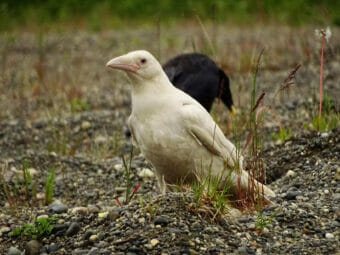
A white raven has been turning heads around Kenai for the last month. Gregory Messimer, a local photographer, has been documenting the bird, and he says the white raven is both visually striking and culturally symbolic.

Messimer is an amateur photographer in Kenai, who has been photographing and keeping tabs on the bird for weeks.

He first saw it on June 16 in North Kenai, among a family of mostly black ravens.

“The parents in this group had seven chicks that made it, and one of its siblings has some white feathers on its chest, and one had reddish feathers on its neck and face,” Messimer said.

According to the Kenai National Wildlife Refuge, the raven probably isn’t albino, a condition involving an absence of certain enzymes that create melanin, and results in a complete lack of that pigment. Instead, it’s what’s called leucistic, which means there’s a lack of pigment in some feathers due to an absence of cells that produce melanin.

Messimer said he took note, not just because of the bird’s aesthetic differences, but because the white raven has symbolic relevance in many religious traditions and mythologies.

“It’s an omen, or it’s a curse, or it’s a blessing, but mainly it’s ‘some sort of change is about in the world,’” he said. “Whether it’s good or bad depends on the tradition.”

In Greek mythology, the white raven is associated with the god Apollo. In Haida tradition in northwest Canada, a white raven helped bring the sun, moon and stars to earth, but turned black when it brought fire to humans.

Messimer said “white raven” is also an idiom.

“In Europe, it turns out, a ‘white raven’ is a saying for something that has a very low chance or an impossibility,” he said.

The Kenai National Wildlife Refuge posted about the bird on Facebook as sightings trickled in, and called it, “truly a once in a lifetime occurrence.” The refuge confirmed that the bird is leucistic, not albino. It has blue eyes instead of red, which would indicate albinism.

Messimer is worried about the prospects for the bird. He said the white coat makes the raven vulnerable because melanin provides structure to the feathers and skin. They’re also more susceptible to bacterial infections and to sunburns and cancers. He suspects the bird is unlikely to survive the winter.

“The white feathers don’t allow it to hold in heat, or absorb heat, so they’re reflective in the winter,” he said.

His hope, he said, is that the bird may be taken in by the Alaska Wildlife Conservation Center near Girdwood, or the Alaska Raptor Center in Sitka. In the meantime, he’s keeping an eye out for the raven to snap more photos, and hoping this one is a good omen.

Invasive pike can use Cook Inlet to travel between freshwater systems, research finds

Northern pike are not native to Southcentral Alaska. But in the decades since the fish were illegally introduced into some Kenai Peninsula lakes, biologists have been hard at work eradicating local pike populations. Now, they know pike can travel between freshwater systems via Cook Inlet — raising concerns about how pike can spread. (Courtesy Of Kristine Dunker/Alaska Department Of Fish And Game)

It was a very ominous discovery back in 2019: invasive northern pike in Vogel Lake, at the tip of the Kenai Peninsula.

And it raised some red flags for biologists with the Alaska Department of Fish and Game. Soldotna-based Fisheries Biologist Eric Wood said before the Vogel discovery, biologists on the peninsula had only found pike in lakes that were accessible by car. Those pike had likely been illegally put there by anglers.

That didn’t explain why there were pike in Vogel — a remote lake near Point Possession, accessible by float plane or snow machine.

Now, for the first time, researchers have concrete evidence that the fish could use the ocean to move between freshwater habitats, introducing new questions about where those fish can travel and what scientists can do to keep their numbers under control.

“This discovery kind of opened the door to a whole bunch of other concerns and questions and things we need to figure out,” Wood said.

Northern pike are native to interior and western Alaska, not Southcentral.

But they’re a popular species among anglers. As the story goes, sport fishermen started introducing pike into lakes in the region in the 1950s and then in Kenai Peninsula lakes in the 1970s, likely by way Fairbanks — causing problems for other fish species. Pike dominate any system they’re in, eating salmon and degrading local fish populations.

Invasive pike pose a threat to native fish species, like salmon. (Courtesy Of Kristine Dunker/Alaska Department Of Fish And Game)

Invasive Species Biologist Kristine Dunker said pike have been found in 150 bodies of water in the region, overall. In the Matanuska-Susitna Borough, researchers have had a hard time getting populations under control.

But on the Kenai Peninsula, the problem has been more manageable. Dunker said over two decades, biologists from a handful of local, state and federal agencies worked hard to eradicate pike on the peninsula.

“And we thought we had. In 2018, we finished a project in the Tote Road area and thought that that was it — that all known populations were gone at that point,” she said. “And it was like, ‘Yay!’ — for about a week.”

That’s when the department heard from an angler who had found the pike in Vogel. The department was also getting word from some set netters that they were catching pike in Cook Inlet.

With a researcher in Fairbanks, Fish and Game started testing pike for signs they had traveled through saltwater. They looked for signs in their otoliths, or ear bones — which can absorb traces of the fish’s environment.

“When we got the results back, you could see on the graph that this fish actually came from somewhere, spent time in saltwater, and then went to a different freshwater location,” Dunker said. “That was very eye-opening to us.”

Biologists first found a pike in Vogel Lake, shown above, in 2019. (Courtesy Of Kristine Dunker/Alaska Department Of Fish And Game)

Wood said that ocean pathway could complicate efforts to contain pike, and he said inlet conditions could become more favorable for the freshwater fish as glaciers continue to melt.

“As to where they came from, how they ended up where they ended up, we don’t know that for sure,” Wood said, adding that the Susitna River seems to be the obvious point of origin, since pike are so widespread there.

Wood and Dunker both said from the research side of things, the new discoveries are fascinating. Now, they’re finding marine signatures in pike from other systems too, including two lakes in Anchorage earlier this year — Campbell Lake and Westchester Lagoon.

But the findings create more challenges on the management side.

Dunker said since pike disperse, it’s important to prevent populations from spreading.

“The big challenge for us now is to try to figure out — How do we do that well? When you have a scenario where pike could be moving around marine estuary corridors, that makes it a much more difficult problem. But it doesn’t make it an impossible one,” she said. “It just means we have to be kind of smart about it and anticipate where they might be going.”

Already, Wood said Fish and Game has put a weir at Miller Creek, which flows out of Vogel Lake, to stop northern pike from entering the system there. But he said that’s not a permanent solution .

“The reality of it is, there’s so much money, so much tradition and everything tied up with salmon in this area, that this could have the potential to wipe out so much,” Wood said. “So it is scary, in that way.”

With many questions remaining, Dunker said every fish they can test and study is helpful. She said anglers and fishermen who catch pike should report their sightings to Fish and Game and bring in retained pike, when possible. The number to report invasive pike is 1-877-INVASIV.

Site notifications
Update notification options
Subscribe to notifications