KDLL - Kenai

KDLL is our partner station in Kenai. KTOO collaborates with partners across the state to cover important news and to share stories with our audiences.
Marijuana charges are leaving CourtView. A new bill would pull them from background checks, too

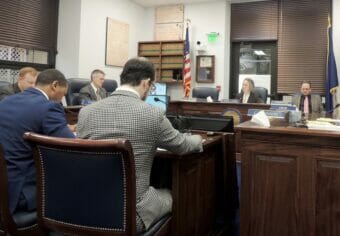
Rep. Stanley Wright (left) and an aide present HB 28 in the House Judiciary Committee on April 14, 2023. (Riley Board/KDLL)

In CourtView — the state’s public website for accessing court records — a marijuana possession charge shows up as something like “Misconduct – Controlled Substance 6A.” It isn’t immediately clear the charge is for something that has been legal now for eight years.

For people 21 and older with marijuana charges from 2014 or earlier, before the state legalized the substance recreationally, this can be a significant barrier to getting housing or a job. Employers and landlords can easily access CourtView to make decisions about applicants.
House Bill 28 is making its way through the Legislature and would remove marijuana convictions from the public record and some state background checks. The bill was introduced by East Anchorage Republican Rep. Stanley Wright.

“It came up during my campaign,” Wright said. “A lot of folks saying things like, ‘I can’t get out of my mom’s house, I can’t get an apartment because I have this marijuana charge. I’m being held back man, you guys need to do something about it. It’s not even illegal anymore.’”

Wright introduced the bill first thing this session, after a similar bill passed the House last year but didn’t make it out of the Senate.

Earlier this year, the Alaska Supreme Court announced a rule change that will remove marijuana charges from CourtView. That goes into effect in just a couple weeks and will scrub 750 names from the site.

Alaska was the third state to legalize recreational marijuana, by a ballot measure in 2014.

Wright’s bill, introduced just before the Supreme Court ruling in January, calls for removing minor marijuana charges from CourtView and also from non-federal background checks administered by the state Department of Public Service, or DPS.

Wright said even though parts of the bill may be redundant with the court ruling, his legislation is still an important additional step because it would codify the CourtView record-clearing in the law.

“If you could easily say that you are going to take it off the website, someone new could come and say ‘We’re gonna put it back on the website,’” he said. “So I think it’s important that we run the bill.”

The legislation also removes pre-2014 marijuana possession charges from background checks conducted by DPS, the kind that might be requested by an employer or landlord. DPS would need to examine 8,500 cases were the bill to pass.

Individuals will still be able to see marijuana records by going in person to a courthouse and requesting the documents, they just won’t be readily available online.

Wright said the bill isn’t really about weed: it’s about removing barriers for Alaskans.

“There are so many stories of people being stuck, folks trying to get jobs. Why would we want to keep people from reaching their full potential? I think this bill helps those individuals do it,” he said.

The bill has bipartisan sponsorship and support from the Alaska Marijuana Industry Association, whose board is headed by Ryan Tunseth, owner of East Rip in Kenai. The association’s legislative liaison submitted a letter of support, calling it an “incremental but important step in the right direction towards destigmatizing cannabis consumption.”

Wright said he’s hopeful about the bill this session.

“I just want people to reach their full potential in life. If this is gonna help you get one step closer to putting food on the table, to living in a better place, I’m all for it,” he said. “I think a lot of folks, once they realize that’s what this is all about, they’ll start to accept it.”

The bill moved out of the House Judiciary Committee last Friday and is waiting for a hearing in House Finance.

Narcan to be available over the counter soon, though questions remain about cost

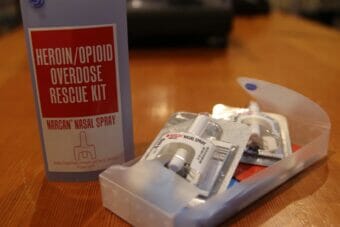
(Emily Kwong/KCAW)

The overdose-reversing drug Narcan soon will be available over-the-counter. The U.S. Food and Drug Administration said this week it approved the product for use without a prescription, with the goal of reducing opioid deaths and making it easier for people to access the life-saving emergency medication.

It will be a while before Narcan is available on pharmacy and grocery store shelves. The FDA estimates it could take months to jump through some regulatory hoops.

But Shari Conner with Change 4 the Kenai said she thinks having it available over-the-counter will help reduce stigma and help Alaskans stay prepared. Conner is the project coordinator with the local coalition, which works to prevent substance abuse on the Kenai Peninsula.

“Really, no one’s immune from having an overdose in your home,” Conner said.

She said anyone who takes an opiate prescription following a surgical or dental procedure has access to opiates, in their house. Having Narcan on hand, she said, is like having a fire extinguisher nearby.

“As Alaskans, we have a little kit of emergency stuff that we take out camping and fishing,” Conner said. “It’s just a safety measure, just like anything else.”

Narcan contains 4 milligrams of naloxone– a medication that quickly reverses the effects of an opioid overdose.

It comes in a nasal spray, and since 2015, has been available by prescription. Today, there are emergency kits around Alaska at libraries and health centers. On the Kenai Peninsula, there are kits available at Kenai Public Health and the Change 4 the Kenai building, for example. Alaskans can find emergency kits in fish processing plants and other high-traffic areas, through Project Gabe. And many emergency service providers carry the drug with them — as well as the more powerful Kloxxado, which contains an 8-milligram dose of naloxone.

It’s been an especially important tool as the state’s drug overdose death rate has shot up. Alaska saw the largest percent increase of any state from 2020 to 2021, according to data from the Alaska Department of Health. A big culprit has been fentanyl, a synthetic opioid that’s more potent than other narcotics.

Conner said there’s still a lot to learn about the way over-the-counter Narcan will be rolled out.

But she said Wednesday’s approval is a good step forward.

“I think we’re going in the right direction, for sure,” she said. “I just wonder what the cost will be.”

Today, prescription Narcan is available in a two-dose pack for less than $10 when it’s not covered by Medicaid or private insurance. But over the counter, those prices could be much higher, health economists and advocates warn — especially when it remains the only over-the-counter overdose reversal drug on the market.

Conner said her organization, Change 4 the Kenai, is hosting an emergency Narcan kit-building event soon. She says they’re trying to plant more Project Gabe boxes across the community, as well, to make Narcan as ubiquitous as possible.

Soldotna City Council rejects lewdness ordinance

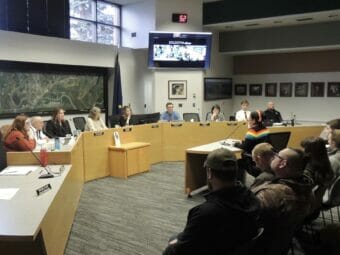
Ash Magallanes testifies in front of the Soldotna City Council Wednesday. (Sabine Poux/KDLL)

A heated debate over what is and isn’t allowed in Soldotna’s public spaces is over, for now, after the city council this month quashed a series of proposed policy changes. That came nine months after a drag performance in Soldotna Creek Park first sparked intense discussion over what’s appropriate and constitutionally protected in public.

A standing-room-only crowd packed Wednesday’s city council meeting, alternating two hours of impassioned testimony on one of those policies, which would have made lewdness in Soldotna’s public spaces a fineable offense.

But members of the council said they didn’t think the policy on the table addressed any real problems the city had, and ultimately voted no on the ordinance.

“I think it comes down to sending a message,” said council member Jordan Chilson after the vote. “And that message that we’re sending, we have to consider very carefully.”

The debate over the city’s policies started last summer, following a Pride month event in Soldotna Creek Park which included performances from drag queens. And while there was no pushback at the event itself, it became a target after the fact when a conservative Alaska blogger posted an eight-second clip of a performer twerking onstage.

Drag performers have become a political target nationwide. Tennessee just passed a law criminalizing public drag performances, and other laws are in the works.

In the months following the performance, a vocal group of local residents and business owners showed up to city council and parks advisory board meetings, demanding the city drill down on what they said was inappropriate behavior at local parks that they don’t want their kids to see.

City Manager Stephanie Queen, who was called on to resign by those who pushed back against the performances last summer, said members of her staff were getting threatened over the issue.

The city council, in response to the pushback, said the performance was legal and protected in the Constitution as freedom of expression, but agreed to take another look at its park policies. Officials crafted a series of proposed policy changes, including one that would’ve drilled down on what’s considered obscene and is not allowed at city parks, and another that would’ve updated the city’s park reservation policies — both of which were shot down earlier this month at the council’s March 8 meeting.

A third ordinance, barring lewdness in public spaces city-wide, not just in parks, came before the council Wednesday night after it was tabled at that earlier meeting. The ordinance would have made “lewdness or lascivious behavior” a minor offense, with a $250 fine.

“A person commits the minor offense of lewdness or lascivious behavior if, in a public place, that person engages in acts of ‘sexual conduct,’ ‘specified sexual activities,’ exposes ‘specified anatomical areas,’ or engages in ‘obscene’ conduct,” the proposed ordinance read.

Some of the behavior outlined in the ordinance is already barred at the state level. Earlier this month, City Attorney Brooks Chandler said, crucially, the ordinance included definitions and examples of what would be barred, such as simulations of sex or performances that would be harmful to minors. City staff said they didn’t think the performance at Pride in the Park wouldn’t have been prohibited under the legislation.

Still, commenters on both sides of the issue said the ordinance would send a message.

“We – the families, the couples that are raising children, our children here – we’re raising the future of this community,” said Joshua Scilzo, who has spoken about the proposed policies at multiple city council meetings. “And we have a right to discuss sexuality with them in the privacy of our own homes and not to go into the public spaces of this town and have to explain to them things that they don’t need to be exposed to at that age.”

But those who organized and attended pride, and testified before the city council Wednesday, said passing laws like this one in response to Soldotna Pride tells the LGBTQ+ community it is not welcome.

“Please understand that your decisions, actions and the language you use directly contribute to how the community receives us when we leave our house,” said Ash Magallanes, a parent and member of Soldotna’s LGBTQ+ community. “And will continue to affect ours and our children’s daily lives on a daily basis, since we hope to never leave the area.”

In the end, the majority of city council members said it was unclear what the ordinance was trying to accomplish, and that the wording in the legislation was still too subjective. The ordinance failed, 4-2.

“I don’t want to see everybody running around the park this summer with their iPhones taking pictures and then going to the chief and saying, ‘Is this something? Can we do something?’ I just can’t get there from here,” said council member Linda Farnsworth-Hutchings.

Farnsworth-Hutchings was joined by Chilson, Dan Nelson and Chera Wackler in voting no; Lisa Parker and Dave Carey voted in favor.

The council could take the ordinance up again but it would have to be reintroduced by one of the members in the majority who voted against it.

Eruption risk down for 2 Aleutian volcanoes

Tanaga in November 2012. (Roger Clifford/Alaska Volcano Observatory/U.S. Geological Survey)

Scientists last week warned that two Aleutian volcanoes were at a heightened risk to erupt following an intense series of earthquakes nearby.

Since then, they’ve lowered the risk levels on Tanaga and Takawangha. But they’re continuing to watch for any signs the volcanoes could still erupt in the future.

John Lyons is a research geophysicist with the Alaska Volcano Observatory, which studies volcanoes like the ones on Tanaga Island and watches out for potential hazards. They keep an eye on the volcanoes on the island with satellites and six remote monitoring sites.

“We had seen seismic unrest going back into the fall of 2022 at Takawangha Volcano,” Lyons said.

Swarms of earthquakes, like the one at Takawangha, can be precursors to volcanic eruptions.

Two weeks ago, Lyons said the unrest started underneath its neighbor, at the Tanaga Volcano.

“At the same time, the earthquakes got shallower — they moved up toward the surface,” he said.

That’s when the observatory upped the risk to color-code orange, which means a volcano is showing signs of unrest with an increased potential to erupt. Activity peaked between March 9 and 11.

But Lyons said after that, the rate, intensity and magnitude of the earthquakes happening there all began to drop — plus, observers weren’t noticing other signs of volcanic activity, like steaming.

“This was last Thursday,” he said. “At that point, we felt pretty good lowering the color code from orange to yellow.”

That means the observatory is seeing signs of unrest of the volcano but doesn’t think those signs are going to lead to what Lyons calls “imminent eruptive activity.”

“Yellow is like an advisory level,” Lyons said. “It’s kind of like, heads up, this isn’t background activity — there are still earthquakes ongoing. I think in the last week, we’ve had maybe 15 or so magnitude 2-plus earthquakes, which are pretty big for volcanoes.”

Still, he said those are a step down from the magnitude 3-plus earthquakes the observatory was picking up earlier in the month.

Lyons said his office is continuing to keep an eye on activities at Tanaga and Takawanga and that they’ll be ready to raise the alert level again, if needed. You can find daily updates on the volcanoes here. Lyons said there isn’t much of a concern about the human impacts of the volcanoes, since Tanaga Island is uninhabited and the closest community to the volcanoes is Adak, 60 miles away.

Decision not to carry abortion drug could be felt even in places without a Walgreens, doctor says

The Walgreens in Soldotna is one of 11 in the state of Alaska. (Sabine Poux/KDLL)

Pharmacy giant Walgreens is going back on a decision to offer the abortion pill mifepristone in Alaska, following pushback from the state’s attorney general and 19 others nationwide. Abortion pills are still available through medical providers, but doctors say Walgreens’s decision could create new barriers and increase stigma.

Dr. Robin Holmes is a Homer-based physician who specializes in reproductive health care and is a fellow with Physicians for Reproductive Health. She said Alaska’s landscape creates unique challenges for abortion access, and that Walgreens’ announcement could have repercussions even in communities where it does not have stores.

“Many remote places that may be off the road system — or even some communities on the road system — only have access to medications through the mail, and that can be provided by these large chains,” she said.

Holmes said the pill is a safe option and long-overdue on pharmacy shelves. In 2021, it was the second most common method of abortion in Alaska.

She said as it stands, Alaskans seeking the pill have to get it through a healthcare provider, at a clinic.

“What this was proposing — and what Walgreens has decided not to proceed with — is that a prescriber could prescribe this pill and you could go to a pharmacy and pick it up just like any other medication, like for your diabetes or asthma,” she said.

Holmes said going to a provider’s office to get a pill can be hard in parts of Alaska with few doctors. She also worries the change sends a message about the role that politics can play in medical access in the state.

“Stigma plays a big role in access to reproductive healthcare in this state,” Holmes said. “So what I’m worried about moving forward is that Walgreens changing their policies due to political pressure is gonna further the dangerous stigma.”

In their letter, the attorneys general write that they see it as their responsibility to, “uphold the law and protect the health, safety, and well-being of women and unborn children in our states.”

On Tuesday, Feb. 7, a group of almost two dozen Alaska legislators shared a letter urging Walgreens to reconsider its decision.

Federal government tosses proposed Kenai refuge rule, upholding restrictions on hunting and trapping

Friday’s withdrawal and Monday’s court dismissal are the latest in a years-long debate over wildlife management in the 2-million acre refuge. (Sabine Poux/KDLL)

The federal government is walking back a proposal that would have allowed brown bear baiting and reversed other restrictions on hunting and trapping in the Kenai National Wildlife Refuge — one of two decisions in the last week that environmental groups say is a win for the refuge and its wildlife.

As it stands, the practice of taking brown bears at bait stations is not allowed on the nearly 2-million acre refuge, as outlined in an Obama-era regulation known as the Kenai Rule. In 2020, the Trump administration tried to reverse those protections in a proposed new rule that also would’ve opened up access in the refuge to more bicycles and snowmachines.

But those rule changes never passed. And on Friday, the U.S. Fish and Wildlife Service — which manages the refuge — announced it was withdrawing the proposal, citing the tens of thousands of comments submitted in opposition to the rule change over concerns about wildlife and visitor safety.

The service also said it considered “new information on recent annual levels of human-caused brown bear mortalities on the Kenai Peninsula, and additional scientific literature” in its decision about brown bear baiting.

“Allowing the harvest of brown bears over bait on the Refuge has a high potential to result in adverse impacts to the Refuge’s brown bear population, and that a cautious approach to management of Kenai Peninsula brown bears remains scientifically warranted,” the service said in its decision.

The withdrawal isn’t the only victory for those commenters. The U.S. Supreme Court decided Monday not to take up a legal challenge from the State of Alaska and Safari Club International on the Kenai Rule — halting a case that has been working its way through the court for seven years.

“This week was a big week in terms of the movement on these protections,” said Nicole Schmitt, executive director of the Alaska Wildlife Alliance.

She said the decisions show the federal government does have authority to manage wildlife on refuge lands, including for the purpose of maintaining natural diversity.

“The second big point is that through the decision to rescind the 2020 rule, I think the refuge really listened to and took a hard look at what those changes would really mean on the ground,” she said.

In its decision, Fish and Wildlife cited concerns about public safety related to brown bear baiting and increased access for hunters, for example.

But advocates of the 2020 rule, including the State of Alaska and Safari Club, have a different take.

Alaska has argued its authority to manage wildlife on federal lands within the state. And it said brown bear baiting does not pose a risk to public safety.

“Wildlife management decisions should not be made based on the number of public comments, but on the best available science,” said Safari Club’s Ben Cassidy in a written statement. “And the best available science supported the proposed rule.”

Site notifications
Update notification options
Subscribe to notifications