KDLL - Kenai

KDLL is our partner station in Kenai. KTOO collaborates with partners across the state to cover important news and to share stories with our audiences.

Months before season begins, state closes most Cook Inlet king salmon fishing

A buoy at a set-net site in Ninilchik in June. (Sabine Poux/KDLL)

Parts of the Kenai River are still frozen over. But the Alaska Department of Fish and Game has already closed the early and late king salmon runs to sport fishing — also shutting down the beleaguered Cook Inlet east side set-net fishery before fishermen can gear up.

“This is my 53rd year coming up as a set-netter, and I have never experienced this,” said Ken Coleman, vice president of the Kenai Peninsula Fishermen’s Association.

He said he’s never seen the fishery close completely this early. Fish and Game does release a preseason forecast for the early king salmon run every winter, to give guides and fishermen a sense of what to expect before the summer starts.

This year, the department projects just 2,900 kings in the early run and 13,630 in the late run — falling below the goal range set by the Board of Fish of 15,000-30,000 fish. In a pair of emergency orders released Thursday night, the Department of Fish and Game said that meant it would close all sport fishing for king salmon in the river. Another emergency order closes Deep Creek and the Anchor River to sportfishing.

Changes have been hard on fishing guides who long relied on taking clients on king salmon trips. As counts have continued to decline and closures have become more common, they’ve pivoted to fishing for sockeye, halibut and trout.

But for set-netters, whose fishery also closes when the king sport fishery does, there’s no plan B.

Coleman said his phone has been ringing nonstop since the orders came out.

“They’ve been asking, is there any way to make a change? Is there anything mechanical that we can do, as set-netters, such as fishing less, or fishing shallower nets?” he said.

Legal action and out-of-cycle proposals to the Board of Fish both failed last year.

Coleman said the best they can hope for is that, in the middle of the summer, the department makes another assessment and gets to a point where it’s able to reconsider opening the fishery, at least partially. But he said that seems unlikely.

Alaska florist gears up for Valentine’s Day: ‘This is our Super Bowl’

Dacia Cunningham has had a Soldotna storefront for her business, Tundra Rose, since 2020. (Sabine Poux/KDLL)

A person’s nose can build up a certain immunity to flowers over time.

Tundra Rose flower shop in Soldotna is lush with the smell of roses and ranunculus. But shop owner Dacia Cunningham is too used to the smell to notice — and frankly, too busy.

Valentine’s Day is less than a week away. In the floral business, that means it’s time for Cunningham and her small staff to buckle down.

“We will just design all day, and then I’ll come in and probably start working back at like 8 tonight and work all night,” she said. “It’s Super Bowl week — this is our Super Bowl.”

Tundra Rose designs floral arrangements for holidays like Valentine’s Day, plus weddings and other events. Arrangements start at $50 a piece.

Cunningham said she’s the only brick-and-mortar, independent flower shop on the Kenai Peninsula. She grew up in Soldotna and came to the floral industry through wedding planning.

“I did wedding flowers for one of my brides, and liked it more than planning,” she said. “And I’ve come a long way. I look back at my old arrangements, and I’m like, ‘Oh my gosh.’”

In 2020, Cunningham signed her first lease for her store. Today, she’s in a small storefront in Soldotna — just enough room for a counter framed by shelves of vases and coolers of bouquets.

This time of year, most of her flowers come from wholesalers in Anchorage and L.A., who she said source from all over the world — from Ecuador, Mexico and Holland.

That can be a challenge, since the flowers aren’t as fresh, and she said they can sometimes freeze in transit — an added thorn to an already difficult process.

“Once we get our boxes in, they come and we have to give them a fresh cut,” she said. “And then we use a hydrating solution, because they’ve been out of water for sometimes 24 hours by the time we get them.”

They cut the stems, put them in buckets of clean fresh water. And then, they start designing.

Cunningham says Valentine’s Day and Mother’s Day are the busiest times of year for business. (Sabine Poux/KDLL)

Cunningham said she didn’t used to think of herself as a creative person. But she loves creating arrangements — making decisions about what kinds and colors of flowers to pair together to create bouquets that are full and bright. She’s taught herself from videos online, and through trial and error. Even today, she’s learning how to mix more modern floral arrangement styles with more traditional kinds, sprucing up dozen roses with other types of flowers, like dahlias.

She said what she likes about flowers is that they’re cheerful. Especially this time of year, they can be a counterweight to the grayness of winter.

“We started doing sympathy arrangements, which is a big part of the business,” she said. “So that’s one of the things where even if it’s sympathy, we try to make it cheerful, so if it’s going to someone that’s sad it brightens their day a little bit.”

She said her biggest holiday is Mother’s Day. And they’ll sometimes get orders for unconventional occasions, like dog birthdays and St. Patrick’s Day.

But in the days leading up to Valentine’s Day, there’s little time to think about much else. Cunningham said a lot of customers cut it pretty close.

“We will get most of our orders Monday” — the day before Valentine’s Day, she said.

Cunningham said she expects the phone will ring so much that day that she won’t be able to answer calls quickly enough.

“Sometimes, at holidays, it comes to the point where we have to turn the phone off, because we’re sold out or we just can’t keep up with people walking in the door and the calls,” she said.

Her advice: Just pick up the phone and order now.

Soldotna Rep. Justin Ruffridge co-chairs caucus of first-time lawmakers

Soldotna Republican Rep. Justin Ruffridge on the campaign trail last fall. Ruffridge said on the House floor that he and the other legislators in the Freshman Caucus are seeing a lot of the same statewide issues come up from constituents. (Sabine Poux/KDLL)

Soldotna Republican Rep. Justin Ruffridge is leading an informal caucus of first-time representatives in the Alaska State House.

At a floor session last week, Ruffridge said the 17 freshmen in the House span geographies and ideologies, but are united across some issues — and in their newness to the Alaska Legislature.

“Our purpose will be to discuss ideas, debate policy, and share those issues most important to the constituents which encompass districts from all over the state,” Ruffridge said. “Most importantly, we will continue to build on great working relationships.”

Members of the Alaska Legislature organize themselves into caucuses — or groups with similar goals or interests.

In the state House, the formal majority and minority caucuses get extra staff and set committee assignments. Ruffridge is part of the Republican-led majority caucus.

But there are other, informal caucuses, too, which come together to discuss issues — like the four-member Bush Caucus, representing rural Alaska. That includes Independent and Democrat representatives from Bethel, Dillingham, Nome and Utquiagvik. In the past, informal caucuses have sometimes been predecessors for formal, governing caucuses.

The freshman representatives in the state House this year are the largest class in two decades, according to the Anchorage Daily News, with 17 new representatives — seven Republicans, eight Democrats and two independents. That’s nearly half of the 40-member house.

Ruffridge said the members met during a multi-day training in December to learn how state government functions.

“We also were able to learn and understand more about one another,” Ruffridge said. “We began to learn what was important to each other. We talked about the number of issues that were important to the constituents in our respective districts.”

He said they want to keep understanding the complex issues facing Alaska. And he said there will be times when they vote together — and times when they don’t.

“Let me be clear: We will not agree on every issue,” Ruffidge said. “But through meaningful dialogue, we will strive to better understand the reasons behind decision-making processes.”

Rep. Andrew Gray, an Anchorage Democrat, is the caucus’s other chair.

Nikiski legislator hires former Alaska budget director Donna Arduin as policy advisor

Donna Arduin answers questions from the press about the governor’s ten-year budget plan in 2019. (Skip Gray/KTOO 360TV)

A former Alaska budget director who was known for her budget-slashing policies is joining the staff of Nikiski Republican Rep. Ben Carpenter this session.

Donna Arduin worked in Gov. Mike Dunleavy’s office between 2018 and 2019 and was the architect behind his plan to cut over $1 billion in state spending to close the state’s budget deficit. Carpenter said she’s in Juneau now and working as his full-time policy adviser.

“And she is going to help me look at long-term fiscal policy planning from a fiscal conservative point of view,” Carpenter said.

In her nearly 10 months in Juneau, Arduin worked with Dunleavy to propose a budget that would’ve drastically cut spending to the public school system, Medicaid and the ferry system, among other state-sponsored programs. Before her stint in Alaska, Arduin directed budget teams in several states, including California and Michigan. She returned to Juneau in 2020 to lead a budget seminar for legislators and legislative candidates.

Carpenter said he and Arduin — listed as Donna Kauranen on the legislative staff sheet — are not focusing on the budget, but rather longer-term policy issues that he said often get lost in the annual budget cycle.

“We’ll have our say with the budget, right? It’s still a focus, still a priority and important to me,” Carpenter said. “But we’re not going to get systemic change — what we might call institutional change … in an annual budget document.”

Carpenter chairs the House Ways and Means committee, which makes decisions about taxation and state spending policies.

He said he wants to work with Arduin to have conversations about the long-term fiscal health of the state, including questions about the Permanent Fund dividend and Alaska’s revenue shortfall. He said now that he’s in the House majority and has more years of experience under his belt, he’s in the right spot to do so — and that Arduin will help him get there.

“She brings the experience I lack in some of the specifics of fiscal policy,” Carpenter said. “I have a general idea of what it is that I want to accomplish; she has experience under multiple governors and different legislators over the last couple decades to bring examples of things that might work to the table, and we discuss it and bring about a policy recommendation.”

Carpenter said Arduin was hired as a range 23 state employee — meaning she’s making a base of $45.17 per hour, near the top of the legislative staff payscale.

Carpenter said this week, the House Ways and Means Committee is going to pick up the work of a fiscal policy working group formed during the last legislative session. The bipartisan group put out an ambitious set of recommendations, including a proposed PFD formula, but none of them were picked up by the broader legislature before the session ended.

Alaska’s job recovery is projected to continue in 2023

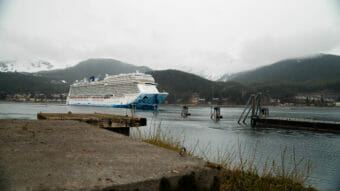
A cruise ship approaches Juneau
The Norwegian Bliss, the first large cruise ship of the 2022 season, arrives in Juneau on April 25, 2022. Jobs in sectors like tourism have been improving, slowly, since 2020. (Photo by Paige Sparks/KTOO)

Alaska’s job market will continue on a path of recovery this year, though it’s still a long way from where it was before the pandemic.

That’s according to the 2023 job forecast from the state’s Department of Labor. Karinne Wiebold is an economist with the state and authored the report in the department’s monthly magazine.

“Pretty much every industry is forecasted to grow next year,” she said. “But a lot of them are just returning to pre-pandemic levels. So this is just kind of a return to normalcy.”

The state’s job market took a huge blow in 2020 when the pandemic hit. Wiebold said that was less true for the Kenai Peninsula than other regions of the state, in part because the peninsula didn’t see such big losses from canceled cruise ships.

“In fact, the Kenai Fjords National Park had one of its best years ever in 2021,” she said. “And that was propelled by local visitors as well as some independent, non-cruise-based travelers.”

That’s a big contrast from Denali National Park, for example, which gets a majority of its visitors from cruise ships.

Since those early pandemic days, the state has been gaining jobs across all regions — slowly.

Some factors are limiting growth nationwide, like low labor force participation.

But on the whole, Alaska’s recovery is slower than in other states. Wiebold said national challenges are compounded by factors like Alaska’s reliance on tourism and oil.

“Oil’s really taken a wild ride,” she said. “And exactly why our oil jobs have been slower to recover than some of the other Lower 48 is a little bit hard to tell. But it might have to do with our more remote location, and it’s just a little bit harder to get things going again.”

Another limiting factor, she said, is that Alaska came into the pandemic in a weak position, following a three-year recession. The state was just starting to add jobs back from that recession when COVID-19 hit in early 2020.

At least one piece of legislation is expected to bring jobs this year: The federal infrastructure bill, passed by Congress in 2021. On the Kenai Peninsula, that money is expected to boost airports and harbors, among other fish passage and bluff stabilization projects.

“But what’s really difficult at this point is really tracking down where that money’s going and when it’s going to hit the road,” Wiebold said.

Construction is one industry that’s forecasted to be above its pre-pandemic levels this year, as is transportation and warehousing.

“That’s pretty much it,” she said. “Those two are going to grow above pre-pandemic levels. Everybody else is still playing catch-up. Oil and gas is a really good example of that.”

Even with forecasted growth this year, Wielbold said employment levels in that industry will still be down 25 percent from where they were before the pandemic — a difference of more than 2,000 jobs.

“So there’s plenty of industries that have a long way to grow,” Wiebold said.

And she said Alaska’s job market is still a workers’ market, since there are so many job openings. She said that provides a lot of opportunity for workers to decide how and where they want to be employed.

Hilcorp is sole bidder in controversial Cook Inlet lease sale

Industry watchers say the lukewarm response to the hotly contested sale points to a long-term trend of low interest in the inlet’s federal waters. (Photo by Sabine Poux/KDLL)

After months of back and forth over a high-profile oil and gas lease sale in Cook Inlet, just one company placed bids last week.

Hilcorp Alaska was the sole bidder in the Dec. 30 federal sale, bidding $63,983 on one tract in Lower Cook Inlet. The 2,304-acre tract is a small sliver of the nearly 1 million acres the Department of the Interior put up for bid.

Economist Roger Marks has been watching Cook Inlet’s oil and gas industry for decades and said he’s not surprised. He said there’s always been lethargic interest from companies in that part of the inlet.

“This was the market speaking,” he said. “And the market is pretty knowledgeable. And I think it just indicates that the federal outer continental shelf is just a poor place to think about developing oil and gas because of the geology.”

Friday’s announcement rounded out a long saga of cancellations and rescheduling for the hotly contested sale. Ultimately, the sale was written into federal law in the Inflation Reduction Act and squeezed in just before the clock wound down on 2022.

The tract Hilcorp bought is not far from Chinitna Bay in Lower Cook Inlet. It doesn’t border existing Hilcorp properties, and it’s unclear what the company wants with the tract. Hilcorp would not answer specific questions about the sale.

A statement provided by company spokesperson Luke Miller said, “Hilcorp is proud of our work to revitalize Cook Inlet natural gas production – an energy source that nearly two-thirds of Alaskans depend on to heat and power their homes and businesses. We look forward to continuing to responsibly produce Alaskan oil and natural gas, create Alaskan jobs and contribute to the state’s economy for decades to come.”

Oil and gas companies play their cards close to their chests, so it’s hard to know what they’re finding when they look for gas in places like Cook Inlet.

But Marks said the long-time lack of interest — even back in Cook Inlet’s heyday — shows that the geology of the area is probably just not good.

“All the production that’s ever occurred in Cook Inlet going back to the 1950s has been on state acreage,” he said. “So the geology on state acreage is good. Just under federal acreage, not good.”

Hilcorp was the sole bidder in a state sale last week, where it picked up six leases in the upper part of the inlet totaling 22,783 acres.

Sue Mauger is executive director of Cook Inletkeeper, one of the environmental groups that sued the feds over the sale last month based on what they said was an incomplete environmental review process.

She called the federal sale a flop and said the lack of new industry interest in federal and state sales both shows there are environmental and economic reasons to not hold auctions there. She said that’s a good thing for Alaska.

“We have a win in that we won’t have new emissions coming out of Cook Inlet with new development,” she said. “However, we have to figure out what the future is for heating our homes. And so the financial resources we’ve spent as a country and a state can now be clearly shifted to solving the problem with non-fossil fuel options.”

Hilcorp provides Southcentral with most of its natural gas supply, used to heat homes and generate electricity. Last year, it warned its buyers it might not have the supply to renew their contracts into the future.

Mauger said the plaintiffs are continuing with the suit and that they’ll keep asking the Biden Administration not to go forward with awarding the lease to Hilcorp. The feds have a 90-day evaluation process before they formally award a lease. Long-term, Mauger said they hope that the feds don’t hold any more lease sales in the inlet.

Site notifications
Update notification options
Subscribe to notifications